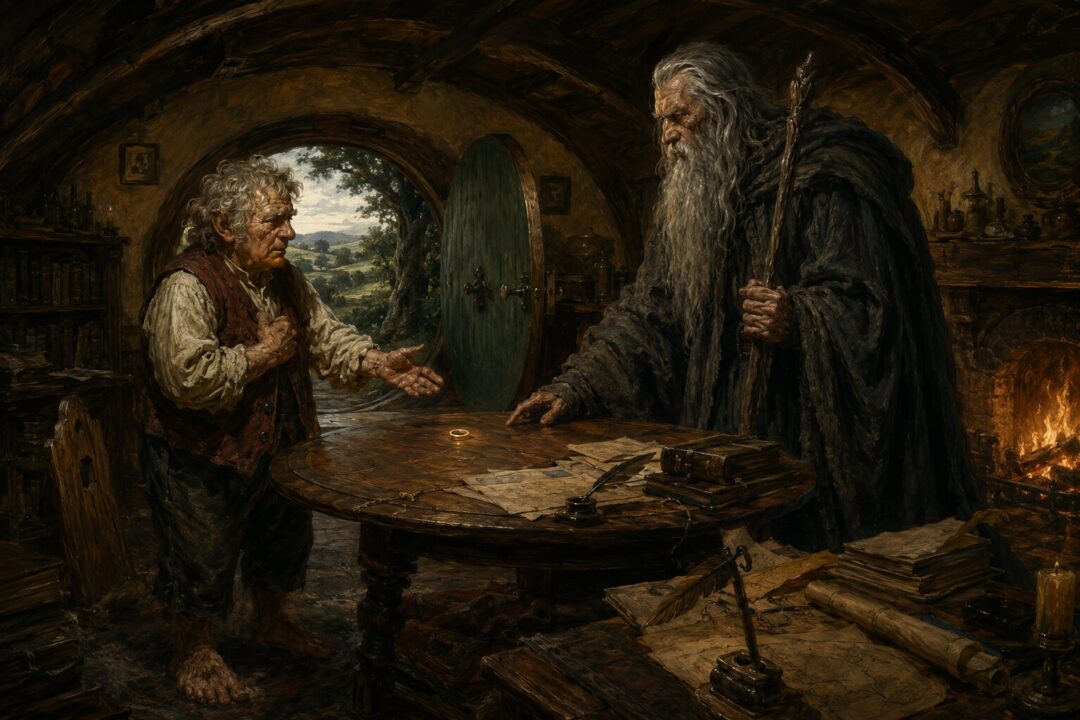
The One Ring is small enough to vanish in a clenched hand. It can be slipped into a pocket, hung on a chain, hidden under a shirt, or mistaken for a plain golden trinket by anyone who does not know what it is. Yet by the end of the Quest, Frodo Baggins can barely bear it. On the slopes of Mount Doom, it is not merely an object he carries. It has become a pressure on mind, memory, hope, and will.
That is one of the most disturbing truths about the Ring: its burden is physical only after it has already become moral.
The Ring does not first defeat its bearers by growing heavy like a stone. It begins by changing the terms of choice. It asks to be hidden. It teaches possessiveness. It turns pity into danger, courage into pride, prudence into delay, and even love into a possible opening for domination. Long before Frodo staggers under its weight in Mordor, the Ring has already been heavy in another sense: it has made every decision around it more perilous.
Its true burden is not simply that it must be carried. It is that it must be carried by someone who must keep choosing not to claim it.
A Small Object With a Vast Moral Field
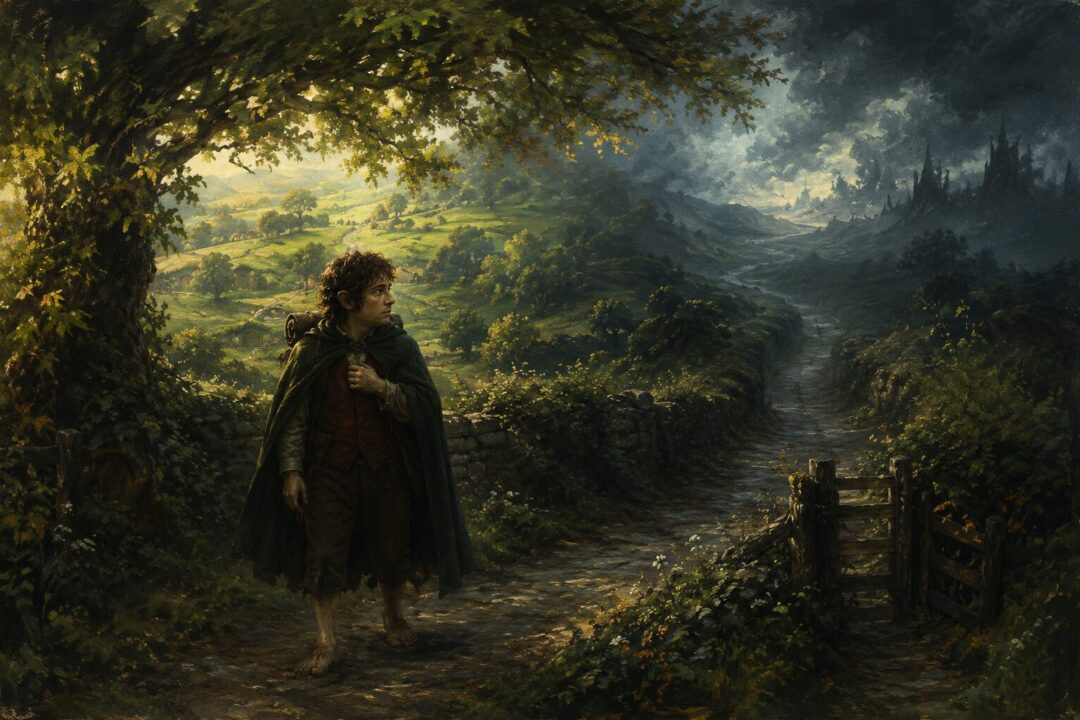
The Ring’s apparent simplicity is part of its terror. It is not described as a massive relic, a blade, a crown, or a throne. It is portable, intimate, almost domestic. Bilbo can keep it for years in the Shire. Frodo can inherit it among ordinary belongings. Gollum can hide it in the darkness and call it his birthday-present.
But the texts make clear that this smallness is deceptive. The Ring is bound to Sauron’s power, and its central temptation is not random greed but the desire to possess, command, preserve, and master. Different characters feel that temptation differently. Boromir imagines using it as a weapon for Gondor. Galadriel imagines what she might become if she accepted it. Sam, briefly bearing it in Mordor, is tempted with a vision scaled to his own nature: heroic greatness, command, and even the transformation of Gorgoroth into a garden.
That last detail matters. The Ring does not tempt Sam by making him suddenly cease to be Sam. It works through what is already there: loyalty, courage, love of growing things, resentment of evil, and the wish to set things right. Its moral weight is personal. It presses on each bearer at the point where desire can masquerade as duty.
This is why the Ring is dangerous even before anyone uses it. To bear it is to stand inside a widening field of distorted motives.
Bilbo’s First Warning: Possession Before Pain
Bilbo is not shown collapsing under the Ring’s physical weight. His danger is quieter and more revealing. He has kept the Ring for many years, and when Gandalf urges him to leave it behind, Bilbo’s reaction is possessive, suspicious, and wounded. He speaks of it as his own. He resents being pressed. For a moment, something hard and ugly breaks through the familiar kindness of Bilbo Baggins.
That scene is one of the earliest signs that the Ring’s burden is moral before it is physical. Bilbo is not exhausted by carrying it in his pocket. He is deformed by having to surrender it.
The moral test is not “Can he lift it?” but “Can he let it go?” And that proves far harder.
Bilbo’s eventual surrender of the Ring is therefore extraordinary. The texts treat it as rare and important. He does give it up, but not easily, and not without Gandalf’s help. The victory is not muscular. It is an act of renunciation: a person parting from something that has quietly taught him to think of possession as identity.
The Ring’s first visible weight is the pain of relinquishment.
Frodo’s Burden Begins With Knowledge
When Frodo receives the Ring, he does not immediately become a tragic figure bent under an unbearable load. For a time, the burden is knowledge. He learns that the thing left to him by Bilbo is not merely useful, not merely strange, but bound to the Enemy. From that point onward, every ordinary action becomes morally charged.
Keeping it in the Shire endangers the Shire. Using it may reveal him. Giving it to the wrong person could be ruinous. Even offering it to the right person is not simple, because the Wise understand that their own strength would become a path to greater evil if joined to the Ring.
Frodo’s early burden is therefore not physical torment but responsibility without a safe solution. He carries an object that should not be used, cannot be casually discarded, and must not be allowed to return to its maker. That is a uniquely moral pressure. It places Frodo in a position where innocence is no longer available. He must act, but every possible action has danger in it.
This is also why his willingness to take the Ring to Mordor is so powerful. At the Council of Elrond, Frodo does not volunteer because he is the strongest. He volunteers into uncertainty, fear, and smallness. He does not master the burden; he accepts it.
The Chain Around the Neck Is Not Just Practical
As the Quest darkens, the Ring’s physical placement becomes symbolic. It is not just kept somewhere. It is worn on a chain near Frodo’s body. The image is intimate and prison-like: a small golden circle resting close to the heart, hidden beneath clothing, touching the bearer even when unseen.
The chain is practical, but it also reveals the nature of the burden. Frodo must keep the Ring close enough to guard it, yet that closeness exposes him constantly. He cannot place it at a safe emotional distance. The Quest requires proximity to corruption.
That is one of the central tragedies of the Ring-bearer. Frodo’s task is not to defeat evil by remaining untouched by it. He must carry evil near enough that it can wound him. The Ring’s moral weight lies in that contradiction: to destroy it, he must endure its nearness; to endure its nearness, he must suffer changes no one else can fully measure.
Sam can help. The Fellowship can protect him for a time. Gandalf can guide, Aragorn can defend, and Galadriel can offer gifts of hope. But the deepest pressure of the Ring cannot be delegated. The burden belongs to the bearer.
Boromir Shows the Ring’s Weight Without Bearing It
Boromir is crucial to understanding the Ring’s moral burden because he does not need to possess it for long to be pulled toward disaster. His temptation grows out of a real grief: Gondor is under threat, Minas Tirith stands in the shadow of Mordor, and he has been raised in a culture of defense, sacrifice, and command. His desire to use the Ring is not presented as petty theft. It is the temptation to turn necessity into permission.
That is precisely the Ring’s moral strategy. It makes evil appear usable for a noble end.
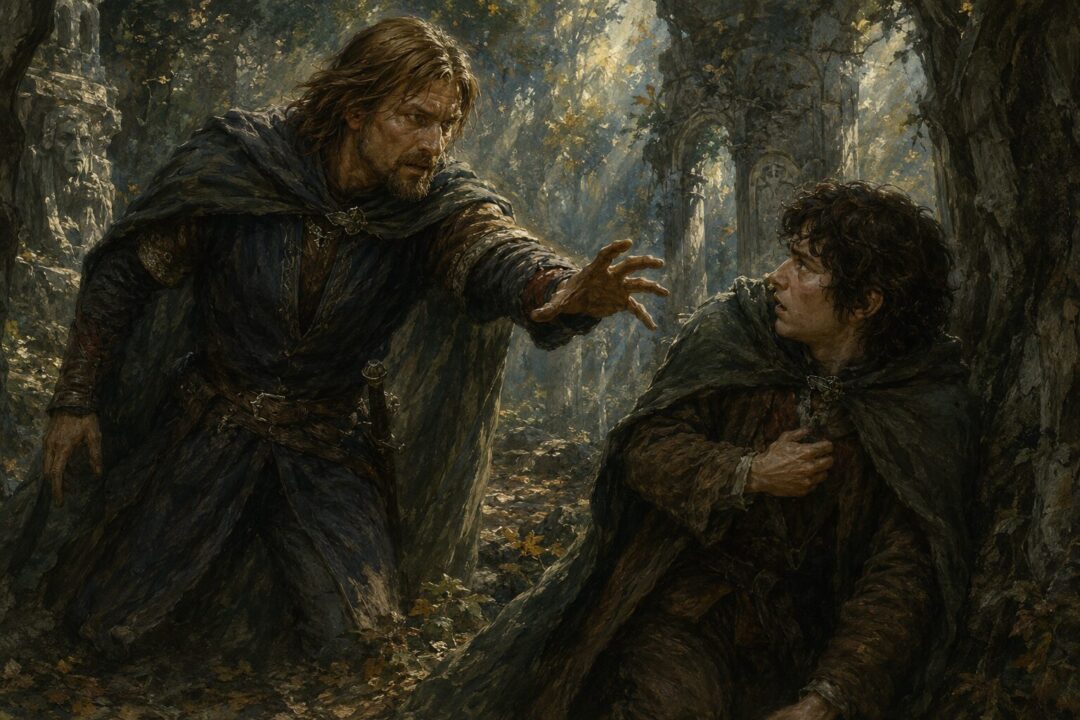
Boromir’s fall at Amon Hen reveals that the Ring’s “weight” extends beyond the person who carries it. Frodo bears it physically, but others are burdened by the choices it forces upon them. Boromir’s attempt to take it is a moral collapse under pressure: fear for his people, pride in his own strength, and inability to accept the humility of the Quest.
His repentance matters too. Boromir’s final courage does not erase his failure, but it shows that the Ring’s moral battlefield is not abstract. It breaks real loyalties and then leaves people to face what they have done.
Sam’s Brief Bearing: A Different Kind of Test
Sam’s time as Ring-bearer is short, but it clarifies the Ring’s method with extraordinary precision. When he takes the Ring after believing Frodo dead, he does so out of love and necessity. He is not seeking power. Yet the Ring still tempts him.
This is important: innocence of motive does not make someone immune.
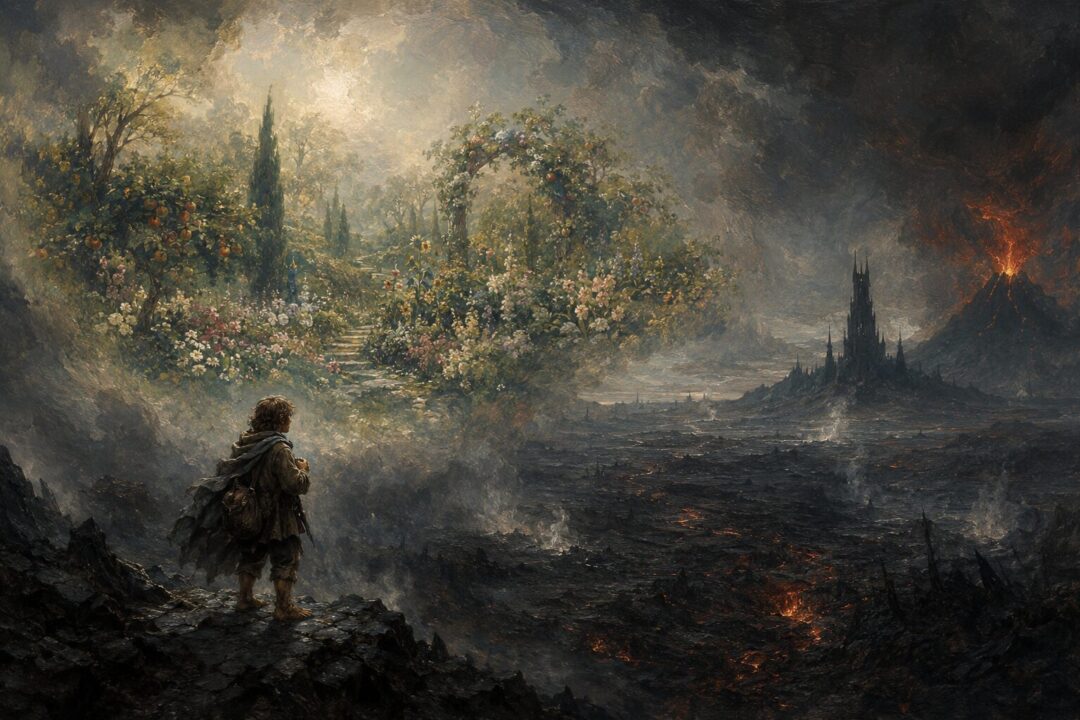
Sam’s visions are shaped by his own heart. The Ring inflates him into “Samwise the Strong,” a figure of command and glory, but it also offers a transformed Mordor, a land made fruitful. For Sam, a gardener, that temptation is not crude. It is almost beautiful. The Ring suggests that his goodness could be enlarged into power.
Yet Sam’s saving wisdom is his humility. He knows, or at least senses, that such visions are too large for him. His plain hobbit sense helps him reject the false scale the Ring offers. He does not imagine himself naturally fit to rule the world.
This does not mean Sam is morally superior in every way to Frodo. His test is shorter, and the Ring has not had years to work on him. But his brief bearing proves the larger point: the Ring’s weight first appears as an argument within the soul. It says, “You could do good with me.” The danger is that the sentence begins with good and ends with me.
Mordor Makes the Inner Weight Visible
Only near the end does the Ring’s burden become overwhelmingly physical. In Mordor, Frodo is starved, wounded, hunted, sleepless, and nearly spent. The land itself is hostile. The Eye is searching. The Ring is closer to the place of its making and to the power of its maker. The texts present Frodo’s torment as both bodily and inward; the distinction almost breaks down.
This is the point at which moral weight becomes visible as physical weight. Frodo can hardly go on. He can no longer remember ordinary comforts clearly. The Shire itself becomes distant. The Ring has not simply tired his body; it has narrowed his inner world until the burden is almost all that remains.
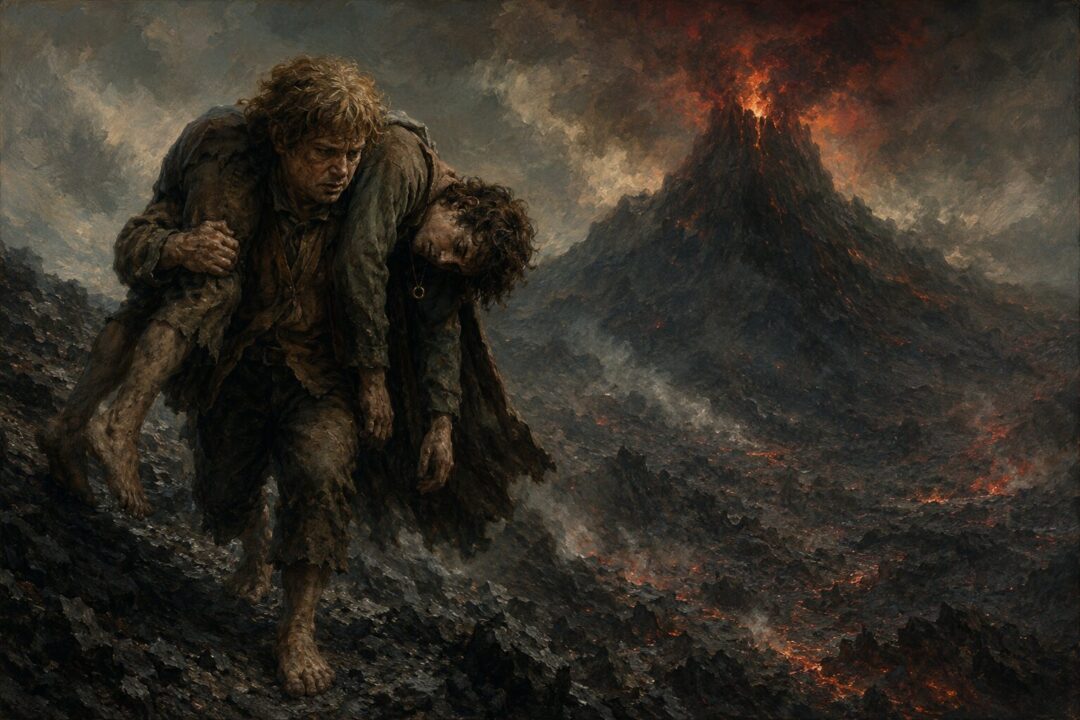
Sam can carry Frodo, but he cannot carry the Ring for him in the deepest sense. That distinction is one of the great emotional truths of the Quest. Sam’s love can bear the person who bears the burden. It cannot make the burden morally harmless.
When Sam lifts Frodo on the slopes of Orodruin, the scene is moving because it does not solve the central problem. It answers exhaustion with love, but it cannot remove temptation. Frodo must still enter the Sammath Naur. He must still face the final choice.
The Final Failure and the Mercy Around It
At the Cracks of Doom, Frodo does not choose to destroy the Ring. He claims it. This moment must be handled carefully. It is not simply a villainous turn, nor is it a clean heroic victory. The text shows the Ring’s power at its maximum, after Frodo has carried it farther than anyone else could reasonably have expected. He reaches the place where the Quest must be fulfilled, and there the burden overmasters him.
The moral weight becomes absolute. The Ring’s long pressure culminates in possession: “mine.” The word that haunted Gollum and troubled Bilbo now reaches Frodo.
Yet the Quest succeeds through a chain of earlier moral choices. Bilbo’s pity spared Gollum. Frodo’s pity continued that mercy. Sam, even after hatred and suspicion, does not murder Gollum on the slope. These acts do not look powerful at the time. They are not strategies of domination. They are refusals to close the moral world around vengeance.
In the end, those refusals matter. Gollum’s presence at the Crack of Doom is not an accident disconnected from the Ring’s history. The destruction of the Ring comes through struggle, failure, desire, and providential irony, but it is made possible by mercy shown long before the final moment.
The Ring is destroyed not because Frodo remains untouched, but because mercy survives around the ruin that the Ring has made.
The Real Weight of the Ring
The Ring’s physical heaviness is unforgettable because it gives visible form to something that has been true all along. It was heavy when Bilbo could barely give it up. It was heavy when Frodo realized the Shire was no longer safe. It was heavy when Boromir thought weaponizing it might save Gondor. It was heavy when Sam imagined a garden blooming under his command.
The Ring’s weight is moral before it is physical because its first burden is choice: whether to hide, use, surrender, spare, trust, dominate, or endure. It presses on weakness, but also on strength. It corrupts evil desires, but it also corrupts good desires by bending them toward possession.
That is why the Ring is such a profound object in Middle-earth. It is not only a magical device or a military prize. It is a test of what people believe they are allowed to do when afraid. Its heaviness begins when a person says, “I need it,” “I deserve it,” or “I could use it for good.”
By the time Frodo can barely carry it up Mount Doom, the Ring has already shown its true nature. Gold can be light in the hand and unbearable in the soul. The body only reveals, at the end, what the will has been suffering from the beginning.
Sources & Notes
- Tolkien Gateway overview of the One Ring. https://tolkiengateway.net/wiki/One_Ring
- J.R.R. Tolkien, The Fellowship of the Ring, Book I, Chapter 1, A Long-expected Party. https://tolkiengateway.net/wiki/A_Long-expected_Party
- J.R.R. Tolkien, The Return of the King, Book VI, Chapter 3, Mount Doom. https://tolkiengateway.net/wiki/Mount_Doom
Sources added.