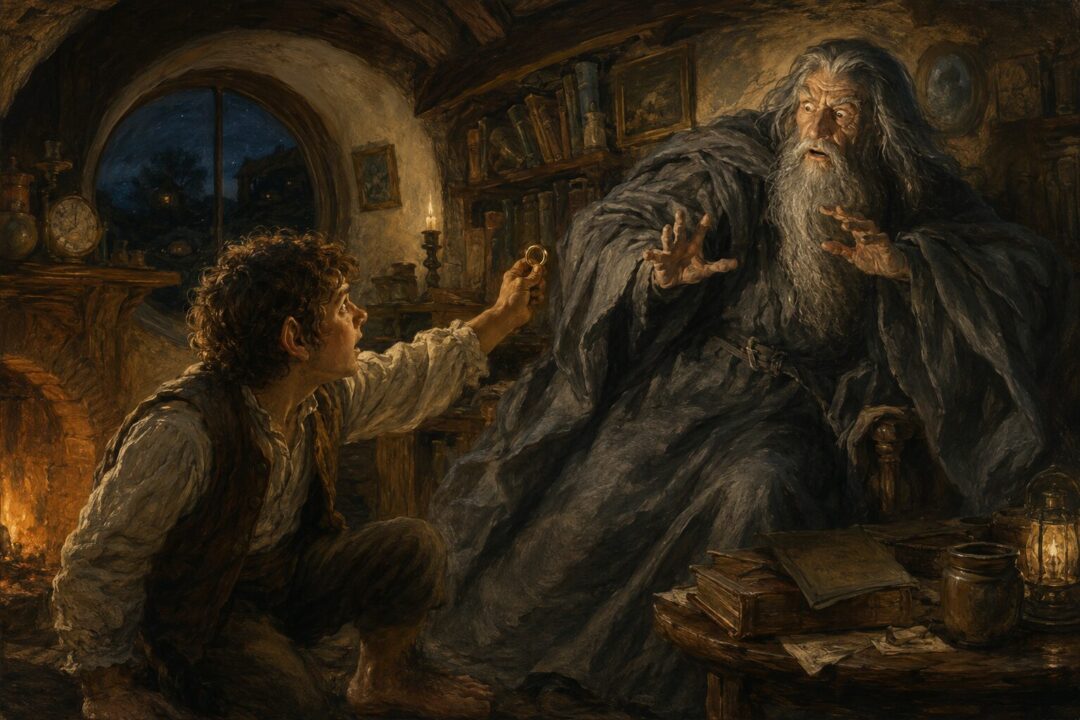
The most dangerous offer in The Lord of the Rings is not made in a throne room, battlefield, or council of kings. It happens in Bag End, between a frightened hobbit and an old grey wanderer.
Frodo, newly burdened with the truth about Bilbo’s Ring, does the most reasonable thing he can imagine. He offers it to Gandalf. Gandalf is wise. Gandalf is powerful. Gandalf understands the Enemy better than almost anyone in the Shire could hope to. Surely, if anyone could keep the Ring safe, it would be him.
Yet Gandalf reacts with sudden terror. He does not merely decline. He leaps away from the temptation. He knows that the Ring would reach him not through greed, cruelty, or hunger for conquest, but through pity and the desire to do good.
That is the terrible point. Gandalf refuses the Ring not because he would immediately become evil in the crude sense. He refuses because he could imagine doing too much good with it.
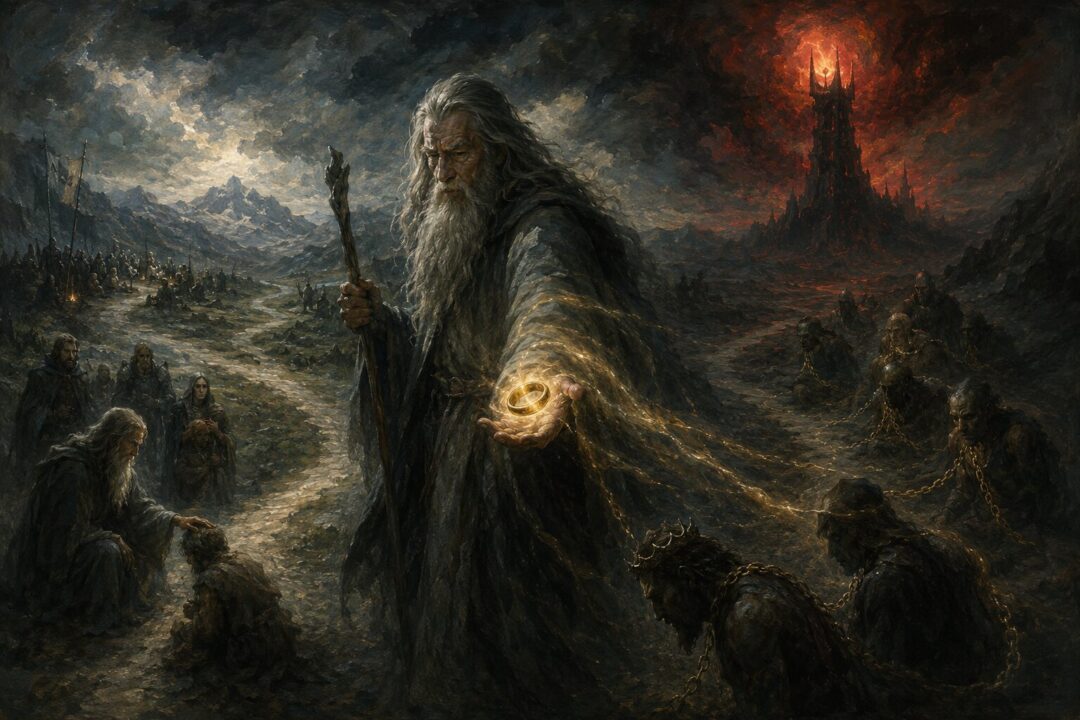
The Ring Did Not Tempt Everyone in the Same Way
The One Ring is not a simple magical tool. It was made by Sauron, and the texts repeatedly present it as bound to domination, preservation, and control. Its power works through the nature of the bearer. It does not need to offer the same dream to every mind.
For Gollum, it becomes secrecy, possession, and survival. For Boromir, it suggests military deliverance: a weapon for Gondor against the armies of Mordor. For Sam, in Mordor, it briefly shows a vision of himself as a mighty gardener, making the ruined lands bloom. Sam’s humility and plain sense help him reject the fantasy, but the moment matters: even Sam’s temptation is shaped as an enlarged version of his own goodness.
Gandalf understands this rule before most others do. The Ring would not need to tell him, “Become Sauron.” It would tell him, “Save them.”
That is why his refusal is so morally sharp. Gandalf is not afraid that he lacks good intentions. He is afraid that his good intentions are exactly where the Ring would enter.
“The Desire of Strength to Do Good”
In “The Shadow of the Past,” Frodo begs Gandalf to take the Ring. Gandalf’s answer reveals the hidden path by which the Ring would reach him. He says that with it he would have power too great and terrible, and that over him the Ring would gain a still deadlier power. He adds that he does not wish to become like the Dark Lord. Then comes the key admission: the way of the Ring to his heart would be pity, pity for weakness, and the desire for strength to do good.
This is one of the clearest statements in The Lord of the Rings about corruption. Evil does not always begin with hatred. Sometimes it begins with impatience toward suffering. Gandalf sees the helplessness of the Free Peoples. He sees the fear in the Shire, the long watchfulness of the Wise, the fading of the Elves, the weakness of Men, and the spread of Sauron’s shadow. He has spent long years laboring against darkness by counsel, warning, and hope.
The Ring would offer him an answer to all of that. No more waiting for courage to grow slowly. No more trusting small hands with impossible tasks. No more persuading proud lords, scattered peoples, and frightened hearts. With the Ring, he might compel the resistance of Middle-earth into unity.
At first, that might look like salvation.
But the One Ring was made for mastery. To use it “for good” would still mean using Sauron’s method: bending other wills beneath one ruling will.
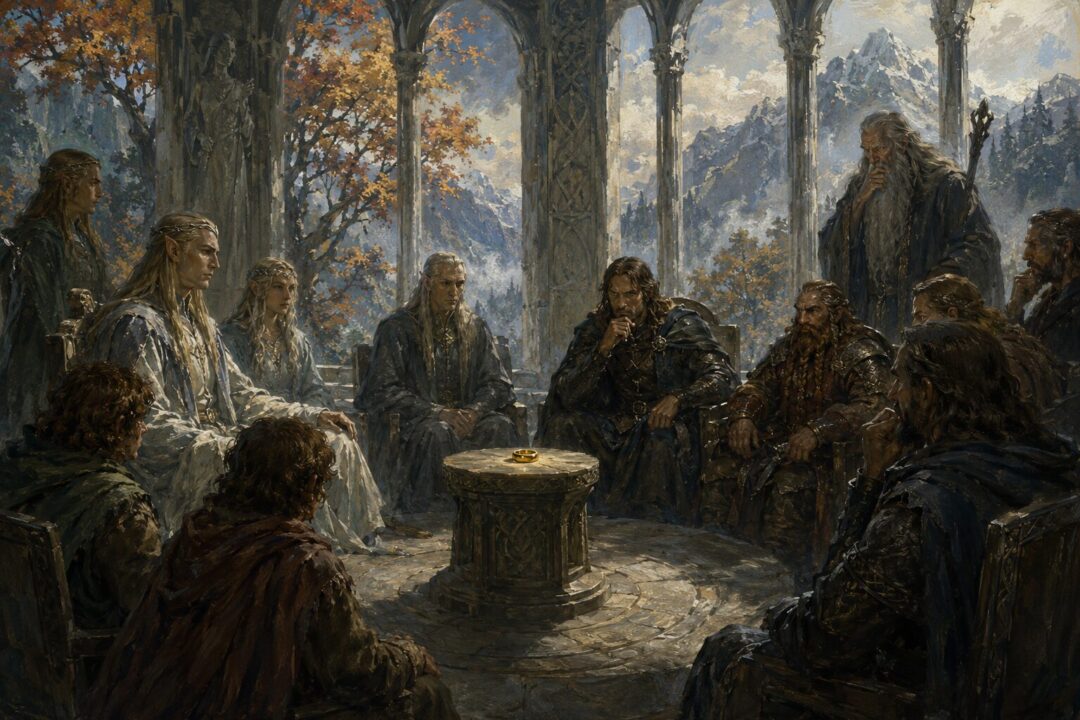
Gandalf’s Power Made the Danger Greater, Not Smaller
A common mistake is to imagine that Gandalf’s wisdom would make him safe. The Council of Elrond suggests the opposite. Elrond says that the Ruling Ring belongs to Sauron, was made by him alone, and is altogether evil. Its strength is too great for anyone to wield at will except those who already possess great power — and for them, it holds an even deadlier peril.
That sentence explains Gandalf’s fear. The weak may be devoured by the Ring, but the strong might actually do something catastrophic with it.
Gandalf is not merely an old man with clever words. The deeper legendarium identifies him as one of the Istari, beings sent into Middle-earth in the form of old men. Their mission was to resist Sauron, but not by matching domination with domination. They were to advise, awaken courage, and unite resistance without revealing their full majesty or ruling the peoples they came to help.
The Ring would be the perfect violation of that mission. Gandalf with the Ring would not simply be Gandalf plus a weapon. He would become a ruler by spiritual pressure, a savior who no longer needed consent. His wisdom, compassion, and authority would become instruments of command.
The more sincerely he wanted to heal Middle-earth, the more completely the Ring could justify his control over it.
The Difference Between Guidance and Dominion
Gandalf’s greatness lies partly in restraint. He arrives in the Shire as a wandering friend, not as a lord. He advises Thorin but does not rule the Quest of Erebor. He guides Frodo but does not seize Frodo’s burden. He strengthens Théoden, but the king must still stand. He counsels Denethor, but he does not claim the Steward’s chair. Even when he returns as Gandalf the White, he remains a servant of the larger struggle, not its owner.
That pattern is not accidental. Gandalf’s victories usually involve awakening others to their own courage. Bilbo must pity Gollum. Frodo must choose to leave the Shire. Aragorn must accept his road. Théoden must ride. Pippin must serve. Even at the end, the Quest depends on people too small to dominate the world.
The Ring offers the opposite logic. It says that one will can settle the matter. One ruler can impose order. One wise hand can correct the weakness of many.
That is why Gandalf’s refusal is not cowardice. It is fidelity to the deepest moral pattern of the story. He will not save Middle-earth by becoming its master.
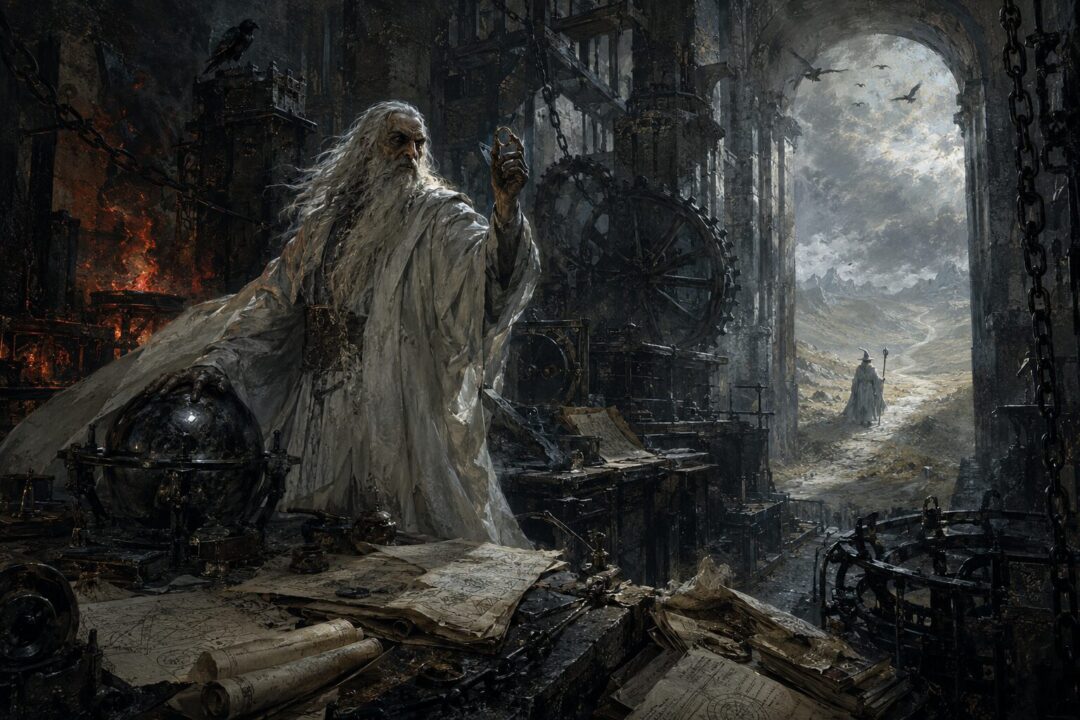
Saruman Shows the Nearer Warning
Gandalf’s fear is made clearer by Saruman. Saruman does not possess the One Ring, but he desires it and begins to imitate the logic of the Enemy. He studies ring-lore, builds power at Isengard, breeds armies, manipulates others, and speaks in the language of necessity. He convinces himself that wisdom means accepting power as it is and directing it.
Saruman is not a random villain beside Gandalf. He is a warning of what a wizard can become when the desire to order the world overtakes humility. He begins as the head of the White Council, a figure of knowledge and authority. Yet his fall shows that great wisdom can be twisted into calculation, and calculation into tyranny.
Gandalf’s refusal at Bag End therefore carries the weight of foresight. He knows that a wizard’s fall would not be small. It would not merely corrupt a private soul. It would reorganize the hopes of Middle-earth around a false deliverer.
The Ring would not have needed to make Gandalf stupid. It would have made him certain.
Would Gandalf Have Defeated Sauron?
The texts do not give a simple battlefield answer inside the narrative, but the possibility is treated with deadly seriousness. The Wise believe that if a sufficiently powerful claimant mastered the Ring, Sauron could be overthrown or displaced. This is part of what Sauron fears: not that someone humble will destroy the Ring, but that a rival power will claim it.
Later commentary in Letter 246 develops the idea of Gandalf as Ring-lord in especially grim terms. It suggests that if Gandalf had taken the Ring and defeated Sauron, the result would have been worse in a particular moral sense: “righteous” rule could make good itself appear hateful. The point is not that Sauron is kinder. It is that Sauron’s evil is recognizable as evil, while Gandalf corrupted by the Ring would cloak domination in the language of justice.
That is the nightmare behind the temptation. Sauron enslaves by darkness. Gandalf with the Ring might enslave by light.
He might command mercy. He might enforce peace. He might compel wisdom. He might build a world where rebellion against his rule looked like rebellion against goodness itself.
Why Frodo Had to Carry What Gandalf Refused
This also explains why the Ring finally passes into the hands of hobbits. The Quest is not won by finding someone strong enough to use the Ring. It is won by finding someone able to bear it without claiming mastery for as long as possible.
Frodo is not incorruptible. The story never pretends that he is. At the Cracks of Doom, he fails to surrender the Ring by his own unaided will. But for most of the journey, his smallness matters. He has no army to command, no kingdom to save by force, no ancient authority over the peoples of Middle-earth. The Ring can torment him, isolate him, and wear him down, but it cannot immediately turn him into a world-ruling power.
Gandalf would be different. His pity is vast, his knowledge deep, and his authority already recognized by many. In him, the Ring would find not a narrow crack but a great gate.
That is why he must refuse, even when refusing leaves Frodo in danger. Gandalf’s mercy cannot become possession. His wisdom cannot become ownership of the Quest. He can help the Ring-bearer, but he cannot become the Ring-bearer in Frodo’s place.
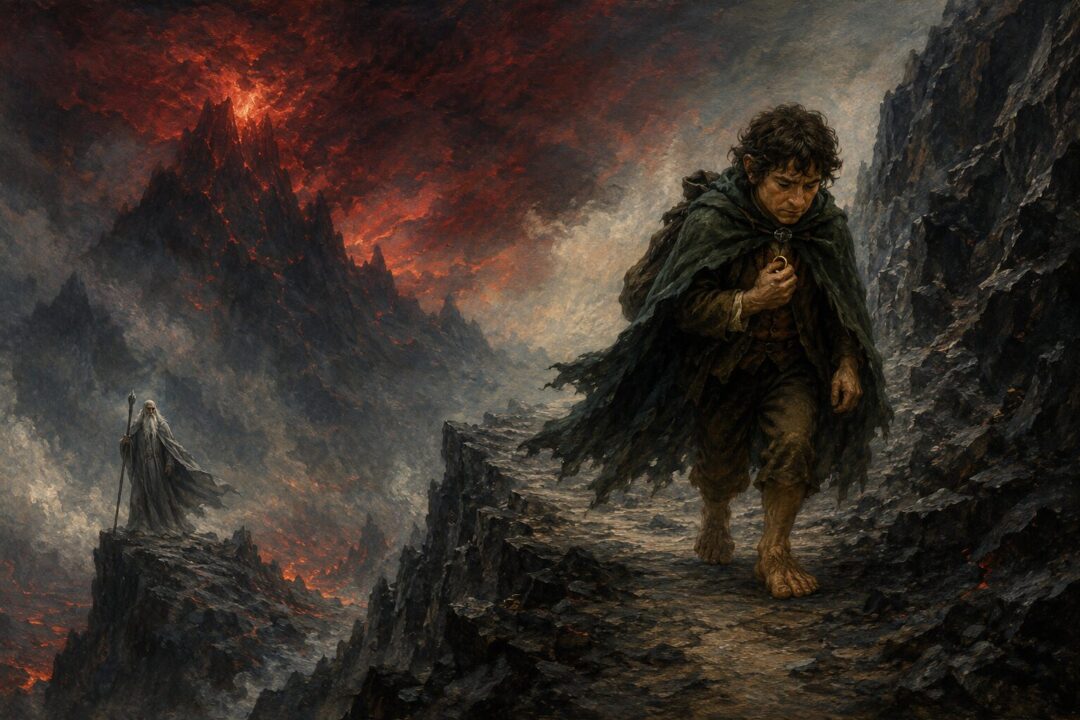
The Terrible Mercy of Restraint
Gandalf’s refusal is one of the great acts of self-knowledge in Middle-earth. He does not say, “I am too pure to be corrupted.” He says, in effect, “I know exactly how I would be corrupted.”
That honesty separates him from many who fall. Boromir imagines the Ring as a weapon for desperate defense. Saruman imagines power as something the wise can manage. Denethor, though he never seeks the Ring in the same direct way, is consumed by a vision of strength, lineage, and inevitable defeat. Again and again, the story shows that despair and pride can disguise themselves as responsibility.
Gandalf’s answer is restraint. He accepts that there are forms of power he must not touch, even for urgent reasons. He chooses the slower road: counsel instead of command, friendship instead of domination, trust instead of certainty.
In a world as threatened as Middle-earth, that restraint is almost unbearable. It would be easier to believe that the strongest good person should take the strongest weapon and end the war. But The Lord of the Rings refuses that comfort. Some powers cannot be purified by good motives. Some tools carry their maker’s will too deeply. Some victories would destroy the very thing they claim to defend.
Gandalf refused the Ring because he could do good with it. Too much good. Good made compulsory. Good made terrible. Good severed from freedom, humility, and pity.
And because he refused, the fate of the world remained where the Ring least expected it: not in the hand of a mighty wizard, but in the endurance of the small, the merciful, and the almost broken.
Sources & Notes
- J.R.R. Tolkien, The Fellowship of the Ring, Book I, Chapter 2, The Shadow of the Past. https://tolkiengateway.net/wiki/The_Shadow_of_the_Past
- Tolkien Gateway character overview for Gandalf. https://tolkiengateway.net/wiki/Gandalf
- Tolkien Gateway overview of the One Ring. https://tolkiengateway.net/wiki/One_Ring
Sources added.