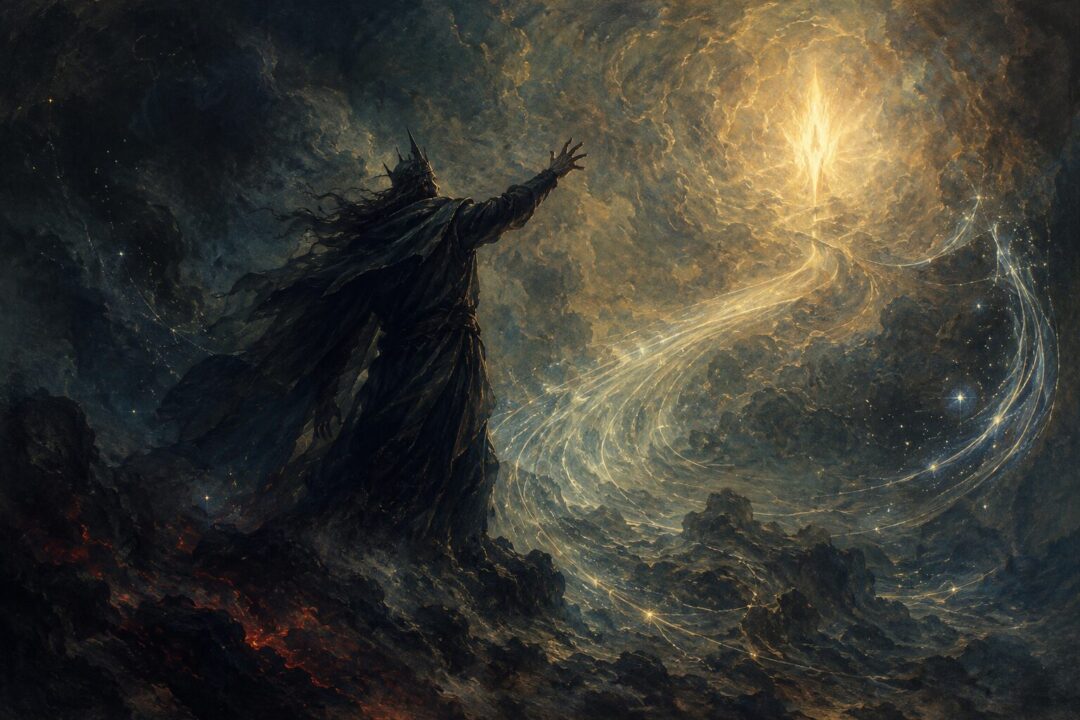
The Dark Lord’s Great Contradiction
Morgoth filled Middle-earth with terrors. Orcs came out of darkness. Dragons crawled from the pits of Angband. Wolves, trolls, and other monstrous servants moved beneath his will. To anyone living under his shadow, it would have looked as if he had become a creator in his own right.
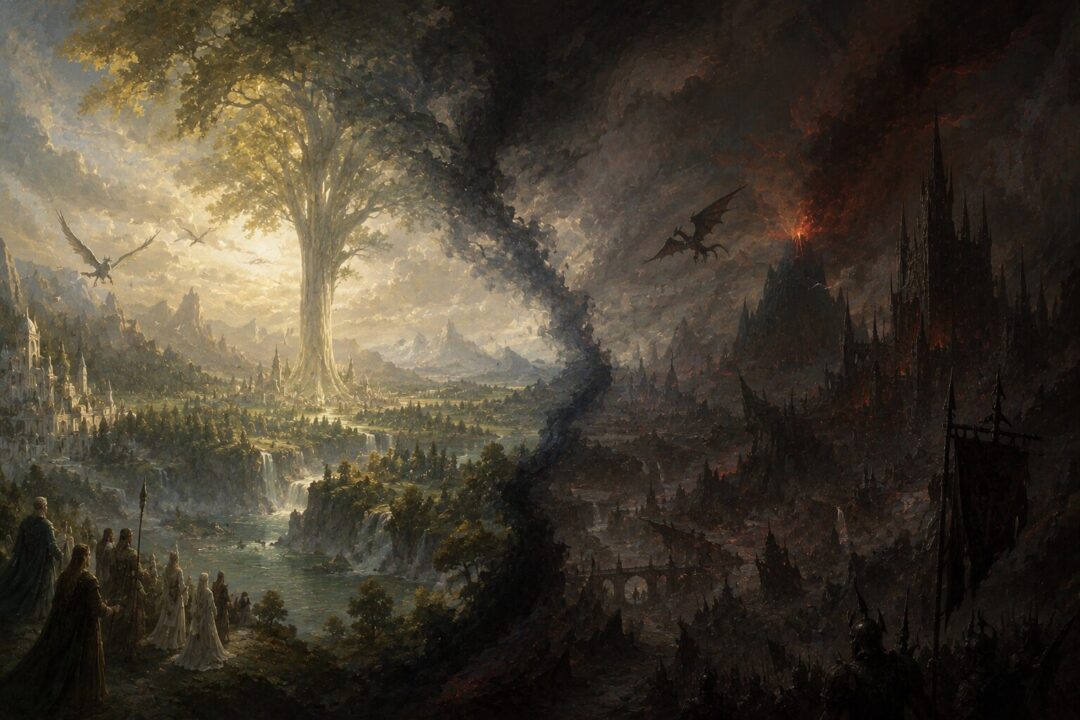
But the deeper rule of Tolkien’s world is stranger and more severe: Morgoth could dominate, distort, breed, mock, and ruin life, but he could not truly create it.
That distinction matters. It is not a small technicality of lore. It is the wound at the center of Morgoth’s rebellion. He desired not merely power over things that already existed, but authorship — the ability to bring being into existence from himself. Yet again and again, the texts imply that this power was not his. The creatures of his darkness were not pure inventions from nothing. They were corruptions, imitations, or degradations of something already rooted in the created order.
Morgoth’s tragedy is that he wanted to be the source of life, but became instead the great corrupter of it.
The Flame Imperishable and the Limit of the Ainur
The deepest answer begins before Middle-earth, in the making of the world. In the Ainulindalë, the Ainur participate in the Music, but they do not independently bring the universe into being. Eru Ilúvatar alone gives the vision reality. The Flame Imperishable, associated with true creative power and being, belongs to Eru.
Melkor’s earliest desire is bound up with this. He searches for the Flame, wanting to bring into being things of his own. But he cannot find it, because it is with Ilúvatar. This is the first great limit placed upon him: Melkor has imagination, power, knowledge, and will, but not the authority to give independent being.
That does not mean the Ainur are powerless. The Valar shape the world. Aulë crafts mountains, substances, and works of great skill. Yavanna is deeply tied to growing things. Ulmo’s power moves through waters. But shaping the world is not the same as creating life from nothing, and making a body is not the same as giving it a true inner life of its own.
Morgoth’s later works must be understood inside this boundary. He can pour power into matter. He can twist bodies. He can breed races into hideous forms. He can impose fear and obedience. But the original gift of life does not come from him.
Aulë’s Dwarves Show the Rule
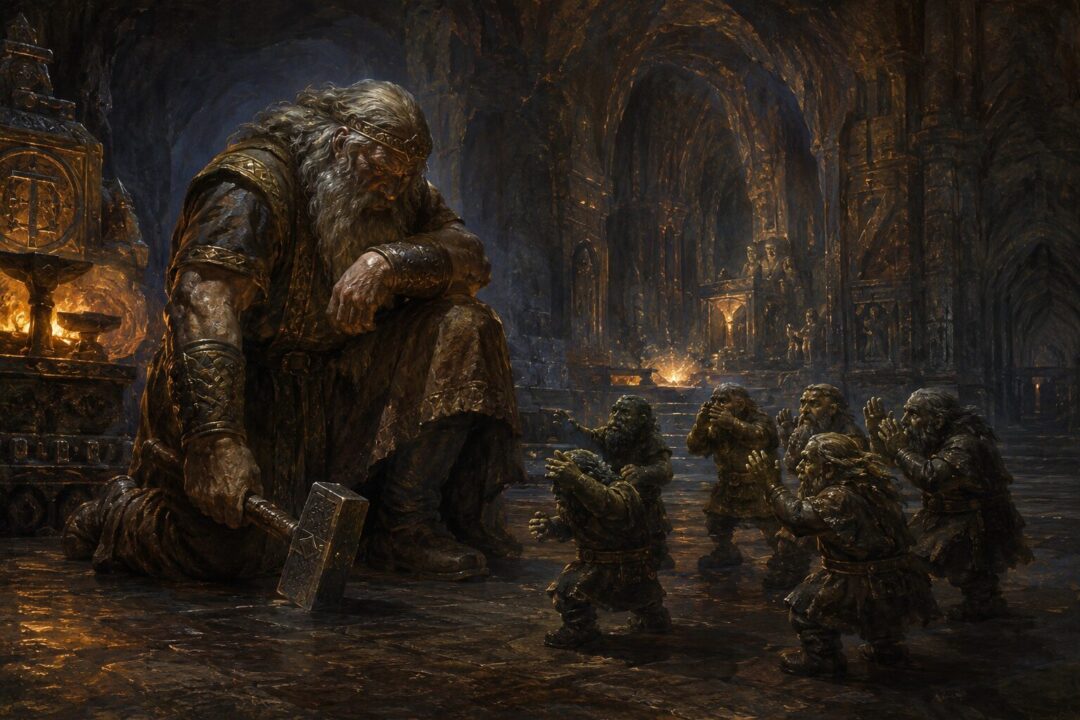
The clearest comparison is Aulë and the Dwarves. Aulë makes the Seven Fathers of the Dwarves in secret, not out of hatred, but from impatience and desire for pupils to teach. Yet when Ilúvatar confronts him, the problem becomes clear: Aulë has made bodies capable only of moving according to his own thought. They do not yet possess true independent life in the full sense.
When Aulë raises his hammer to destroy them in obedience, the Dwarves shrink from the blow. That moment reveals that Ilúvatar has accepted them and given them life beyond Aulë’s own will.
This episode is crucial because Aulë is not evil, yet even he cannot complete living beings without Eru. His humility makes the difference. Aulë surrenders his work. He does not claim ownership against Ilúvatar. The Dwarves become adopted children of Eru, though they awaken only after the Elves.
Morgoth is Aulë’s opposite. Where Aulë repents, Morgoth refuses. Where Aulë submits his making, Morgoth tries to possess and dominate. If Aulë could not truly create life by craft alone, Morgoth could not do so by malice.
Orcs: Corruption, Not Original Creation
The origin of Orcs is one of the most debated areas of Tolkien’s legendarium. The published Silmarillion presents the belief of the Wise that Orcs were bred from Elves captured by Melkor in the early days, corrupted by torture and dark arts. Other writings explore different possibilities, including connections to Men or other origins, and Tolkien never left a single perfectly settled final account.
But one point remains stable: Orcs are not presented as beings created by Morgoth from nothing.
The Elvish-origin version makes the moral horror especially sharp. If Orcs began as captured Elves, then Morgoth’s “making” is actually violation. He does not create a new race in innocence; he ruins the Children of Ilúvatar into a form of servitude and hatred. Even if one follows the later uncertainty around Orc origins, the same caution applies: the texts do not give Morgoth the power to originate rational life independently.
This is why Orcs are so disturbing. They are not merely monsters in the simple sense. They are evidence of the Enemy’s parasitic genius. Morgoth can take what was meant for freedom, beauty, speech, memory, and community, and bend it toward fear and cruelty. His power is real, but it is derivative. It needs something living to injure.
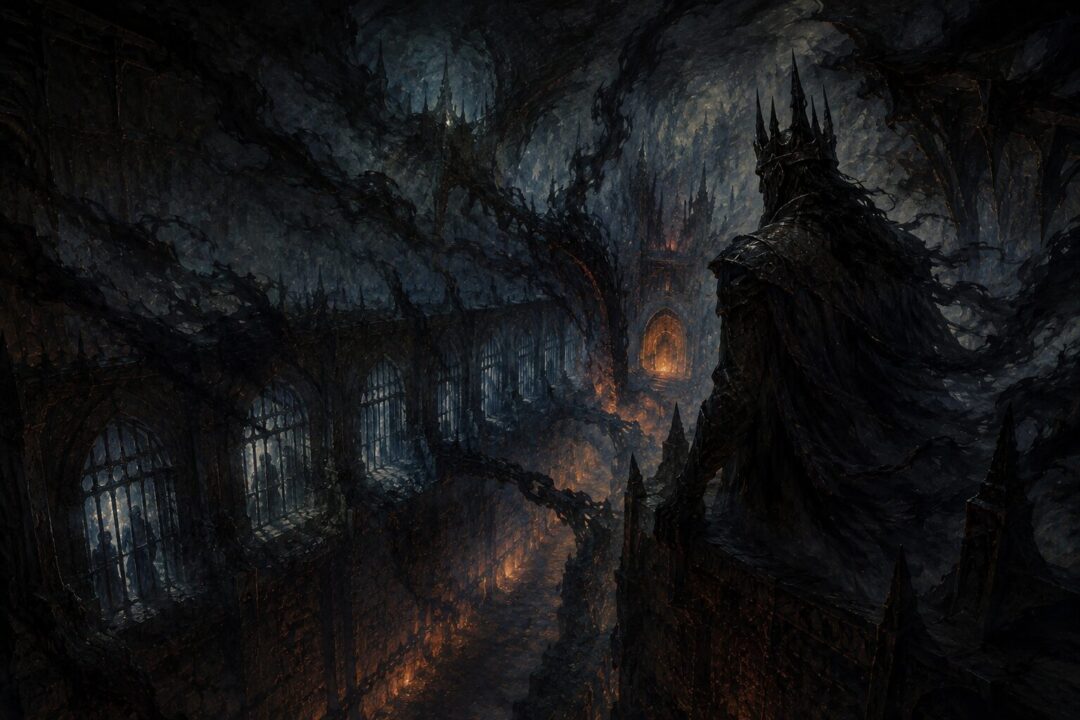
Dragons and the Mockery of Majesty
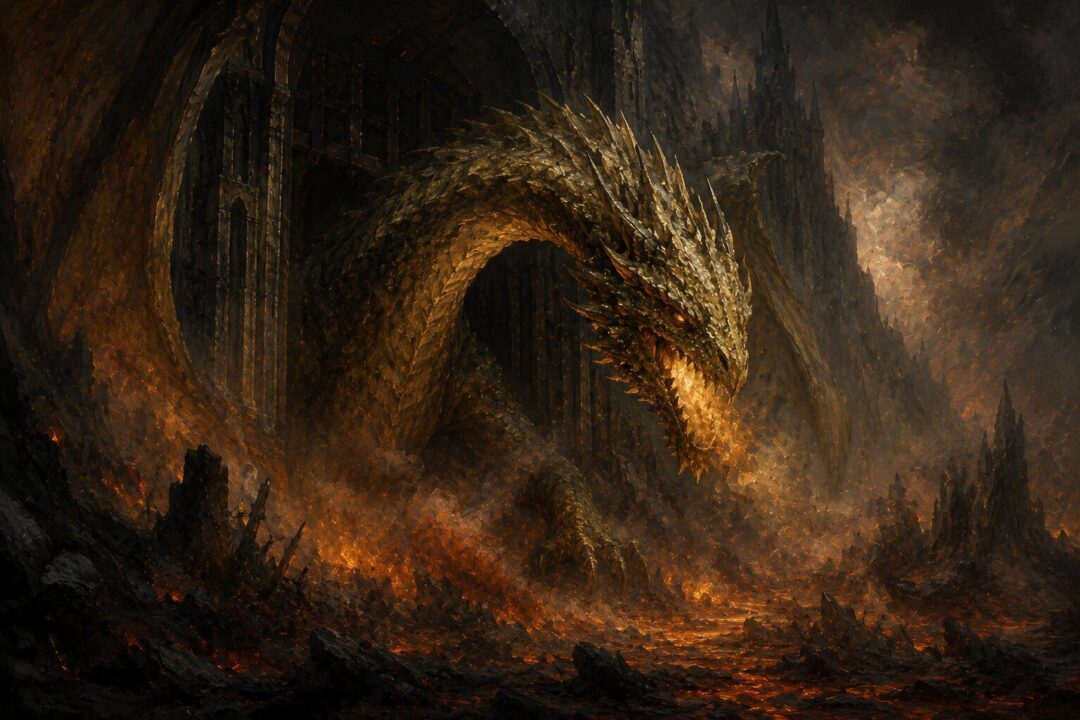
Dragons seem at first like a stronger challenge. Glaurung, the first of the great fire-drakes, appears as one of Morgoth’s most terrible works. Later dragons such as Ancalagon the Black become symbols of overwhelming destructive might. They are not merely beasts; some possess cunning, speech, malice, and a power to dominate minds.
Yet even here, the texts do not require Morgoth to be a true creator of life. Dragons are described as bred or devised in the deep places of Angband, but not as life summoned from nothing. Their nature remains mysterious, and Tolkien does not fully explain the biological or spiritual process behind them.
What matters is their role. Dragons are not a new creation of goodness. They are a weaponized distortion of life: intelligence without mercy, majesty without humility, fire without light. Glaurung’s power over Túrin and Nienor is not merely physical; it is psychological and spiritual. He lies, manipulates, and freezes the will. In him, Morgoth’s corruption becomes almost artistic — a living instrument of despair.
But even that dark artistry depends on what Morgoth did not originate: life, mind, speech, desire, fear, and the vulnerability of the soul.
Trolls, Wolves, and Imitation
Other servants of darkness follow the same pattern. Trolls are often understood as mockeries of Ents, though the exact nature of their origin is not fully explained. The comparison matters because mockery is one of evil’s repeated habits in Middle-earth. The Enemy makes things that resemble the good, but in diminished, brutal, or enslaved form.
Werewolves and evil wolves likewise show Morgoth’s tendency to bind spirits, beasts, and bodies into terror. Carcharoth, fed by Morgoth’s own hand and filled with a dreadful fate, is not a creature of innocent nature. He is a living weapon swollen by malice.
Again, the line is consistent: Morgoth can intensify, deform, enslave, and weaponize. He can produce horrors through breeding, sorcery, and domination. But these are not the same as the divine act of giving being.
Why Corruption Was So Powerful
It would be a mistake to make Morgoth sound weak. His inability to create true life did not make him harmless. In fact, it made his evil more dangerous.
Because he could not be the source of life, he sought to become its master. Because he could not originate being, he tried to possess the being of others. His power worked by invasion: into matter, into bodies, into wills, into fear, into history itself.
Later writings emphasize that Morgoth dispersed much of his native power into the physical substance of Arda. This is one reason his corruption is not limited to a few monsters or armies. The world itself becomes “Morgoth’s Ring” in a broad interpretive sense: not because he created Arda, but because he invested his will into it, marring it from within.
That is a more frightening idea than simple monster-making. Morgoth’s evil is not only in Angband. It stains the conditions of life. Decay, domination, possessiveness, and violence become part of the long sorrow of the world.
The Moral Cost of Making Without Love
Aulë made the Dwarves because he desired students and makers after his own heart. His error was impatience, but his work could be redeemed because he did not cling to it in pride.
Morgoth’s works are different because they are not acts of generous making. They are acts of possession. He does not want other beings to flourish in their own freedom. He wants them to reflect his will.
That is why his inability to create is not only metaphysical but moral. True creation in Tolkien’s world is bound to gift. Life is not merely machinery. It is not simply animation. It involves freedom, otherness, and a mystery beyond the maker’s control.
Morgoth cannot bear that. He hates what is not himself. He envies what he cannot author. So he makes by reducing. He takes the living and makes it less free, less whole, less itself.
Sauron Inherits the Same Pattern
Sauron, Morgoth’s greatest servant, follows a similar but narrower road. He does not create true life either. His masterpiece, the One Ring, is not alive in the same way as the Children of Ilúvatar, but it carries a dreadful portion of his power and will. It dominates, preserves, tempts, and corrupts.
This is the same principle in a smaller, more concentrated form. Sauron’s power is not the power to bring new life into being. It is the power to bind wills to himself. He turns kings into Ringwraiths, not by creating new souls, but by enslaving existing ones until their own life is consumed by his.
The Ring is therefore a perfect descendant of Morgoth’s failure. It is a thing made by craft, filled with will, designed not to create but to rule.
The Hidden Hope Inside the Limit
The fact that Morgoth cannot truly create life is not only a restriction on evil. It is also a source of hope.
If Morgoth did not create life, then life does not belong to him. Orcs, dragons, and all corrupted things remain signs of terrible ruin, but their existence does not prove that evil has become equal with the Creator. The Shadow can wound the world deeply, but it cannot become the world’s source.
This is why mercy matters so much in Middle-earth. The good characters do not always know what can be healed. They do not pretend corruption is harmless. But they also do not grant evil the final dignity of authorship. Gollum is ruined by the Ring, yet not reducible to the Ring. Théoden is bent under shadow, yet can be restored. Frodo is wounded beyond ordinary healing, yet his pity helps save the world.
The pattern is consistent: evil can deform life terribly, but it cannot erase the truth that life began elsewhere.
Morgoth’s Defeat Was Built Into His Desire
Morgoth wanted to be a creator, but everything he made revealed his dependence. Orcs required captured or pre-existing life. Dragons required living form and will turned toward destruction. His fortresses required stone. His armies required bodies. His terror required hearts capable of fear.
He could not escape the world he hated. He could only mar it.
That is the final irony. Morgoth’s power was vast enough to darken ages, break kingdoms, and leave scars that endured long after his defeat. Yet at the root of his rebellion was an absence. He could not kindle the Flame Imperishable. He could not make life truly his own.
So he became the greatest corrupter precisely because he could never be the true Creator.
Sources & Notes
- J.R.R. Tolkien, The Silmarillion, Ainulindale. https://tolkiengateway.net/wiki/Ainulindal%C3%AB
- Tolkien Gateway overview of Morgoth. https://tolkiengateway.net/wiki/Morgoth
- Tolkien Gateway overview of Orcs and the corruption tradition. https://tolkiengateway.net/wiki/Orcs
Sources added.