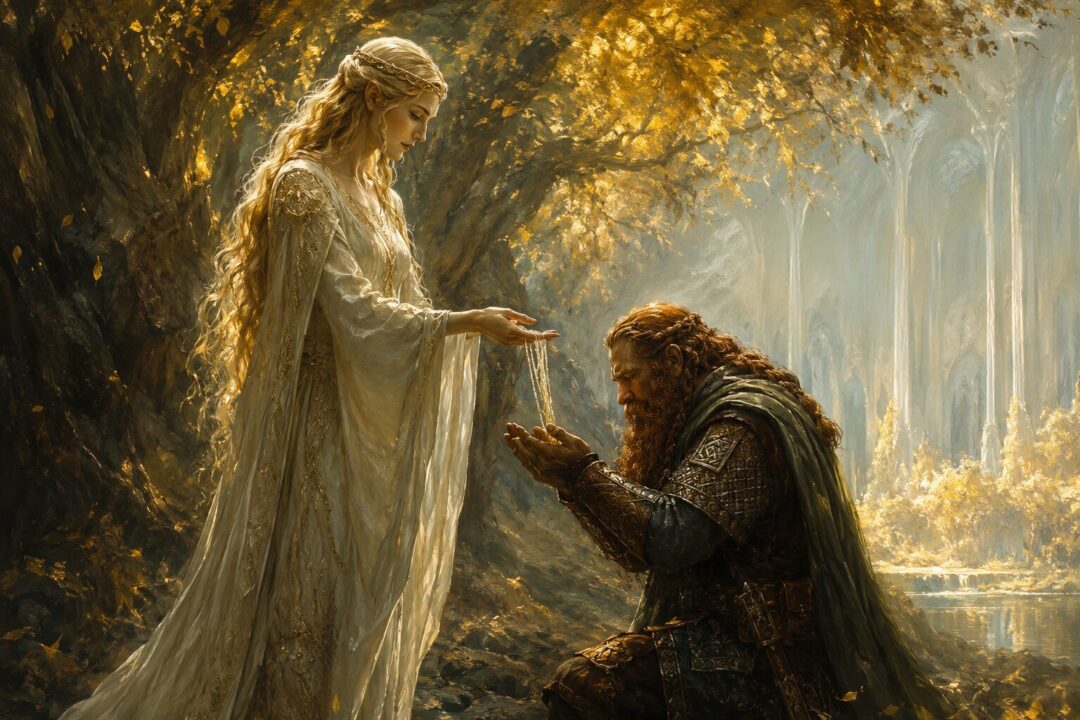
The moment seems almost impossibly small. A Dwarf asks an Elven queen for a gift. Instead of jewels, weapons, or ancient treasures, he asks for three strands of her hair.
For readers encountering The Lord of the Rings for the first time, the exchange may feel charming, even curious. Yet beneath those few lines lies one of the deepest echoes in the history of Middle-earth. Galadriel's gift to Gimli was not merely an act of generosity. It quietly overturned an ancient refusal, healed centuries of distrust between Elves and Dwarves, and revealed that true worth in Middle-earth is measured not by birth or power, but by humility and grace.
The significance becomes even greater when placed beside an older story from the Elder Days—one involving the greatest craftsman among the Elves and one of the tragedies that helped shape the history of Arda.
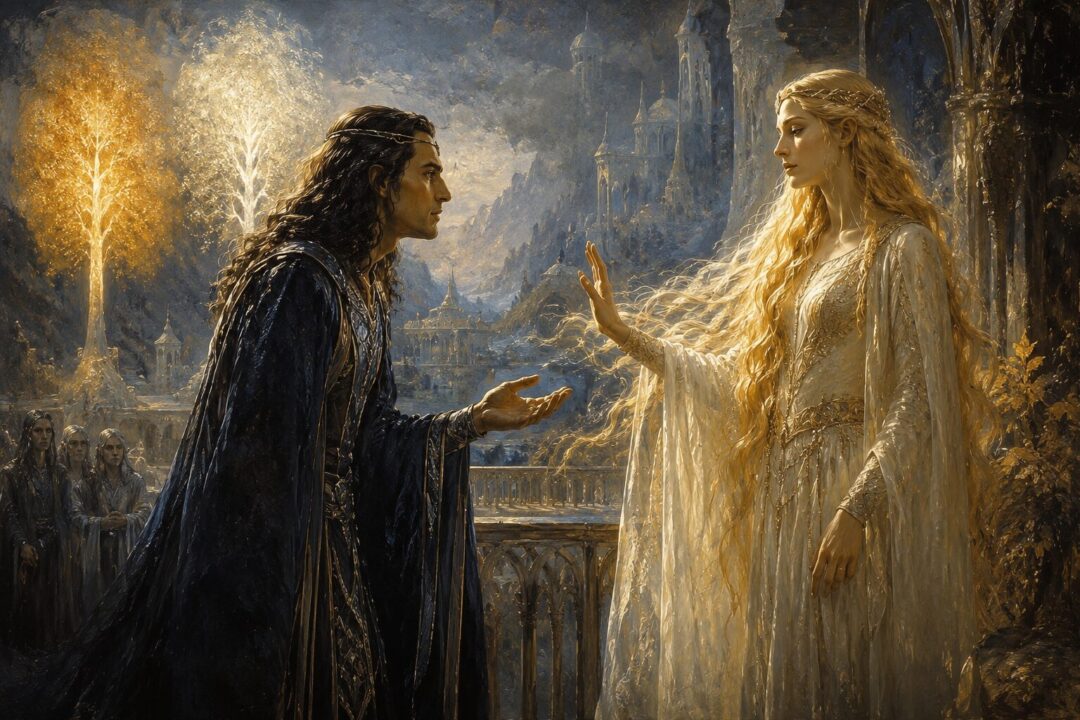
The Famous Hair of Galadriel
Galadriel's hair is not simply described as beautiful. It occupies a unique place in the lore.
In Unfinished Tales, her golden hair is said to have been remarkable because it seemed to capture both the gold associated with her father’s Vanyarin ancestry and the silver associated with her mother’s Telerin kin. The texts even note that some believed its radiance had inspired thoughts that later contributed to the creation of the Silmarils, though this connection is presented as tradition rather than direct historical certainty.
Whether or not that belief is literally true, the important point is clear: Galadriel's hair possessed extraordinary symbolic significance long before the Fellowship ever entered Lórien.
It represented beauty unmarred by possession. Unlike jewels or crafted treasures, it was something living. It could be admired, but never truly owned without the willing consent of its bearer.
That distinction becomes crucial.
Fëanor Asked Three Times—and Was Refused
Long before the War of the Ring, the greatest craftsman among the Noldor desired a small portion of Galadriel's hair.
According to Unfinished Tales, Fëanor asked her three separate times for a tress of her hair.
She refused him every time.
The text gives a reason that reaches beyond simple dislike. Galadriel perceived darkness within him. Even before the rebellion of the Noldor and the making of the terrible Oath, she recognized an inner pride and possessiveness that troubled her.
The refusal was therefore not arbitrary.
Fëanor was already driven by a consuming desire to create, possess, and preserve beauty under his own mastery. His greatest achievement—the Silmarils—would become objects whose possession led to betrayal, slaughter, exile, and generations of grief.
Galadriel denied him something because she would not allow beauty freely given to become another object of possessive desire.
The irony is striking.
The greatest prince of the Noldor, perhaps the most gifted Elf to ever live in craft and skill, could not obtain even a single strand.
Why Three Strands Matter
When Gimli later asks Galadriel for her hair, he also asks for three strands.
This number is almost certainly intended to recall the earlier episode.
Nothing in the text states that Gimli consciously knew the ancient story. There is no indication that he asked for three strands specifically because of Fëanor.
Instead, the literary parallel invites readers to compare the two requests.
One request came from extraordinary pride.
The other came from extraordinary humility.
That contrast explains why Galadriel responds so differently.
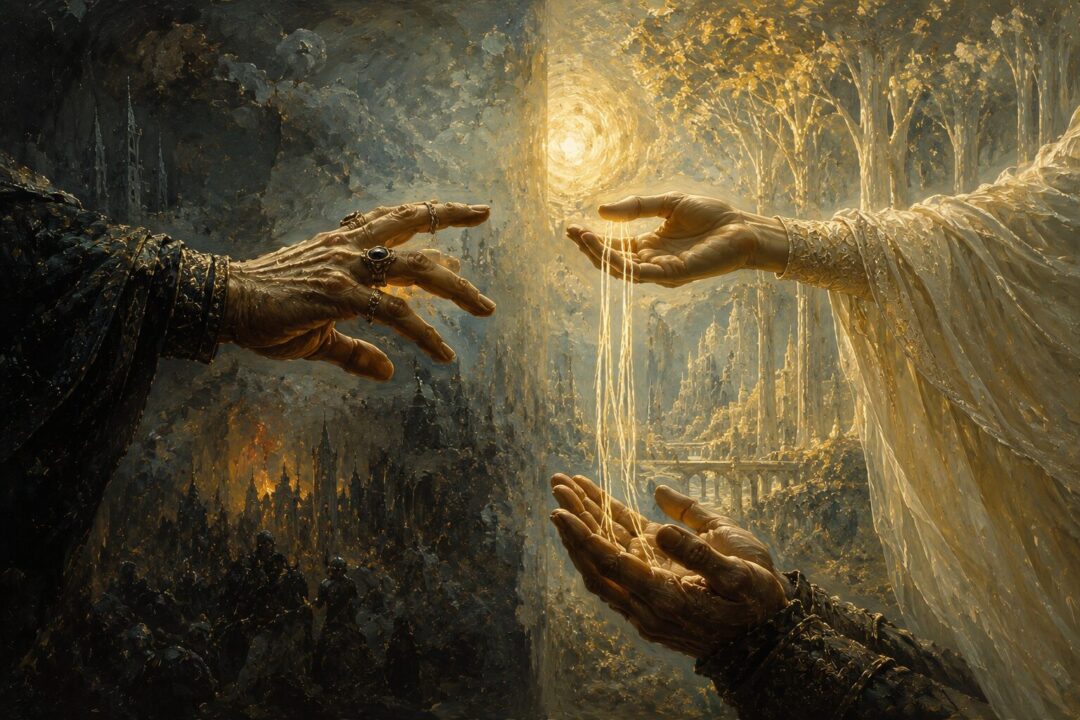
Gimli Never Intended to Possess Her Beauty
After Galadriel invites each member of the Fellowship to name a gift, Gimli hesitates.
He insists that it would be enough merely to have seen her.
Only after she gently encourages him does he speak.
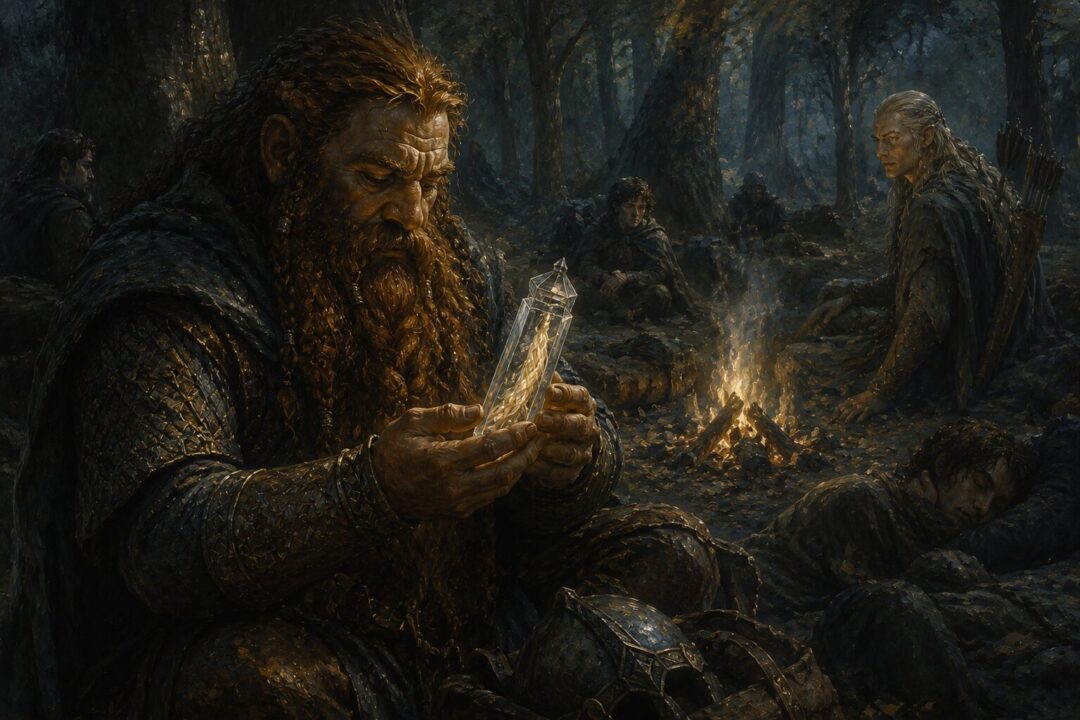
He asks for a single strand of her hair to preserve in crystal as an heirloom for his house, calling it a memory of the beauty of Lórien. He does not demand it. He even expects refusal, saying his request is foolish.
Instead of one strand, Galadriel laughs and grants him three.
The exchange reveals something essential.
Gimli does not seek ownership.
He seeks remembrance.
His request is not driven by greed, ambition, or artistic rivalry. Unlike Fëanor, he has no intention of transforming the gift into something that magnifies himself. The value lies entirely in what it represents: gratitude, admiration, and memory.
The object matters because of the relationship.
The Gift Was Freely Given
One of the recurring themes throughout Tolkien's legendarium is that freely given gifts carry a moral significance that stolen or demanded treasures never possess.
The One Ring is seized and fought over.
The Silmarils become objects of oath-bound obsession.
The Arkenstone inspires rivalry among allies.
Galadriel's hair follows the opposite pattern.
Its worth comes precisely because it cannot be taken.
Fëanor's greatness cannot compel it.
Gimli's humility receives it.
The contrast reflects a broader pattern throughout Middle-earth: power reaches its highest form when it refuses domination.
Galadriel herself demonstrates this later when she rejects the One Ring. She has the strength to seize overwhelming power but instead chooses renunciation.
Her gift to Gimli reflects that same principle. Beauty remains beautiful because it is freely shared rather than possessed.
Healing the Wounds Between Elves and Dwarves
The exchange also carries another layer of meaning.
Relations between Elves and Dwarves had long been strained.
The tensions stretched back to the Elder Days, including the conflict surrounding King Thingol, the Nauglamír, and the Silmaril, which ended in violence between the Sindar and the Dwarves of Nogrod. Later centuries saw further suspicion, misunderstandings, and isolation. By the late Third Age, friendship between the two peoples had become uncommon.
When the Fellowship arrives in Lórien, the distrust remains visible.
Many of Galadriel's people are uneasy about allowing a Dwarf into the Golden Wood.
Even within the Fellowship, Legolas initially reflects inherited suspicion toward Gimli, although that relationship changes profoundly during the journey.
Against this backdrop, Galadriel's decision becomes even more remarkable.
She gives one of her most personal gifts not to an Elven lord, but to a Dwarf.
In doing so, she quietly rejects inherited prejudice.
Galadriel Saw Character, Not Lineage
Galadriel's actions throughout The Lord of the Rings consistently demonstrate remarkable insight into character.
She looks into the hearts of the Fellowship.
She perceives temptation without exposing it publicly.
She understands Boromir's struggle.
She recognizes Frodo's burden.
With Gimli, she sees something many others overlook.
She sees reverence without envy.
His admiration does not diminish him.
Instead, it elevates him.
This helps explain why her response exceeds his request.
He asks for one strand.
She grants three.
The gift itself becomes an affirmation that virtue deserves abundance rather than mere sufficiency.
Gimli's Devotion Was Never Romantic in the Modern Sense
Modern readers sometimes misunderstand Gimli's admiration for Galadriel.
The text presents it as profound reverence rather than a conventional romance.
He speaks of her beauty with awe.
He treasures her memory throughout the journey.
Yet nothing suggests possessive desire or expectations of reciprocation.
His devotion resembles the courtly admiration found in older literary traditions, mixed with sincere gratitude for undeserved kindness.
The gift of the hair confirms this understanding.
Galadriel does not reject his admiration because it is rooted in respect rather than entitlement.
A Quiet Turning Point in Middle-earth
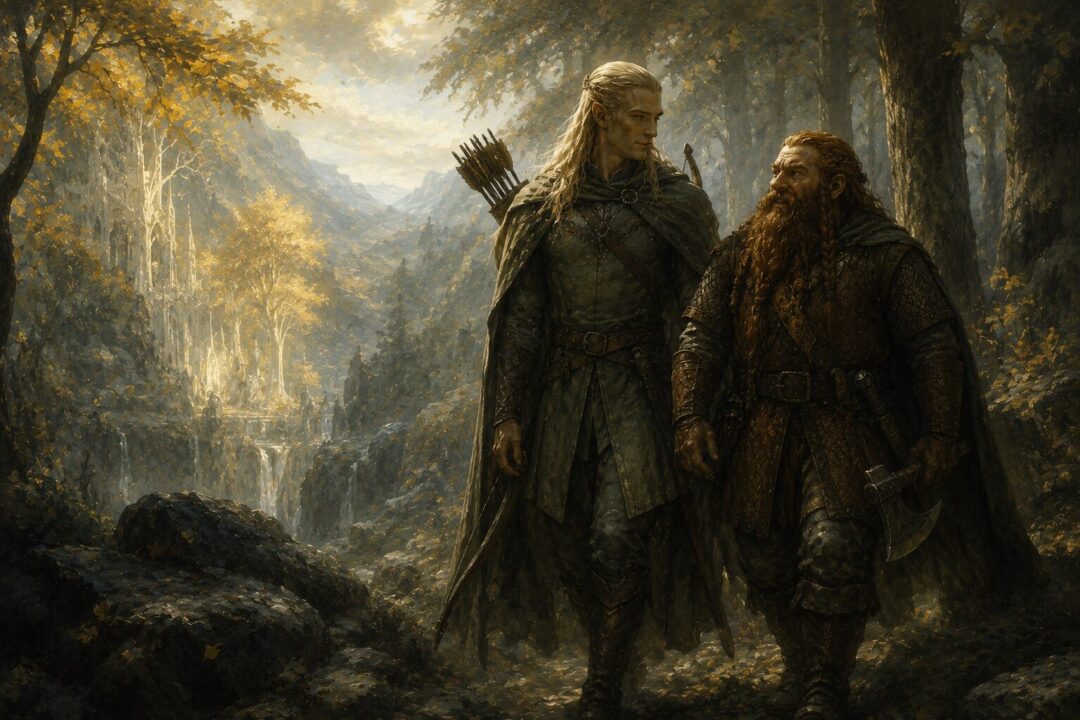
The importance of the gift becomes even clearer when viewed alongside Gimli's friendship with Legolas.
At the beginning of the quest, centuries of inherited suspicion separate Elf and Dwarf.
By its conclusion, they have become inseparable companions.
Their friendship outlives the War of the Ring and becomes one of the greatest reconciliations in the history of the Free Peoples.
Galadriel's kindness stands near the beginning of that transformation.
Her willingness to honor Gimli helps establish the mutual respect that later blossoms between him and Legolas.
No single moment erases ancient grievances.
Instead, healing begins through countless acts of trust freely offered.
Why This Moment Still Resonates
The episode is remembered because it overturns every expectation.
The mighty Fëanor could not receive what the humble Gimli did.
The ancient divisions between Elf and Dwarf briefly disappear.
A priceless treasure becomes meaningful not because of rarity, but because it is freely bestowed.
The reversal is almost perfect.
One request came from someone history remembers for extraordinary genius, yet also consuming pride.
The other came from someone who believed himself unworthy even to ask.
Only the second received the gift.
That pattern appears repeatedly throughout The Lord of the Rings. Hobbits succeed where great warriors fail. Mercy proves stronger than vengeance. Renunciation triumphs over domination.
Galadriel's three strands of hair belong to that same moral pattern.
They reverse an ancient insult not by humiliating Fëanor after the fact, but by revealing the deeper principle that had always governed the gift. Beauty could never be earned through greatness alone. It could only be received through humility, respect, and freely given grace.
In just a few sentences, Tolkien transforms a simple exchange into the quiet resolution of a story that had begun thousands of years earlier. The gift is not only for Gimli. It is a reminder that even in a world scarred by pride, oath, and ancient enmity, the oldest wounds can begin to heal through generosity that expects nothing in return.
Sources & Notes
- J.R.R. Tolkien, The Fellowship of the Ring, Book II, Chapter 8, Farewell to Lorien. https://tolkiengateway.net/wiki/Farewell_to_L%C3%B3rien
- Tolkien Gateway character overview for Gimli. https://tolkiengateway.net/wiki/Gimli
- Tolkien Gateway character overview for Galadriel. https://tolkiengateway.net/wiki/Galadriel
Sources added.