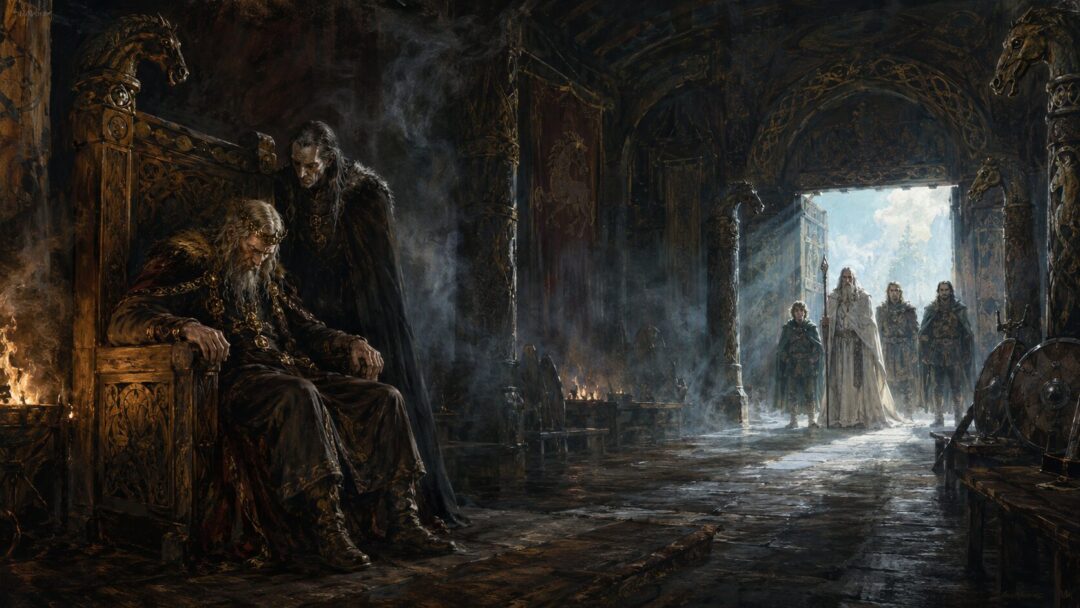
In Meduseld, the old king of Rohan seems almost already buried.
Théoden sits in the Golden Hall, bent with age, dimmed by grief, and surrounded by the language of defeat. His son Théodred is dead. His nephew Éomer has been imprisoned. His sword Herugrim is no longer at his side but hidden away under Gríma Wormtongue’s control. Outside, Saruman’s war is closing around the Riddermark. Inside, the king has been taught to believe that weariness is wisdom.
That is why Théoden’s healing is easy to misunderstand.
It is tempting to imagine the scene as a simple magical exorcism: Gandalf arrives, breaks Saruman’s spell, and the true king instantly returns. But in the book, the moment is stranger, quieter, and more human than that. Gandalf does not merely drive out an invading power. He exposes a false world that has been built around Théoden — word by word, fear by fear, delay by delay — and gives the king the chance to stand inside the truth again.
Théoden is healed. But the healing is not only medical, magical, or political. It is the restoration of judgment, courage, memory, and kingship.
The Hall Was Sick Before the King Stood Up
The first sign that something is wrong in Edoras is not Théoden’s body. It is the atmosphere of his court.
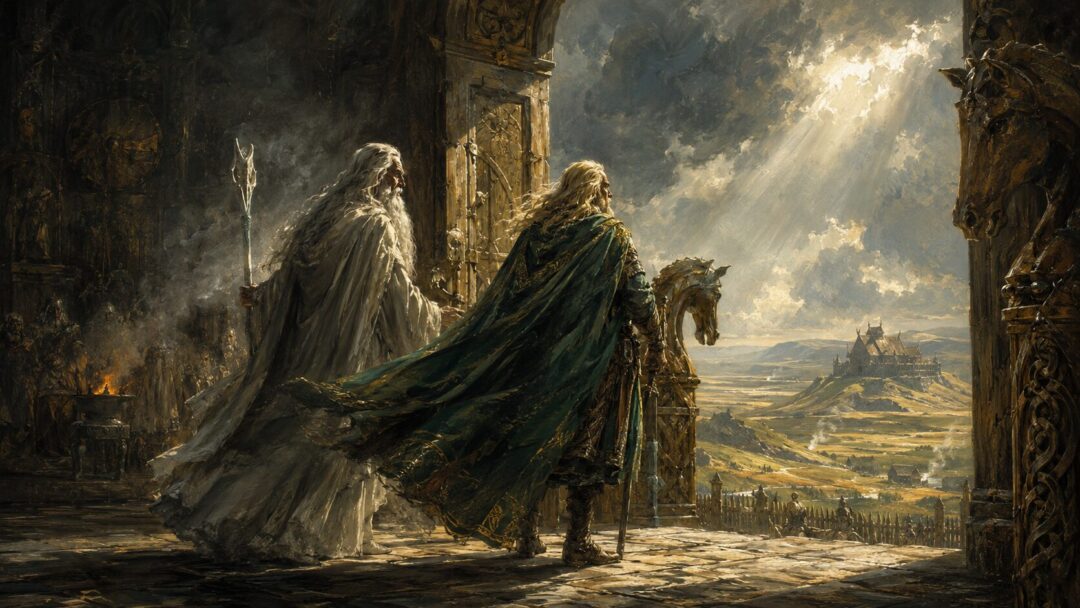
Meduseld should be the heart of Rohan: a hall of memory, lineage, hospitality, and royal command. Yet when Gandalf, Aragorn, Legolas, and Gimli arrive, everything is defensive and diminished. Weapons must be left at the door. Guards speak carefully. The king’s counsellor seems to stand between every visitor and Théoden himself.
Gríma’s power is not shown as open conquest. He has not seized the throne with soldiers. He has captured access.
That detail matters. Saruman’s assault on Rohan is partly military, but his deepest attack on Théoden is administrative and psychological. The king is isolated from faithful counsel. Éomer, one of Rohan’s strongest defenders, is accused and imprisoned. Théoden’s own sword is withheld. The hall still looks like a king’s hall, but its lines of loyalty have been quietly rewired.
Tolkien Gateway summarizes the scene by noting that Gandalf freed Théoden from despair and Wormtongue’s wicked influence, after which Éomer was released and Herugrim was recovered from Wormtongue’s locked chest. That sequence is important because the healing is immediately followed by political repair. Théoden’s mind, his household, his kinship bonds, and his war leadership all begin to return together.
This is not just a man waking from enchantment. It is a kingdom remembering who its king is.
Wormtongue’s Weapon Was Counsel
Gríma’s name makes the danger obvious, but his method is subtle. He does not need to shout. He counsels.
He turns caution into paralysis. He makes resistance sound reckless. He frames loyalty as disobedience. He encourages Théoden to see Gandalf as a bearer of trouble rather than hope. He also appears to have deepened Théoden’s physical decline through “remedies” or poisons, a detail supported in lore summaries drawing on the primary text and related material.
But even here, the crucial word is not simply “poison.” It is “words.”
Saruman’s own greatest power is famously connected with speech. His voice can persuade, soften suspicion, flatter pride, and make surrender feel reasonable. The Encyclopedia of Arda describes Saruman’s voice as an extraordinary power of persuasion, most effective upon individuals and connected both with his deep understanding and his arts.
Encyclopedia of Arda
Gríma is not Saruman’s equal, but he functions like a lesser echo of that same corruption: the crooked voice in the king’s ear.
That is why Gandalf’s confrontation with Gríma is not incidental. Gandalf does not begin by wrestling an invisible Saruman out of Théoden’s body. He challenges the false interpreter who has trained the king to misread reality.
Gríma has made weakness sound prudent. Gandalf makes hope sound sane again.
Gandalf Does Not Replace Théoden’s Will
One of the most important things about the scene is that Gandalf does not simply puppet Théoden in the opposite direction.
He commands, rebukes, reveals, and strengthens. Yet Théoden still must answer.
When Gandalf calls him forth, Théoden is not treated as an empty shell. He is addressed as the Lord of the Mark. He is invited back into his own name. Gandalf’s power clears the air, but Théoden’s agency is not erased. The old king must stand, look outward, hear different counsel, and choose.
This is one reason the healing feels so morally different from domination. Saruman’s way is to narrow the victim’s world until only fear remains. Gandalf’s way is to widen the world again. He brings light, weather, movement, memory, and news from beyond the suffocating chamber of Wormtongue’s advice.
The symbolic direction is striking. Théoden is drawn from the inner hall toward the open air. He sees the land. He feels the change. The king who had been trapped in inward decay is turned outward toward his people and his duty.
If this were only a spell removed, the deeper question would be technical: what magic did Gandalf use? But the book presses a larger question: what does a ruler become when the truth has been kept from him, and what must return before he can rule again?
The answer is not strength alone. Théoden needs truthful counsel, restored bonds, the courage to act, and the humility to admit that he has trusted wrongly.
Herugrim Matters Because Kingship Is Embodied
After Théoden is restored, his sword matters enormously.
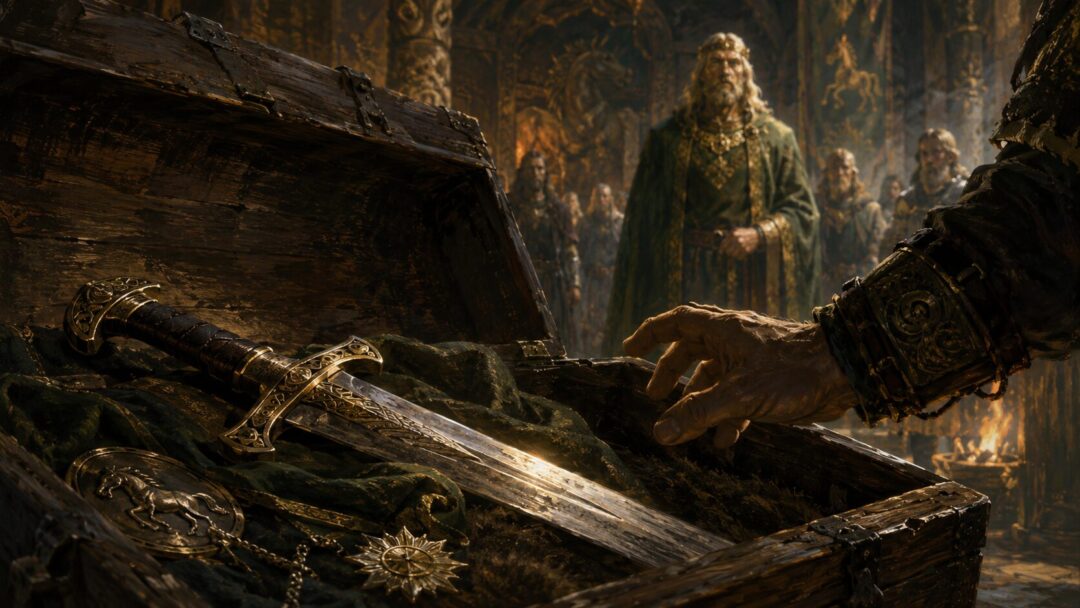
Herugrim is not just a weapon. It is a visible sign that Théoden’s kingship had been taken from him piece by piece. A king of the Rohirrim without his sword is not merely disarmed; he is symbolically severed from the martial duty of his house. The fact that Herugrim is found in Wormtongue’s possession reveals how far the corruption had reached.
Lore summaries consistently place the recovery of Herugrim immediately after the healing of Théoden, with the sword having been kept under Gríma’s control. The point is not that the sword magically heals him. The point is that healing must become visible in action.
Théoden stands. Théoden judges Gríma. Théoden releases Éomer. Théoden takes up his sword. Théoden rides.
Each step reverses one layer of the corruption. He had been seated; now he rises. He had been misled; now he judges. His kin had been divided; now Éomer is restored. His sword had been hidden; now it returns to his hand. His kingdom had been waiting; now it moves.
This is why the scene has such force. The restoration of Théoden is not private therapy. It is a public reordering of Rohan.
Mercy Is Part of the Healing Too
Théoden’s treatment of Gríma is one of the most revealing parts of the episode.
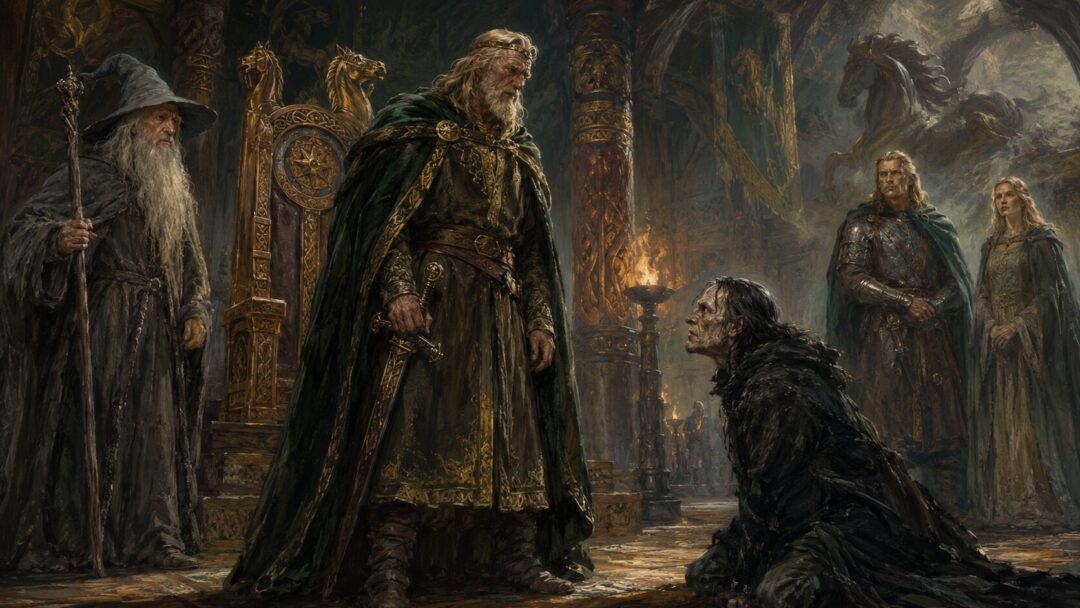
Once exposed, Gríma is not simply executed on the spot. Théoden gives him a choice: prove loyalty in battle or leave. That mercy is not softness. It is a sign that Théoden is again capable of royal judgment rather than reactive rage.
This matters because anger would be understandable. Gríma has endangered the king, helped estrange him from loyal kin, and served Saruman’s designs. Yet Théoden’s first restored act is not blind vengeance. He does what kings in Middle-earth are often tested by: he judges, but he does not become cruel.
The choice also reveals Gríma’s heart. When given the chance to repent through service, he rejects it. Théoden’s mercy does not save him, but it shows that Théoden’s recovery is not merely a return of energy. It is a return of moral proportion.
The opposite of Wormtongue’s corruption is not brutality. It is clear sight.
Théoden Ednew: Renewed, Not Replaced
After the Battle of the Hornburg, Théoden becomes known as Théoden Ednew, the Renewed. Tolkien Gateway notes that this name is connected with his throwing off the yoke of Saruman. The word “renewed” is crucial.
Théoden does not become a young man again. He is not transformed into someone untouched by grief. Théodred is still dead. Rohan is still in danger. Saruman’s armies still march. Later, Théoden will ride to the Pelennor Fields and die there.
So what was healed?
Not mortality. Not age. Not all sorrow.
What returns is the king’s ability to spend what remains of his life rightly.
Before Gandalf’s coming, Théoden is alive but withheld from action. Afterward, he is still doomed to die someday, but he can choose the meaning of his final days. That is one of the most deeply Tolkienian aspects of the scene: healing does not always mean escape from death. Sometimes it means being freed to meet death with honor.
The tragedy of Théoden is not removed. It is transfigured.
Saruman’s Failure Was That He Misread Men
Saruman’s strategy against Rohan depends on a cold assumption: if Théoden can be isolated, shamed, weakened, and surrounded by defeatist counsel, the kingdom will become useless. In practical terms, the plan nearly works. Gríma helps weaken the king and estrange him from faithful allies, giving Saruman space to build his threat against Rohan.
But Saruman misjudges something.
He understands fear, ambition, resentment, and delay. He understands how to make words serve domination. What he does not understand is renewal — the possibility that a weary man, once shown the truth, may choose courage even late in life.
That is why Gandalf’s arrival is so dangerous to him. Gandalf does not bring an army into Meduseld. He brings revelation. He breaks the enclosed system of lies. He reminds Théoden that the world is larger than Wormtongue’s whisper and that despair is not the same as wisdom.
The healing of Théoden is therefore one of the great anti-Saruman moments in The Lord of the Rings. Saruman corrupts by making surrender sound intelligent. Gandalf heals by making courage visible again.
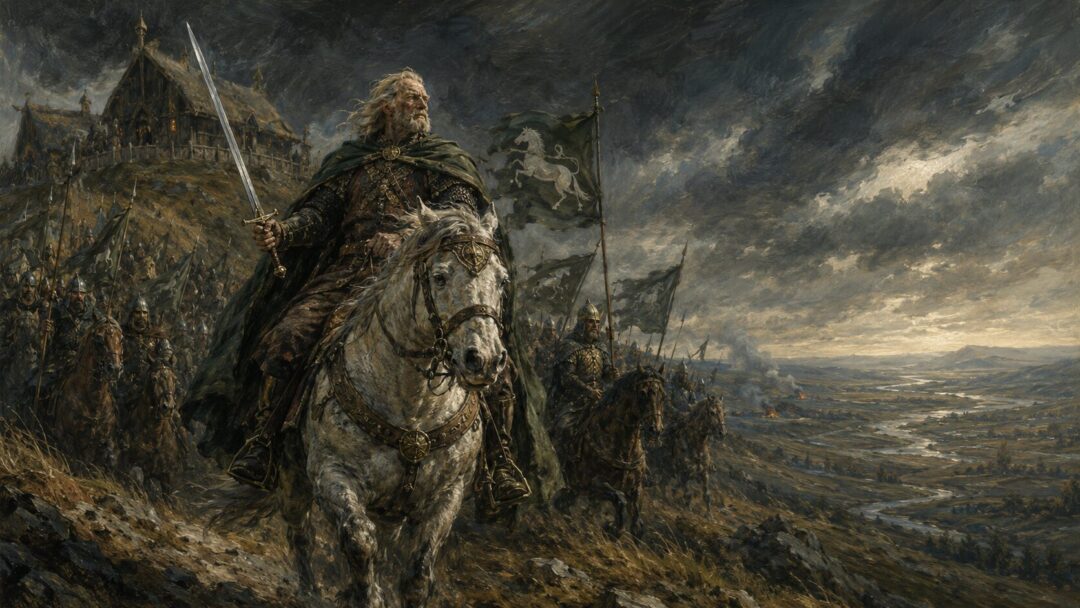
The Spell Was Real, But Not Simple
Was there a spell on Théoden?
The safest answer is: the text presents a real dark influence, but not a simple possession scene. Saruman’s power, Gríma’s counsel, possible poisoning, age, grief, and despair all work together. Gandalf’s intervention is certainly more than ordinary conversation, but the book does not reduce Théoden’s condition to a single removable enchantment.
That is what makes the scene richer.
If Théoden were merely possessed, his restoration would be mostly Gandalf’s victory. But because Théoden has been weakened through counsel, grief, isolation, and fear, his healing also becomes Théoden’s own return. Gandalf opens the prison door. Théoden still walks out.
And when he does, Rohan changes.
The old king who had sat in shadow becomes the rider who leads his people west, survives Helm’s Deep, rejects Saruman’s later voice, befriends Merry, answers Gondor’s call, and dies on the Pelennor with his honor restored. None of that is possible if the healing in Meduseld is only a magical correction.
It is the moment when a king is given back his last freedom: not to live forever, not to undo his losses, but to choose courage before the end.
Sources & Notes
- J.R.R. Tolkien, The Two Towers, Book III, Chapter 6, The King of the Golden Hall. https://tolkiengateway.net/wiki/The_King_of_the_Golden_Hall
- Tolkien Gateway character overview for Theoden. https://tolkiengateway.net/wiki/Th%C3%A9oden
- Tolkien Gateway character overview for Grima Wormtongue. https://tolkiengateway.net/wiki/Gr%C3%ADma_Wormtongue
Sources added.