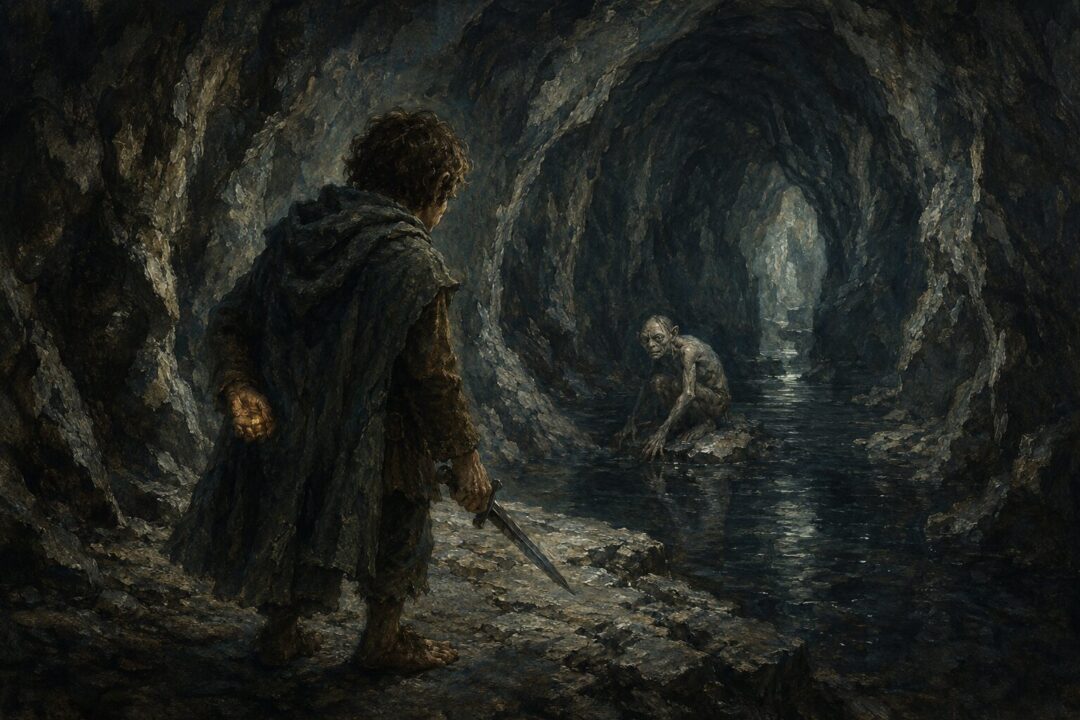
When Frodo first learns what Bilbo’s ring truly is, one of his earliest reactions is not wonder, but fear. The small golden thing in his keeping is no harmless heirloom from the goblin tunnels. It is the One Ring, made by Sauron, lost for ages, and now somehow lying in the Shire. And at the edge of that discovery stands another figure Frodo wishes had simply vanished from the story: Gollum.
Frodo’s thought is brutally understandable. If Bilbo had killed Gollum when he had the chance, perhaps the danger would be smaller. Perhaps the Ring would not have been followed. Perhaps Sauron would not have learned the words “Shire” and “Baggins.” But Gandalf refuses that logic. He does not deny Gollum’s wickedness. He does not pretend that Gollum is safe, innocent, or trustworthy. Instead, he argues that Bilbo’s pity was not weakness. It was mercy — and it may yet govern the fate of many.
That sounds like a moral answer. It is. But it is also one of the wisest strategic judgments in The Lord of the Rings.
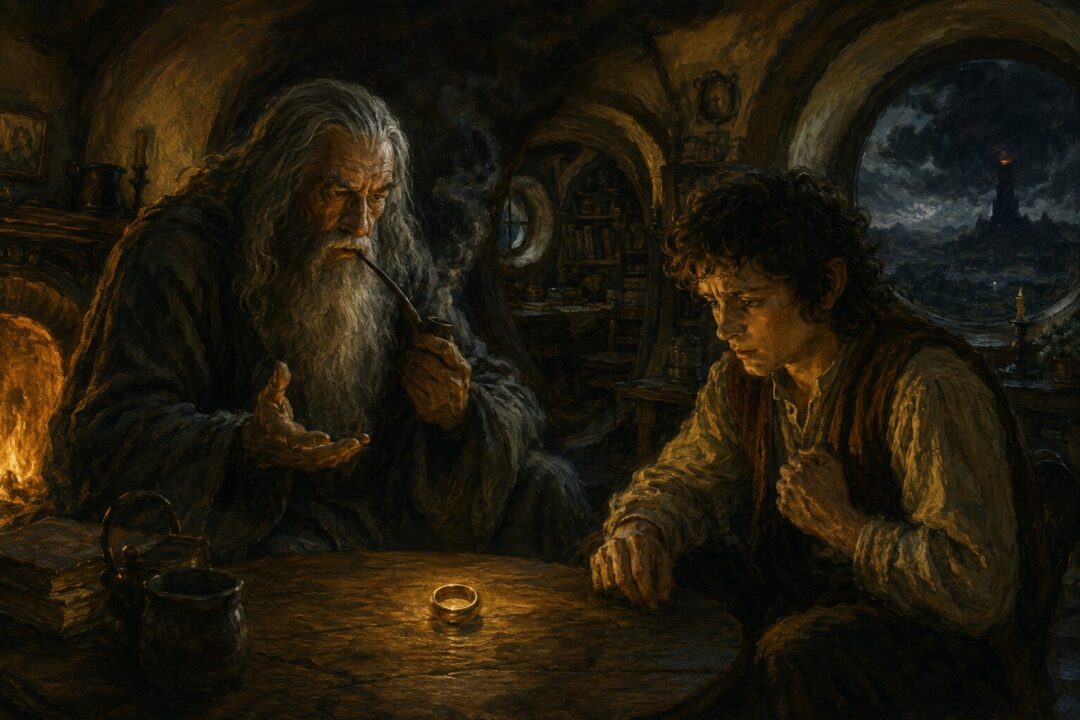
Gandalf Does Not Confuse Mercy With Naivety
Gandalf’s argument is sometimes softened into a simple lesson about being kind. But in the book, it is sharper than that. Gandalf knows more about Gollum than almost anyone alive. He has investigated him, questioned him, traced his history, and learned enough to understand both his misery and his danger.
He knows that Sméagol murdered Déagol for the Ring. He knows that Gollum became a creature of secrets, malice, hunger, and long corruption. He knows that Gollum later went toward Mordor and was captured there. He knows that Sauron has learned dangerous information from him. Gandalf is not defending Gollum because he has misread him.
That is what makes the argument powerful. Gandalf’s mercy is not based on ignorance. It is based on limits. Even the wise cannot see all ends. That line is not a sentimental excuse; it is a strategic principle. In Middle-earth, the future is not a machine that even the greatest minds can calculate perfectly. A living creature, even a ruined one, may still become part of events in ways no planner can foresee.
Gandalf does not say Gollum will certainly do good. He says Gollum has some part to play, “for good or ill.” That is a very careful claim. It leaves room for danger. It leaves room for betrayal. But it also refuses the false certainty that killing him would automatically produce a better world.
The Ring Cannot Be Defeated by Ring-Like Thinking
The One Ring is not merely a weapon. It is a temptation to dominate, possess, and bend the world to one will. Those who imagine they can use it for good are already stepping into its logic. Gandalf understands this better than most. He refuses the Ring when Frodo offers it to him because he knows that his desire to do good would become terrible through it.
The same pattern appears, in a smaller but crucial way, in the question of Gollum. Frodo sees a dangerous creature and imagines a clean solution: remove him. Kill him. End the risk. That response is not the same as claiming the Ring, but it belongs to a similar moral landscape. It assumes that the future can be made safe through final judgment over another life.
Gandalf’s answer cuts against that impulse. He does not say justice is meaningless. He says Frodo does not have the power to restore life to those who deserve it, and therefore should be slow to deal death in judgment. In strategic terms, this means the Free Peoples cannot defeat Sauron by becoming a smaller version of Sauron. If their war becomes only calculation, disposal, and domination, then the Shadow has already shaped their hearts.
The mission to destroy the Ring depends on a kind of resistance that is deeper than military strength. It depends on refusing the Ring’s worldview.
Bilbo’s Pity Preserves Frodo’s Path
Bilbo’s choice in the dark under the Misty Mountains is the first great turning point. He has the Ring. Gollum is vulnerable. Bilbo could kill him and escape. Instead, seeing Gollum’s misery, he leaps over him and runs.
That act matters immediately because Bilbo leaves the tunnels without beginning his possession of the Ring with murder. This is not a small detail. The Ring came to Sméagol through murder, and his corruption deepened around that crime. Bilbo’s ownership begins differently. He has already lied about the Ring in the earlier version of his tale, and the Ring does begin to work on him; but his pity keeps one door closed. He is not innocent of temptation, but he is not another Sméagol.
That difference later matters to Frodo. Frodo inherits not only the Ring, but the moral consequences surrounding it. Bilbo’s mercy becomes part of the story Frodo receives. Gandalf’s argument plants the seed that Gollum is not only an enemy but also a warning, a victim of the Ring, and perhaps a strange instrument of providence.
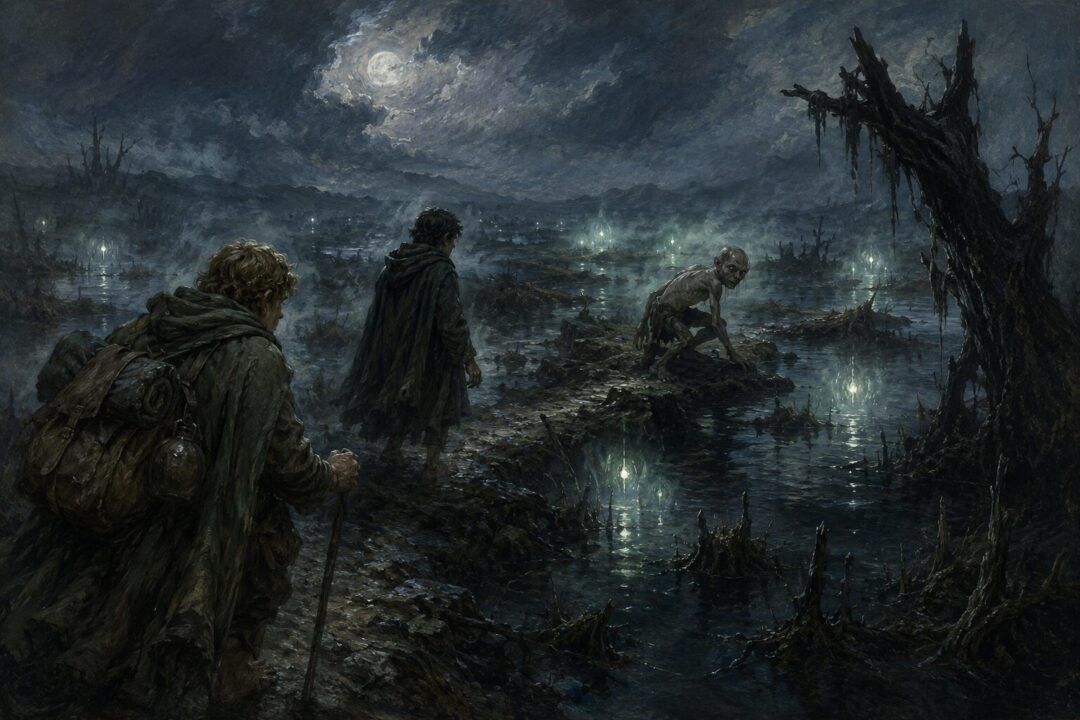
When Frodo finally sees Gollum for himself in the Emyn Muil, pity becomes possible. He remembers Gandalf’s words. He does not kill Gollum. He tames him, binds him by oath, and uses him as a guide. Without that choice, Frodo and Sam would almost certainly have failed to find their way through the Dead Marshes and toward the secret stair above Minas Morgul. The texts never present Gollum as safe, but they do show that his knowledge becomes practically indispensable.
Mercy does not remove danger. It opens a road that no map had provided.
Gollum Is Both Threat and Necessary Guide
From a purely tactical view, Gollum is a disaster. He is treacherous, addicted to the Ring, and divided against himself. He leads Frodo and Sam toward Shelob. He repeatedly endangers them. Sam’s distrust of him is not foolish; it is often justified.
Yet the darker irony is that the Quest needs someone like Gollum. Not because he is noble, but because he knows the paths of darkness. He knows the Marshes. He knows the approaches to Mordor. He knows the secret stair and the tunnel. His corrupted life has made him a guide through corrupted lands.
This is why Gandalf’s mercy becomes strategy. The West cannot storm Mordor in strength. The Council of Elrond rejects using the Ring and chooses secrecy, humility, and an almost impossible journey. In that kind of mission, overlooked creatures matter. Small choices matter. The pity shown in a cave decades earlier becomes more useful than armies at the Black Gate.
Gandalf does not plan all this in detail. That is important. He is not manipulating Gollum as a chess piece. His wisdom lies in leaving room for what he cannot command. He senses that Gollum’s story is not finished. Strategy, for Gandalf, includes humility before the unknown.
Mercy Also Protects the Merciful
Gandalf’s argument is not only about Gollum’s future usefulness. It is also about Frodo’s soul.
Frodo will have to carry the Ring into lands where pity becomes harder and harder. The burden isolates him, wounds him, and presses upon his will. If he begins the Quest by accepting that some lives are simply disposable because they are ugly, dangerous, or deservedly condemned, the Ring has easier soil to work in.
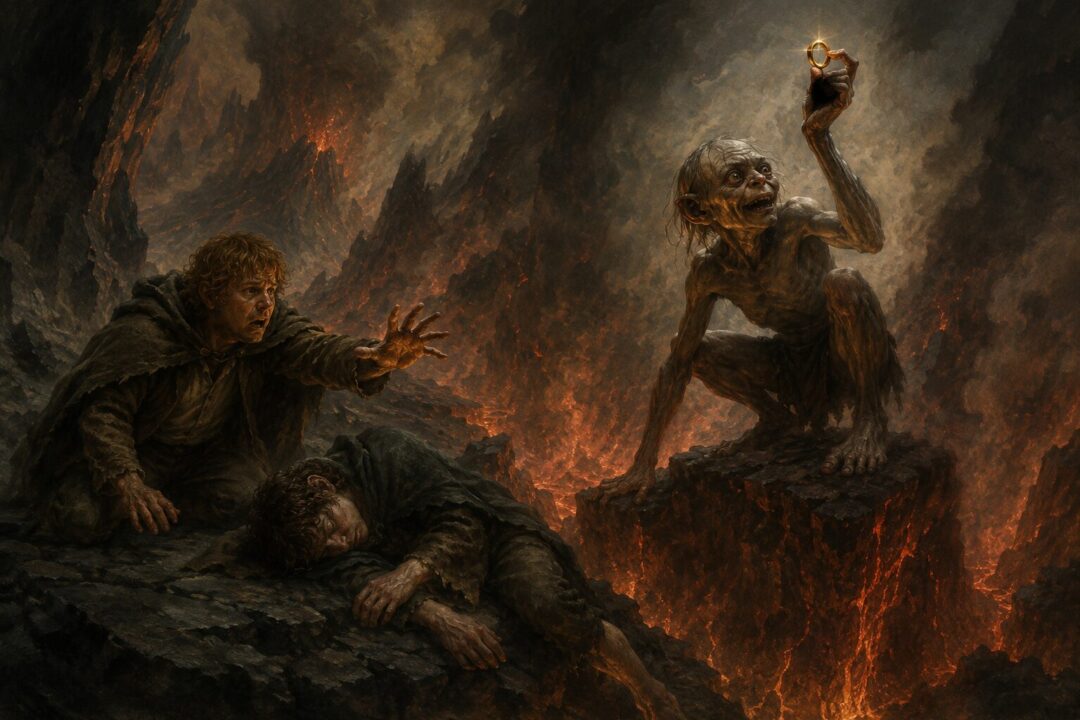
His mercy toward Gollum becomes one of the ways he remains himself. It does not make him invulnerable. At the Sammath Naur, Frodo cannot voluntarily destroy the Ring. The power brought to its own place is too great. But Frodo’s earlier mercy has created the situation in which the Quest can be completed even when Frodo’s strength fails.
This is one of the most profound ironies in the story. Frodo does not triumph at the Fire by heroic willpower alone. He is saved, in part, by the very creature he spared. Gollum attacks him, bites off the Ring, and falls with it into the fire. His act is not repentance in that moment; it is possessive madness. Yet because Gollum is there, the Ring is destroyed.
Mercy did not make Gollum good. It made possible an ending that strength could not achieve.

The Failed Chance on the Stairs
There is one especially painful moment before Shelob’s lair when Gollum appears close to change. He sees Frodo asleep, with Sam nearby, and for a brief instant his manner softens. The scene is delicate and uncertain, but the text strongly invites the reader to see a real possibility there. Gollum is not simply plotting; something like old Sméagol seems to rise near the surface.
Then Sam wakes and speaks harshly. Sam’s reaction is understandable. He has every reason to distrust Gollum, and he is exhausted, frightened, and protective of Frodo. But the moment breaks. Gollum hardens again, and the path to betrayal continues.
This scene matters because it prevents a shallow reading of Gandalf’s mercy. Mercy is not guaranteed to reform the person who receives it. It can be resisted. It can be wasted. It can be answered with treachery. But the possibility was real enough to make its loss tragic.
Gandalf’s strategy is therefore not optimism. It is hope under conditions where certainty is impossible.
Why Sauron Could Not Understand This Strategy
Sauron’s power rests on domination, fear, surveillance, and the assumption that others desire power as he does. He understands armies. He understands terror. He understands the lure of the Ring. What he does not understand is the logic of renunciation.
That is why the decision to destroy the Ring rather than wield it remains hidden from him for so long. It is also why mercy toward Gollum belongs to the same pattern of resistance. Sauron uses ruined beings. Gandalf pities them. Sauron thinks in terms of mastery. Gandalf leaves space for freedom, repentance, and unforeseen grace.
This does not mean Gandalf is passive. He labors constantly: investigating the Ring, warning Frodo, seeking counsel, opposing Saruman, guiding the Fellowship, and rallying resistance. But his action is shaped by moral boundaries. He will not seize the Ring. He will not treat every enemy as a thing to be spent. He will not pretend that wisdom means seeing all ends.
In a world threatened by absolute control, that humility becomes a weapon Sauron cannot imitate.
The Best Strategy Was Not the Safest One
Gandalf’s mercy argument was dangerous. Gollum did betray Frodo. People died because Gollum escaped captivity. Frodo and Sam suffered terribly on the road he showed them. No honest reading can turn mercy into a harmless choice.
But the safer-looking alternative may have been worse. If Bilbo had killed Gollum, Bilbo himself might have been spiritually darkened at the beginning of his possession of the Ring. Frodo might never have learned pity in the same way. The Quest might have lacked its miserable guide. And at the last moment, when Frodo could not cast the Ring away, no one would have been there to bring the terrible pattern to its end.
The deep strategy of The Lord of the Rings is that evil is not defeated only by greater force. It is defeated by courage, endurance, friendship, secrecy, sacrifice, and mercy — including mercy that looks, for a long time, like a mistake.
Gandalf’s wisdom is not that he knows exactly what Gollum will do. It is that he knows no one else knows either. To kill Gollum would be to close a door in the dark. To spare him is to accept risk while refusing to become the judge of all ends.
That is why the pity of Bilbo becomes more than a private act of kindness. It becomes a hidden strategy running beneath the whole War of the Ring. The Ring is destroyed not by the powerful mastering every variable, but by the humble leaving room for what power cannot foresee.
Gandalf’s mercy was not the opposite of strategy. In the end, it was the only strategy deep enough for the Ring.
Sources & Notes
- Tolkien Gateway overview of Gollum and the consequences of Bilbo and Frodo sparing him. https://tolkiengateway.net/wiki/Gollum
- Tolkien Gateway summary of The Shadow of the Past, where Gandalf explains pity, mercy, and Gollum’s future part. https://tolkiengateway.net/wiki/The_Shadow_of_the_Past
- Tolkien Gateway summary of Mount Doom, where Gollum’s survival becomes decisive in the Ring’s destruction. https://tolkiengateway.net/wiki/Mount_Doom
Sources selected to support the Tolkien textual/lore context discussed in this article.