
The palantír of Orthanc is one of the most dangerous objects in Middle-earth—not because it lies, but because it reveals truth without wisdom. When Peregrin Took, curious beyond caution, steals the Stone from Gandalf and looks into it, the moment seems like the perfect example of a foolish hobbit making yet another disastrous mistake.
In isolation, it is exactly that.
Yet the consequences ripple through the final days of the War of the Ring in ways that reach far beyond Pippin himself. His reckless curiosity forces Gandalf to change his plans, draws the attention of Sauron at a critical moment, places a humble hobbit inside Minas Tirith before the siege begins, and ultimately helps preserve both Gondor's future ruler and one of its greatest captains.
The remarkable irony is that none of these outcomes erase Pippin's mistake. Instead, the story demonstrates one of Middle-earth's recurring themes: even genuine failures may become part of a greater good when courage, mercy, and faithful choices follow.

The Curiosity That Could Not Be Resisted
After the fall of Isengard, the Company discovers the palantír that had belonged to Orthanc. Gandalf immediately recognizes both its value and its danger.
Pippin does not.
Unable to sleep, and consumed by curiosity, he secretly takes the Stone while Gandalf rests. The desire is deeply in character. Throughout the journey, Pippin repeatedly acts before thinking, whether dropping a stone into the well of Moria or asking questions at unfortunate moments. His impulsiveness is neither malicious nor foolish in the sense of lacking intelligence. Rather, it reflects youthful curiosity without mature restraint.
Looking into the palantír proves far more dangerous than he could imagine.
Instead of simply seeing distant places, Pippin comes into direct contact with Sauron's searching will. The Dark Lord questions him, believing he has somehow captured the halfling connected to Saruman. Pippin survives largely because Sauron misunderstands what he sees rather than because the encounter is harmless. The experience leaves the hobbit shaken and exhausted, while Gandalf immediately realizes that events have accelerated.
Why Gandalf Changed His Plans
The immediate consequence is not punishment.
It is movement.
Gandalf decides that Pippin cannot safely remain in Rohan. More importantly, he understands that Sauron now knows at least one hobbit has been involved with Orthanc. Whatever conclusions the Enemy draws, they will influence his next decisions.
So Gandalf rides at once for Minas Tirith, bringing Pippin with him.
In the text, Gandalf even reminds Pippin that the journey is a consequence of his own actions. Yet behind the gentle rebuke lies strategic necessity. Gandalf himself also needs to reach Gondor as quickly as possible, where Denethor's leadership, the coming siege, and the defense of the city all require his presence.
Without Pippin's mistake, there is no indication Gandalf would have departed precisely as he did with that particular companion.
Sauron's Dangerous Miscalculation
One of the most fascinating aspects of the palantír episode is that Sauron receives truthful information but reaches an incorrect conclusion.
The palantíri do not fabricate visions. Their danger lies in interpretation and in the unequal struggle between minds of different strength. Sauron sees an actual hobbit.
He does not understand why.
From his perspective, Saruman had been searching for the Ring. Now a halfling appears in Orthanc's Stone. Sauron naturally assumes Saruman has somehow captured someone connected to the Ring.
That assumption contributes to one of the defining strategic mistakes of the war.
Combined with Aragorn's later decision to reveal himself openly through the same palantír, Sauron becomes increasingly convinced that his enemies intend to wield the Ring against him. Rather than imagining that anyone would seek to destroy it, he expects a rival claimant to challenge his power.
As a result, he hastens his military plans instead of patiently searching Mordor for two insignificant travelers. The texts never state that Pippin alone caused this acceleration, but his encounter forms an important part of the chain of misunderstandings that Sauron creates for himself.
An Unexpected Meeting with Denethor
When Gandalf and Pippin arrive in Minas Tirith, another consequence begins to unfold.
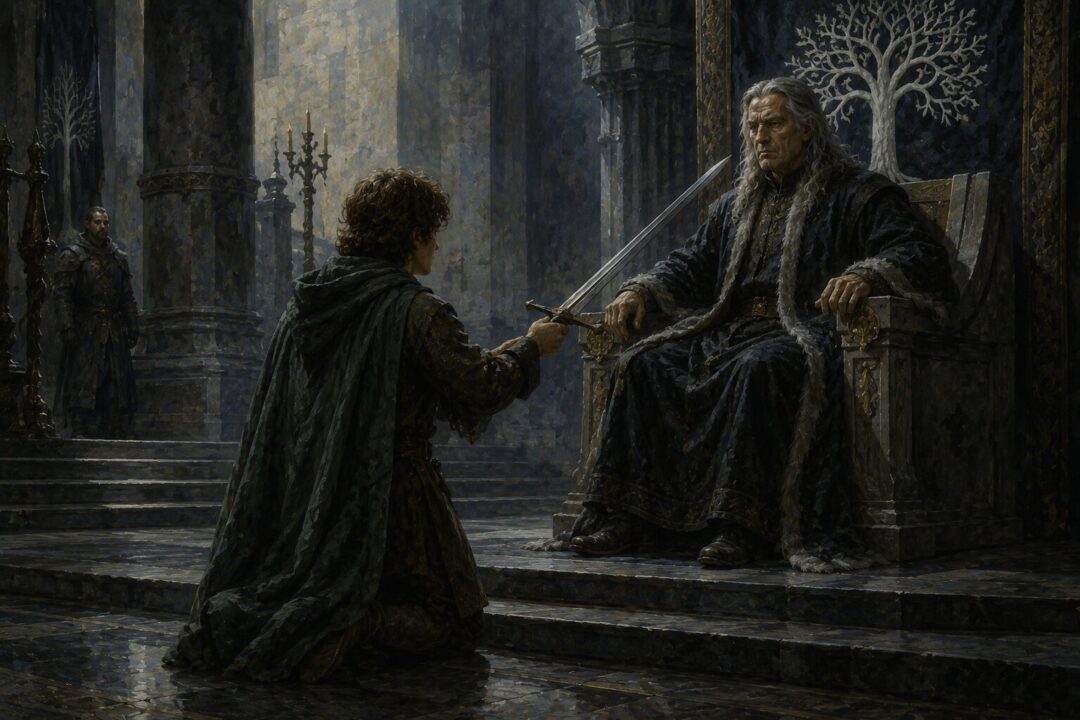
Pippin meets Denethor, Steward of Gondor.
The meeting is emotionally charged because Boromir has recently died defending Merry and Pippin. Carrying guilt over Boromir's death, Pippin freely offers his service to Denethor in repayment of a debt he feels he can never truly settle.
The oath is sincere.
It also places Pippin inside the household of Gondor's ruler during the city's darkest days.
Denethor initially appears powerful, commanding, and perceptive. Indeed, Pippin observes that the Steward seems almost more wizard-like than Gandalf at first glance. Yet beneath that dignity lies profound despair, strengthened by years of using another palantír under Sauron's influence. Denethor is not simply deceived by lies. Rather, Sauron selectively shows him truths that encourage hopelessness. The Fandomentals
Without Pippin's accidental arrival in Gondor, he would never witness what follows.
The Small Guard Who Saw What Others Missed
During the Siege of Gondor, Pippin serves among the guards of the Citadel.
His duties seem modest compared to the deeds of great captains.
Yet this humble position becomes essential.
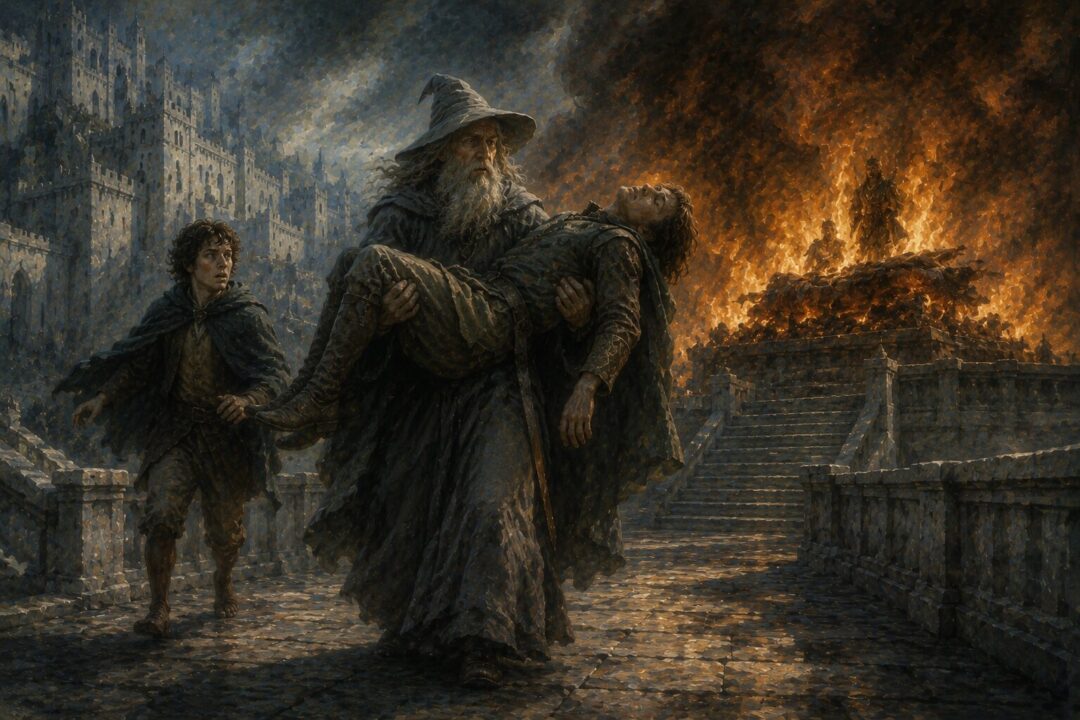
After Faramir returns from Osgiliath gravely wounded, Denethor abandons hope completely. Believing both the war and his son's life lost, he resolves to die on a funeral pyre while burning Faramir beside him.
Many within the city either obey the Steward automatically or hesitate to oppose him.
Pippin does not.
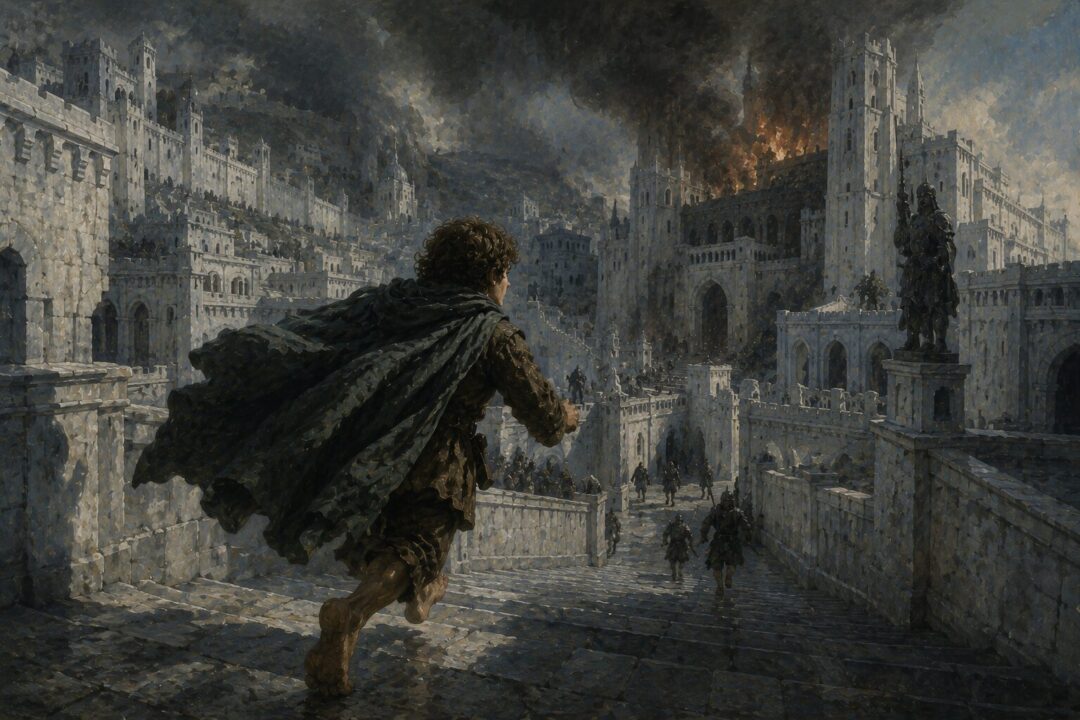
He recognizes that something is terribly wrong and refuses to accept that this is the proper course.
His first instinct is not heroism but help.
He runs to find Gandalf.
That decision saves Faramir's life.
Why Saving Faramir Meant Saving Gondor
It is difficult to overstate how significant Faramir's survival becomes.
Had Pippin remained elsewhere, Gandalf might never have learned of Denethor's intentions before it was too late.
The rescue comes at the last possible moment. Denethor dies by his own choice, but Faramir is carried from the House of the Stewards alive.
This matters for far more than one man's survival.
After the War of the Ring, Faramir becomes Steward under the restored kingship of Aragorn. He governs Ithilien, marries Éowyn, and represents the renewal of Gondor after generations of decline.
Unlike Boromir, whose strength often leaned toward martial glory, Faramir consistently demonstrates wisdom, restraint, and resistance to temptation. Earlier in the story he famously refuses to seize the One Ring even after discovering Frodo's mission.
Preserving such a leader becomes one of the quiet victories that make the Fourth Age possible.
Pippin never intended any of this.
His mistake merely placed him where only he could recognize the danger in time.
The Pattern Hidden Throughout Middle-earth
This episode fits a broader pattern woven throughout the history of Middle-earth.
Small actions often reshape great events.
Bilbo's pity for Gollum appears insignificant until it becomes essential decades later.
Sam's decision to spare Gollum after harsh words preserves the possibility of the Ring's destruction.
Merry's presence beside Théoden allows Éowyn to strike the Witch-king.
Likewise, Pippin's curiosity appears to create only disaster.
Instead, it becomes one link in a chain that no strategist could have designed.
This does not mean recklessness is secretly desirable. The narrative never praises Pippin for stealing the palantír. Gandalf rightly rebukes him, and the danger is entirely real.
Rather, the story repeatedly shows that providence may work through flawed people without excusing their flaws.
The mistake remains a mistake.
Its consequences are redeemed by faithful choices that follow.
Pippin's Growth Matters as Much as the Strategy
Perhaps the greatest transformation is not military at all.
The Pippin who peers into the palantír acts out of unchecked curiosity.
The Pippin who serves Denethor accepts responsibility.
The Pippin who races through Minas Tirith to find Gandalf risks everything for someone else.
These are not the actions of the carefree young Took who left the Shire.
They are the choices of someone who has learned that courage is often quieter than charging into battle.
By the time the War ends, Pippin has become a knight of Gondor, later returns to defend the Shire during the Battle of Bywater, and ultimately serves his own people with maturity that seemed almost unimaginable at the beginning of the journey.
His worst mistake becomes the turning point from which much of that growth begins.
A Failure That Became Part of Victory
Pippin's encounter with the palantír stands among the clearest examples of how Middle-earth treats failure.
The act itself is reckless.
It exposes him directly to Sauron.
It forces Gandalf to react.
It accelerates events that could easily have ended in catastrophe.
Yet because Gandalf responds wisely, because Sauron interprets truth incorrectly, because Pippin later chooses duty over fear, and because he refuses to ignore Denethor's madness, the consequences become astonishingly different from what anyone expected.
Gondor does not survive because Pippin made a good decision.
It survives in part because, after making a terrible one, he keeps choosing better ones.
That distinction lies at the heart of the story. Great victories in Middle-earth rarely belong to perfect heroes. More often they belong to ordinary people who stumble, repent, remain faithful, and discover that even their failures need not have the final word.
Sources & Notes
- Wikipedia overview of Peregrin Took and the palantír incident — https://en.wikipedia.org/wiki/Peregrin_Took
- Wikipedia overview of palantíri and Sauron’s mistaken assumptions — https://en.wikipedia.org/wiki/Palant%C3%ADr
- Wikipedia overview of Minas Tirith and Gondor during the War of the Ring — https://en.wikipedia.org/wiki/Minas_Tirith
Sources selected for Tolkien-lore context and reader verification.