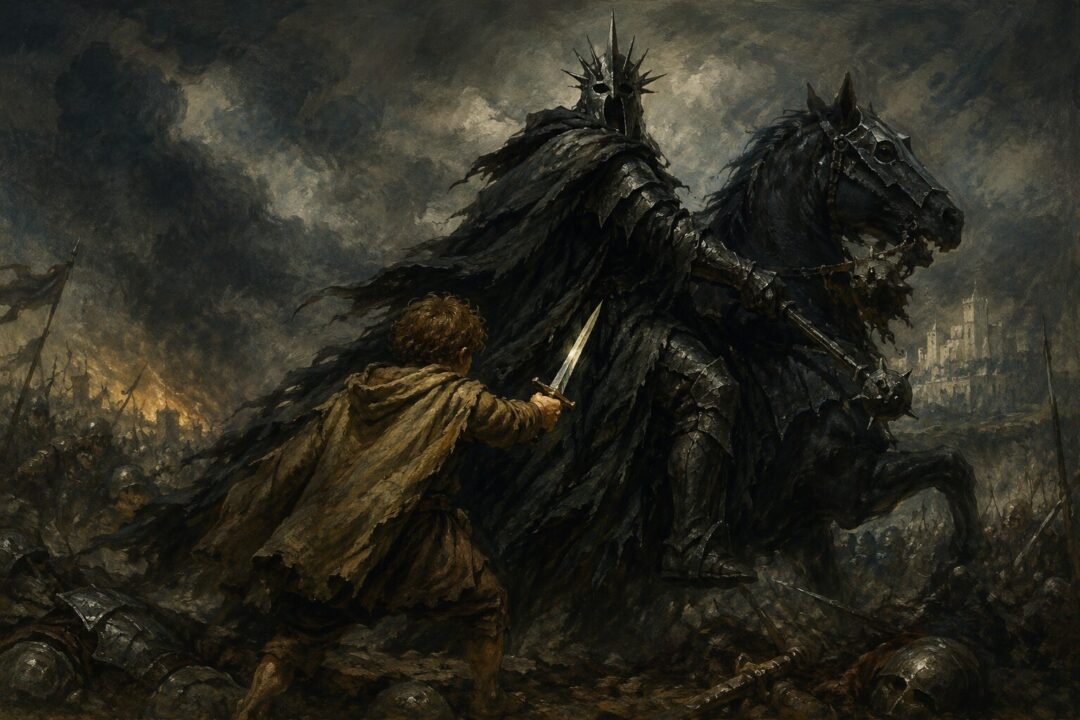
Few moments in The Lord of the Rings feel as impossible as the fall of the Witch-king of Angmar. Before the gates of Minas Tirith, the Lord of the Nazgûl rides beneath a sky darkened by war, breaks the courage of hardened warriors, and even causes Gandalf's horse to recoil in fear. Ancient prophecy has long surrounded him: "not by the hand of man will he fall."
Then, at the turning point of the Battle of the Pelennor Fields, a hobbit with a short sword strikes him from behind.
At first glance, Merry Brandybuck's blow appears almost insignificant compared to Éowyn's final strike. Yet Tolkien's text makes clear that Merry's attack was not merely brave—it was essential. His blade accomplished something that ordinary weapons could not. It weakened the Witch-king in a unique way, making his destruction possible.
The deeper story is not about chance. It is about ancient craftsmanship, forgotten kingdoms, and the long reach of history into the greatest battles of the Third Age.
The Witch-king Was More Than a Powerful Warrior
Understanding Merry's blade begins with understanding the enemy it faced.
The Witch-king was the chief of the Nine Ringwraiths, once a mortal king who had fallen completely under the domination of Sauron through one of the Nine Rings. By the end of the Third Age, he had become something far stranger than a living man.
The texts deliberately leave aspects of the Nazgûl's existence mysterious. They possess visible forms only when clothed and armed, yet their true being exists partly in the unseen world. Their power inspires overwhelming fear, and ordinary weapons often seem ineffective against them.
This explains why confronting the Witch-king was never simply a contest of strength.
Even mighty captains hesitated before him. Théoden's guard scattered. Experienced warriors faltered. His supernatural presence itself functioned as a weapon.
Destroying such a being required more than courage alone.
An Ordinary Sword Would Not Have Been Enough
The key detail appears immediately after Merry strikes.
The narrative explains that the blade broke as it pierced the sinew behind the Witch-king's knee, but it also adds a remarkable explanation. This was no ordinary dagger. It had been forged long before by the Men of Westernesse, specifically for use against the realm of Angmar.
The passage states that the weapon had been made with spells for the downfall of Mordor's enemy, and that because of this its work was fulfilled.
This is one of the clearest examples in Tolkien's legendarium of a weapon possessing a purpose beyond simple craftsmanship.
Unlike enchanted weapons in many fantasy settings, Tolkien rarely presents magic as flashy or mechanically explained. Instead, extraordinary objects often carry the wisdom, intention, and spiritual authority of those who created them.
Merry's sword belongs to this tradition.
The Forgotten War That Prepared the Blade
To understand why the blade mattered, it helps to look back nearly a thousand years before the War of the Ring.
After the fall of Arnor, the Witch-king established the kingdom of Angmar in the north. For centuries he waged relentless war against the Dúnedain, slowly destroying their divided kingdoms.
The Men of Arnor learned their enemy through bitter experience.
They faced his armies repeatedly. They watched his sorcery devastate their lands. They endured generations of conflict specifically against the Witch-king himself.
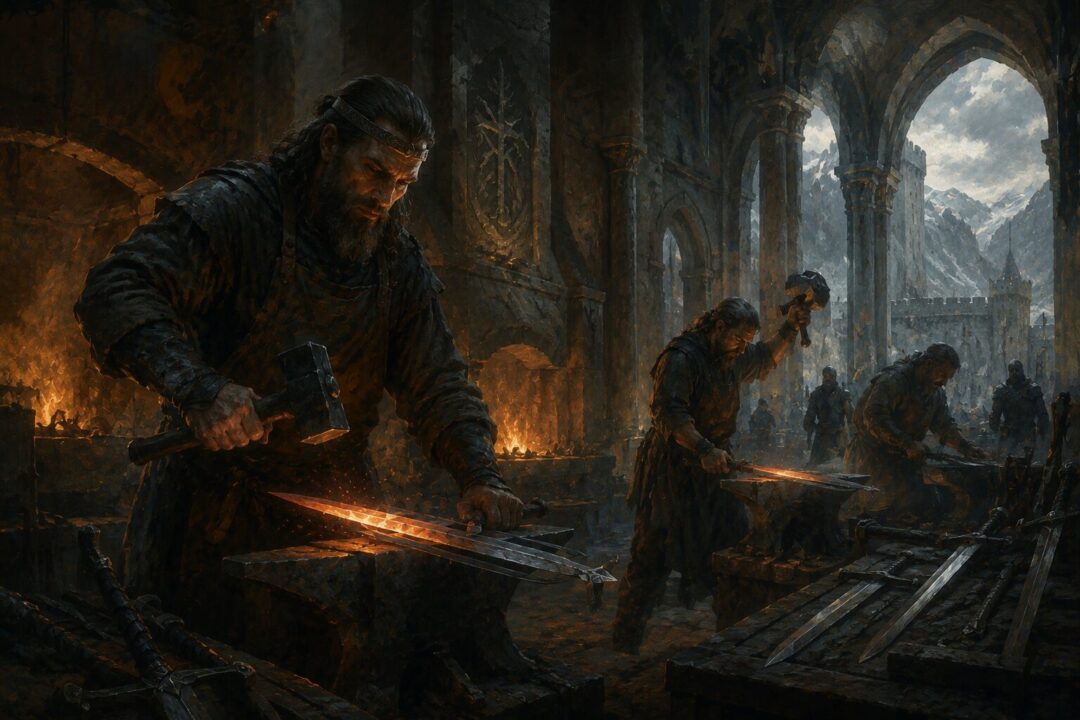
During these wars, smiths of Westernesse forged weapons intended to oppose Angmar's dark ruler.
Tolkien never explains precisely how these blades were made or exactly what "spells" were laid upon them. The texts remain intentionally restrained. What they do establish is that the weapons were crafted with knowledge of this specific enemy.
That detail matters enormously.
The blade was not simply ancient.
It was purpose-built.
How Merry Received the Blade
Merry did not seek out a legendary weapon.
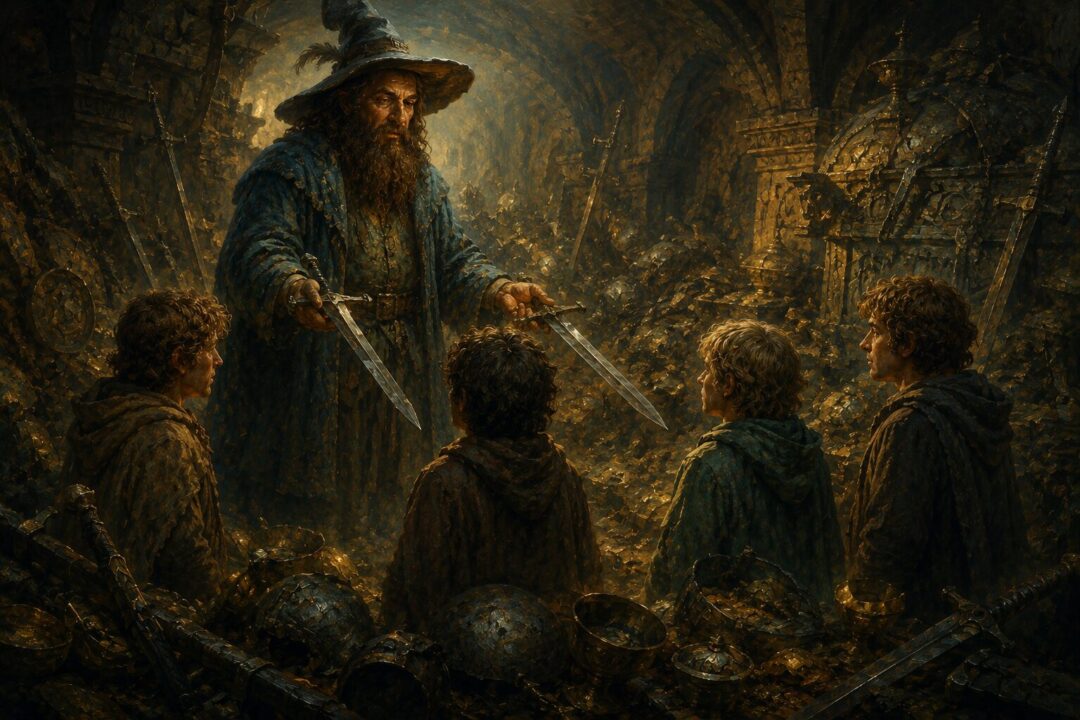
After leaving the Barrow-downs, the hobbits were rescued by Tom Bombadil. Inside the burial mounds they found treasures left from the lost kingdom of Cardolan, one of Arnor's successor realms.
Bombadil gave each hobbit a sword recovered from those ancient graves.
Only much later does the reader discover their true significance.
For most of the story they appear to be little more than well-made short swords suitable for hobbits.
Their hidden history mirrors one of Tolkien's recurring themes: objects from forgotten ages often carry consequences far beyond what later generations realize.
Merry carried precisely the right weapon for months without understanding why.
What Merry's Strike Actually Did
A common misconception is that Merry killed the Witch-king.
The text does not support that reading.
Instead, Tolkien describes Merry's blow as breaking the spell that held together the Nazgûl's unseen sinews.
This wording is unusually important.
The strike appears to disrupt the supernatural force sustaining the Witch-king's physical form. Rather than simply causing physical injury, the blade damages the very condition that allows the Ringwraith to exist and fight in the visible world.
Immediately afterward, Merry himself experiences an unnatural numbness, and the sword disintegrates.
Its work is complete.
Without this disruption, Éowyn's following strike would almost certainly have faced a very different opponent.
Why Éowyn's Victory and Merry's Strike Cannot Be Separated
Readers sometimes debate who truly defeated the Witch-king.
The text does not encourage competition between the two heroes.
Instead, it presents a partnership.
Merry provides the crucial opening.
Éowyn delivers the decisive blow.
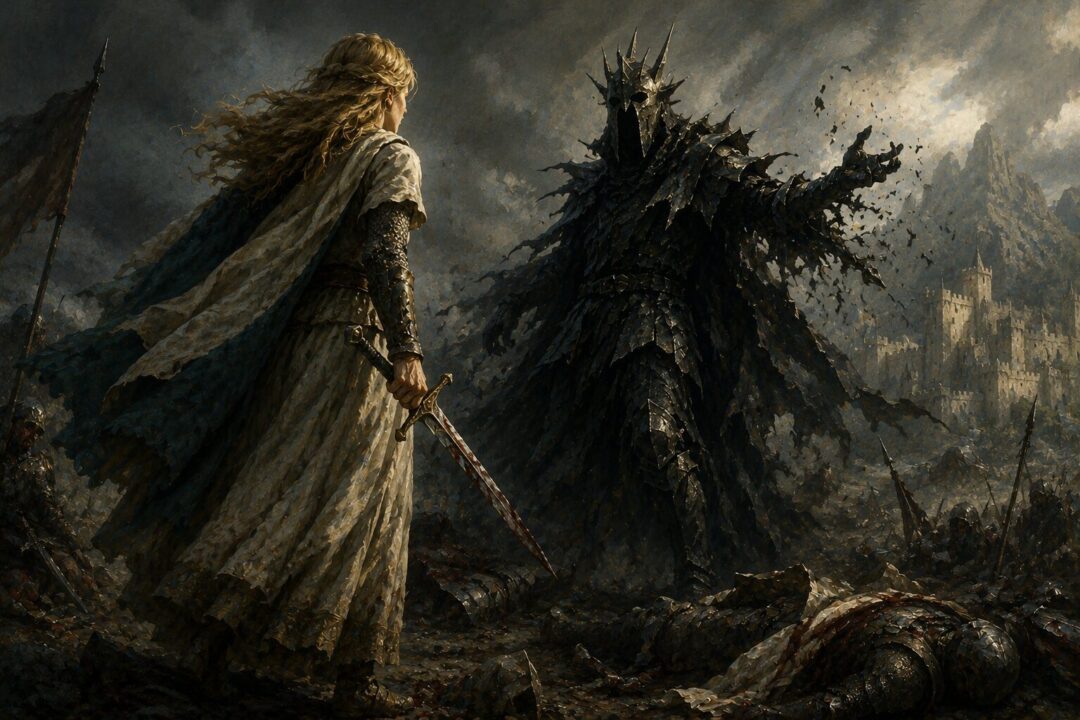
After Merry's enchanted blade breaks the Witch-king's protection, Éowyn drives her sword into the space between crown and mantle. The Nazgûl collapses, his garments empty.
Neither act diminishes the other.
Without Merry's unique weapon, Éowyn may never have found a vulnerable enemy.
Without Éowyn's courage, Merry's strike alone would not have ended the Lord of the Nazgûl.
The victory belongs to both.
Did the Prophecy Cause His Fall?
The famous prophecy often causes confusion.
Long before the Battle of the Pelennor Fields, Glorfindel declared that the Witch-king would not fall "by the hand of man."
This is frequently mistaken for magical protection.
The text gives no indication that the prophecy itself prevented men from killing him.
Instead, it functions as foresight.
Glorfindel foretells what will happen rather than creating a supernatural rule.
The fulfillment comes naturally.
Éowyn is a woman, not a man.
Merry is a hobbit, also not a man in the sense intended by the prophecy.
Neither character acts because of the prophecy. In fact, Merry almost certainly knows nothing about it.
The prophecy describes the future; it does not produce it.
Why Ancient Craftsmanship Matters So Often in Middle-earth
Merry's sword belongs to a broader pattern throughout Tolkien's world.
The greatest works usually come from earlier ages.
The Silmarils cannot be recreated.
The Rings of Power surpass later craftsmanship.
The swords Glamdring and Orcrist survive from Gondolin.
Narsil, reforged as Andúril, carries both history and authority.
This recurring decline is one of Middle-earth's defining themes.
Civilizations inherit greatness more often than they create it anew.
Merry's blade is another example.
It represents the fading strength of Arnor—a kingdom long vanished, whose final gift reaches across centuries to strike down its oldest enemy.
The people who forged it never lived to witness its success.
Yet their work still mattered.
The Irony of the Witch-king's Defeat
The Witch-king devoted centuries to destroying Arnor.
His wars shattered its kingdoms.
Its cities became ruins.
Its people dwindled into scattered Rangers.
From every visible measure, he won.
Yet one forgotten weapon from that defeated civilization ultimately contributed to his own destruction.
This irony fits one of Tolkien's deepest historical patterns.
Evil often measures victory by immediate conquest.
Good frequently works through memory, endurance, and preservation.
The kingdom the Witch-king believed he had erased still reached into the future through a single sword resting unnoticed in an ancient barrow.
Its final triumph arrived almost a thousand years later.
Courage Still Remained Essential
The enchanted blade did not act on its own.
Merry had to overcome terror unlike anything he had experienced.
The Witch-king's supernatural fear caused even seasoned warriors to flee.
Merry initially feels almost unable to move.
Only his loyalty to Théoden finally drives him forward.
This balance between providence and personal choice is characteristic of Tolkien's storytelling.
The right weapon exists.
History prepares the moment.
Prophecy points toward its fulfillment.
But none of those things remove the need for courage.
Had Merry yielded to fear, the blade would have remained unused.
Ancient craftsmanship alone could not save the day.
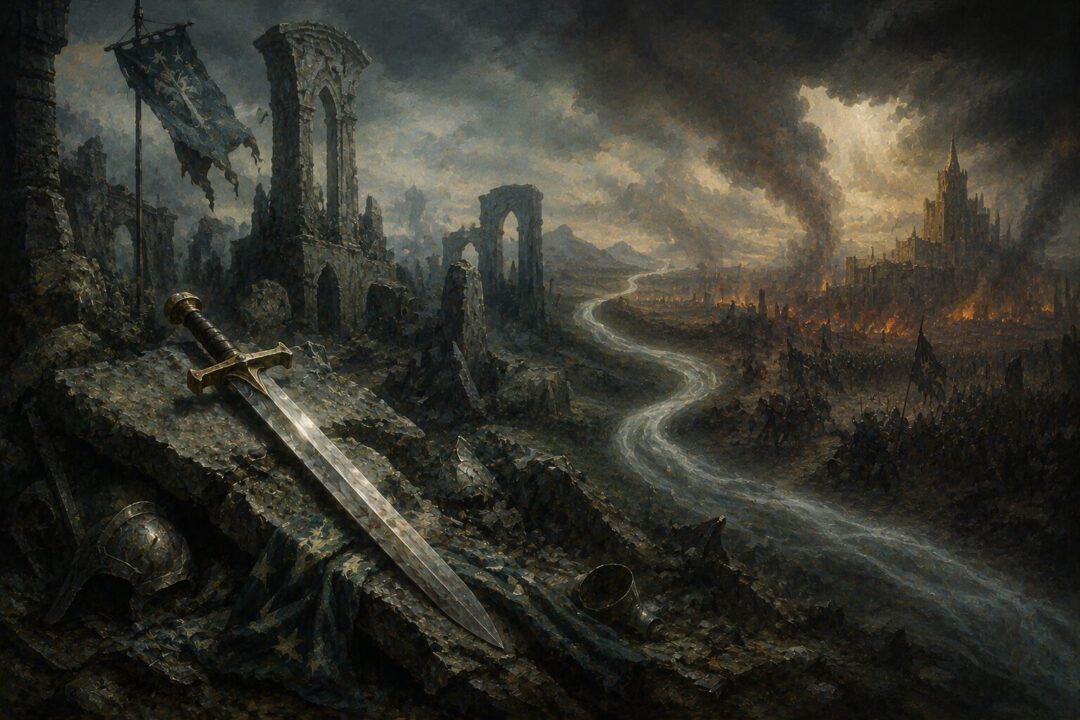
A Victory Forged Across Ages
Merry's sword demonstrates that in Middle-earth, victories are rarely created in a single moment.
They are built over generations.
The smiths of Westernesse forged a blade during desperate wars against Angmar.
The sword survived the collapse of kingdoms.
It lay hidden for centuries in forgotten tombs.
Tom Bombadil placed it into the hands of a hobbit who had no idea of its history.
That hobbit found himself standing behind the greatest servant of Sauron at precisely the moment history demanded.
The Witch-king's downfall was therefore not merely the triumph of one warrior over another. It united the courage of the present with the wisdom of the past. The forgotten kingdom of Arnor, long thought defeated, played its final part through a blade made for a single purpose.
When Merry struck behind the Witch-king's knee, he was not simply attacking an enemy. He was completing a story that had begun centuries earlier, proving that even the smallest hands may carry the unfinished work of ages—and that in Middle-earth, history is often the greatest weapon of all.
Sources & Notes
- Wikipedia overview of Meriadoc Brandybuck and his role at the Pelennor Fields — https://en.wikipedia.org/wiki/Meriadoc_Brandybuck
- Wikipedia overview of the Witch-king of Angmar and his defeat — https://en.wikipedia.org/wiki/Witch-king_of_Angmar
- Wikipedia overview of The Return of the King for the Battle of the Pelennor Fields context — https://en.wikipedia.org/wiki/The_Return_of_the_King
Sources selected for Tolkien-lore context and reader verification.