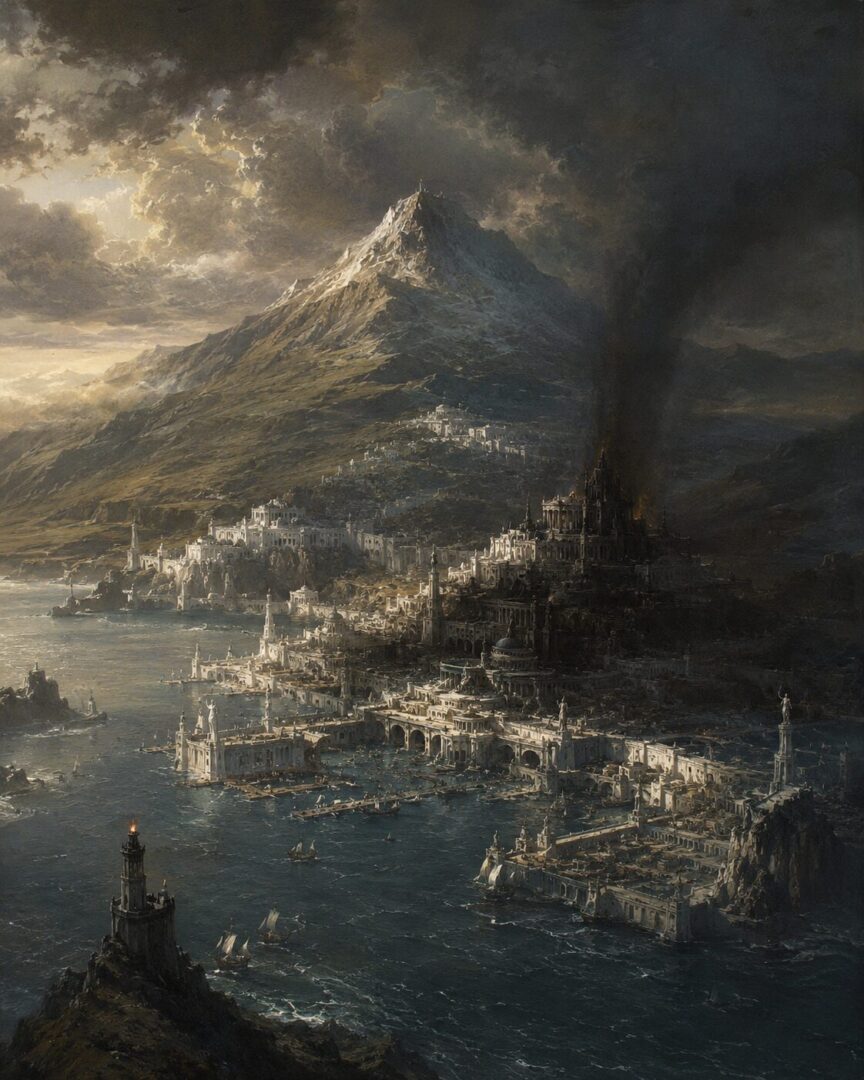
The most haunting thing about Númenor is not only that it sank. It is that so much of Middle-earth afterward still lived in its shadow.
Gondor’s white towers, Arnor’s lost northern kings, the long lives of the Dúnedain, the pride of Denethor, the memory of Elendil, even the dread name of the Black Númenóreans — all of these are fragments of a drowned world. Númenor was gone, but its afterimage remained powerful enough to shape the Third Age.
So the question is tempting: if Sauron corrupted Númenor so completely, why did he never try to rebuild it?
The answer is not that he lacked ambition. Sauron wanted dominion over all Middle-earth. But Númenor was never his true kingdom. It was a captured weapon. Once that weapon shattered, he did not need to restore it. He needed to prevent its surviving memory from becoming a rival power.
Númenor Was Not Sauron’s Homeland
Númenor began as the Land of Gift, the island granted to the Edain after the First Age. Its greatness was tied to a blessing Sauron could not create: long life, closeness to the West, friendship with the Eldar, and a special place in the history of Men. Even when Númenor later declined into pride and fear of death, its original meaning remained older than Sauron’s corruption.
Encyclopedia of Arda
That matters. Sauron could build fortresses. He could raise temples. He could command armies, forge rings, and dominate wills. But Númenor was not merely stone, harbor, and throne. It was an entire moral history.
To rebuild Númenor in any true sense would mean recreating the very thing Sauron hated most: a great kingdom of Men whose noblest tradition looked westward, honored the Valar, remembered the Elves, and traced its dignity to resistance against Morgoth. Sauron could imitate power. He could not restore grace.
He Did Not Want Númenor Preserved — He Wanted It Inverted
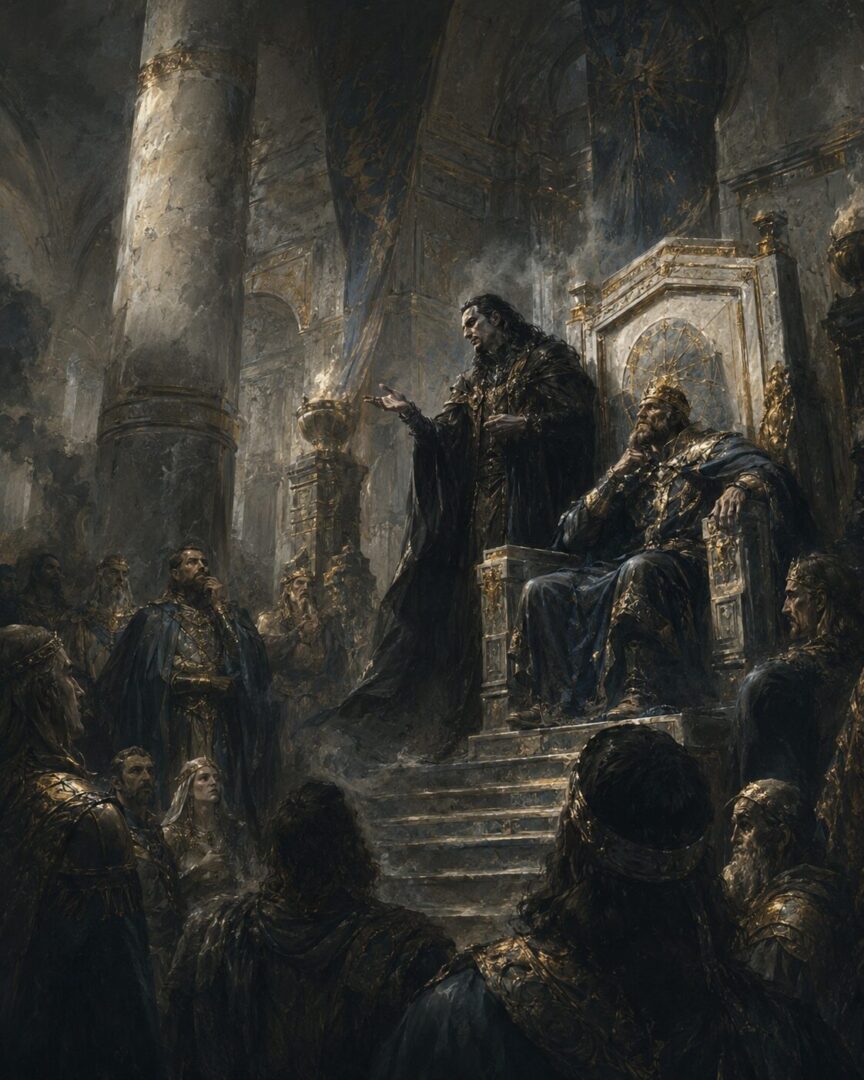
When Ar-Pharazôn brought Sauron to Númenor as a prisoner, Sauron’s defeat quickly became a different kind of victory. The texts present him as unable to overcome Númenórean military might directly at that moment, so he submitted and used persuasion instead. He rose from captive to counsellor, turned the king’s fear of death into rebellion, and helped twist the island’s greatness into worship of darkness.
This is the crucial distinction. Sauron did not conquer Númenor in order to rule it as Númenor. He conquered it by making it betray itself.
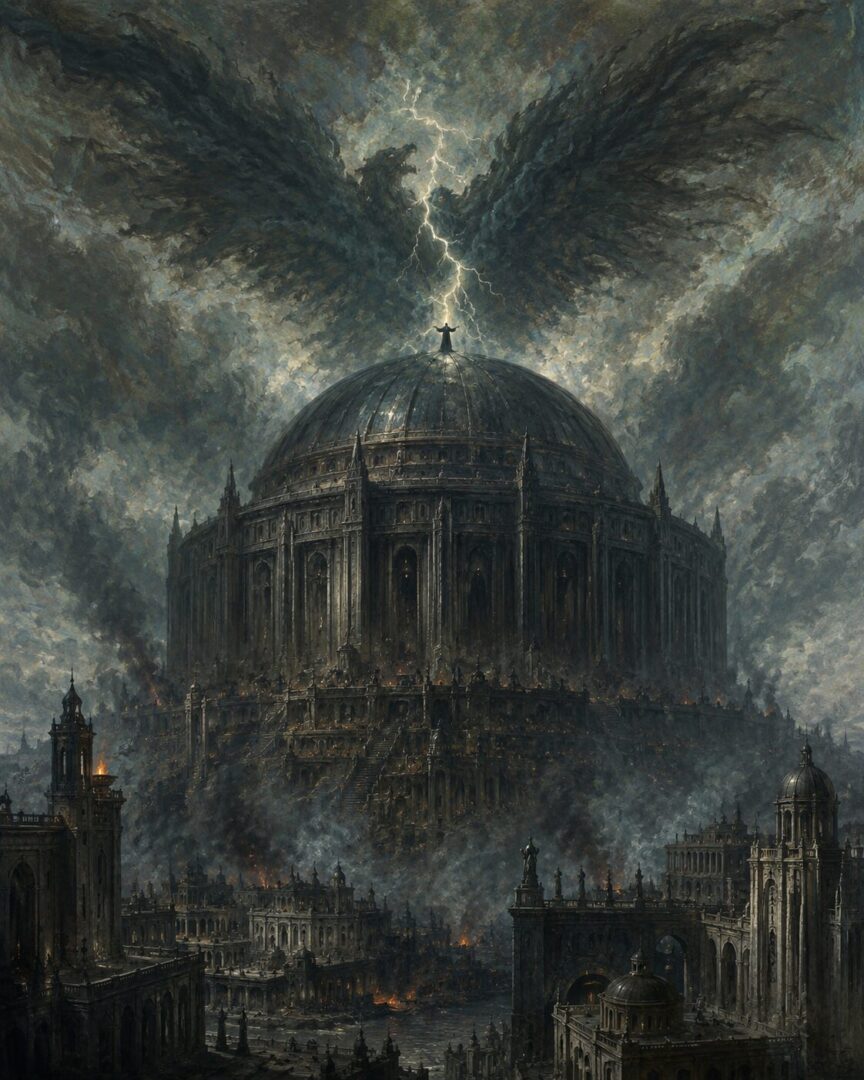
The Temple in Armenelos is the clearest symbol of that inversion. Built at Sauron’s urging for the worship of Melkor, it replaced the old reverence of Númenor with smoke, fear, and sacrifice. The island did not become Sauron’s restored paradise of Men. It became a theater of corruption — proof that even the mightiest human civilization could be made to deny its own foundations.
From Sauron’s point of view, Númenor’s highest use had already been fulfilled before the waves came. It had been turned against the Valar, against the Faithful, against the memory of its own beginning.
The Downfall Put True Númenor Beyond Reach
The Downfall was not a normal defeat. It was not the fall of a city that could be rebuilt, nor the loss of a province that could be recolonized. Númenor was destroyed when Ar-Pharazôn broke the Ban of the Valar and sailed against Aman; the island was swallowed by the Sea in S.A. 3319, and the world itself was changed so that mortal sailors could no longer reach the Undying Lands by ordinary paths.
That makes “rebuilding Númenor” almost impossible in the literal sense. The island was gone. Its sacred geography was gone. Its mountain, Meneltarma, belonged to a vanished order of the world. The old relationship between Númenor and the West could not simply be reconstructed by Sauron on another coast.
He could have raised a new realm of Men and called it Númenor. But that would have been a counterfeit, not a restoration. Sauron was certainly capable of counterfeits — but a counterfeit Númenor would carry a dangerous problem: it would remind Men of what had been lost.
Sauron preferred domination without holy memory. He did not want Men asking what Númenor had once been before the Temple, before the armada, before the king listened to lies about death.
Mordor Was the Better Seat of His Power
After the Downfall, Sauron’s spirit returned to Middle-earth. The loss was real: his body was destroyed, and he could no longer take a fair form. But his power was not ended. The natural place for him to resume his war was not a drowned western island. It was Mordor, where Barad-dûr and the fires of Orodruin were already bound to his greatest work, the One Ring.
Mordor suited Sauron in ways Númenor never did.
It was enclosed, fortified, and near the mountain where the Ring had been made. It faced Gondor directly. It stood within Middle-earth, among the peoples he meant to subdue. It did not depend on ships, memory, legitimacy, or the dangerous prestige of the West.
Númenor had given Sauron access to a king’s ear. Mordor gave him a machine of war.
That difference matters. Sauron’s deepest goal was not nostalgia. It was control. Barad-dûr expressed him more honestly than Armenelos ever could: not seduction wearing royal robes, but domination made architectural.
The Surviving Númenóreans Were Mostly His Enemies
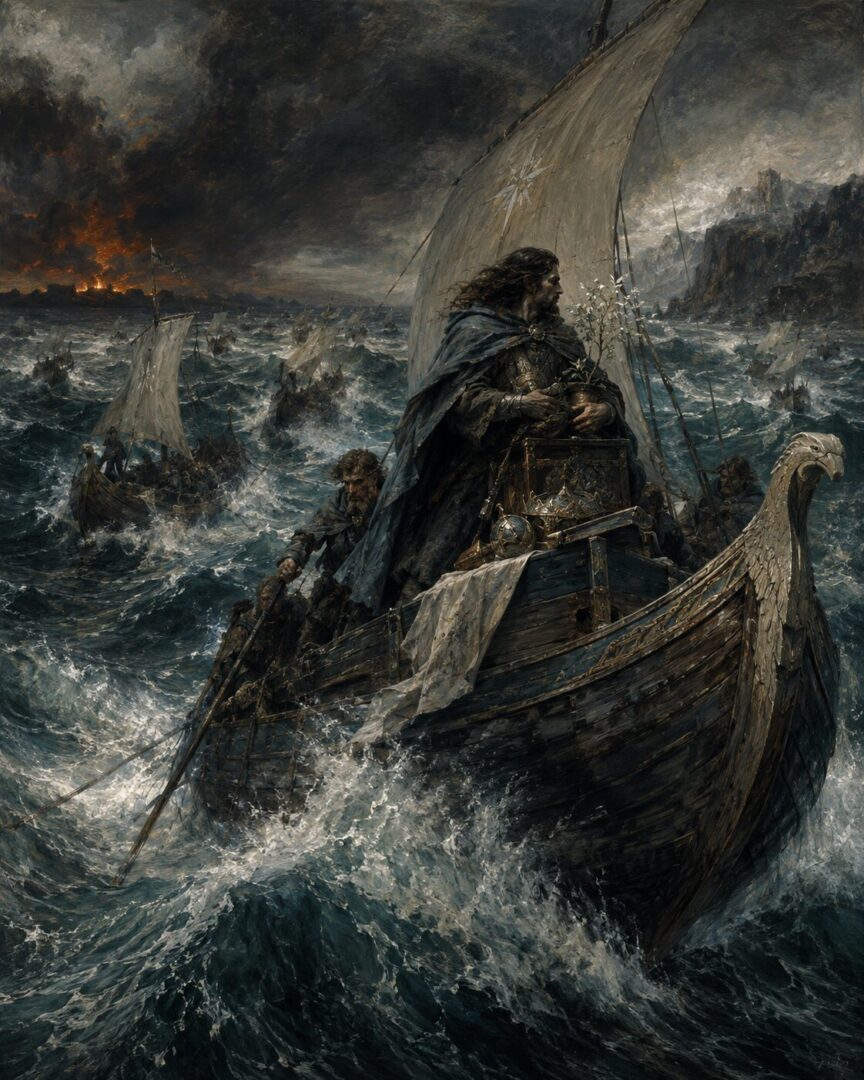
The Downfall did not erase the Númenóreans entirely. Elendil and the Faithful escaped and founded the Realms in Exile: Arnor in the north and Gondor in the south, established after the destruction of Númenor. These kingdoms preserved much of the older Númenórean memory that Sauron had tried to corrupt.
For Sauron, that was the real problem.
If he had tried to “rebuild Númenor,” the strongest surviving claim to Númenórean legitimacy did not belong to him. It belonged to Elendil’s house. The Faithful had the lineage, the memory, the heirlooms, and the moral claim. They were not merely refugees. They were a living accusation.
Gondor especially became a kind of anti-Númenor from Sauron’s perspective: a Númenórean-descended kingdom planted directly beside his old stronghold, armed with stone cities, royal memory, and hatred of the Shadow. Rebuilding Númenor would have meant competing with the Exiles on ground where they were stronger: legitimacy.
So Sauron chose the simpler answer. He made war on them.
He Used the Fallen Remnants Instead
This does not mean Sauron ignored Númenórean blood. The texts preserve the existence of the Black Númenóreans, descended from the King’s Men and associated with the old colonial strongholds and lordships in Middle-earth. Many of them remained hostile to the Faithful and, after the Downfall, some still served Sauron.
That is probably the closest thing to Sauron “rebuilding Númenor”: not a restored island, but corrupted Númenórean remnants folded into his wider empire.
He did not need to raise a new Armenelos if he could use Umbar, Harad, Mordor, and the servants already bent toward the Shadow. He did not need to preserve Númenórean civilization as a whole if its most useful fragments — pride, sea-power, hatred of Elendil’s heirs, fascination with dark knowledge — could be detached and weaponized.
Sauron was a scavenger of greatness. He did not honor what he used. He hollowed it out.
A New Númenor Would Have Been Dangerous to Sauron
There is another reason he may not have wanted the name restored: Númenor was too powerful a story.
The memory of Númenor contained both temptation and warning. For proud Men, it recalled height, splendor, long life, and imperial power. But for the Faithful, it also recalled judgment, mercy, exile, and the cost of rebellion. A revived Númenor might inspire obedience for a time, but it could also awaken questions Sauron would rather bury.
Why did the island fall? Who lied to the king? Why did the Faithful survive? Why did the proudest fleet in the world never return?
Those questions all lead back to Sauron’s greatest “victory” revealing itself as a catastrophe. He escaped the Downfall, but he did not escape its meaning. Númenor proved that even his most brilliant corruption could summon a judgment beyond his control.
That is a memory no Dark Lord would want carved into the foundation stones of a new kingdom.
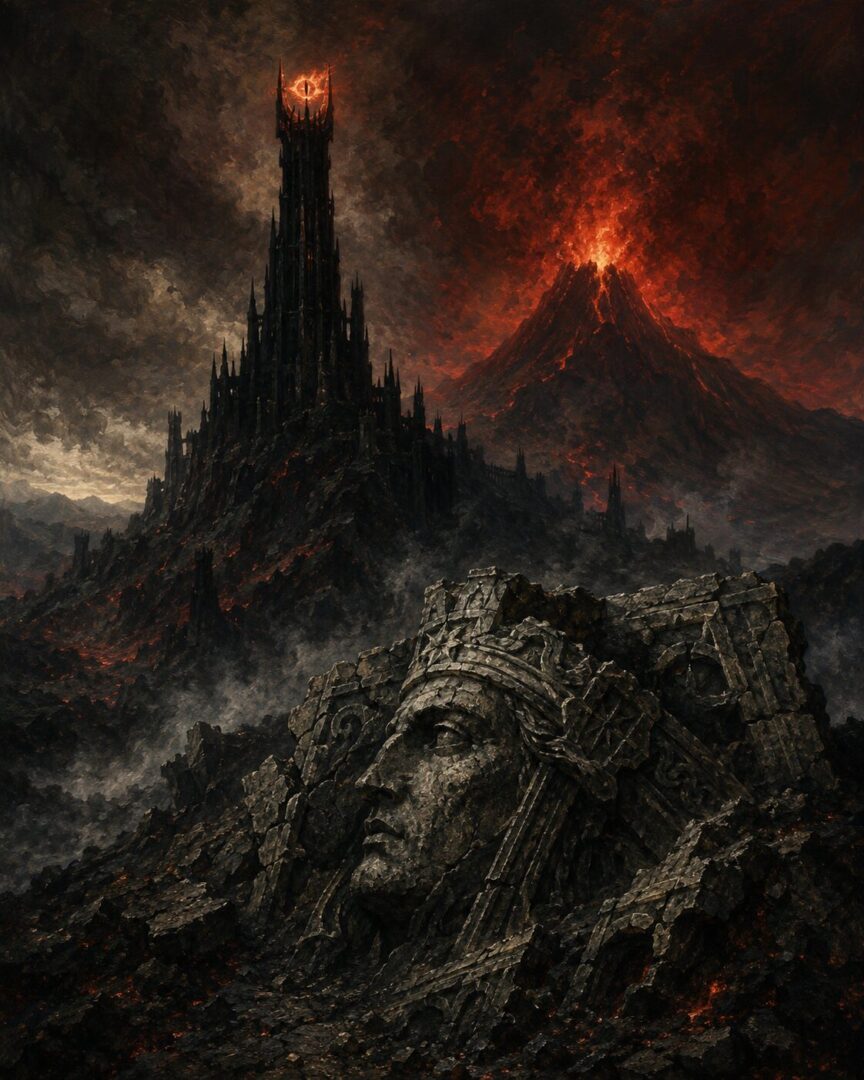
The Real Númenor Was Rebuilt Without Him
The final irony is that Númenor was rebuilt — just not by Sauron, and not as an island.
It was rebuilt imperfectly in Arnor’s northern memory. It was rebuilt in Gondor’s walls, towers, tombs, and laws. It was rebuilt in the White Tree, in the line of Elendil, in the long resistance against Mordor, and finally in the return of the king. None of these restorations fully recovered Númenor’s lost height, and the texts are honest about decline. But they preserved the part of Númenor Sauron failed to kill.
That is why he never needed, and never truly could, rebuild Númenor.
He could build a fortress. He could command a cult. He could corrupt kings and gather armies. But Númenor at its deepest was not merely a realm of Men. It was a test of what Men would do with death, power, memory, and obedience.
Sauron’s version of Númenor ended exactly as his rule always tends to end: impressive, terrifying, and hollow, until the foundations give way.
What survived was not his counterfeit. It was the exile.
Sources & Notes
- Wikipedia overview of Sauron’s role in Númenor and later Middle-earth — https://en.wikipedia.org/wiki/Sauron
- Wikipedia overview of Númenor and its downfall in Tolkien’s legendarium — https://en.wikipedia.org/wiki/N%C3%BAmenor
- Wikipedia overview of The Lord of the Rings for the War of the Ring context — https://en.wikipedia.org/wiki/The_Lord_of_the_Rings
Sources selected for Tolkien-lore context and reader verification.