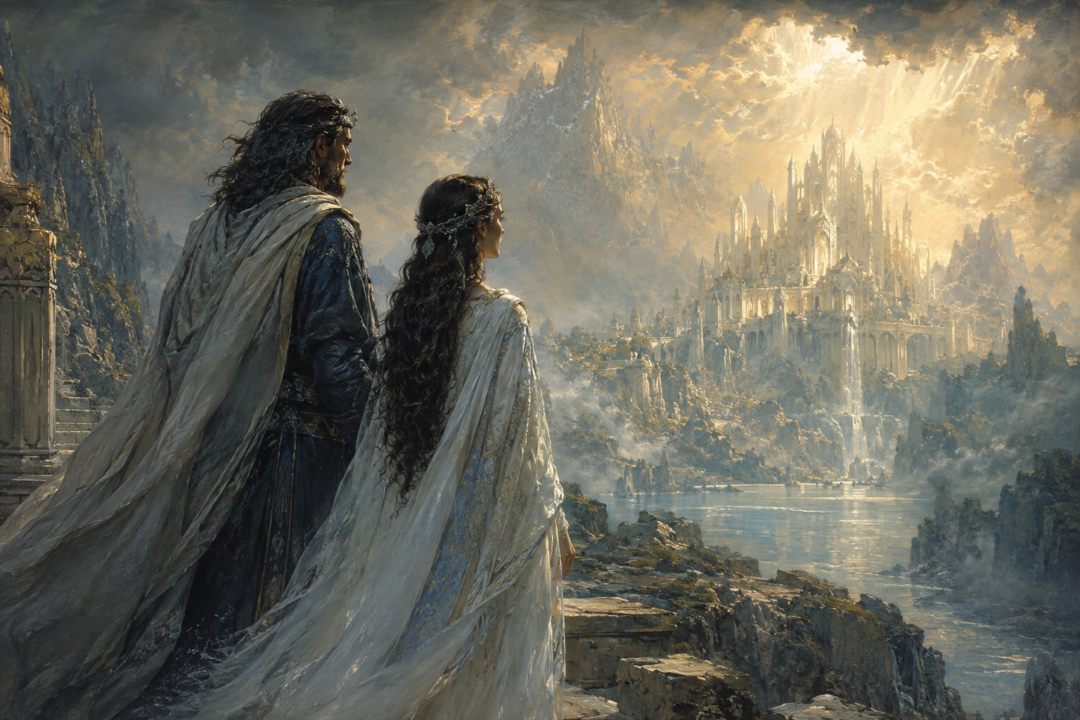
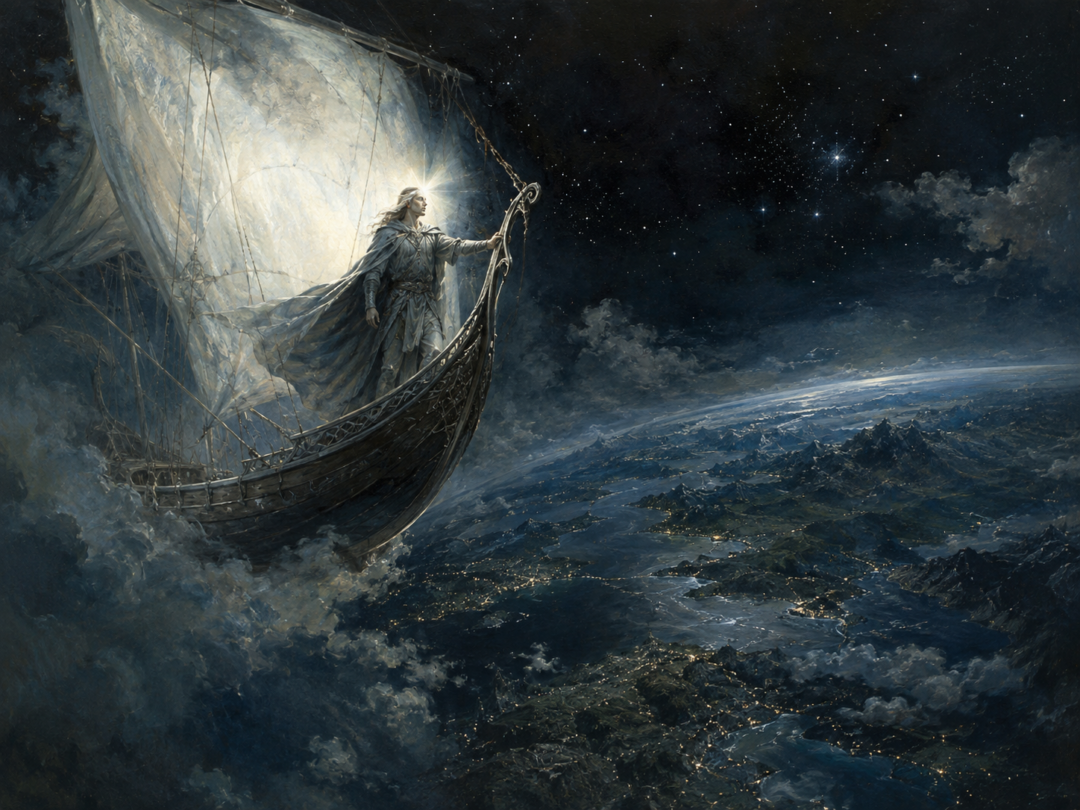
Eärendil stands at the end of the First Age carrying something no ordinary traveller could bear: a Silmaril upon his brow, the hopes of ruined Beleriand behind him, and the blood of both Elves and Men in his veins.
Yet after crossing the forbidden Sea and reaching Aman, he faces a choice more personal than his mission to the Valar.
Eärendil is allowed to decide whether his fate will belong to Elves or Men. The remarkable detail is that the choice he ultimately makes is apparently not the one toward which his own heart naturally leans.
The text says that Eärendil’s heart was more with the kindred of Men and with the people of his father. Nevertheless, when Elwing chooses to be counted among the Firstborn, he chooses the same fate for her sake. thefellowshipofthereaders.substack.com
It is one of the quietest sacrifices in the story of Eärendil. The mariner who unites the histories of the Two Kindreds does not finally choose according to ancestry alone. He chooses according to love.
Eärendil Was Truly Between Two Peoples
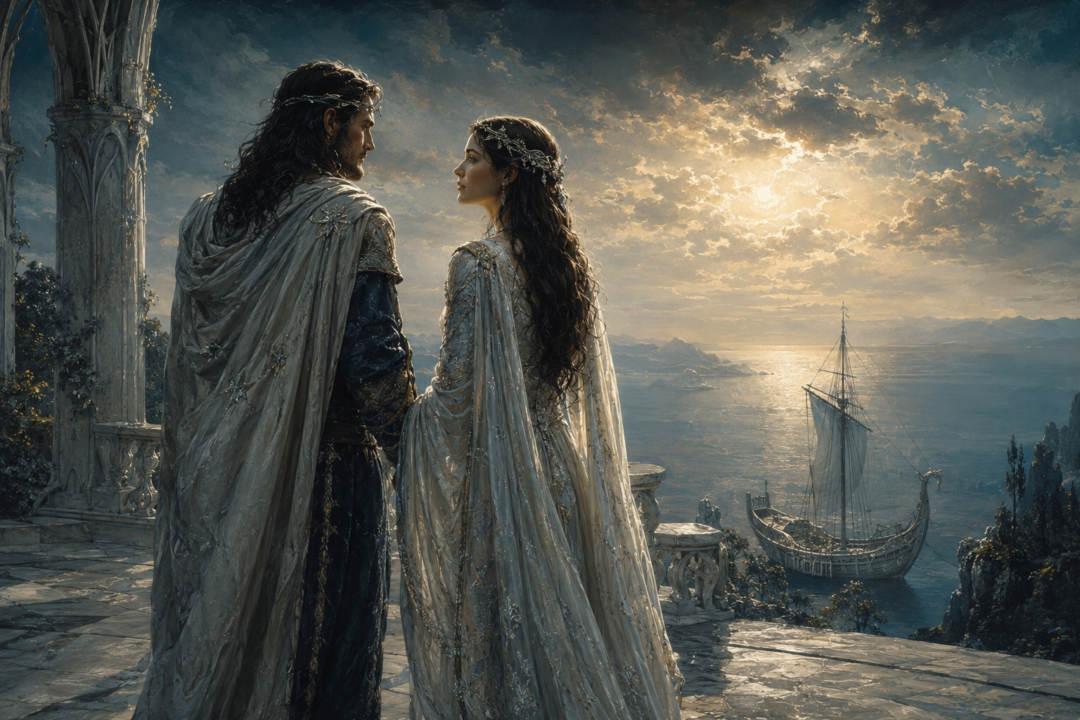
Eärendil’s divided inheritance was not symbolic. His parents embodied one of the great unions of Elves and Men.
His mother was Idril, daughter of Turgon of Gondolin. His father was Tuor, son of Huor of the House of Hador. Their marriage followed the earlier union of Beren and Lúthien, bringing the histories of the Firstborn and the Followers together for a second time.
Eärendil therefore inherited both worlds.
Through Idril he belonged to the royal house of Gondolin and the Eldar. Through Tuor he belonged to one of the greatest houses of the Edain.
The distinction mattered because Elves and Men do not merely possess different lifespans. Their ultimate destinies differ. Elves remain bound to Arda for its duration, while the spirits of Men depart from the world according to the mysterious Gift of Ilúvatar.
Ordinarily, this is not a preference that individuals may simply change.
Eärendil and his family were exceptional.
After his voyage to Aman, Manwë’s judgment granted Eärendil, Elwing, and their sons the freedom to choose to which kindred their fates would be joined. The published account explicitly presents this as an individual choice rather than an automatic consequence of mixed ancestry.
🧙The Tolkien Forum🧝
That distinction makes what follows more powerful.
Eärendil genuinely could have chosen Men.
His Heart Was With His Father’s People
When modern readers think of Eärendil, it is easy to associate him primarily with the immortal world. He reaches Aman. He bears a Silmaril. His ship eventually sails the heavens. His light becomes a sign of hope visible from Middle-earth.
But the judgment scene preserves a strikingly different interior truth.
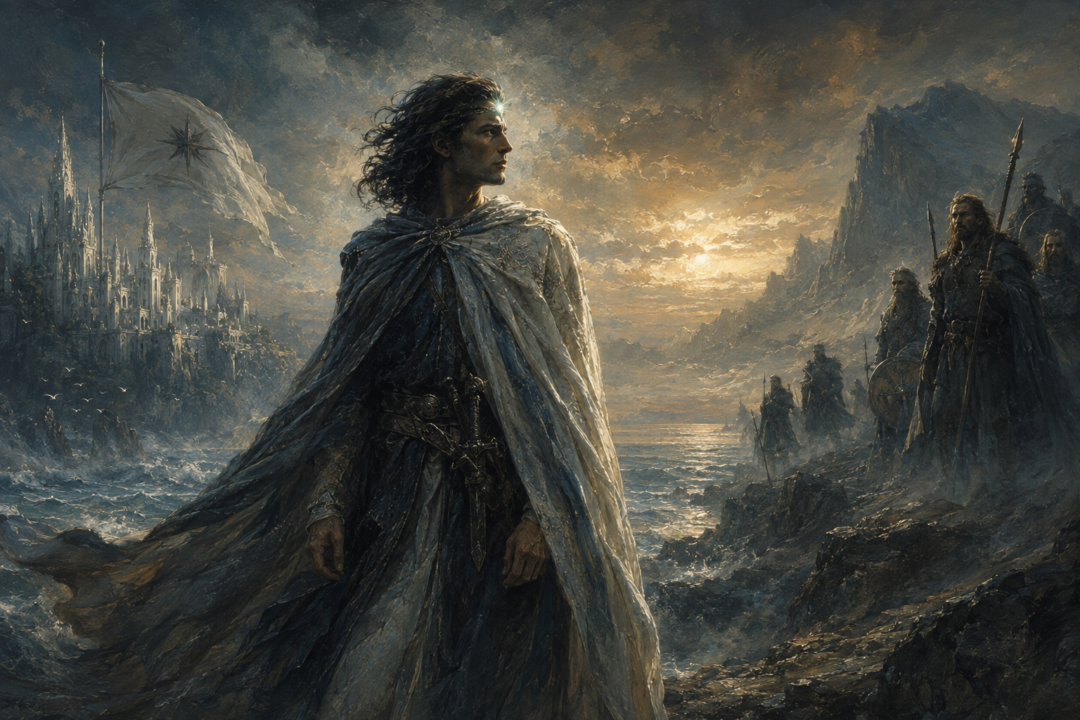
Eärendil’s heart inclined toward Men.
More precisely, the text associates that inclination with “the people of his father.” Tuor had been born among Men, even though an extraordinary tradition concerning Tuor later held that he alone of mortal Men was numbered among the Elder Kindred.
Eärendil’s preference therefore should not be reduced to a calculation about whether immortality was desirable. Nothing in the passage says he weighed endless life against death and reluctantly selected immortality.
Instead, his inclination is described in terms of belonging.
He felt drawn toward his father’s people.
That makes Eärendil unusual among characters confronted by mortality. He does not appear frightened away from the fate of Men. If left entirely to his own inclination, the passage strongly suggests that he would have chosen it.
But he does not make the decision alone.
Elwing Is Given the Choice
It is important not to misstate what happens between Eärendil and Elwing.
Eärendil does not possess authority to assign Elwing an Elven fate. Manwë’s decree grants each of them freedom to choose. Elwing makes her own decision.
Eärendil, weary after everything that has occurred, tells Elwing to choose. She chooses to be judged among the Firstborn Children of Ilúvatar. The text gives the tantalizing explanation that she does so “because of Lúthien.” Eärendil then chooses likewise for Elwing’s sake.
The exact meaning of Elwing’s reason is never fully explained.
That deserves caution because the obvious interpretation produces a paradox.
Lúthien, Elwing’s grandmother, famously did not remain among the immortal Elves. For love of Beren, she accepted mortality so that their final destinies would not divide them.
So Elwing cannot simply be imitating Lúthien’s literal choice.
The text says “because of Lúthien,” but does not spell out the reasoning behind those words. Any more detailed psychological explanation must therefore remain interpretation.
What can be said securely is that Lúthien’s identity and fate mattered decisively to Elwing.
The Strange Mirror of Lúthien’s Choice
There is nevertheless a remarkable structural resemblance between the two women.
Lúthien faces a choice touching the division between Elves and Men. Love shapes her answer.
Elwing faces another choice between those same kindreds. Her connection to Lúthien shapes hers.
And then Eärendil faces the consequence of Elwing’s decision.
Here the older story almost reverses itself.
Lúthien leaves the fate of the Elves to share Beren’s mortality. Eärendil, although personally inclined toward Men, accepts the fate of the Elves rather than choose differently from Elwing.
The results point in opposite directions, yet the underlying principle is similar: the person loved matters more than the fate that might otherwise have been preferred.
That does not mean Eärendil was forced.
The whole force of Manwë’s decree is that he was free.
His sacrifice matters precisely because he could have chosen otherwise.
Elwing Does Not Erase Eärendil’s Identity
It would also be misleading to say that Eärendil simply becomes culturally Elvish because of his decision.
The text preserves the tension.
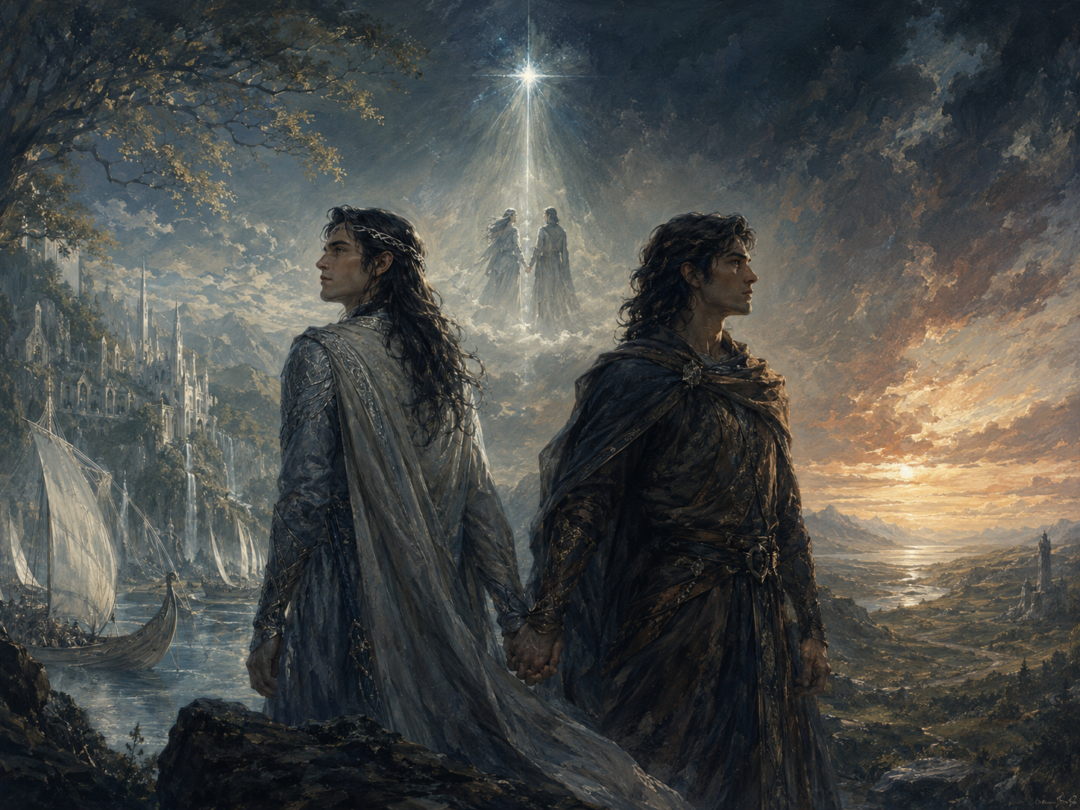
He chooses to be counted among the Firstborn while still telling us that his heart leaned toward Men.
His judgment changes his appointed fate; it does not rewrite his ancestry or make his earlier attachment to his father’s people unreal.
That is especially fitting for Eärendil.
His entire life occupies boundaries.
He is descended from Gondolin and the Edain. He marries Elwing, descendant of Beren and Lúthien. He sails from Middle-earth toward the Undying Lands. He becomes the messenger whose plea brings the Powers of the West into the struggle against Morgoth.
Even after his choice, his destiny remains liminal. Eärendil does not simply settle into an ordinary immortal existence. He sails Vingilótë through the heavens bearing the Silmaril, and his light becomes visible to those still living beneath the Shadow.
The man whose heart inclined toward Men becomes permanently distant from them, yet also becomes one of their greatest signs of hope.
That is not a simple reward.
It carries the character of sacrifice.
His Choice Does Not Decide His Sons’ Choices
The next generation makes the significance of Manwë’s judgment even clearer.
Eärendil and Elwing’s decision does not automatically bind Elrond and Elros.
Their sons are granted their own choices.
Elrond chooses the Firstborn. Elros chooses Men and eventually becomes the first King of Númenor.
The brothers therefore divide along the very line their father once stood across.
This is crucial when interpreting Eärendil.
He does not reject Men as lesser. The subsequent history of his own family makes such a reading impossible to sustain. One son follows the Elven fate; the other accepts mortality.
Both branches become enormously important to later history.
Through Elrond comes Arwen, who eventually makes another choice involving mortality.
Through Elros comes the line of Númenórean kings and, after immense spans of history, the ancestry of Aragorn.
The divided inheritance of Eärendil never truly disappears.
It becomes one of the central threads of Middle-earth.
The Cost Hidden Inside Eärendil’s Greatest Victory
Eärendil’s voyage is usually remembered as triumph.
He reaches the West when all other hope has failed. His plea is heard. The Host of the West comes against Morgoth. The War of Wrath ends the Dark Enemy’s dominion in Beleriand.
But his personal ending contains something quieter.
Having sailed for the sake of Elves and Men, Eärendil must choose which of those peoples will determine his own fate.
His heart inclines toward Men.
Elwing chooses the Firstborn.
And Eärendil follows her.
The texts do not present a long speech explaining his emotions, nor do they tell us that he suddenly discovers he prefers immortality. Instead, the decision is almost startlingly simple: he chooses as Elwing chooses, for her sake.
That simplicity is precisely why the moment matters.
Eärendil’s greatest act is crossing the Sea to save two kindreds.
His most intimate act may be surrendering the fate he personally preferred so that he and Elwing will not choose separate paths.
The mariner who becomes a star is remembered across the ages for the light he carries.
Yet underneath that cosmic destiny lies something much more human: when finally given freedom to decide where he belonged, Eärendil chose not merely a people, but a person.
Sources & Notes
- The Encyclopedia of Arda — Eärendil: biographical account of his mixed descent, voyage to Aman, judgment by the Valar, personal affinity with Men, and decision to share Elwing’s Elven fate — https://www.glyphweb.com/arda/e/earendil.php
- The Encyclopedia of Arda — Elwing: reference on Lúthien’s granddaughter, bearer of the Silmaril, reunion with Eärendil in Aman, and choice to be counted among the Firstborn — https://www.glyphweb.com/arda/e/elwing.php
- The Encyclopedia of Arda — Half-elven: overview of the exceptional choice granted to Eärendil’s line and the differing decisions made by Eärendil, Elwing, Elrond, and Elros — https://www.glyphweb.com/arda/h/halfelven.php
- The Encyclopedia of Arda — Gift of Men: reference explaining the distinct mortal fate toward which Eärendil’s own heart inclined through his father’s people — https://www.glyphweb.com/arda/g/giftofmen.php
Sources document Eärendil and Elwing’s separate choices, the special judgment of the Half-elven, and the difference between the fates of Elves and Men that gives Eärendil’s decision its weight.