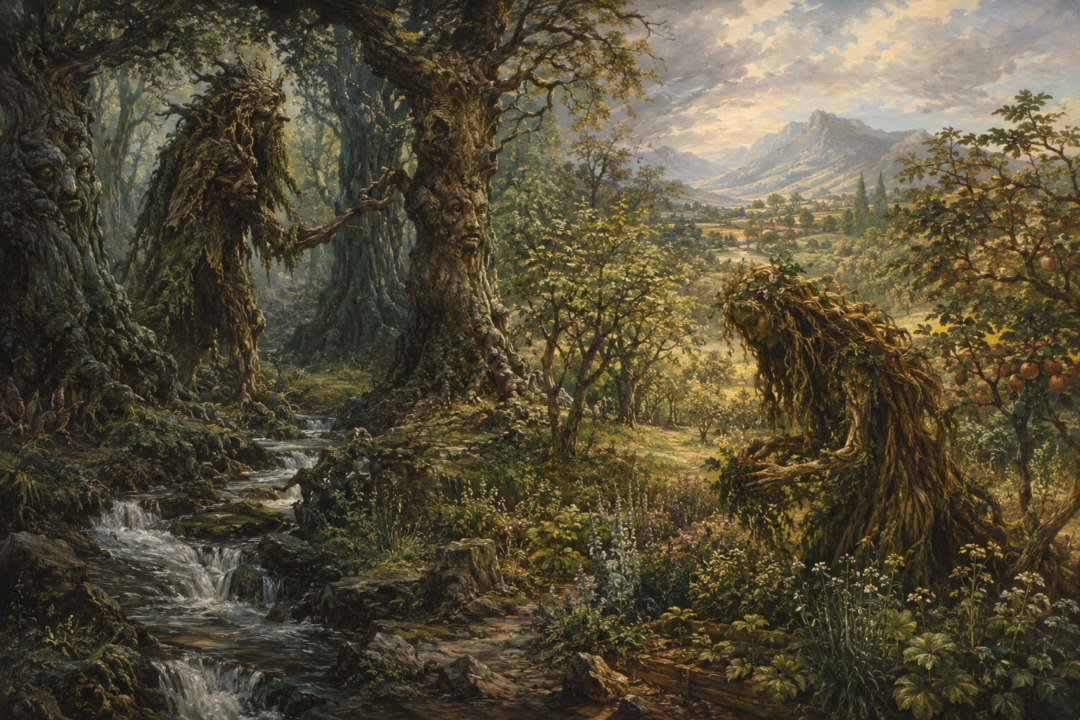
When Treebeard tells Merry and Pippin about the lost Entwives, the obvious tragedy is separation. The Ents cannot find their mates. There are no Entings. An ancient people is slowly dwindling.
But hidden inside Treebeard’s story is another division—one that began long before the Entwives vanished.
The Ents and Entwives did not simply prefer different places. They developed profoundly different relationships with growing things.
The Ents loved wild woods, great trees, mountain streams, and landscapes that largely followed their own courses. The Entwives turned toward meadows, smaller trees, herbs, grasses, orchards, gardens, and cultivated fields. Where the Ents sought conversation with trees, the Entwives wanted plants to respond to direction.
The contrast is so deliberate that the Entwives’ gardens can be read as a rival ecology within Middle-earth: not an evil alternative to the forest, but another vision of what caring for the living world means.
And the tragedy is that neither vision survives intact.
Two Ways of Loving the Same World
Treebeard explains in The Two Towers that Ents and Entwives once walked and lived together. Their separation came gradually because their hearts did not continue developing in the same direction.
The Ents gave themselves to great trees, wild forests, hills, and mountain waters. They ate fruit that trees dropped naturally and learned from the Elves to communicate with trees.
Their relationship with nature was therefore remarkably conversational.
Trees were not merely material to be managed.
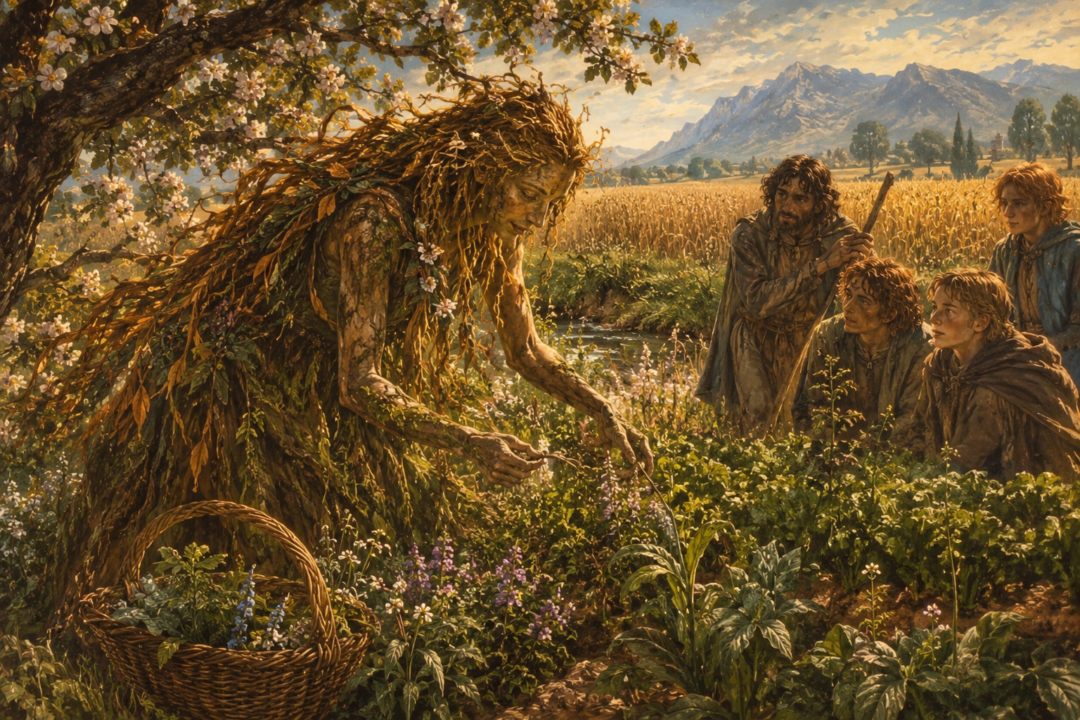
The Entwives turned toward another part of the vegetable world: smaller trees, sunny meadows, sloes, wild apples, cherries, herbs growing in wet places, and grasses producing seed in autumn.
That distinction matters.
The Entwives were not rejecting living things. They loved them differently.
Treebeard says that rather than speaking with these plants, they wanted the plants to heed their instructions. They directed growth toward particular forms and desired what Treebeard describes as order, plenty, and peace.
From that desire came gardens.
The opposition is therefore not nature against civilization in any simple sense.
It is closer to wild growth versus cultivated growth.
Fangorn Is a Community, Not a Plantation
Fangorn helps reveal what makes the Entish approach distinctive.
The forest is old, dangerous, uneven, and difficult to control. Some trees are awake in strange ways. Some have become hostile. Huorns blur the distinction between trees and Ent-like beings. Even Treebeard cannot reduce the forest to a neat system.
That disorder is part of its nature.
The Ents are shepherds of trees, but “shepherd” does not mean absolute master. Treebeard describes relationships with trees that involve teaching, waking, listening, and speaking.
His role is closer to guardianship than manufacture.
This helps explain why Saruman’s destruction of trees is so offensive to him. Saruman does not merely use timber. From Treebeard’s perspective, he has begun destroying living beings recklessly and without regard for what they are.
The Ents stand almost at the opposite extreme.
They wander.
They listen.
They remember individual trees and ancient forests.
They allow the woodland to remain something that exceeds their control.
The Entwives desired something else.
The Garden Changes the Relationship
Treebeard’s account of the Entwives contains one especially revealing distinction: they wanted growing things to obey.
That makes their gardens fundamentally different from the Entish woods.
A garden involves selection.
Some plants are encouraged. Others are removed. Growth is directed. Space is arranged. Fruitfulness is valued. The landscape becomes shaped according to intention.
Treebeard even explains the Entwives’ idea of peace in terms of things remaining where they had placed them.
That line should not automatically be read as condemnation. Nothing in Treebeard’s account makes the Entwives servants of evil, and cultivation itself is certainly not treated as wicked throughout Middle-earth.
The Shire alone makes such an interpretation difficult.
Instead, the Entwives represent an ordered relationship with the earth.
They do not merely dwell among growing things. They organize them.
Their ecology therefore stands between wilderness and civilization.
And eventually, human beings enter it.
The Entwives Become Teachers of Men
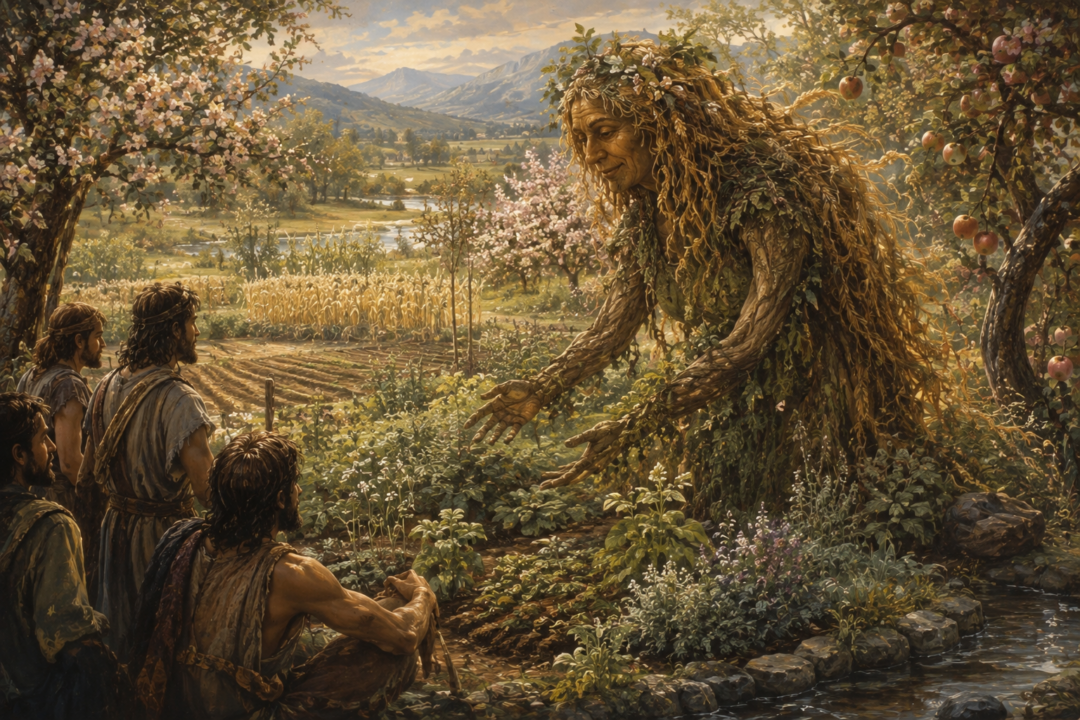
After crossing the Anduin, the Entwives established new gardens and tilled fields. Following the overthrow of the earlier Darkness, Treebeard remembers their country becoming rich and fertile, with fields full of corn.
Then comes an extraordinary detail.
Men learned their crafts from the Entwives and honoured them.
Treebeard does not give a complete history of agriculture among Men, so it would go beyond the text to claim that the Entwives invented all human farming. His statement is narrower: many Men learned the Entwives’ crafts.
But the implication remains significant.
The Entwives’ form of ecological knowledge was transferable to human communities.
The Ents’ world is harder to reproduce. Men may enter forests, but they do not ordinarily speak with trees as Ents do. The Entwives, by contrast, practiced skills involving cultivation, fields, fruitfulness, and deliberate arrangement.
Their knowledge could become culture.
In that sense, their gardens are not merely the female counterpart of Fangorn.
They are a bridge between the ancient world of the Ents and the settled world of Men.
Why Treebeard Thinks They Would Love the Shire
This makes Treebeard’s reaction to the Shire particularly revealing.
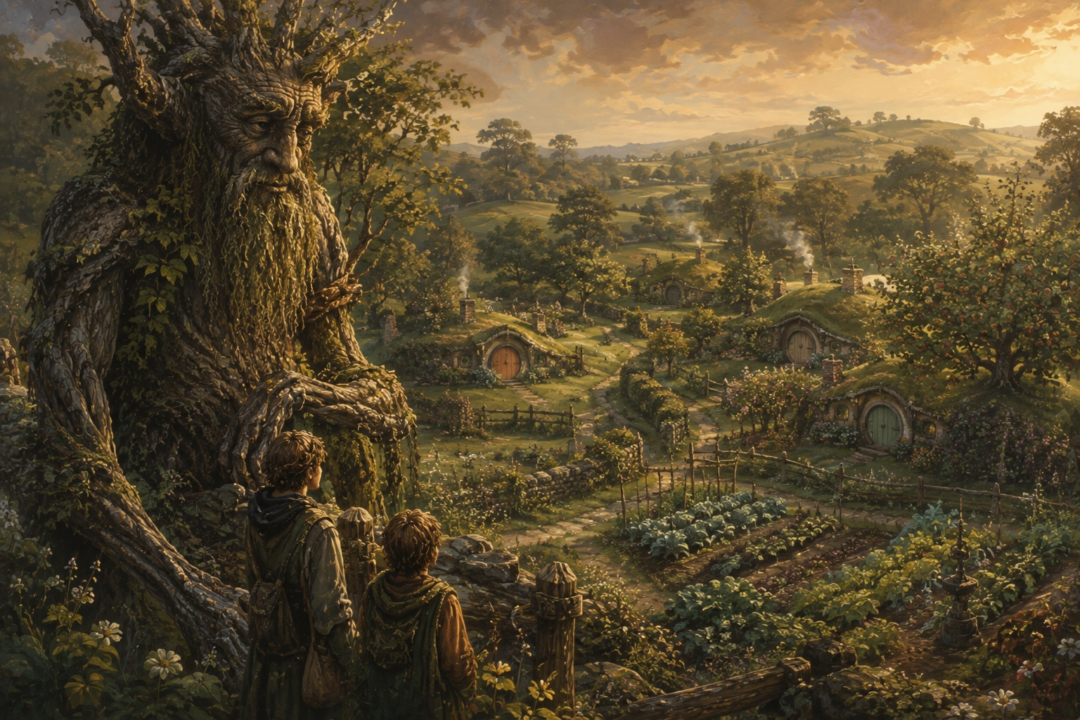
After hearing about the hobbits’ homeland, he believes the Entwives would probably have liked it.
The resemblance is easy to see.
The Shire is neither wilderness nor an industrial landscape. It contains fields, gardens, hedges, orchards, lanes, farms, and carefully inhabited countryside.
Hobbits alter the land constantly, but at their best they do so on a small scale.
They grow food.
They tend gardens.
They maintain boundaries.
They prize fertility, comfort, regular seasons, and peaceful continuity.
None of this proves that the Shire consciously preserves the Entwives’ traditions, nor does the text establish that hobbits learned cultivation from them.
The connection is thematic rather than genealogical.
The Shire shows that cultivation itself is not the enemy.
The real question is what kind of cultivation takes place.
The Entwives Are Not Early Sarumans
It is tempting to make the contrast too simple.
Ents respect nature. Entwives control nature. Saruman also seeks control. Therefore the Entwives must represent an early step toward the same error.
The text does not justify that conclusion.
Saruman’s Isengard is characterized by destruction, machinery, excavation, smoke, furnaces, and the consumption of trees as resources. His system damages the living world in pursuit of power and war.
The Entwives seek plenty and peace.
Their gardens produce life rather than devastation.
Their mistake—if “mistake” is even the right word—is not that they cultivate. Treebeard himself never describes their gardens as corrupt.
What emerges instead is a spectrum of relationships with the natural world.
Fangorn preserves wildness.
The Entwives cultivate fertility.
The Shire domesticates the landscape gently.
Isengard consumes it.
Mordor reduces much of it to sterility and exploitation.
These are not morally identical forms of control.
Middle-earth repeatedly asks not simply whether people change the world, but why they change it and what remains alive afterward.
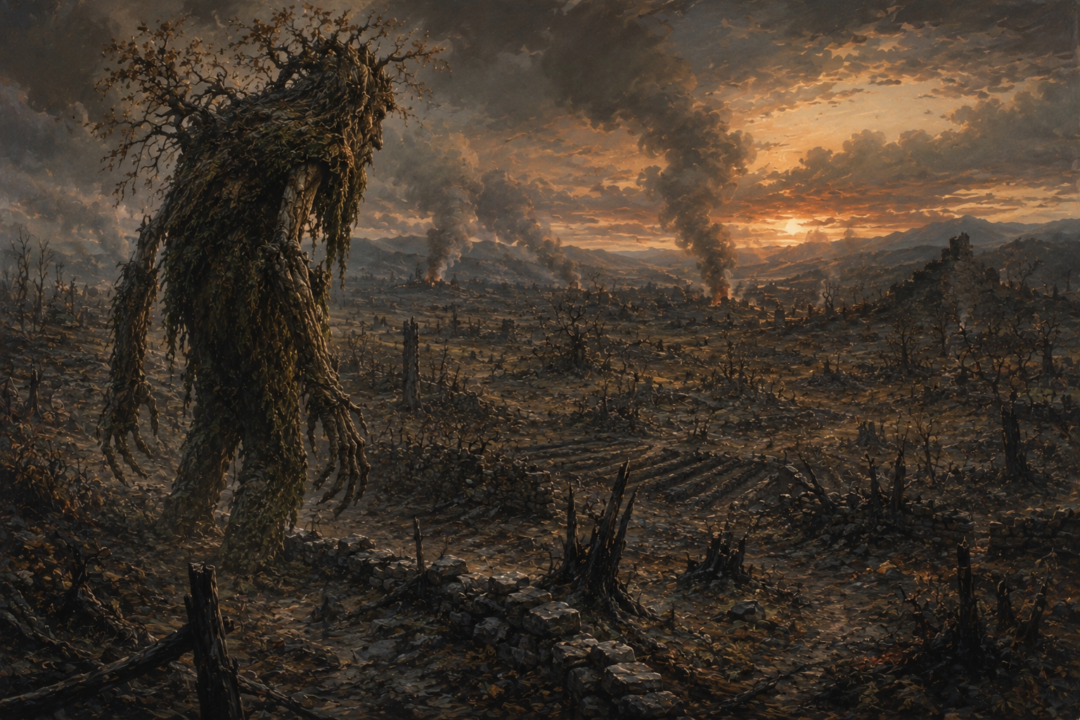
The Brown Lands Are the Cruel Answer
The deepest irony of the Entwives’ story is visible when the Fellowship travels past the Brown Lands.
This desolation was once associated with their fertile country.
Treebeard remembers discovering the region burned and wasted when he went searching for Fimbrethil during the time of the war between Sauron and the Men of the Sea—the conflict of the Last Alliance.
The ordered gardens had become barren ground.
The Entwives wanted things rooted in their proper places.
War uprooted everything.
They wanted plenty.
Their fields became waste.
They wanted peace.
Their country was destroyed in one of the greatest wars of the Second Age.
The reversal is almost painfully exact.
Later commentary in Tolkien’s letters suggests that the Entwives may in fact have been destroyed with their gardens during the War of the Last Alliance, though he left some possibility that survivors might have fled. Within the narrative itself, their fate remains unresolved.
Treebeard only knows that they are gone.
The garden did not fail because cultivation was inherently wrong.
It was overwhelmed by a power whose relationship with the world was far more destructive than either Entish wildness or Entwife cultivation.
Even the Ents’ Wilderness Is Dying
There is another cruel symmetry.
The Entwives’ gardens disappeared first.
But the Ents’ woods are disappearing too.
Fangorn is only a surviving remnant of forests that once stretched vastly farther. Treebeard remembers lands and trees that no longer exist. By the end of the Third Age, the Ents themselves understand that their people are fading.
Without the Entwives there are no new Entings.
Meanwhile, some Ents are becoming increasingly “tree-ish,” just as some trees can become more Entish.
So neither ecological vision wins.
The garden is devastated.
The forest contracts.
The people who represented these two relationships with growing things cannot reunite.
Their separation becomes part of the wider pattern of loss running through Middle-earth.
The Ent and Entwife Needed Each Other
The old song of the Ent and Entwife gives their disagreement a haunting conclusion.
Each voice praises its own landscape. One longs for woodland; the other for cultivated country. Yet the song eventually imagines a time when both may leave their separate paths and journey together toward the West.
Whether that reunion ever occurs is not established.
But the longing matters.
The story does not end by proving that the Ent was right and the Entwife wrong.
Instead, separation produces sterility.
Once their two worlds divide completely, the Entwives disappear and the Ents begin their long decline without offspring.
That does not mean the tale should be reduced to a literal ecological allegory. But one reading is difficult to avoid: Middle-earth loses something when wilderness and cultivation become entirely separated from one another.
The Ents know how to listen to the wild.
The Entwives know how to shape living abundance.
Neither resembles the Enemy, whose ultimate tendency is toward domination, exhaustion, and waste.
Their tragedy is not that one ecology defeats the other.
It is that the two ways of loving the earth never find their way back to each other before the world changes beyond recognition.
Sources & Notes
- The Encyclopedia of Arda — Entwives: reference entry on their separation from the Ents, preference for ordered gardens and fields, teaching of agriculture to Men, and disappearance from the Brown Lands — https://www.glyphweb.com/arda/e/entwives.php
- The Encyclopedia of Arda — Ents: overview of the tree-shepherds’ origin, relationship with trees, dwindling after the loss of the Entwives, and role in Fangorn — https://www.glyphweb.com/arda/e/ents.php
- The Encyclopedia of Arda — Fangorn Forest: history and ecology of the ancient forest preserved under Treebeard and the Ents, including its Huorns and surviving wild character — https://www.glyphweb.com/arda/f/fangornforest.php
- The Encyclopedia of Arda — Brown Lands: geographic history of the Entwives’ former gardens and the devastation that left their cultivated country barren — https://www.glyphweb.com/arda/b/brownlands.php
Sources document the Entwives’ cultivated gardens and teaching, the Ents’ tree-shepherding tradition, and the contrasting fates of Fangorn and the former gardens in the Brown Lands.