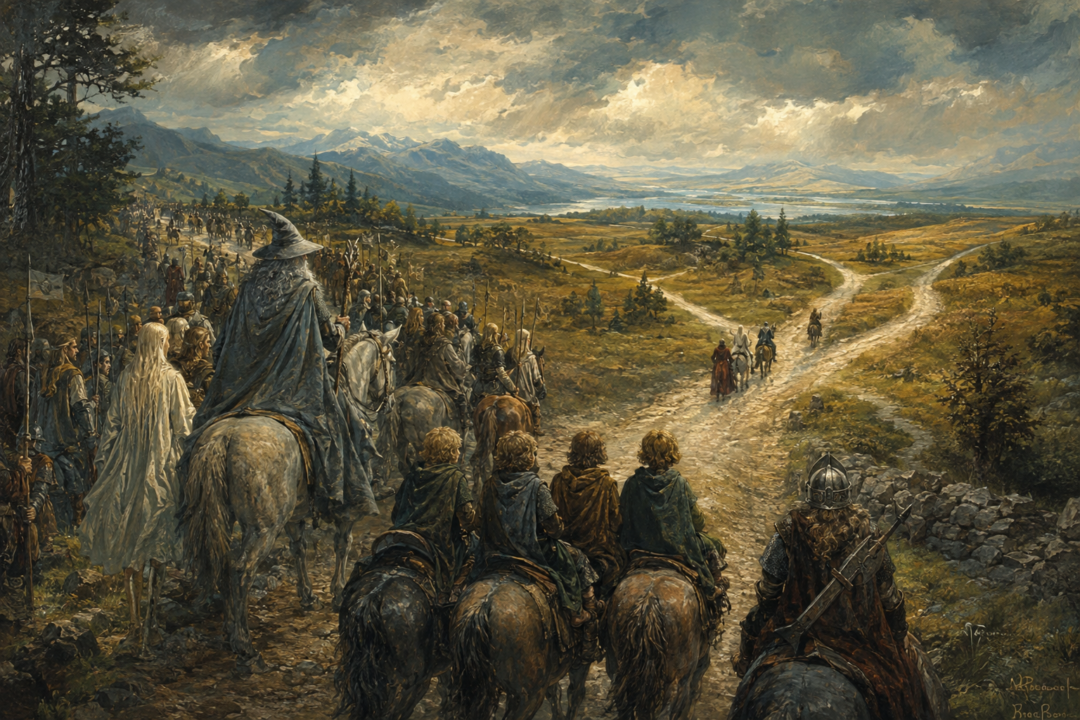
When Frodo, Sam, Merry, and Pippin finally approach the Shire again, something strange has happened to their company. The great host surrounding them after Sauron’s defeat is gone. Aragorn is gone. Legolas and Gimli are gone. Galadriel and Celeborn are gone. Elrond and his household have been left behind. Finally even Gandalf turns aside.
No council dissolves the company. No leader declares that the journey is over. Nobody formally dismisses the hobbits.
Instead, their companions disappear from the road one parting at a time.
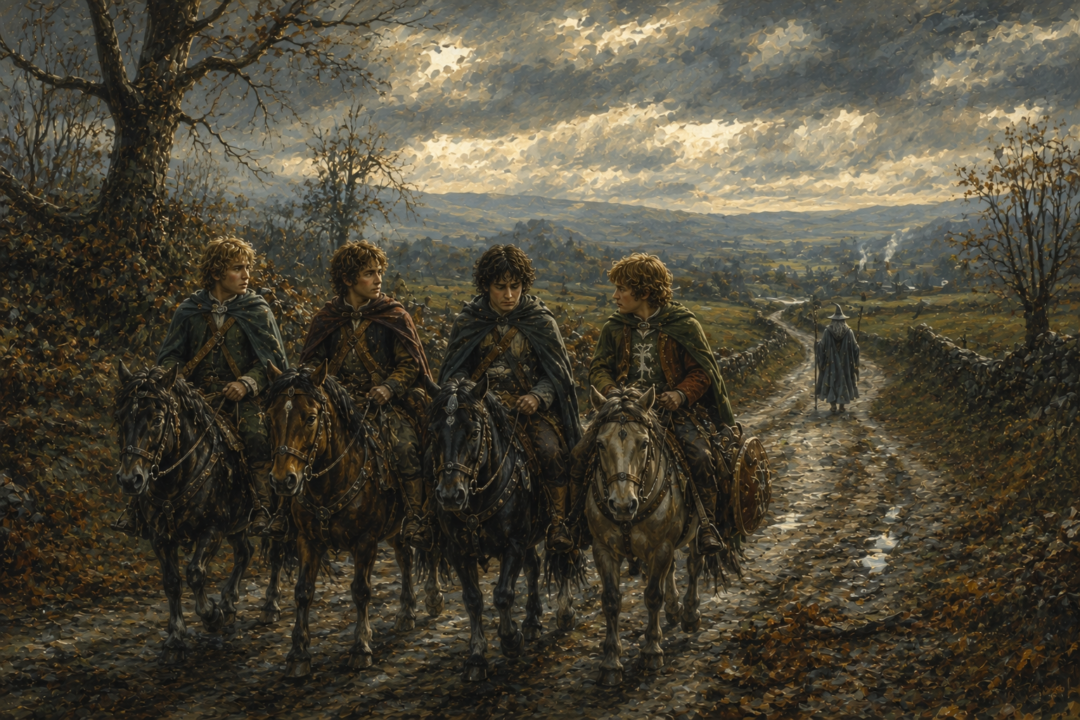
By the time the four reach the borders of their own country, they have almost returned to the shape in which their adventure began: four hobbits travelling together through the quiet lands west of Bree.
Yet they are not the same four hobbits.
That is precisely why the shrinking company matters. The homeward journey quietly removes the protection of the great until the smallest members of the War of the Ring must face their final danger alone.
Victory Creates a Company That Cannot Last
After the destruction of the Ring and Aragorn’s coronation, the surviving friends are briefly gathered within an extraordinary world of kings, Elves, warriors, and heroes.
The hobbits who once slipped frightened out of the Shire now travel among some of the greatest figures remaining in Middle-earth.
But this company has no new Fellowship-like purpose.
The original Fellowship was created at Rivendell for a specific task: the Ring had to be taken toward its destruction, even though the road and final decisions could not all be planned beforehand. After Sauron falls, that necessity is gone.
The travellers now have different homes, duties, and destinations.
Aragorn has become King. Éomer has inherited the kingship of Rohan. Faramir and Éowyn have their own future. Legolas and Gimli have journeys they still wish to make. Galadriel and Celeborn must return toward Lórien. Elrond returns to Rivendell.
And the hobbits want the Shire.
So the homeward road does not resemble a military withdrawal under a single commander. It resembles a great river gradually dividing into smaller streams.
Each traveller reaches the place where his or her road naturally turns away.
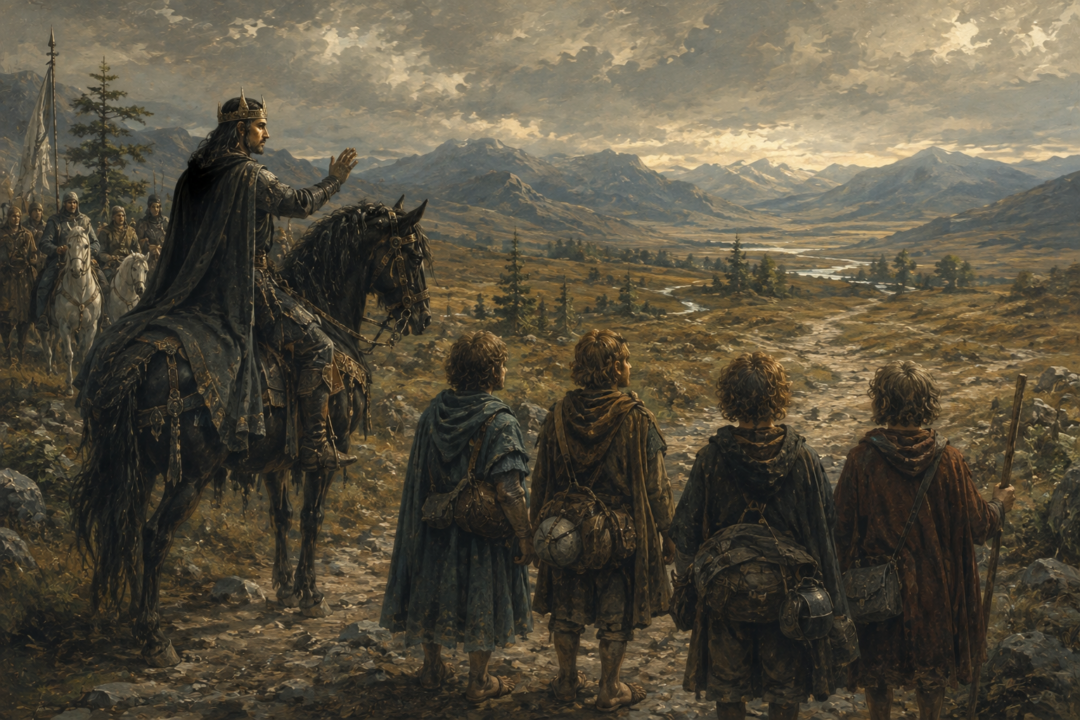
Aragorn’s Parting Removes the King
One of the most important separations occurs after the travellers have passed through Rohan and visited Isengard.
Aragorn cannot simply accompany Frodo indefinitely.
His wandering years are over. He now bears responsibilities that did not belong to Strider. The restored King has a realm to govern.
When he finally parts from the northbound company, something larger than a friend is being removed from the hobbits’ immediate world.
For much of their journey, powerful figures have stood between them and dangers beyond their understanding. Aragorn was among the first. At Bree, when the hobbits were inexperienced travellers being hunted by the Nazgûl, Strider became their guide through the wilderness.
Now the relationship has changed.
Aragorn does not need to escort them to their front door.
The King turns back toward his kingdom, while the hobbits continue west.
That difference is easy to overlook. The early Frodo desperately needed Strider. The returning Frodo can say farewell to King Elessar and keep walking.
Legolas and Gimli Follow Their Own Road
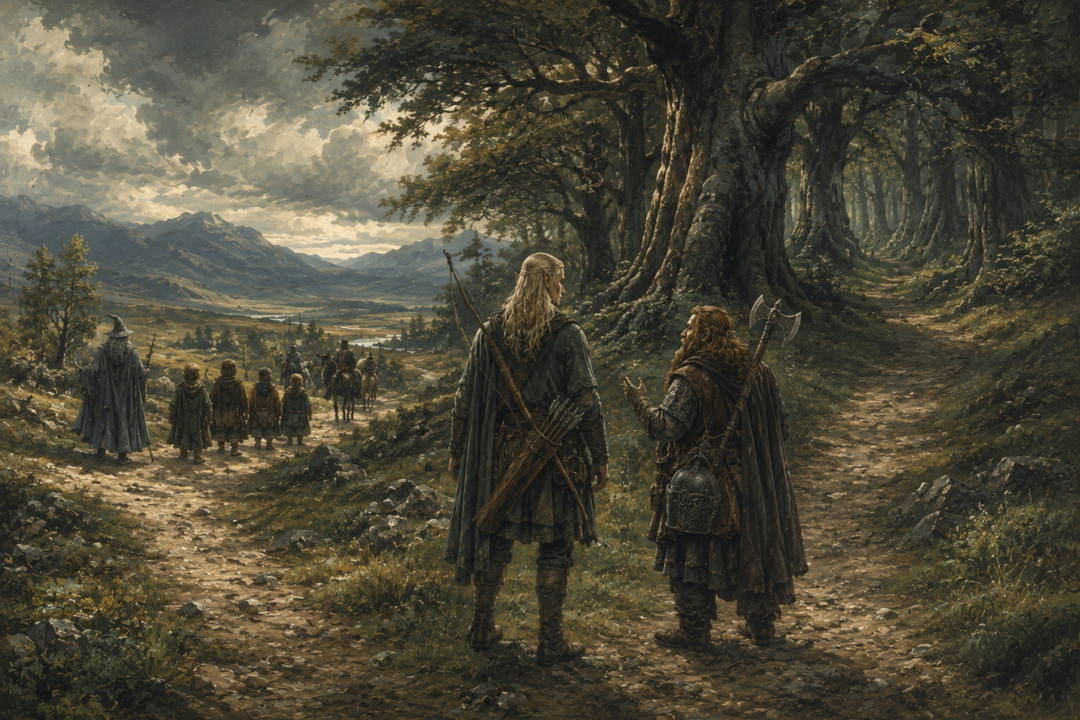
Legolas and Gimli also leave the company rather than being released from it.
Their friendship has developed its own unfinished business.
Earlier, Gimli had spoken passionately of the Glittering Caves of Aglarond, while Legolas longed for Gimli to see Fangorn. On the homeward journey, those promises can finally be fulfilled. They visit the caves, and later the two depart from the larger company to travel through Fangorn together.
It is a wonderfully ordinary reason for two heroes to leave.
They are not summoned to another battle. No emergency separates them from Frodo. Their road simply becomes their own.
This is part of the deeper pattern of the return journey. During the war, necessity repeatedly forces people together. After the victory, freedom allows them to separate.
Legolas and Gimli can now choose where they wish to go.
The hobbits can do the same.
The Fellowship's friendship survives even when its members no longer need to share the same road.
Galadriel and Celeborn Turn Toward Lórien
The company becomes smaller again when Galadriel and Celeborn depart toward their own lands.
Before this, the travellers encounter Saruman and Gríma wandering on foot. Saruman is diminished but not harmless, and his conversation contains enough bitterness to remind the reader that defeating Sauron has not removed every consequence of the war.
Then the Elves turn away.
This separation carries a different emotional weight.
Galadriel is not merely another travelling companion. She belongs to the older powers of Middle-earth whose time is drawing toward its end. The destruction of the One Ring has defeated Sauron, but it also has consequences for the Three Rings and the realms preserved through their power.
The homeward journey is therefore also a journey through a world beginning to divide according to its future.
Aragorn belongs to the restored kingdom of Men.
Galadriel belongs to an Elvish world that is passing.
Frodo belongs to neither completely anymore, although he does not yet fully understand what that will mean.
The road west is becoming increasingly Hobbit-sized.
Rivendell Is Another Ending, Not a New Beginning
At Rivendell, Frodo encounters perhaps the clearest evidence that returning geographically does not mean recovering the past.
Bilbo is there.
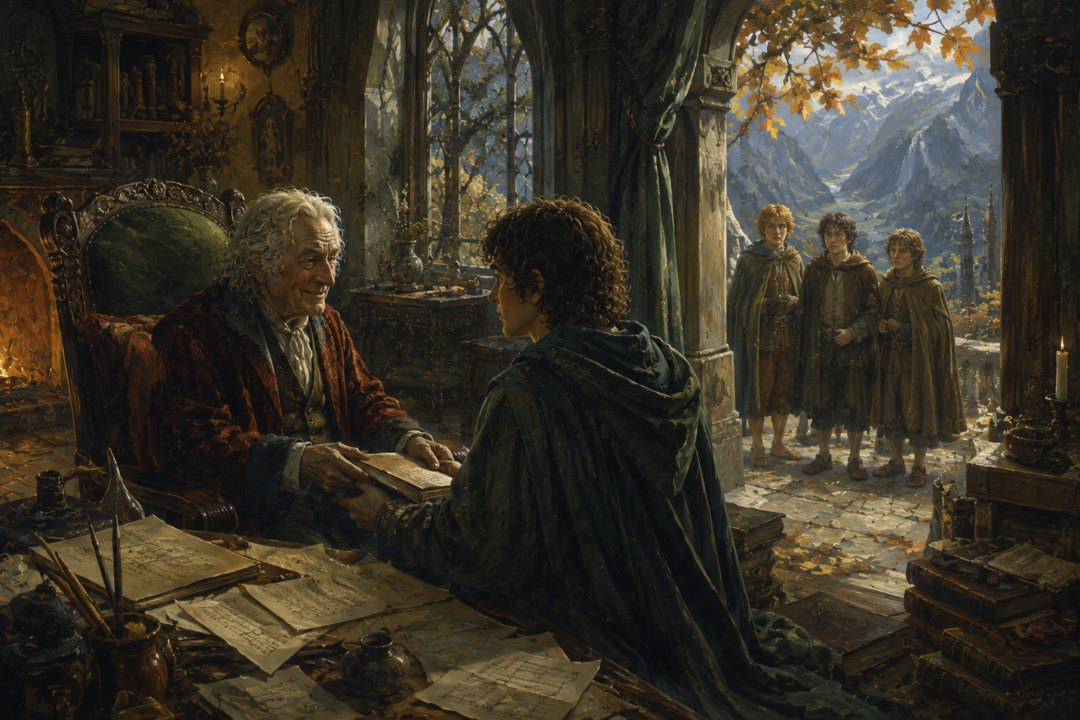
But the Bilbo Frodo finds is very old. He remains interested in their adventures, his papers, poetry, and lore, yet age has overtaken him. He does not become the fifth hobbit on the road back to the Shire.
That matters because Rivendell was where the outward journey expanded.
Frodo arrived there after surviving the pursuit of the Nazgûl. Then the Council of Elrond transformed his private burden into the central mission of a great company. The Fellowship departed Rivendell with representatives of several peoples.
On the return journey, Rivendell does almost the opposite.
It does not assemble another company around Frodo.
It gives him rest, memories, Bilbo’s writings, and another farewell.
Frodo then leaves with Sam, Merry, Pippin, and Gandalf.
The great company has contracted almost completely.
Only one protector remains.
Gandalf Leaves Because the Hobbits No Longer Need Him
The decisive parting comes after Bree.
Gandalf chooses not to accompany the four hobbits all the way into the Shire. He intends to visit Tom Bombadil, with whom he wishes to speak.
But his explanation to the hobbits is even more important than his destination.
He makes clear that they no longer require his help as they once did. They have grown.
This is not simply a compliment.
It is tested almost immediately.
The Shire they approach is not the Shire they left. News at Bree has already suggested that the peaceful North has suffered disturbances. When the hobbits finally reach home, they discover rules, intimidation, destruction, armed Men, and eventually Saruman himself behind the corruption.
The younger versions of these characters would almost certainly have looked toward Gandalf or Aragorn.
Neither is there.
The absence is deliberate within the story's structure, but the text does not require us to imagine Gandalf secretly arranging every detail as a test. He has his own reasons for leaving, and he expresses confidence in the hobbits.
What follows proves that confidence justified.
The Four Who Return Are Not the Four Who Left
Near the end of the homeward road, Merry observes that only the four hobbits who originally set out together remain.
The symmetry is striking, though not exact in every stage of the original journey.
Frodo, Sam, Merry, and Pippin are together again.
But the resemblance exposes how much has changed.
Merry is now a knight of Rohan and has learned leadership in war.
Pippin is a Guard of the Citadel and has survived the siege of Gondor and the final campaign against Mordor.
Sam has crossed Mordor, resisted the Ring when it came into his possession, and carried Frodo when Frodo could go no farther.
Frodo has endured wounds and burdens that victory has not simply erased.
When they enter familiar country in foreign-looking gear, they themselves have almost forgotten how extraordinary they appear to ordinary hobbits and Bree-folk.
That is the hidden purpose of the shrinking company.
Remove Aragorn, and Merry and Pippin must exercise authority themselves.
Remove Legolas and Gimli, and there are no legendary warriors to win their fights.
Remove Galadriel and Elrond, and there is no Elvish refuge.
Remove Gandalf, and there is no wizard to tell them what to do.
What remains is what the journey has made of them.
The Scouring Only Works Because the Great Are Absent
The Scouring of the Shire would mean something very different if Gandalf rode into Hobbiton beside them.
It would become another rescue.
Instead, the hobbits discover that the evil afflicting their homeland is smaller than Sauron but still real: petty tyranny, fear, violence, needless destruction, and Saruman’s vindictive malice.
They deal with it themselves.
Merry and Pippin help organize resistance. Sam becomes deeply involved in restoring what has been damaged. Frodo, meanwhile, increasingly acts as a restraint upon vengeance and unnecessary killing.
Their different experiences during the War of the Ring now produce different kinds of strength.
This is why the company does not need a formal dismissal.
The quest ended when the Ring was destroyed.
What remains is the harder problem of returning to ordinary life after extraordinary events.
One companion after another reaches the point where his road diverges. Each farewell strips away another layer of the epic world surrounding the hobbits.
Eventually there are only four travellers on a road toward home.
Merry sees something dreamlike in that return. Frodo experiences it differently, as though ordinary life itself has become strange.
That difference foreshadows the final truth of his homecoming.
Merry, Pippin, and Sam can eventually build lives within the restored Shire.
Frodo can help save it, but saving home does not mean that he can fully return to the person who once lived there.
The shrinking company therefore does more than bring the story back to its starting point.
It reveals what the journey has cost.
The great figures fall away without orders or ceremony because their shared task is finished. The four hobbits continue because theirs, unexpectedly, is not.
They still have to discover whether home can be recovered.
And they must do it without anyone greater walking ahead of them.
Sources & Notes
- Wikipedia — The Return of the King: sourced synopsis of the novel’s closing movement, including the companions’ return journey, the partings, and the hobbits’ return to the Shire — https://en.wikipedia.org/wiki/The_Return_of_the_King
- Wikipedia — The Scouring of the Shire: sourced account of the four hobbits returning without the great powers and organizing the Shire’s liberation themselves — https://en.wikipedia.org/wiki/The_Scouring_of_the_Shire
- Wikipedia — Frodo Baggins: sourced overview of Frodo’s homeward journey, the Scouring, his refusal to answer violence with vengeance, and the lasting wounds that distinguish the returning hobbits from those who left — https://en.wikipedia.org/wiki/Frodo_Baggins
Sources support the chapter sequence, gradual partings, and the four hobbits facing the Scouring without their former protectors.