The Lord of the Rings Pretends You Are Reading a Translation of an Ancient Copy
Open The Lord of the Rings and it appears to be a novel about a hobbit carrying a Ring into Mordor. Look more closely at its Prologue and Appendices, however, and the book quietly claims to be something stranger.
The story presents itself as the surviving form of an older record: written principally by hobbits, preserved by their descendants, copied by scribes, annotated in Gondor, and ultimately rendered into the language of the modern reader.
In other words, within its own literary framework, The Lord of the Rings is not simply a story being told to us. It is a translated historical document whose original manuscript is no longer available.
That conceit explains some of the most unusual features of Middle-earth—from translated place-names to disagreements between sources—and it changes the feeling of the entire story. We are supposedly reading something that has survived the world it describes.

The Book Frodo Leaves Behind
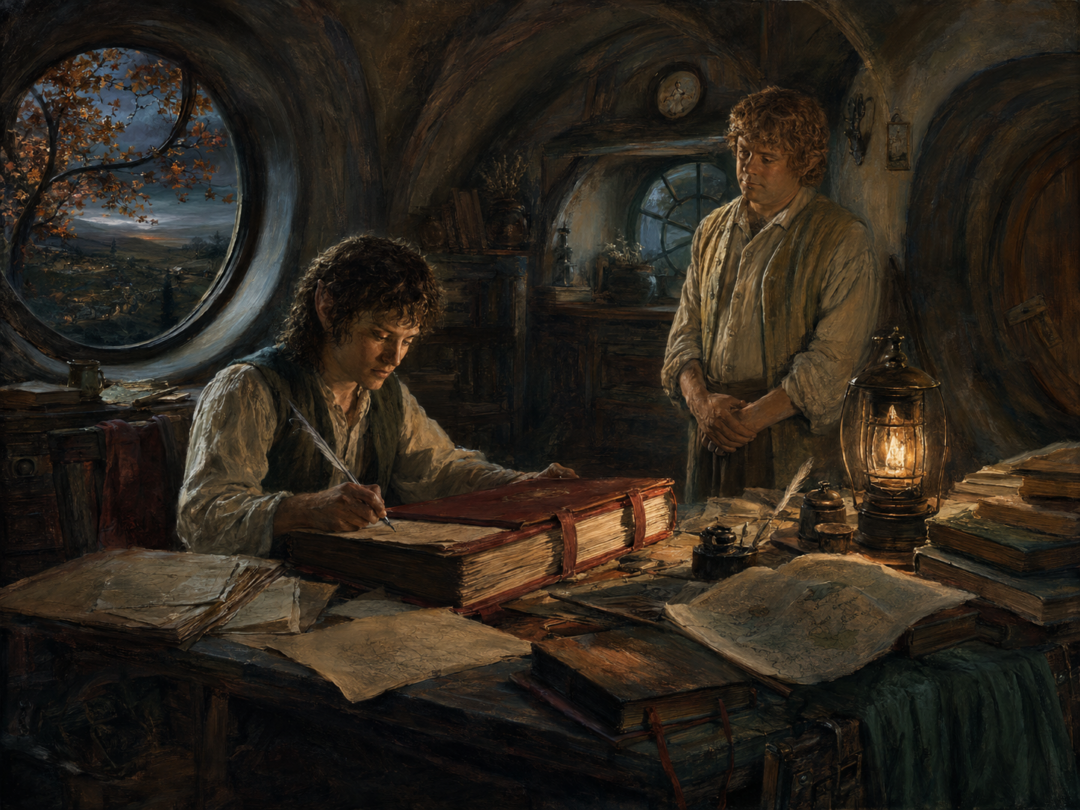
Near the end of The Lord of the Rings, Frodo does something easily overshadowed by his departure from Middle-earth: he passes a book to Sam.
Bilbo had begun the record. Frodo had continued it, describing the War of the Ring and the journey that followed Bilbo’s earlier adventure. Sam became its final keeper and contributed to the tradition that would later be known as the Red Book of Westmarch.
The Prologue’s “Note on the Shire Records” treats this book not as a metaphor but as an actual historical source within Middle-earth. The Red Book becomes the foundation from which the story known to readers has supposedly descended. Bilbo’s material included his account of his journey and his three volumes of “Translations from the Elvish,” while Frodo’s portion contained the history of the War of the Ring.
This creates an important distinction.
The Lord of the Rings is not framed as an omniscient voice giving us direct access to the past. It is framed as a record made by people who actually lived through part of that past.
That difference introduces memory, authorship, preservation, and even uncertainty into the structure of the legend.
We Do Not Supposedly Possess the Original
The conceit becomes more elaborate because the Red Book itself is not presented as the immediate object behind our modern text.
The Prologue explains that copies were made.
One particularly important textual line led through the Thain’s Book, a copy associated with Great Smials. That version had connections with Gondor and benefited from corrections and annotations concerning names, languages, and other matters preserved in southern records.
Then, in the year 172 of the Fourth Age, a royal scribe named Findegil completed another copy. Findegil is identified as a King’s Writer, and his manuscript preserved material of exceptional importance, including the complete version of Bilbo’s Translations from the Elvish.
The fictional transmission therefore has layers.
Events happen.
Participants write about them.
Their writings are collected.
The book is copied.
Another copy is corrected against outside records.
A later scribe copies that version.
And the work reaching us is presented as descending through that manuscript tradition.
This resembles the way many genuine ancient and medieval works survive: not as an author’s original pages, but through copies of copies.
That is the deeper trick. Middle-earth is given not merely a history, but a textual history.
Even the English Is Supposed to Be a Translation
The illusion goes further still.
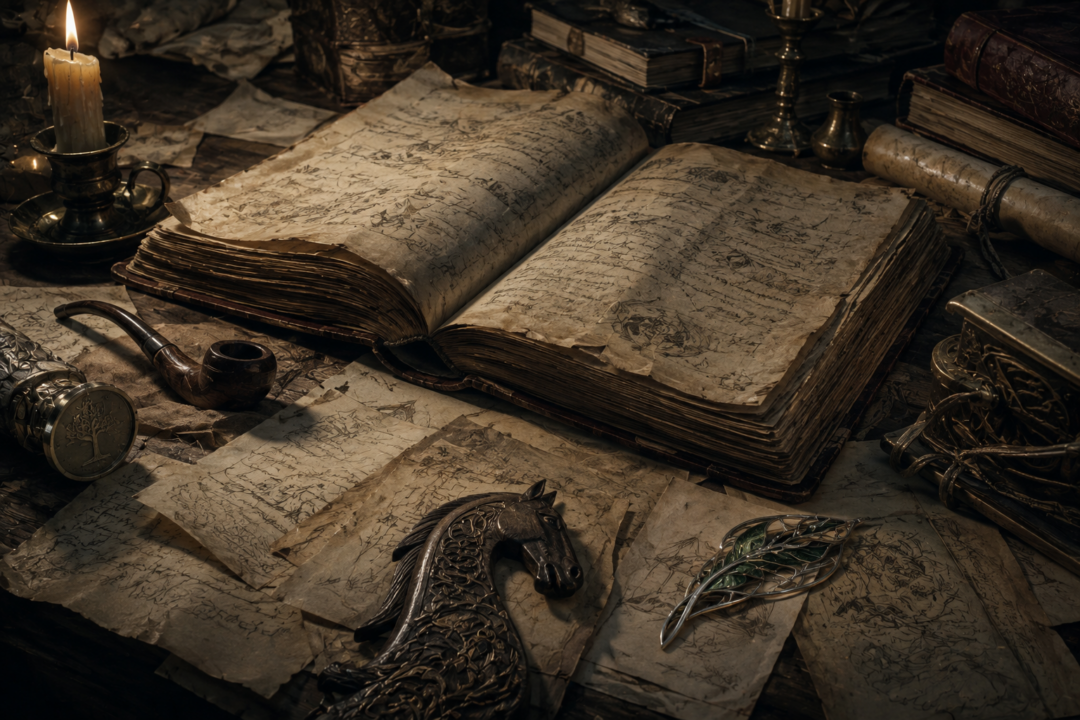
Appendix F explains that the Common Speech of Middle-earth—Westron—has been represented by English. The characters were therefore not, within the fictional framework, actually speaking modern English.
This applies even to many familiar names.
The forms presented to readers are sometimes intended to reproduce the meaning, social effect, or linguistic relationship of names in the supposed original languages. “Brandybuck,” for example, represents the Westron form Brandagamba rather than simply being the untouched historical name of the family. The same principle extends throughout the treatment of Hobbit names and place-names.
The language of Rohan demonstrates the method particularly clearly.
The Rohirrim are not literally imagined as Anglo-Saxons speaking historical Old English. Their language is represented using Old English because its relationship to Westron can thereby suggest something of the relationship between the speech of Rohan and the Common Speech.
So when Théoden sounds linguistically older than a hobbit from the Shire, the effect is not simply decorative archaism. It belongs to the fictional act of translation. The published text attempts to reproduce relationships between languages rather than pretending every original word has reached us unchanged.
An essay hosted by the Tolkien Estate likewise describes Appendix F as spelling out consequences arising from the work being purportedly translated from the Red Book into modern English.
The Tolkien Estate
The Hobbit Becomes a Source With a Problem
This manuscript framework also helps explain one of the strangest features connecting The Hobbit and The Lord of the Rings.
Bilbo is not merely the protagonist of the earlier adventure. Inside the later framework, he is also one of its authors.
That matters because Bilbo once gave a false account of how he obtained the Ring.
In the version revealed by The Lord of the Rings, Bilbo concealed the uncomfortable truth that Gollum had not voluntarily given him the Ring as a present after their riddle contest. Gandalf recognizes that this lie is significant because Bilbo is normally unusually honest. The Ring has already begun influencing the way he thinks about possession.
The revised history makes the contradiction part of the fictional record itself.
Bilbo told one version. Later knowledge exposed the distortion. The text can therefore treat a discrepancy not simply as an external revision but as something belonging to the history of its source.
This does not mean every inconsistency in the legendarium should be explained as a deliberate scribal error. That would go beyond what the texts establish. But in this particular case the narrative explicitly makes Bilbo’s misleading account important to the story of the Ring.
The supposed manuscript has an author who was capable of being wrong.
Why Some Passages Sound Like History Rather Than a Novel
Once the Red Book framework is noticed, several stylistic peculiarities become easier to understand.
The Appendices contain genealogies, calendars, linguistic explanations, chronologies, royal histories, fragments of traditions, and information extending far beyond Frodo’s personal experience.
That material makes sense because the fictional textual tradition did not stop with one hobbit’s eyewitness memoir.
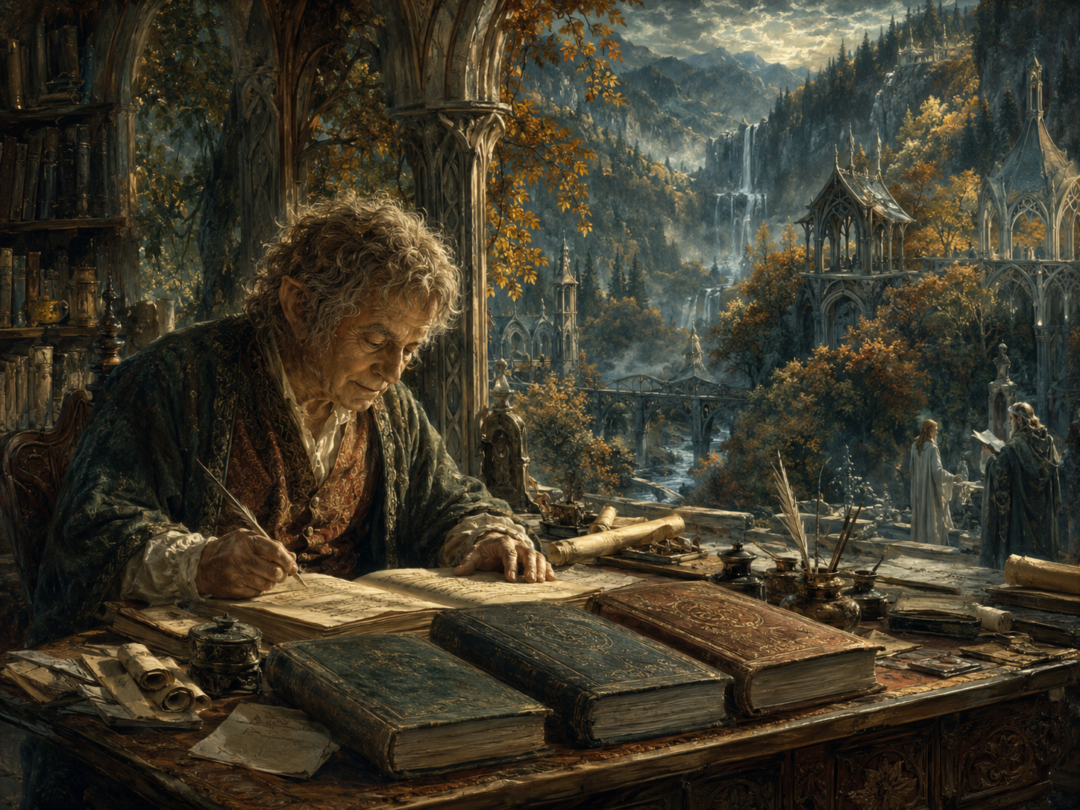
Bilbo researched older lore in Rivendell. The Red Book tradition incorporated extensive historical material. Copies connected with Gondor could be checked and annotated using records unavailable in the Shire. The final result therefore resembles a compilation assembled from sources of different ages and origins rather than a single uninterrupted narrative voice.
This also explains why some events are described with extraordinary intimacy while remote ages appear through compressed annals and inherited tradition.
The fall of Boromir can be remembered as lived tragedy.
The rise and destruction of ancient kingdoms must be reconstructed as history.
Middle-earth feels old partly because its own inhabitants do not possess the past equally. Some things are memories. Some are songs. Some are written records. Some have become legends.
The Manuscript Creates Distance From the Great Heroes
There is another, subtler consequence.
If the book is a surviving document from Middle-earth, then Aragorn, Gandalf, Galadriel, and Sauron are not presented merely as characters standing eternally in the dramatic present.
They have already become figures in history.
Even the victorious kingdom of Aragorn belongs to a vanished age from the imagined perspective of the reader.
The framing therefore places loss around the entire narrative before the first chapter properly begins. We know, structurally, that the world capable of producing the Red Book has passed away.
That feeling reaches its fullest expression in the Fourth Age. Elves depart. great figures of the Third Age disappear. The Shire continues, but memories must increasingly be preserved through records rather than living witnesses.
The book in Sam’s hands becomes, in that sense, part of the struggle against forgetting.
Not against Sauron—his defeat has already been achieved—but against time.
Middle-earth Survives as Something Copied
The deepest illusion in The Lord of the Rings may therefore be neither its maps nor its invented languages.
It is provenance.
The narrative behaves as though someone had to preserve it.
A hobbit wrote what he remembered. Other hands inherited his pages. Scribes copied them. Scholars corrected names. Records from distant kingdoms supplemented local knowledge. Languages were transformed for later readers.
By the time the story reaches us, the Fellowship itself has supposedly vanished into an immense historical distance.
That is why the Red Book conceit is more than a playful framing device. It reinforces one of the central emotional movements of the whole work: great things pass away, and what remains depends upon memory, testimony, and preservation.
The Ring is destroyed.
The kingdoms change.
The Elves depart.
Frodo leaves Middle-earth.
Eventually even the people who remembered these things firsthand are gone.
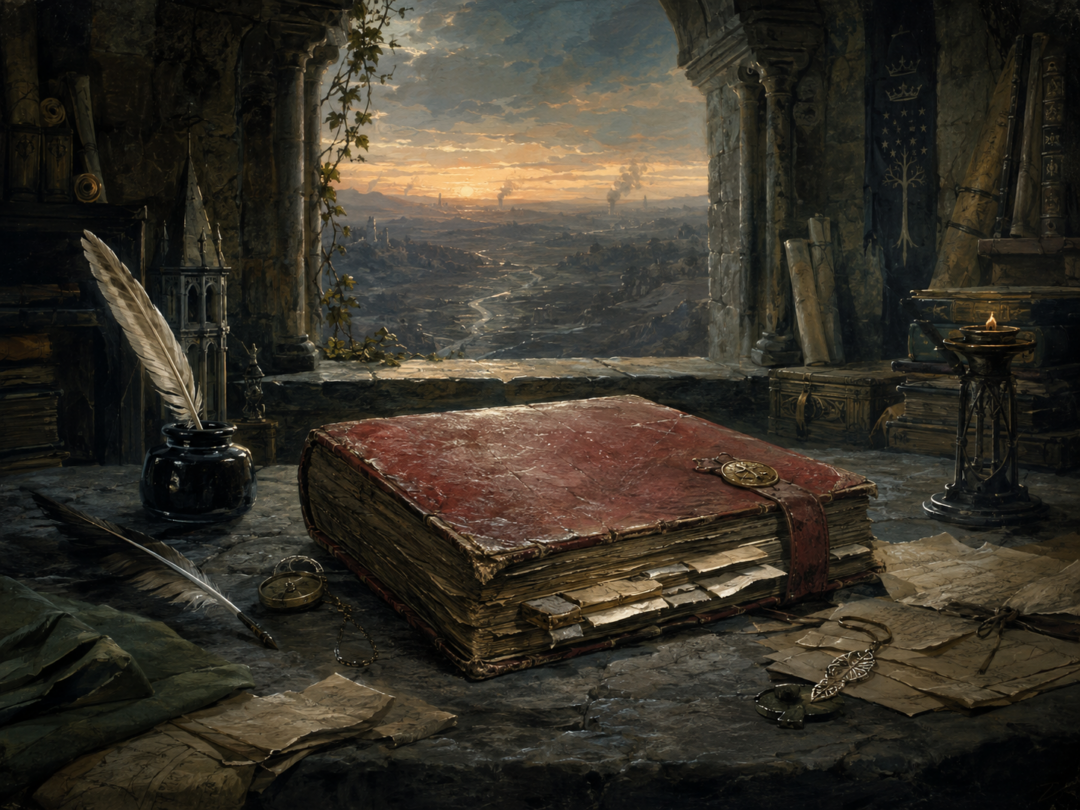
What remains is a book.
And according to the fiction The Lord of the Rings constructs around itself, even that book reaches us only because somebody, centuries after the heroes were dead, cared enough to make another copy.
Sources & Notes
- The Encyclopedia of Arda — Red Book of Westmarch: authorship, contents, copying, and loss of the original — https://www.glyphweb.com/arda/r/redbook.html
- The Encyclopedia of Arda — Thain’s Book: the Great Smials copy and its relationship to the Red Book — https://www.glyphweb.com/arda/t/thainsbook.html
- The Encyclopedia of Arda — Findegil: the King’s Writer who completed the important copy in Fourth Age 172 — https://www.glyphweb.com/arda/f/findegil.html
- The Encyclopedia of Arda — Westron: Tolkien’s representation of the Common Speech through translated English — https://www.glyphweb.com/arda/w/westron.html
Primary-text anchors: The Lord of the Rings, Prologue, “Note on the Shire Records” (the Red Book, Thain’s Book, and Findegil manuscript tradition), and Appendix F II, “On Translation” (English for Westron and the translated treatment of names and languages).