On the Pelennor Fields, Éowyn has already done the impossible. She has stood between the fallen Théoden and the Lord of the Nazgûl, faced the terror that broke seasoned warriors, and helped destroy the Witch-king of Angmar.
Then she falls.
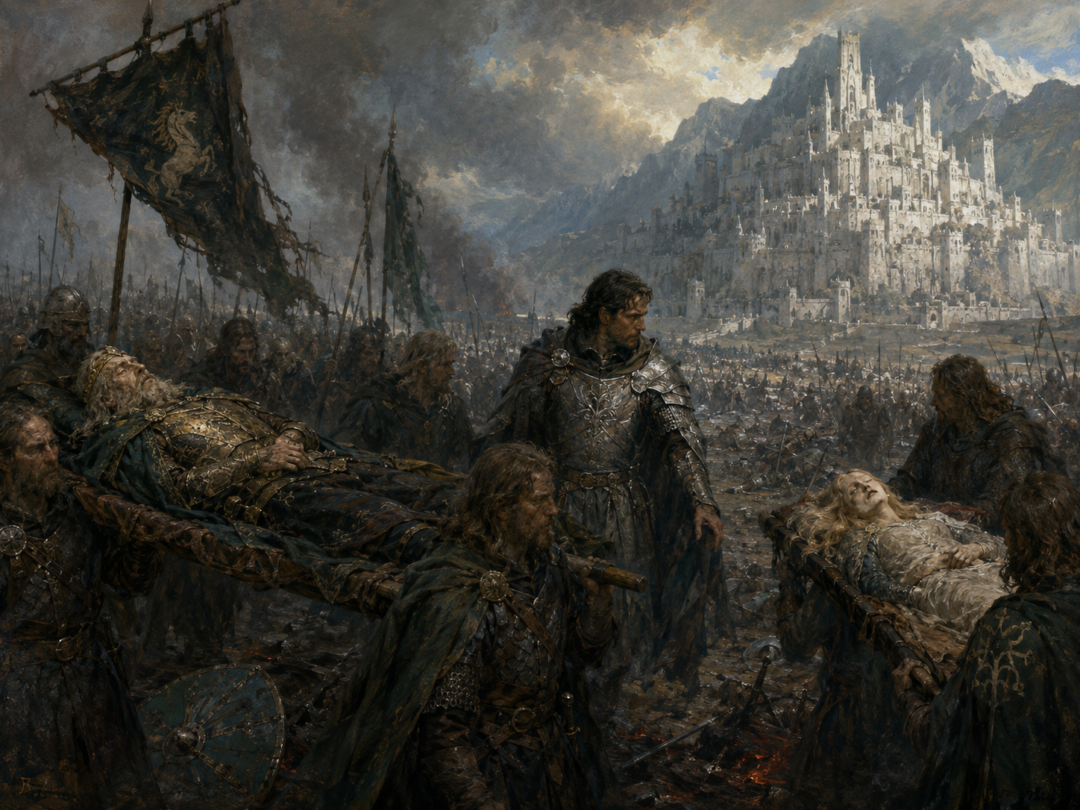
By the time the dead and wounded are gathered, the distinction between the two has become frighteningly thin. Éowyn is pale, cold, and apparently lifeless. The men carrying her believe they are bearing another body from the battlefield.
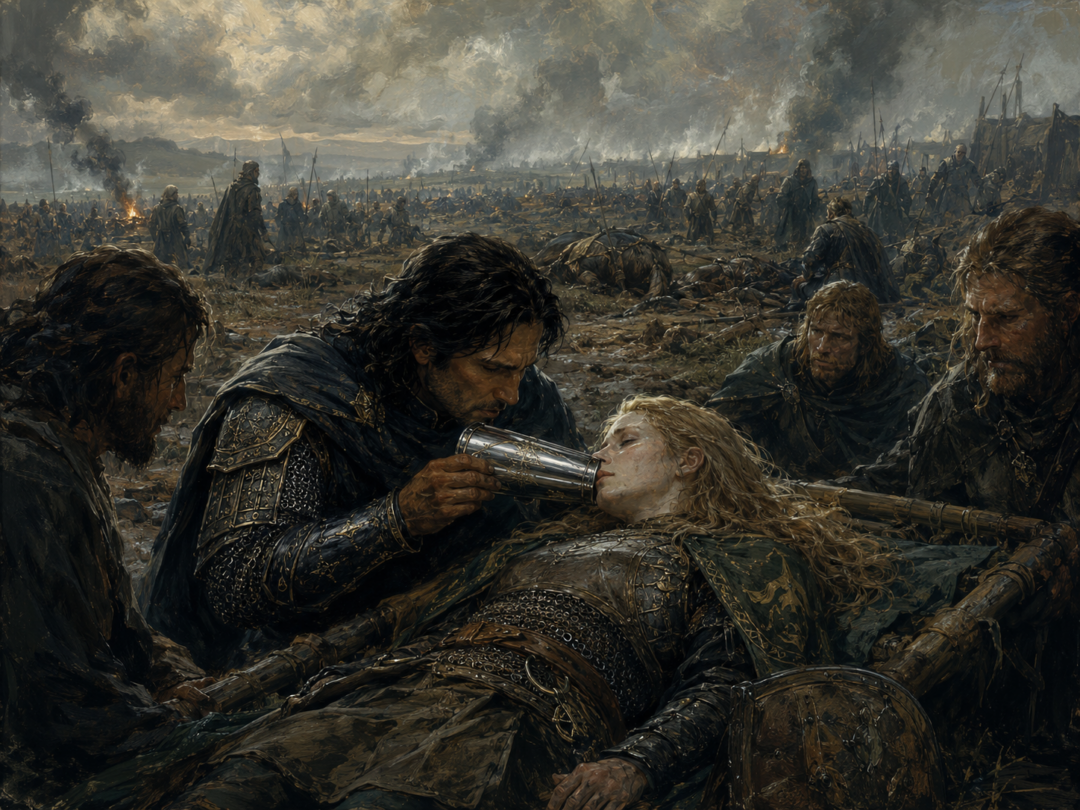
Prince Imrahil of Dol Amroth sees something they have missed.
He bends down, takes the bright vambrace from his arm, and holds it before Éowyn's lips. A faint mist appears upon the polished metal.
She is breathing.
The moment lasts only a few lines, yet it is one of the most revealing small scenes in The Return of the King. Imrahil does not miraculously heal Éowyn, nor does he possess some supernatural power to perceive life. What distinguishes him is attention: amid slaughter, urgency, and assumptions about death, he actually tests whether the woman before him is beyond saving.
And that small act changes everything.
Éowyn Looks Dead Because She Is Very Near Death
The bearers' mistake is understandable.
Éowyn has suffered far more than an ordinary battlefield wound. She confronts the Witch-king at close range and strikes the final blow after Merry's sword has wounded him. Her shield-arm is broken, and she collapses after the encounter.
More importantly, those who directly confront the Nazgûl may fall beneath what the narrative calls the Black Shadow or Black Breath. In the Houses of Healing, Éowyn, Merry, and Faramir are all treated for conditions connected with the Enemy's shadow, though their individual wounds and circumstances differ. Aragorn eventually uses athelas while calling them back from darkness.
Éowyn therefore does not merely look like someone who has fainted.
Her life has retreated so far that ordinary observation fails to detect it.
The text makes the battlefield confusion even more convincing by placing her beside Théoden, who truly is dead. Both have fallen in the same terrible encounter. Both belong to the royal House of Rohan. Both are carried away after the charge of the Rohirrim has turned from triumph into grief.
For men hastily collecting the fallen amid thousands of casualties, the conclusion seems obvious.
But it is wrong.
Imrahil Does Not Simply Accept What Everyone Else Assumes
When Imrahil encounters the bearers, he learns that they are carrying Théoden and the woman found beside him.
The crucial thing is what happens next.
He does not merely look at Éowyn and pronounce her alive. He performs a simple test. He brings the polished surface of his vambrace close enough to her mouth that even an extremely faint breath will reveal itself as moisture upon the metal.
That detail matters because it removes the need for any mystical explanation.
Imrahil does not have a special supernatural perception unavailable to ordinary Men. The scene instead presents him as unusually observant and unwilling to surrender a life to appearances. Tolkien Gateway's summaries likewise describe Imrahil as recognizing that Éowyn still lived and ordering that she be taken for healing.
The bearers see a dead woman.
Imrahil asks whether she is actually dead.
That difference between assumption and examination is the whole scene.
Why Imrahil Is the Perfect Character for This Moment
The choice of Imrahil is significant.
He is Prince of Dol Amroth, one of Gondor's greatest lords, and he arrives at Minas Tirith leading the knights and men of his fief. During the crisis following Denethor's withdrawal from command, Imrahil becomes one of the principal leaders defending the city.
Yet his nobility is consistently expressed through conduct rather than display.
On the Pelennor, surrounded by events of enormous military importance, he gives his attention to one apparently dead stranger.
At this point he does not even know that the fallen warrior is Éowyn.
That makes the episode stronger.
He does not investigate because he recognizes a famous princess whose survival matters politically. He notices because there remains the possibility that a human being is alive.
One reasonable reading is that the episode illustrates a form of nobility repeatedly valued throughout the story: the ability to preserve care and discernment when catastrophe encourages people to become hurried, numb, or purely utilitarian.
Imrahil is a battlefield commander.
But he has not stopped seeing individuals.
The Bearers Are Not Presented as Foolish
It would be easy to read the scene as Imrahil being intelligent while the bearers are incompetent.
The text gives little reason to do so.
The Pelennor has just witnessed one of the greatest battles of the age. Théoden is dead. Countless soldiers of Gondor, Rohan, and the Enemy lie across the field. The wounded must be moved rapidly toward Minas Tirith, while the dead are being identified and gathered.
Éowyn also gives virtually no outward sign of life.
Imrahil detects her breathing only by placing polished metal before her lips and watching closely enough to see the faintest trace of condensation. That strongly implies that simply looking at her was insufficient.
The men carrying her have therefore made an understandable battlefield judgment.
Imrahil's greatness in the moment lies precisely in refusing to treat an understandable judgment as certainty.
The distinction is subtle but important.
He checks.
Éomer's Grief Makes the Mistake Even More Tragic
There is another painful layer to Éowyn's apparent death.
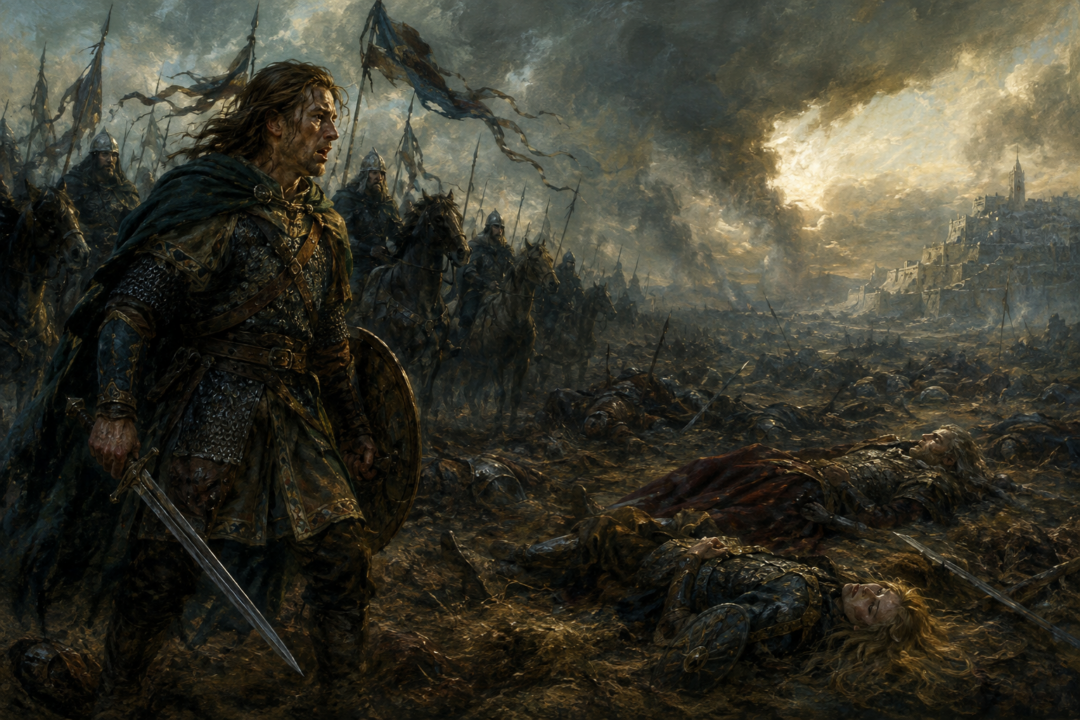
Éomer has already seen his sister lying beside Théoden and believed that she was dead.
The discovery nearly destroys his restraint.
Earlier he has ridden through the battle as a commander. After seeing Éowyn, grief and fury overwhelm him, and he leads the Rohirrim onward in desperate wrath. His belief is entirely sincere: as far as Éomer knows, both the king he loved and the sister he sought to protect have been killed.
Only later does he learn that Éowyn survives.
The irony is brutal.
Her own brother sees her and believes her dead.
A foreign prince who does not know her stops long enough to discover otherwise.
That is not an indictment of Éomer. He sees Éowyn during one of the most emotionally catastrophic moments of his life. Imrahil encounters the situation with far greater detachment.
Indeed, that difference may partly explain why Imrahil can observe what grief has hidden from others.
Her Body Is Alive, but Éowyn Is Still in Grave Danger
Discovering Éowyn's breath does not mean the danger has passed.
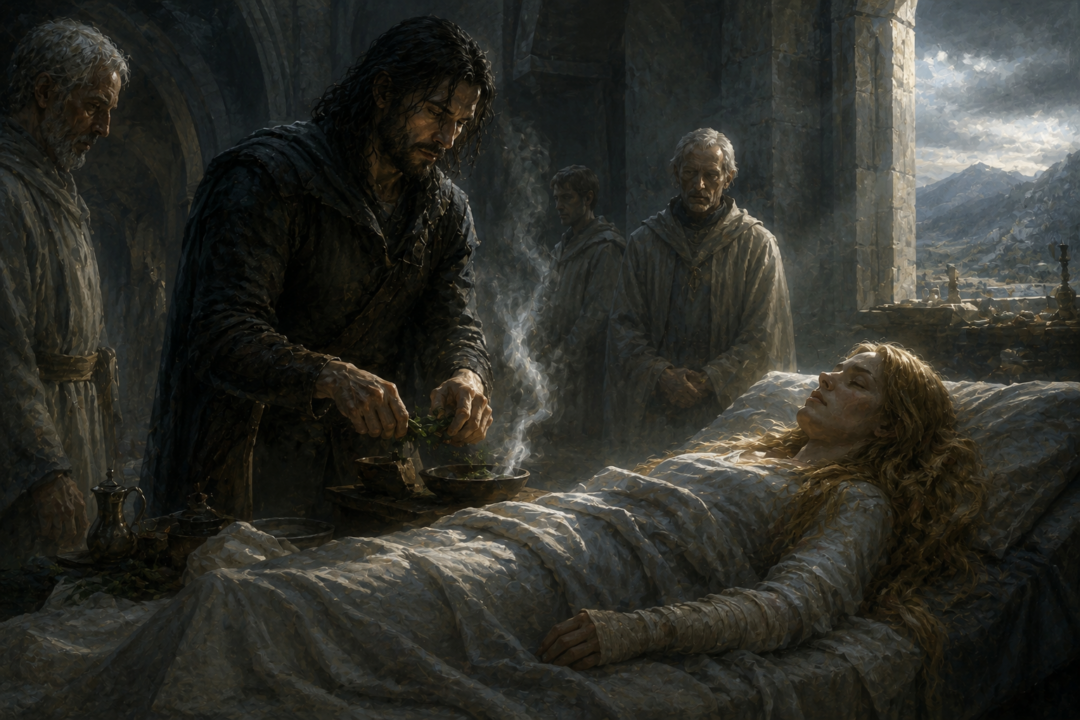
Imrahil immediately has her sent to the Houses of Healing rather than treated as one of the dead.
There, the story reveals that her condition is deeper than a broken arm.
Aragorn recognizes the shadow lying upon her and attempts to call her back. Yet his words about Éowyn also make clear that her suffering did not begin on the Pelennor.
Long before she confronted the Witch-king, she had been living under fear, confinement, grief, and growing hopelessness. She watched Théoden decline under Wormtongue's influence. She feared being trapped while the people she loved rode toward danger. Her encounter with Aragorn awakened desires that could not be fulfilled, and she increasingly sought escape through heroic action.
The Witch-king's shadow therefore falls upon someone whose spirit was already wounded.
Aragorn's healing restores her from immediate peril, but it does not instantly solve everything inside her.
That comes later.
Imrahil Saves the Possibility of Éowyn's Second Life
This is why the little gleam of breath upon Imrahil's vambrace carries such weight.
Everything that follows depends upon it.
Éowyn awakens in the Houses of Healing. She must confront the fact that she survived the glorious death she had been prepared to embrace. While recovering, she meets Faramir, himself wounded by battle and shadow. Their conversations gradually lead her away from despair and toward another understanding of courage.
She eventually declares that she will no longer seek death in battle but will become a healer and love things that grow.
That transformation should not be simplified into Éowyn merely abandoning warfare or being cured by romance. Her change is connected with the broader movement of her character away from despair and toward the desire to live.
Her survival makes that choice possible.
Imrahil does not create the change.
He creates the opportunity for it to happen.
A Tiny Act of Attention Against the Shadow
Many great deeds on the Pelennor are unmistakable.
Théoden's charge changes the course of the battle. Éowyn and Merry bring down the Witch-king. Aragorn arrives with reinforcements from southern Gondor. Swords, courage, command, and sacrifice determine the fate of Minas Tirith.
Imrahil's act looks insignificant beside them.
He holds a piece of polished armour before a dying woman's lips.
Yet the scene belongs naturally beside the larger victories because the struggle against the Shadow in The Lord of the Rings is never fought only through force.
Again and again, lives depend upon someone refusing to dismiss what appears small, hopeless, or already lost.
Bilbo spares Gollum.
Faramir refuses the Ring.
Sam carries Frodo when the quest seems almost finished.
And on a field filled with the dead, Imrahil looks twice.
There is no explicit statement that this moment is meant as a grand moral lesson, and it should not be forced into one. But the narrative consequence is undeniable.
Éowyn survives because someone recognizes that apparent death is not yet death.
The bearers saw what the battlefield had taught them to expect.
Imrahil searched for what might still be there.
And upon the cold brightness of his vambrace appeared the smallest possible evidence of hope:
a living breath.
Sources & Notes
- The Encyclopedia of Arda — Imrahil — https://www.glyphweb.com/arda/i/imrahil.html
- The Encyclopedia of Arda — Éowyn — https://www.glyphweb.com/arda/e/eowyn.html
- The Encyclopedia of Arda — Black Breath — https://www.glyphweb.com/arda/b/blackbreath.html
- The Encyclopedia of Arda — Houses of Healing — https://www.glyphweb.com/arda/h/housesofhealing.html
Background sources for Imrahil, Éowyn’s fall on the Pelennor, the Black Breath, and the Houses of Healing. The vambrace-and-breath detail is from The Return of the King, Book V, Chapter 6, ‘The Battle of the Pelennor Fields.’