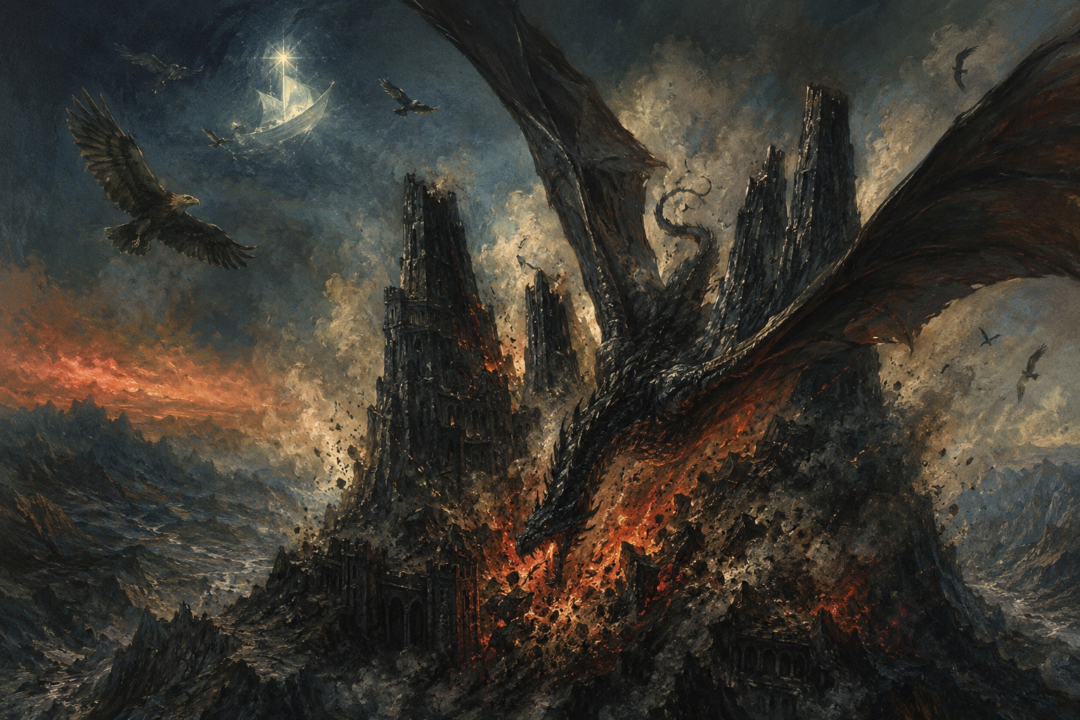
Ancalagon the Black is remembered for one of the most spectacular deaths in all the legends of Middle-earth. After a day and night of battle in the skies, Eärendil slew the greatest of Morgoth’s winged dragons and cast him down upon Thangorodrim. The towers above Angband were broken beneath his ruin.
It is an image so enormous that it has encouraged an even larger conclusion: if Ancalagon could destroy Thangorodrim by falling upon it, perhaps his impact was also the catastrophe that drowned most of Beleriand.
That conclusion is dramatic, but the texts do not say it.
The destruction of Thangorodrim and the drowning of Beleriand belong to the same apocalyptic conflict, yet they are described as distinct parts of a much wider ruin. Ancalagon’s fall ends the greatest aerial struggle of the War of Wrath and physically breaks Morgoth’s mountains. Beleriand, meanwhile, is devastated through the overwhelming violence of the war itself until most of the land disappears beneath the Sea.
Understanding that distinction does not make Ancalagon less impressive. It actually makes the War of Wrath far more terrifying.
What the Text Actually Says About Ancalagon
Near the end of the War of Wrath, Morgoth unleashed a weapon his enemies had never faced before in such form: winged dragons.
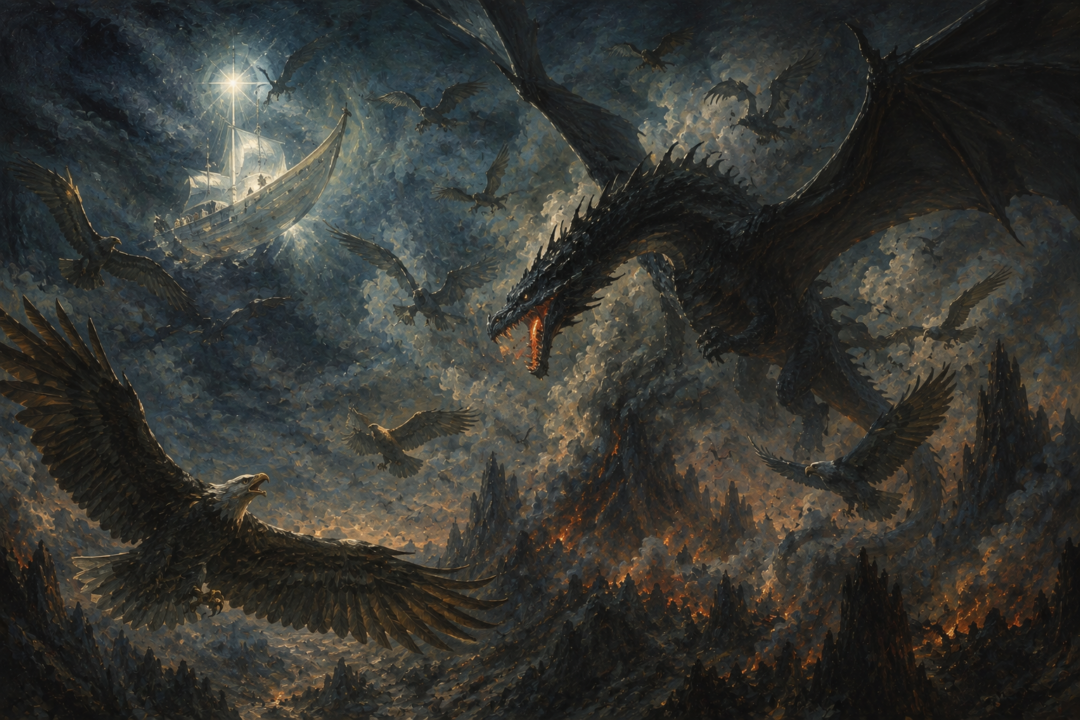
The sudden assault was catastrophic. The dragon-host drove back the forces attacking Angband, and at its head flew Ancalagon the Black, described as the mightiest of that host. Eärendil then entered the battle aboard Vingilot, accompanied by Thorondor and the great birds of heaven.
The aerial struggle continued through the day and into a dark night. Before sunrise, Eärendil killed Ancalagon and cast him from the sky. The dragon fell upon the towers of Thangorodrim, and they were broken in his ruin.
That is the essential canonical statement.
It establishes several things firmly. Ancalagon was extraordinarily powerful. His fall was physically devastating. Thangorodrim did not merely suffer damage; its towers were broken. His death also marked the collapse of Morgoth’s final great military counterstroke.
What it does not establish is that the shock of his impact travelled across Beleriand and sank the continent.
That idea requires adding a causal connection the narrative itself never makes.
Thangorodrim Was Not All of Beleriand
The scale becomes clearer when the geography is separated.
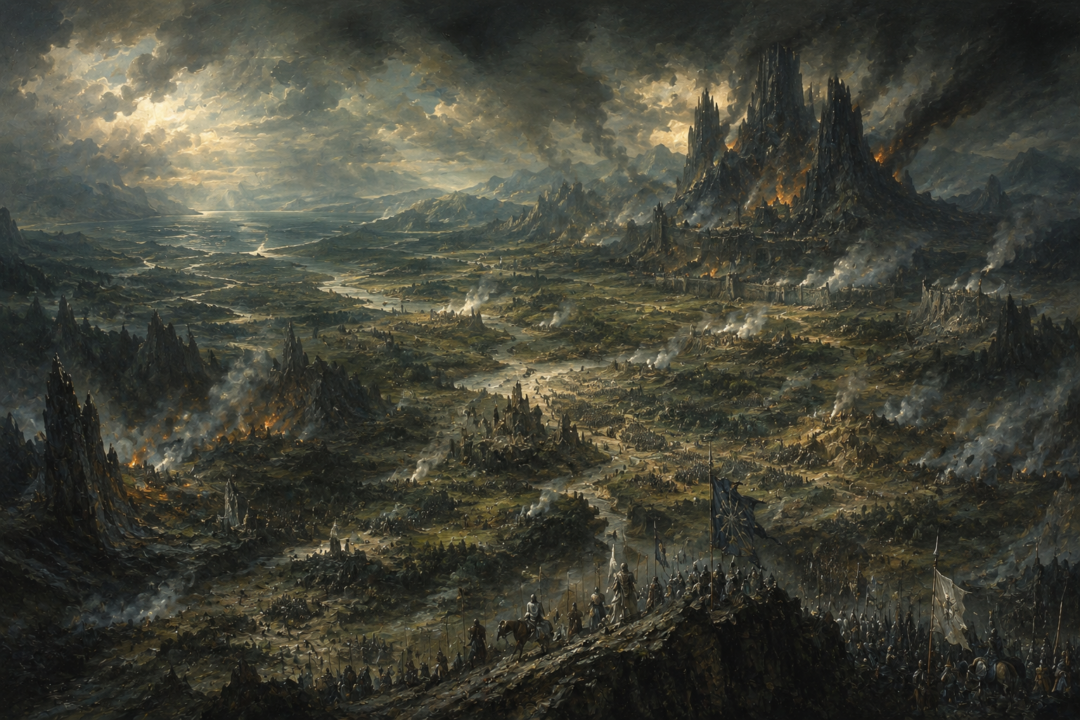
Thangorodrim stood in the extreme north, above the vast underground fortress of Angband. The name referred to the immense peaks or towers Morgoth had raised over his stronghold. They were among the defining landmarks of his northern realm and symbolized the apparently unbreakable strength of Angband.
Encyclopedia of Arda
Beleriand was vastly larger.
Its lands stretched far south and west from Morgoth’s northern fortress and included regions once occupied by Doriath, Nargothrond, Gondolin, Hithlum, Brethil, Ossiriand, Nevrast, and many other realms and wildernesses.
Destroying Thangorodrim, therefore, was not equivalent to destroying Beleriand geographically.
Ancalagon could smash the mountains directly beneath him without his body needing to be comparable in size to the entire western land. The text gives no measurements for him at all, and attempts to calculate his exact length from the destruction of Thangorodrim go beyond what the narrative supports.
He was the mightiest of Morgoth’s dragon-host. He was immense enough, or fell with sufficient ruin, to break Thangorodrim.
Beyond that, numerical scale becomes speculation.
Beleriand Was Ruined by the War of Wrath
The broader destruction is attached not to Ancalagon alone but to the Great Battle.
The War of Wrath was no ordinary campaign. The Host of the West came against Morgoth after centuries in which the kingdoms of the Eldar and Edain had already been shattered. The fighting was so destructive that the geography of northwestern Middle-earth was permanently changed.
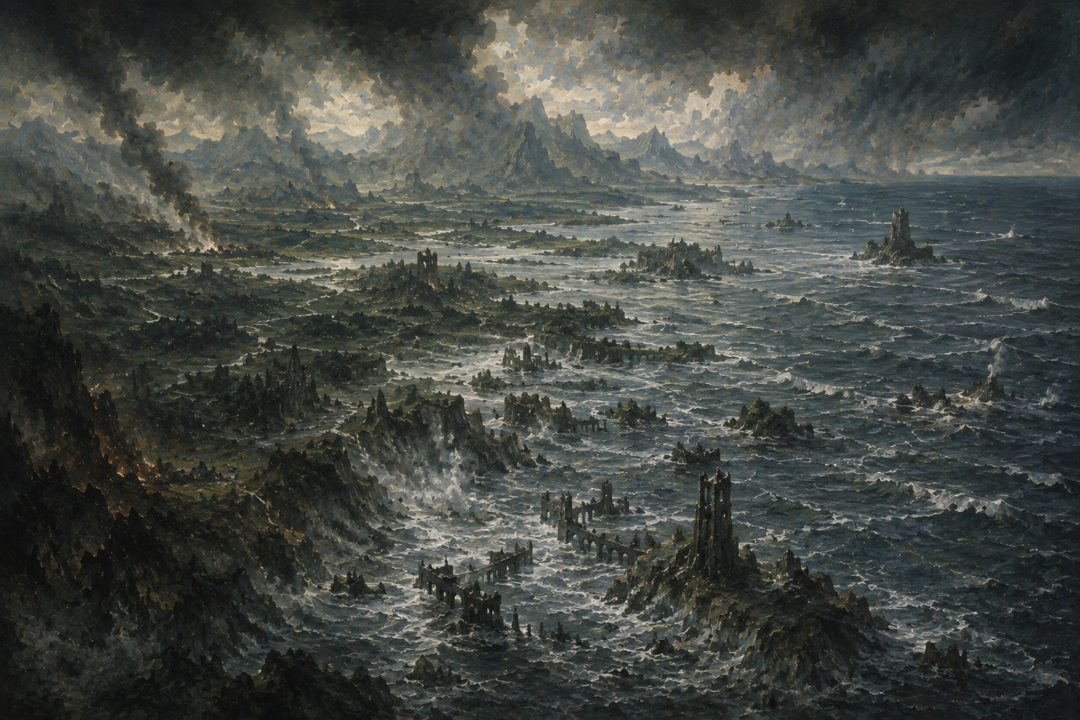
Accounts of the event associate Beleriand’s devastation with the tumult or violence of the war. Most of the land was destroyed and submerged beneath the Sea, leaving only remnants such as parts of former Ossiriand, which became Lindon, together with isolated surviving heights.
Encyclopedia of Arda
That wording matters.
Ancalagon’s death occurs within this disaster, but it is one event inside an enormously destructive conflict. The host of Morgoth, the armies from the West, Balrogs, dragons, and powers greater than those usually seen in later ages were involved in a war whose consequences affected the land itself.
The texts never provide a geological mechanism explaining precisely how every region sank. They do not describe a single explosion, impact wave, magical command, or named combatant as the sole cause.
The conservative reading is therefore the strongest one: Beleriand was ruined in the cataclysm of the War of Wrath as a whole.
Why Ancalagon Gets Blamed for Everything
The misunderstanding is easy to see.
Narratively, the events occur almost on top of each other.
Morgoth releases the winged dragons. The Host of the West reels. Eärendil fights Ancalagon. Ancalagon falls. Thangorodrim breaks. Angband is opened. Morgoth is defeated. The First Age ends amid the destruction of Beleriand.
When events of this magnitude are compressed into a short account, readers naturally connect them into a single chain of physical cause and effect.
But narrative sequence is not the same thing as explicit causation.
The text gives Ancalagon a specific destructive achievement: the breaking of Thangorodrim.
The wider war receives the larger one: the ruin of Beleriand.
Combining the two makes for spectacular fan imagery, but separating them produces a more accurate picture of the legendarium.
It also avoids creating an Ancalagon so impossibly gigantic that other parts of the story become difficult to visualize. Nothing requires him to be continent-sized. His greatness is established by his place among the dragons, the terror of the assault he leads, the extraordinary battle required to defeat him, and the destruction caused by his fall.
That is already enough.
“Broken in His Ruin” Does Not Give Us a Body Measurement
There is another subtle problem with treating Thangorodrim as a ruler for Ancalagon’s physical dimensions.
The wording does not simply say that his corpse covered the mountains.
It says that they were broken in his ruin.
That leaves the exact mechanics undescribed.
A dying fire-drake falling from immense height could cause destruction through weight, momentum, fire, violent movement, collapsing mountains, or some combination of effects. Tolkien provides no engineering diagram, and none is necessary for the scene.
We therefore cannot safely reason backward and say that because several immense peaks were broken, Ancalagon’s body must have been as large as those peaks.
The moment works on mythic scale rather than mathematical scale.
The important contrast is that Morgoth’s greatest remaining creature, launched as a final instrument of terror, becomes the instrument through which the visible crown of Angband is shattered.
There is almost a grim irony in it.
The dragon sent upward to preserve Morgoth’s dominion comes crashing downward onto Morgoth’s own fortress.
The Destruction of Thangorodrim Still Matters Enormously
Rejecting the idea that Ancalagon personally drowned Beleriand should not diminish what his fall represents.
Thangorodrim had dominated the wars of the First Age.
For generations, Elves and Men lived beneath the threat of the northern mountains. Fingolfin rode toward them when he challenged Morgoth. Countless armies marched beneath their shadow. Angband endured siege, invasion attempts, and centuries of war while its towers remained a visual emblem of Morgoth’s strength.
Then, at the end, they break.
Not through the slow labour of an army, but beneath the fall of Morgoth’s own greatest winged dragon.
The symbolic destruction is almost as important as the physical one. The mountains that seemed permanent are revealed to be temporary. The fortress that shaped the entire political geography of Beleriand is finally exposed.
Ancalagon’s death is therefore not the destruction of all Beleriand.
It is the breaking of the threshold behind which Morgoth had hidden.
Beleriand’s Drowning Is a Larger Tragedy
There is also a thematic reason not to reduce the drowning of Beleriand to one dragon’s impact.
The end of the First Age is not simply a victory.
Morgoth is defeated, but the lands generations fought to defend are largely lost.
Doriath was already destroyed. Gondolin had already fallen. Nargothrond had already become a ruin. By the time the Host of the West finally defeats the Enemy, liberation comes too late to restore the world that once existed.
The War of Wrath finishes what centuries of conflict had begun: the old geography of the Elder Days passes away.
Later ages retain fragments. Lindon survives east of the new coastline. Some heights of ancient Beleriand remain above the water as islands. Places once separated from the Sea eventually lie beneath it or beside an altered shore.
Encyclopedia of Arda
This is larger than the death of any individual creature.
Ancalagon can shatter mountains.
The War of Wrath shatters an age.
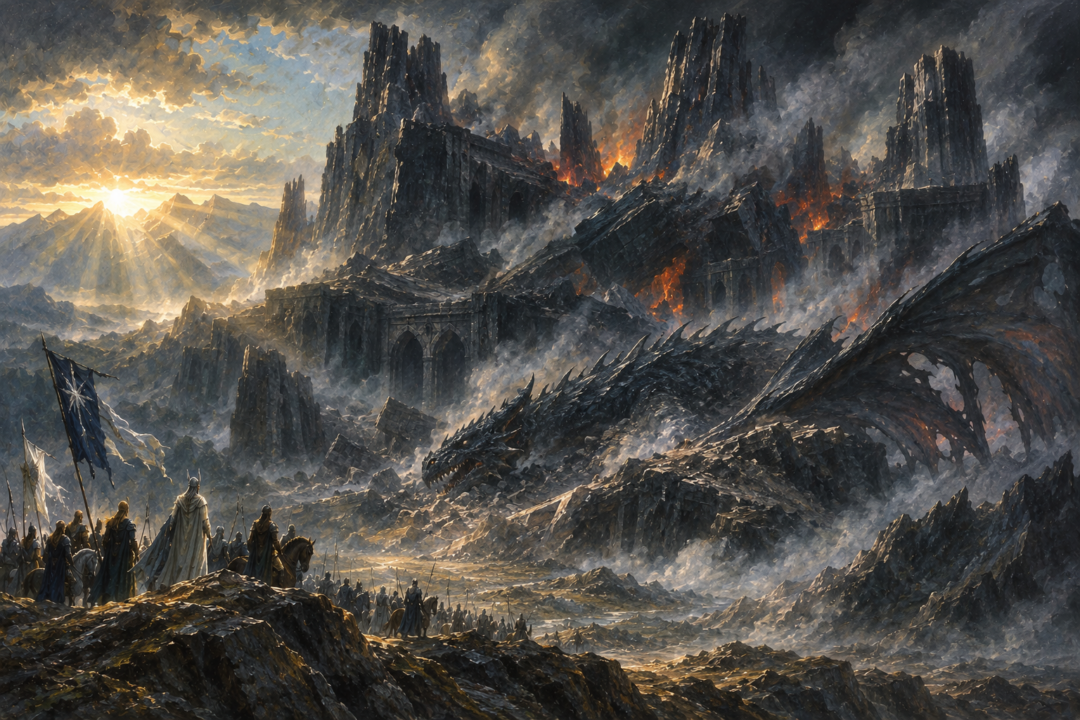
Two Catastrophes, Not One
The cleanest lore-grounded reading is therefore also the simplest.
Eärendil kills Ancalagon.
Ancalagon falls upon Thangorodrim.
Thangorodrim is broken in his ruin.
The War of Wrath devastates the wider lands.
Most of Beleriand eventually sinks beneath the Sea.
These events are connected because they belong to the same final struggle against Morgoth, but the text does not say that the first mechanically causes the second.
That distinction preserves both scales of destruction.
Ancalagon remains the mightiest dragon of Morgoth’s final host, whose fall annihilates the mountainous crown of Angband.
Yet beyond him lies something even greater: a war so catastrophic that when victory finally comes, the land over which the entire First Age was fought is itself largely gone.
Thangorodrim dies beneath the dragon.
Beleriand dies in the war.
Sources & Notes
- Encyclopedia of Arda — Ancalagon: the winged dragon-host, Eärendil’s victory, and the breaking of Thangorodrim — https://www.glyphweb.com/arda/a/ancalagon.php
- Encyclopedia of Arda — Thangorodrim: the peaks above Angband and their destruction in Ancalagon’s fall — https://www.glyphweb.com/arda/t/thangorodrim.php
- Encyclopedia of Arda — War of Wrath: the Great Battle and the wider ruin of Beleriand — https://www.glyphweb.com/arda/w/warofwrath.php
- Encyclopedia of Arda — Beleriand: the First Age region largely lost beneath the Sea after the War of Wrath — https://www.glyphweb.com/arda/b/beleriand.php
Primary-text anchor: The Silmarillion, ‘Of the Voyage of Eärendil and the War of Wrath.’ Tolkien’s account places Ancalagon’s fall on Thangorodrim within the much broader Great Battle whose violence broke and submerged most of Beleriand; it does not identify the dragon’s impact alone as the cause of the drowning.