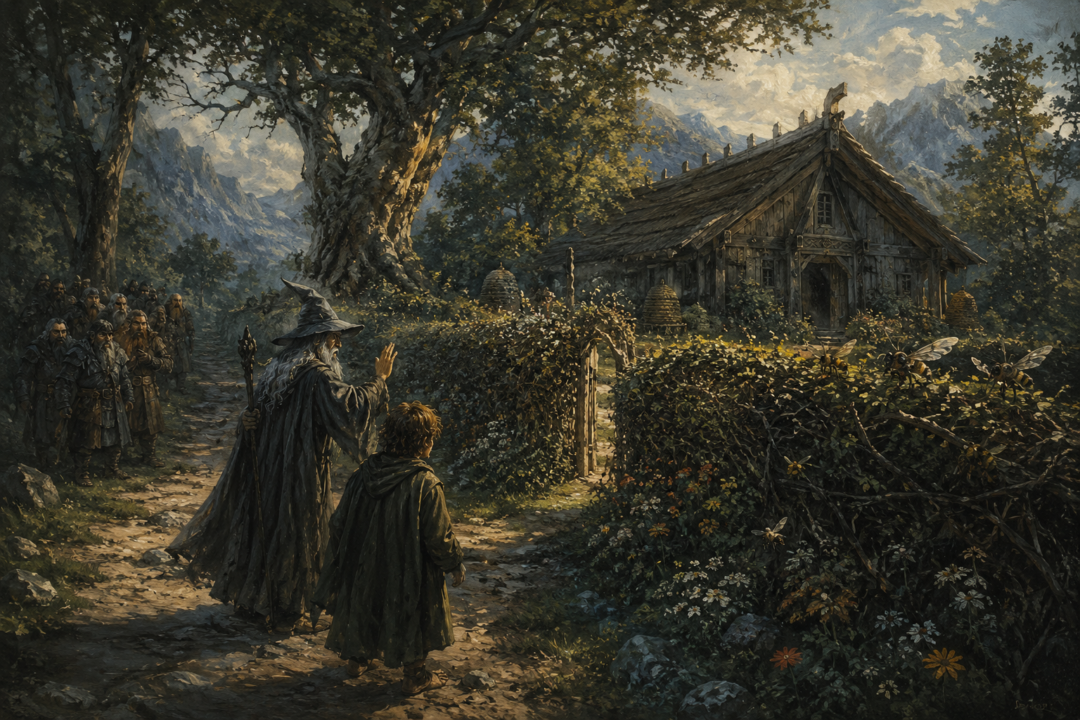
When Thorin Oakenshield’s company reaches Beorn’s country in The Hobbit, they desperately need what he can provide: shelter, food, information, and a safer route toward Mirkwood. There is only one problem.
There are thirteen dwarves.
Gandalf knows that arriving unannounced with an entire armed travelling company is an excellent way to make Beorn angry. And Beorn is not merely an irritable woodsman. He is a formidable skin-changer who can take the shape of a great bear, lives largely apart from other people, and is described by Gandalf as dangerous when angered.
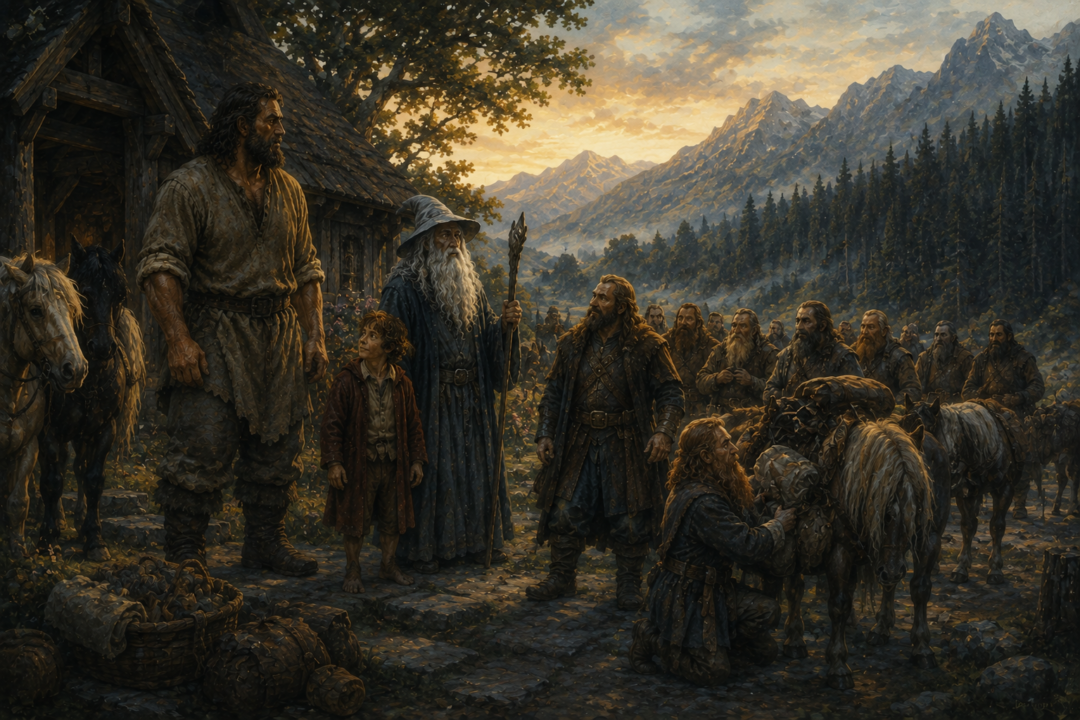
So Gandalf devises one of the cleverest social maneuvers in The Hobbit: he enters Beorn’s grounds with Bilbo first and has the dwarves appear gradually, generally in pairs, at roughly five-minute intervals.
On the surface, it is comic. Gandalf tells a story while more and more unexpected dwarves keep appearing.
Underneath the comedy, however, is something more revealing. The episode shows how Gandalf handles a powerful person who cannot simply be commanded, threatened, or bribed. He does not overpower Beorn.
He gives Beorn time to decide that these strangers are worth helping.
Gandalf Knows That Fifteen Strangers Would Be a Problem
Before they ever reach Beorn’s house, Gandalf warns the company about their prospective host.
Beorn is a skin-changer who lives between the Misty Mountains and Mirkwood. Gandalf is uncertain about Beorn’s precise origins and tells Bilbo competing stories about him rather than presenting either as established fact. What matters immediately is Beorn’s temperament.
He can be hospitable, but he is also fiercely independent and dangerous when angered.
That makes the company’s size a practical problem.
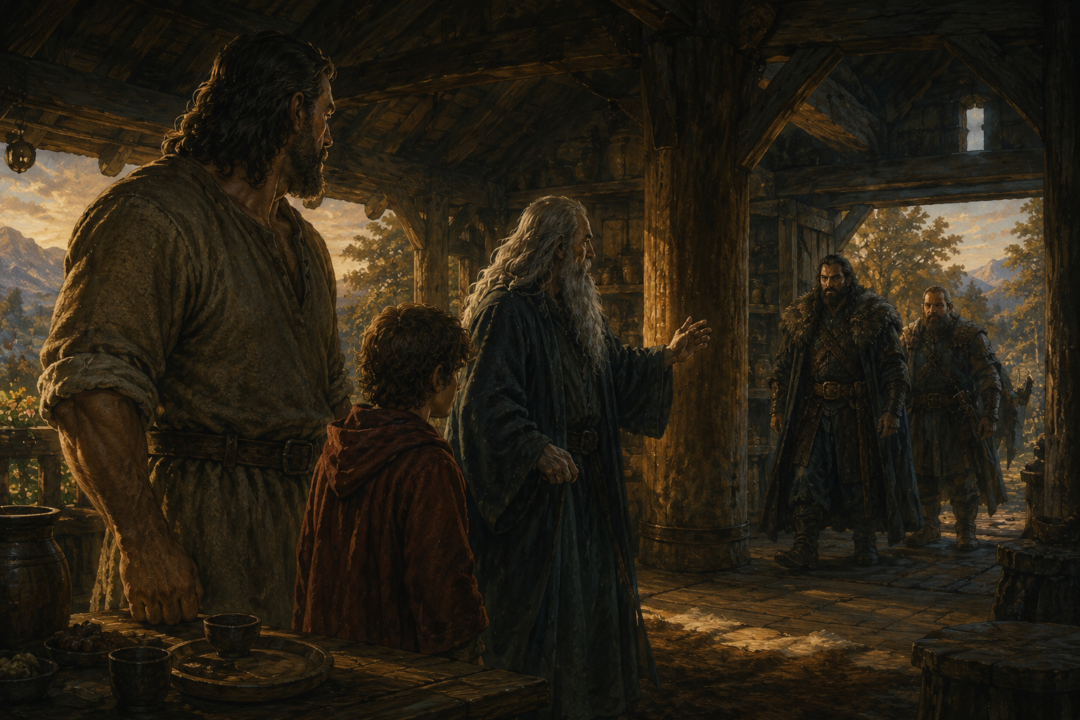
Gandalf, Bilbo, and thirteen dwarves appearing together would mean fifteen unexpected visitors descending upon an isolated household. Gandalf therefore explains his plan before they arrive: he and Bilbo will go first, while the dwarves follow gradually in pairs when summoned.
The purpose is explicit. Gandalf wants to introduce them slowly rather than annoy Beorn by having everyone arrive at once.
This is important because the scene is sometimes treated as though Beorn himself established some mysterious rule requiring visitors to enter in small groups. He did not.
The arrangement is Gandalf’s idea.
Beorn does not order the dwarves to come two at a time. Gandalf anticipates Beorn’s reaction and organizes the company accordingly.
Why Bilbo Goes First
Gandalf chooses Bilbo as his first companion.
That choice makes sense within the immediate situation. Bilbo is physically small and hardly resembles the leader of an invading war-band. More importantly, the dwarves are the part of the company most likely to create difficulty.
When Thorin eventually appears, Beorn makes his attitude clear: he is not particularly fond of dwarves.
Gandalf therefore begins with the least confrontational version of the truth—himself and one hobbit—and allows the larger company to reveal itself gradually.
There is a comic echo here of the beginning of The Hobbit. Bilbo once found dwarves arriving at Bag End one after another until his comfortable home was full of unexpected guests.
Now Bilbo stands beside Gandalf while someone else experiences a similar invasion.
But Beorn is not Bilbo.
Bilbo responds to his unexpected party with flustered hospitality. Beorn possesses the temperament and physical power to make offending one’s host considerably more dangerous.
Gandalf has adapted the trick to the man.
The Dwarves Are Part of Gandalf’s Story
Once Gandalf begins explaining how he and Bilbo came to Beorn’s lands, the arrivals become more than a way of reducing the initial shock.
They become part of the storytelling.
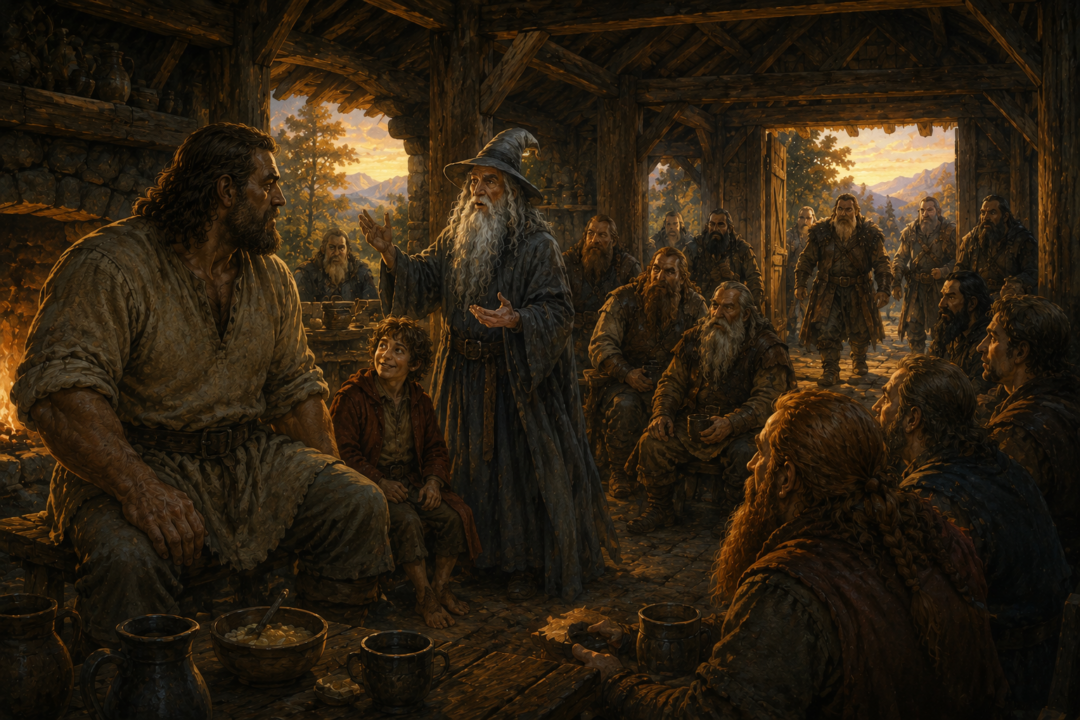
Gandalf mentions companions without immediately revealing their full number. Beorn notices the discrepancies and asks questions. At convenient moments, another pair of dwarves arrives.
Thorin and Dori appear first. Later come Nori and Ori, then Balin and Dwalin, followed by Fíli and Kíli, Óin and Glóin, and finally Bifur, Bofur, and Bombur—the last arrivals not perfectly following the intended pair-by-pair pattern.
Each interruption exposes a little more of the company.
But each interruption also keeps Beorn listening.
Instead of standing at Beorn’s gate and effectively announcing, “Here are thirteen dwarves who require food and lodging,” Gandalf turns their existence into a sequence of revelations inside an increasingly compelling account.
That distinction matters.
By the time Beorn understands the true size of the party, he is no longer merely evaluating strangers who have appeared on his property.
He is listening to what happened to them.
The Goblins Change Everything
The strongest point in the company’s favor is not their destination or Thorin’s royal ancestry.
It is their enemies.
Gandalf tells Beorn about the company’s escape from the goblins of the Misty Mountains and their subsequent confrontation with goblins and Wargs before the Eagles rescued them.
This immediately places the travelers within a conflict Beorn understands.
Beorn hates goblins and Wargs.
That does not mean he instantly accepts everything Gandalf says. His later actions demonstrate quite the opposite. He eventually investigates the story himself, travelling back toward the place of the company’s recent danger and confirming that Gandalf’s account is substantially true.
Only after that verification does his support become much stronger.
This reveals something important about the earlier introduction scene.
Gandalf is not simply tricking a foolish host.
Beorn is suspicious, independent, and capable of checking the evidence for himself. Gandalf’s strategy works because the story gives Beorn reasons to continue listening until the company’s actions can speak for them.
The staggered arrivals buy attention.
The shared enemies create sympathy.
Truth ultimately secures trust.
Gandalf Carefully Controls What Beorn Learns
There is another revealing detail in the first conversation.
Gandalf does not immediately tell Beorn the entire purpose of Thorin’s expedition.
He describes the dwarves as travelling toward the lands of their fathers beyond Mirkwood, but he does not initially foreground the treasure of Erebor or the full confrontation with Smaug.
That restraint fits Gandalf’s larger method throughout the encounter.
He reveals what is necessary when it becomes useful.
This should not be confused with inventing a false story. The adventures he recounts really happened, and Beorn later verifies their substance. But Gandalf controls the order in which information arrives.
First Beorn meets Gandalf and Bilbo.
Then he discovers there are dwarves.
Then he hears how many.
Meanwhile he learns that these strangers have fought the very enemies he despises.
Gandalf is managing the difference between information and persuasion. The facts remain facts, but their sequence determines whether Beorn is willing to hear them.
Beorn Still Refuses to Trust Them Blindly
If the small-group entrance were merely a magical piece of diplomacy, the chapter could end with supper.
It does not.
Beorn disappears.
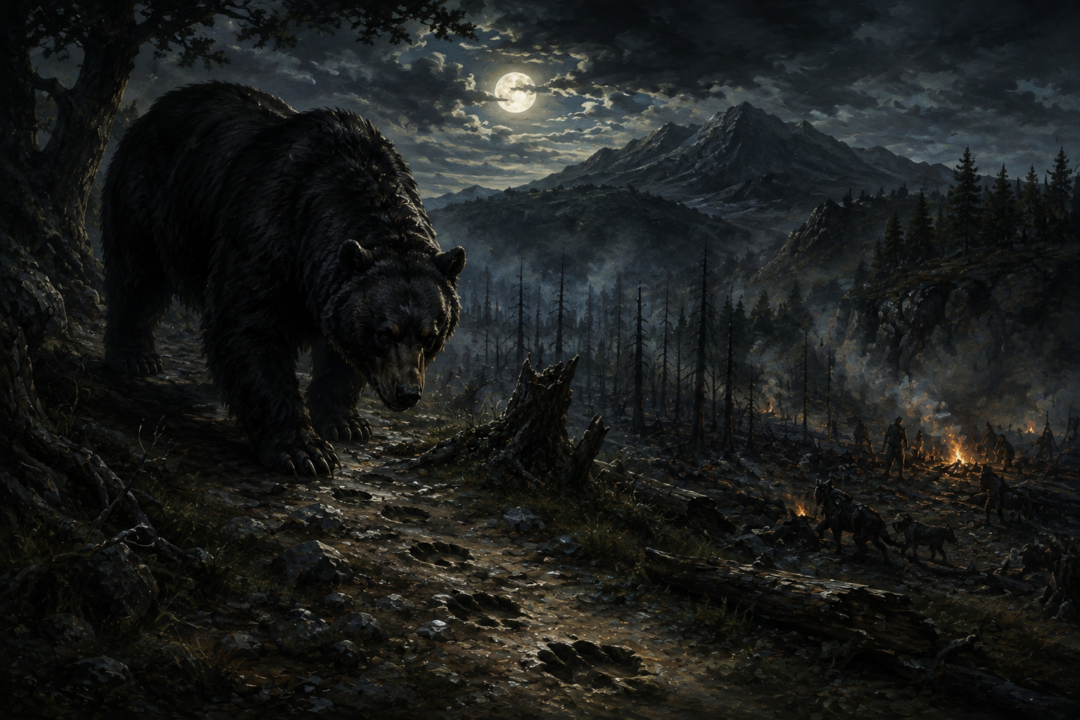
Gandalf later finds evidence of many bears gathering during the night and tracks leading westward toward the country where the company had encountered the goblins and Wargs.
When Beorn returns, he reveals that he has investigated the travelers’ account himself. He has obtained confirmation from a captured goblin and Warg that their enemies are indeed searching for the company.
The grisly evidence outside his home leaves little doubt about his attitude toward those enemies.
Only now does Beorn’s assistance become exceptionally generous.
He supplies the travelers with provisions and lends them ponies for the journey toward Mirkwood. He gives them crucial warnings about the forest and insists that his animals must be returned rather than taken inside.
His hospitality has transformed from cautious tolerance into active support.
That transformation was not produced by cleverness alone.
Gandalf got the company through the door.
Their truthful story earned Beorn’s alliance.
The Scene Reveals Beorn’s Moral World
Beorn is one of the strangest figures in The Hobbit because he sits outside many of the political structures familiar elsewhere in Middle-earth.
He is not serving a king. He does not live in a city. His household is dominated by remarkable animals, which he treats with extraordinary care. He possesses great personal power but shows little interest in conventional displays of wealth.
His loyalties are intensely personal.
He can be terrifying toward enemies and remarkably generous toward those he accepts.
That combination explains why Gandalf approaches him so carefully.
Beorn cannot be treated like an innkeeper whose hospitality can simply be purchased. Nor can Thorin demand assistance on the strength of his ancestry.
Beorn decides for himself.
The visitors must therefore cross an invisible boundary before they can benefit from his protection: they must cease being suspicious strangers and become people whose cause he considers worthy.
The gradual entrance helps that process happen without provoking him before it can begin.
It Also Reveals Gandalf’s Real Strength
Gandalf certainly possesses supernatural power, but many of his most important victories in The Hobbit come from understanding people.
He knows Bilbo better than Bilbo initially knows himself.
He understands enough about Thorin to recognize both his greatness and his dangerous pride.
And at Beorn’s house, he understands that force would be useless and entitlement disastrous.
So he uses timing.
The plan is mischievous, but it is not random. Every new arrival occurs while Beorn is becoming more invested in the story. Every revelation makes it slightly harder to dismiss the travelers as merely unwanted guests.
Gandalf effectively turns hospitality into suspense.
Beorn wants to know what happens next.
And what happens next keeps walking through his gate.
Why the Small Groups Really Matter
So why do the dwarves enter Beorn’s home in small groups?
The simplest answer is the correct one: because Gandalf fears that presenting the entire company at once will annoy a powerful and unpredictable potential host.
But the scene becomes richer when we notice what Gandalf does with that precaution.
He converts a logistical problem into a storytelling advantage.
The dwarves arrive gradually because Beorn is dangerous. Their timing then allows Gandalf to unfold the company’s recent adventures in a way that keeps Beorn curious long enough for hostility to soften.
Yet the chapter refuses to suggest that clever words are enough.
Beorn checks the story.
He discovers that the goblins and Wargs truly are pursuing the travelers. Once convinced that the strangers under his roof have told him the truth—and that they are enemies of his enemies—he helps them far beyond the bare requirements of hospitality.
That is the hidden rule of Beorn’s hall.
Not “two dwarves at a time.”
Trust must be earned.
Gandalf merely understands how to keep the door open long enough for that to happen.
Sources & Notes
- LitCharts — The Hobbit, Chapter 7, ‘Queer Lodgings’: summary and analysis of Gandalf introducing the company gradually while keeping Beorn engaged in his story — https://www.litcharts.com/lit/the-hobbit/chapter-7-queer-lodgings
- Encyclopedia of Arda — Beorn: character reference covering his nature, guarded independence, meeting with Thorin’s company, and aid on their journey — https://www.glyphweb.com/arda/b/beorn.html
- Wikipedia — Beorn: sourced overview of Beorn’s home, temperament, animal household, relationship to Gandalf’s company, and literary interpretations — https://en.wikipedia.org/wiki/Beorn
Primary-text anchor: J.R.R. Tolkien, The Hobbit, Chapter 7, ‘Queer Lodgings.’ Gandalf explicitly plans the staggered introduction before reaching Beorn’s hall; the chapter supplies the arrival order, Beorn’s interruptions, his distrust of dwarves, his later verification of Gandalf’s tale, and the aid he gives the company.