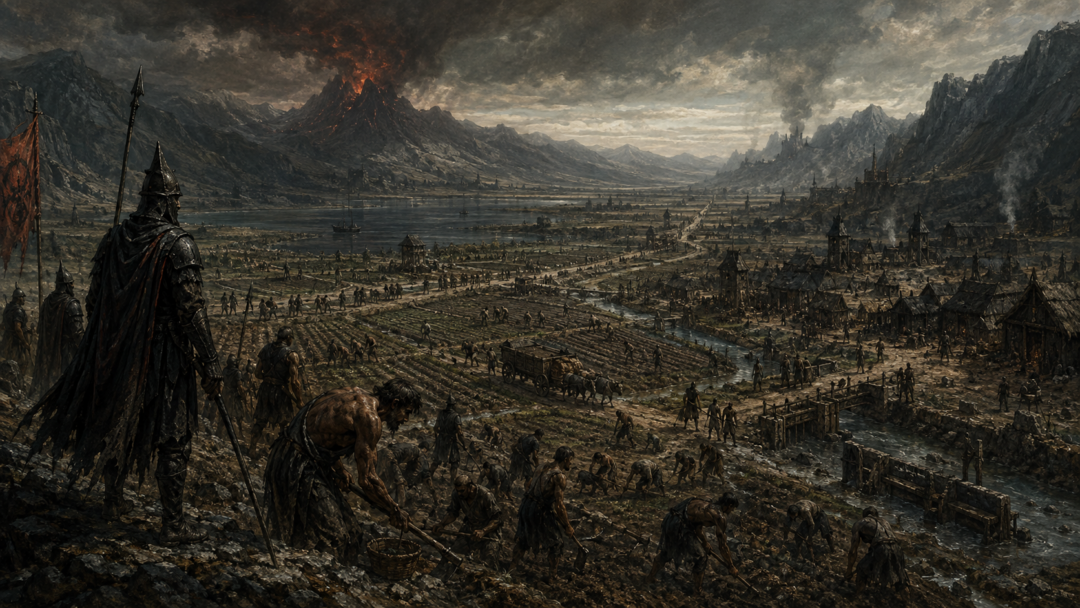
When Frodo and Sam cross Mordor, nearly everything they see seems incapable of supporting ordinary life. Gorgoroth is ash, slag, stone, smoke, military roads, mines, forges, and camps. Yet one practical question hangs over the whole landscape: how could Sauron feed such enormous armies in a land that looked dead?
The answer lies far to the south, beyond the fumes of Orodruin.
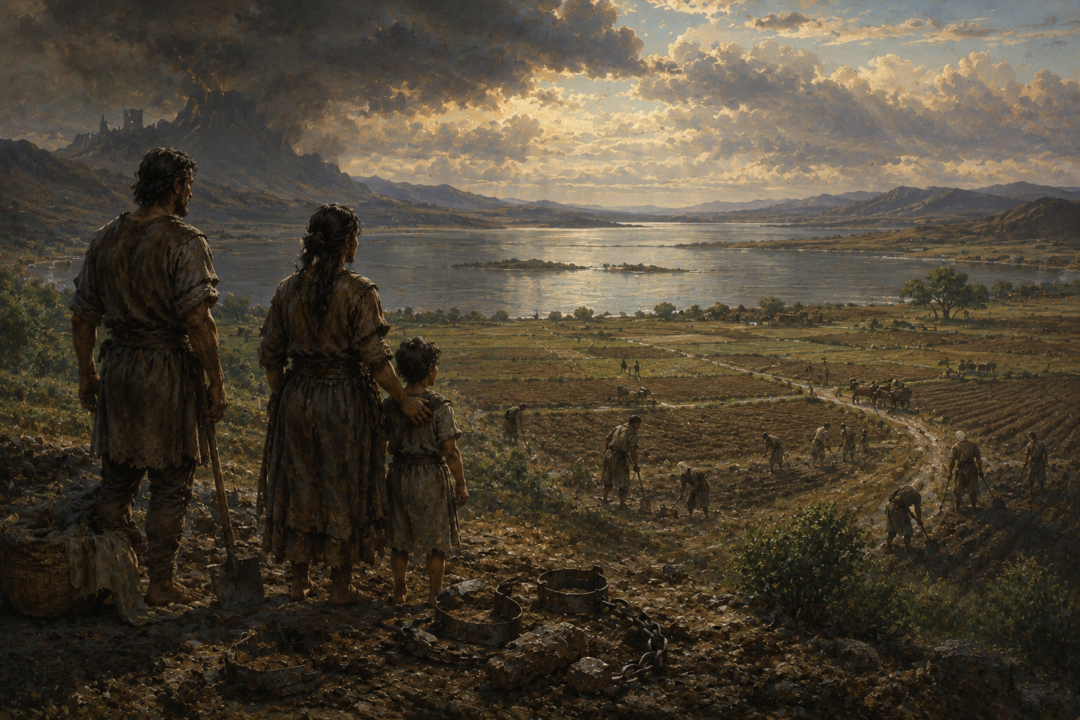
There, around Lake Núrnen, were the “great slave-worked fields” of Mordor. Roads also ran east and south into tributary lands, carrying goods, booty, and new captives back toward Sauron’s realm. The Black Land was therefore not merely a fortress full of Orcs. It rested upon an agricultural and imperial system whose human cost was mostly invisible to the heroes moving through its northern wasteland.
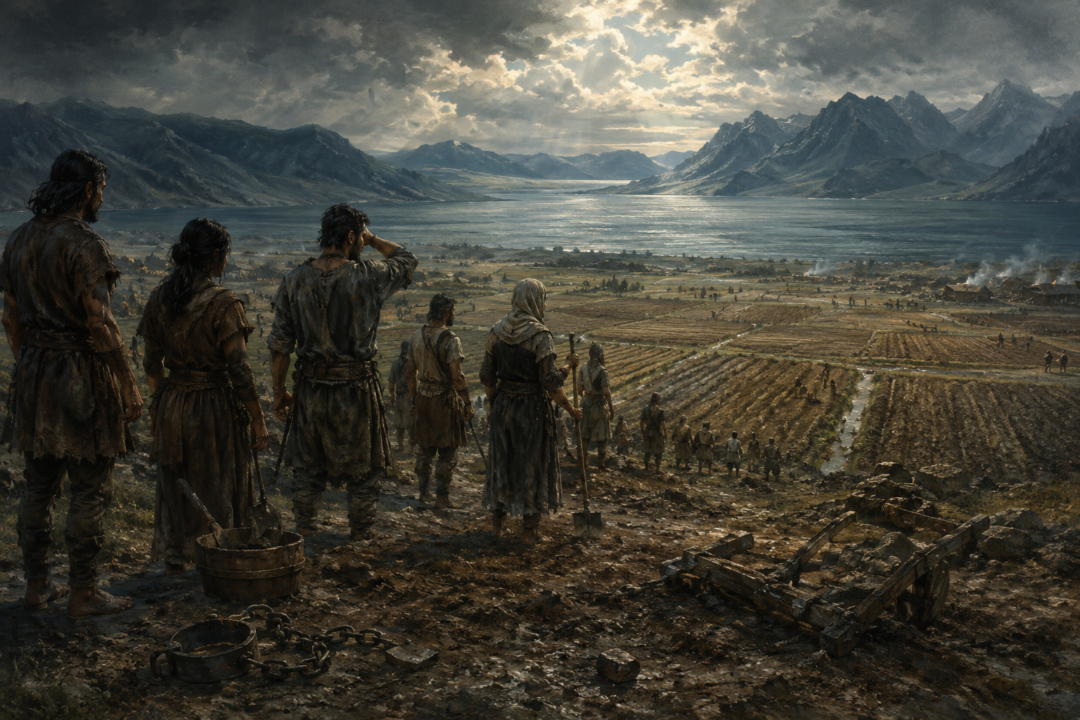
After Sauron fell, Aragorn did something striking with that system. He did not simply claim its productive heart for Gondor. He released Mordor’s slaves and gave them the lands around Lake Núrnen “to be their own.”
That brief sentence gives us one of the clearest glimpses of what the end of Sauron actually meant for ordinary people.
Mordor Had a Breadbasket
The popular mental picture of Mordor is naturally dominated by the region Frodo and Sam traverse: the Plateau of Gorgoroth, Mount Doom, Barad-dûr, and the militarized northern country.
But Mordor was larger than that devastated landscape.
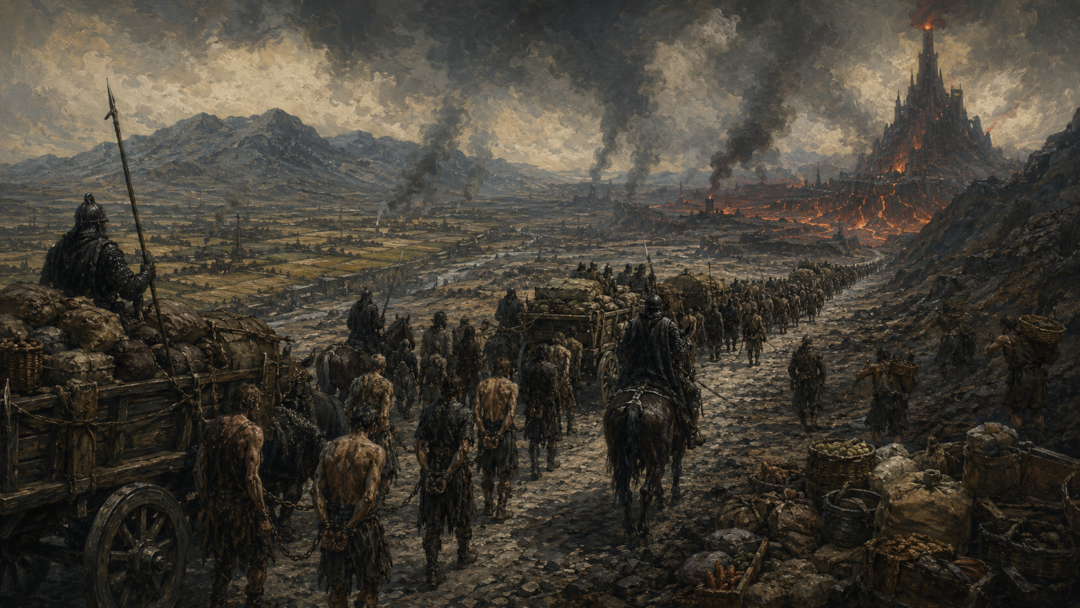
In “The Land of Shadow,” the narrative explains that Frodo and Sam know nothing of the extensive agricultural fields farther south, near the dark waters of Lake Núrnen. Those fields were worked by slaves. Meanwhile, roads connected Mordor with subject territories to the east and south, along which Sauron’s forces transported supplies, plunder, and captives. The northern regions, by contrast, contained the mines, forges, and preparations for war.
This matters because it reveals the structure beneath Sauron’s military power.
His armies did not sustain themselves through supernatural power. Soldiers still required food. Smithies required resources. Vast concentrations of troops required supply networks. Mordor’s terror depended upon agriculture, transport, coerced labor, and extraction from conquered or tributary peoples.
Nurn was therefore not peripheral to Sauron’s power merely because it lay far from Barad-dûr. It helped make that power materially possible.
And the people working its fields were not free participants in that system.
The Victims We Never Meet
One of the most haunting things about the slaves of Mordor is how little the story tells us about them.
No individual slave of Nurn becomes a named character. We are not given their languages, families, customs, or precise origins. The text says that fresh slaves were brought along roads from tributary lands, but it does not identify the population around Núrnen closely enough to justify assigning them to one particular people.
That uncertainty should be preserved.
They may have included captives drawn from several regions under Sauron’s influence, but the text never provides a complete ethnic or political description of the community Aragorn eventually frees.
What is certain is more important: people were compelled to cultivate the land that helped sustain Mordor’s war machine.
Their absence from the main narrative also produces a revealing contrast. Frodo and Sam experience Mordor chiefly as prisoners, fugitives, and exhausted travellers. Far away, others have experienced the same realm through years—or perhaps generations—of forced labor. The exact duration of their bondage is not stated.
The War of the Ring therefore has consequences well beyond the destruction of the One Ring and the survival of Gondor.
For people around Lake Núrnen, Sauron’s fall means emancipation.
Aragorn Gives Them More Than Freedom
The wording of Aragorn’s settlement is unusually important.
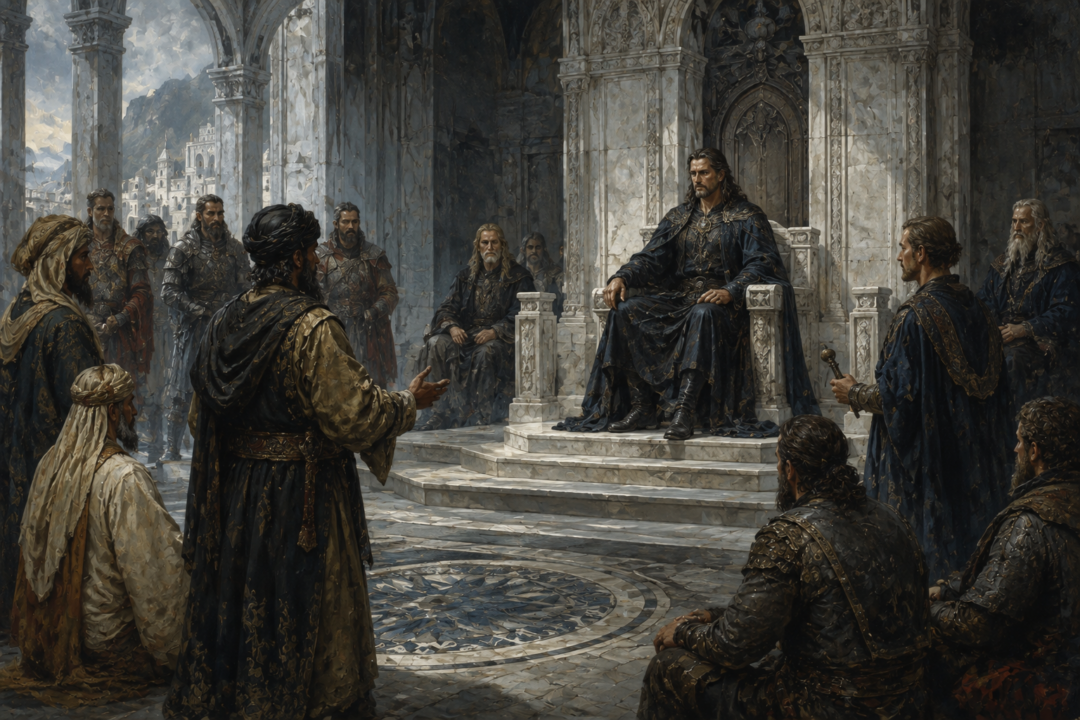
After his coronation, the King issues judgements concerning several peoples affected by the war. He pardons Easterlings who surrendered, sends them away free, makes peace with the peoples of Harad, and releases the slaves of Mordor. Then he gives the freed slaves the lands around Lake Núrnen “to be their own.”
Freedom alone would have ended their legal bondage.
The grant of land changes something deeper.
The people who had been forced to make Nurn productive were now given possession of the country they had labored upon. The former economic foundation of Sauron’s armies was transferred to the very people whose coerced labor had sustained it.
The text does not provide a constitution for Nurn. It never tells us whether the freed people created a kingdom, council, federation, village communities, or some other form of government. Nor does it explicitly define their diplomatic relationship with Gondor.
Calling postwar Nurn an “independent kingdom,” therefore, goes beyond what is actually stated.
But “to be their own” is still powerful language. At minimum, the settlement indicates that Aragorn did not treat the lands around Núrnen as ordinary spoils to be divided among victorious Gondorians.
The land went to the freed.
Why Aragorn Does Not Simply Annex Nurn
Gondor would have had practical reasons to care about Mordor after the war.
The Black Land had threatened it for centuries. Its passes, fortresses, roads, and remaining populations could not simply be ignored. A victorious king might easily have justified direct occupation of valuable territory as compensation or security.
Yet the recorded settlement around Lake Núrnen points in another direction.
Aragorn’s kingship is presented here not merely as victory over enemies but as the restoration of order through judgement, mercy, and release. The same passage pairs several different responses to former enemies and subjects: surrendering Easterlings are pardoned; peace is made with Harad; enslaved people are liberated and given land.
These decisions are not identical, but together they show that the postwar settlement is not based upon indiscriminate vengeance.
That distinction is crucial.
Sauron’s political system turns lands and peoples into instruments. Tributary regions provide goods. Captives provide labor. Farms provide food. Everything flows toward the needs of the Dark Tower.
The new settlement reverses that direction.
Nurn’s fields are no longer described as belonging to a war machine. They belong to the people who live and work there.
A Quiet Reversal of Sauron’s Idea of Power
The destruction of Barad-dûr is the spectacular defeat of Sauron.
The grant of Nurn represents another kind of defeat.
Sauron repeatedly organizes the world around possession. Lands are conquered, wills are dominated, resources are accumulated, and people become tools within a larger design. Even far from the Eye, the slave-worked fields reveal the same principle operating at an everyday level.
A field under Sauron is not simply a field.
It is part of an apparatus of domination.
That makes Aragorn’s decision symbolically fitting without requiring us to invent motives the text never states. The same ground remains agricultural ground. The same lake remains beside it. The difference is who possesses the fruits of that landscape and under what condition they labor.
The former slaves are not moved elsewhere while Gondor inherits the valuable farms.
They receive the farms.
Sauron’s defeat consequently reaches all the way down from towers and armies to the question of who may call a piece of land their own.
Nurn Was Not Magically Healed
It is tempting to turn this ending into a picture of instant restoration: chains broken, green fields flourishing, a free new country appearing overnight.
The text does not give us that.
We know almost nothing about Nurn’s early Fourth Age beyond Aragorn’s act of emancipation and land grant. The consequences have to be inferred cautiously.
The former slaves would have inherited land shaped by Sauron’s regime. The fields had been organized to support Mordor, and the wider region had been connected to an imperial system of roads and tribute. That much follows from the description in “The Land of Shadow.”
But whether those communities faced famine, conflict, reconstruction, population movement, or political division is never narrated.
Likewise, we should not assume that everything associated with Mordor vanished when the Ring was destroyed. Sauron’s controlling will was broken, but landscapes, roads, farms, survivors, and memories remained.
Liberation was a beginning, not a detailed history of what followed.
The Most Important Word May Be “Own”
The fate of Nurn occupies only a few lines near the end of an enormous story.
Yet those lines expand the meaning of victory.
The War of the Ring is not concluded merely when Sauron falls. A world shaped by him still has to decide what happens to prisoners, conquered peoples, collaborators, enemies who surrender—and victims whose labor helped sustain a system they never chose.
Aragorn’s answer concerning Mordor’s slaves is remarkably concrete.
Release them.
Give them the land.
Let it be their own.
We are not told what flag eventually flew beside Lake Núrnen, if any. We do not know the names of its first leaders or what institutions its people built. Any confident description of those things would be invention.
What the text does give us is enough.
For years, the fields of southern Mordor had existed to feed someone else’s armies. Their workers belonged to someone else. Their harvests served someone else’s war.
After Sauron, the same land was placed into the hands of the people who had been forced to work it.
Barad-dûr falling showed that the Dark Lord could be defeated.
Nurn becoming the possession of the freed showed what that defeat was for.
Sources & Notes
- Encyclopedia of Arda — Nurn: its fertile fields, enslaved population, and Elessar’s postwar grant of the land — https://www.glyphweb.com/arda/n/nurn.html
- Encyclopedia of Arda — Sea of Núrnen: the agricultural region worked by Sauron’s slaves to feed Mordor’s armies — https://www.glyphweb.com/arda/s/seaofnurnen.html
- Encyclopedia of Arda — Mordor: geography and the contrast between Gorgoroth and the southern lands around Núrnen — https://www.glyphweb.com/arda/m/mordor.html
- Encyclopedia of Arda — Elessar: Aragorn’s reign and settlement of the lands formerly under Sauron — https://www.glyphweb.com/arda/e/elessar.html
Primary-text anchors: The Lord of the Rings, Book VI, Chapter 2, “The Land of Shadow” (Mordor’s slave-worked southern fields and supply system), and Book VI, Chapter 5, “The Steward and the King” (Elessar frees Mordor’s slaves and grants them the lands around Núrnen).