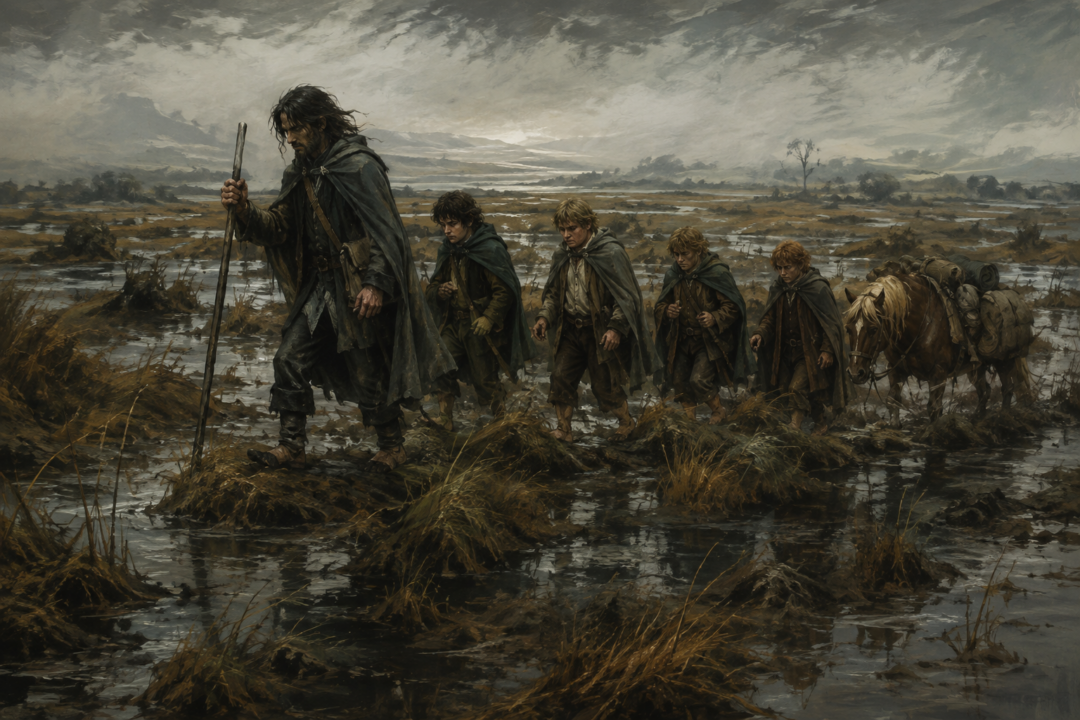
The Midgewater Marshes contain no Ringwraith ambush, no Orc-band waiting among the reeds, and no monster rising from a black pool. Yet when Strider leads Frodo, Sam, Merry, and Pippin through them after leaving Bree, the journey becomes miserable almost immediately.
That matters because the danger of the Marshes is not an enemy at all.
It is the ground.
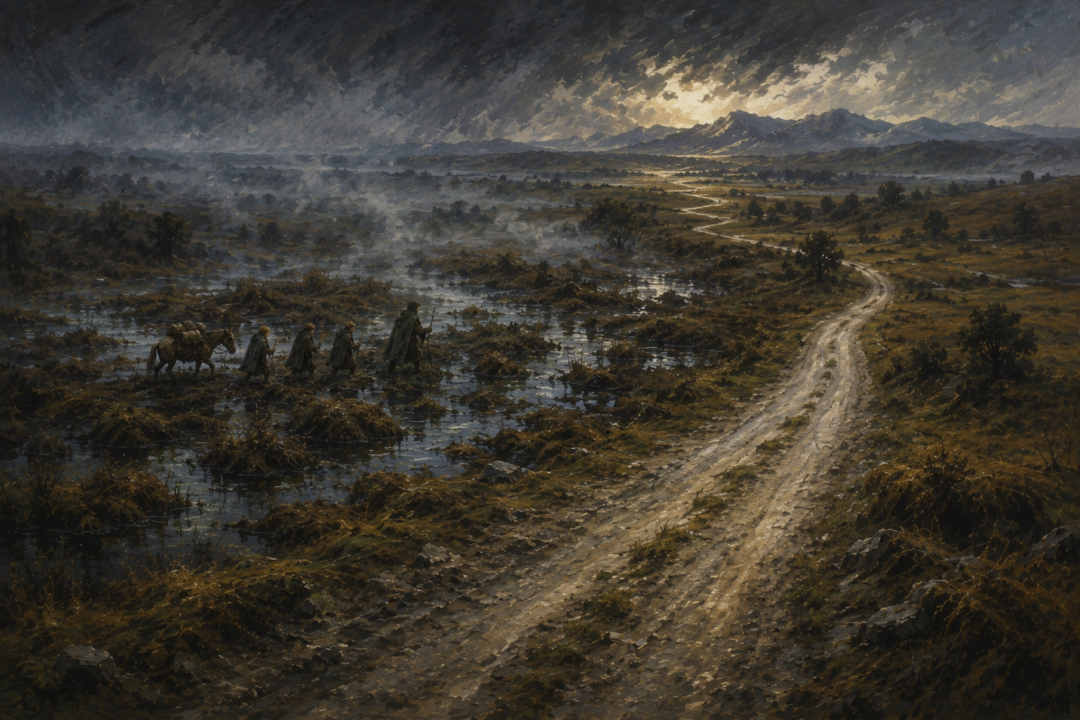
For two days the hobbits struggle through boggy country where there is no reliable path, where pools and reeds break up the landscape, where biting insects torment them by day, and where cold, damp camps and incessant noise rob them of proper rest at night. Nothing has to attack them for the country to take something from them.
The Midgewater Marshes reveal one of the quieter rules governing travel in Middle-earth: avoiding an enemy does not mean avoiding danger. Sometimes safety itself has a cost.
Strider Deliberately Leaves the Easier Road
After the hobbits escape Bree with Strider, the obvious route east is the Road toward Rivendell. But the Road is also obvious to anyone searching for them.
That is precisely the problem.
The Black Riders have already reached Bree. Their pursuit is no longer a distant possibility, and Strider understands that remaining on a predictable route would make the travellers easier to find. He therefore takes the hobbits into the wild, eventually leading them through the Midgewater Marshes north of the Road.
This is an important distinction: Strider has not accidentally become lost in a swamp.
The difficult country is part of the price of travelling less openly.
The decision shows why wilderness travel in The Lord of the Rings cannot simply be measured by distance. A straight, firm road may be faster, but speed is not the only consideration when the Nazgûl are searching for the Ring-bearer. A slower route that provides less predictable movement may be strategically preferable.
The Marshes therefore impose a trade.
The travellers gain distance from the obvious road, but surrender speed and comfort.
There Is No Permanent Path Through the Marsh
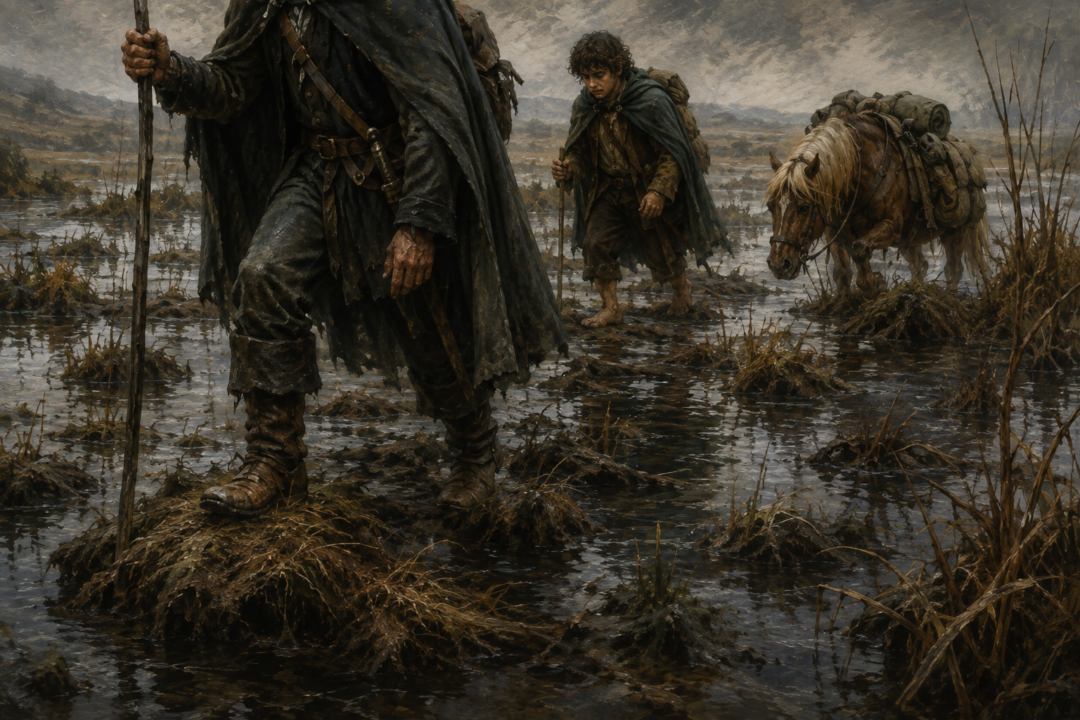
The text emphasizes how awkward the terrain itself is. The ground is boggy, with pools, reeds, and rushes, and there is no permanent trail that simply carries the travellers across.
That changes the nature of walking.
On an ordinary road, the party can devote most of its attention to moving forward. In marshland, every stretch of ground potentially becomes a small decision. Where can a pony pass? Which patch will bear weight? Where does firm ground end? Is a direct line actually usable?
Strider's experience can guide the party, but it cannot turn marsh into road.
That is one of the understated strengths of this episode. Aragorn is already being established as extraordinarily capable in the wild, yet his skill does not abolish geography. Good leadership can reduce danger without removing hardship.
The hobbits still have to cross what lies in front of them.
And what lies in front of them is slow country.
Bill the Pony Makes the Problem More Complicated
The party is not travelling on foot alone.
They have Bill, the pony bought in Bree after their previous ponies disappear. Bill is carrying much of their baggage, making him enormously useful, but a pack animal also has to be led through the same difficult terrain.
That matters in a bog.
The text does not describe Bill suffering a dramatic accident in Midgewater, so it would be wrong to invent one. But the party's actual composition places an obvious practical limit on how recklessly they can move. Strider is not merely choosing footholds for himself. He is guiding four inexperienced hobbits and a laden pony across broken wet ground.
The slowest safe passage matters more than the fastest possible passage.
This is part of why Strider's competence can look almost invisible. When a skilled guide succeeds, catastrophe does not happen. Nobody vanishes into a pool. Bill is not abandoned in the mire. The hobbits emerge from the Marshes exhausted and irritated, but alive and still together.
Success here looks like inconvenience.
The Midges Turn Discomfort Into Exhaustion
The Marshes earn their name.
The hobbits are plagued by enormous numbers of tiny biting midges. Pippin complains that he is being eaten alive, while Sam wonders what the insects live on when hobbits are unavailable.
The moment is comic, but the underlying problem is serious.
The insects do not need to injure the travellers badly to affect the journey. They only need to remain persistent.
A traveller who cannot stop scratching, cannot become comfortable, and cannot rest properly is gradually worn down. The party spends a miserable day crossing unpleasant country and then reaches a campsite that offers little relief.
This is where the Marshes become more than a simple movement penalty.
Their effects continue after walking stops.
Night Does Not Restore What the Day Takes Away
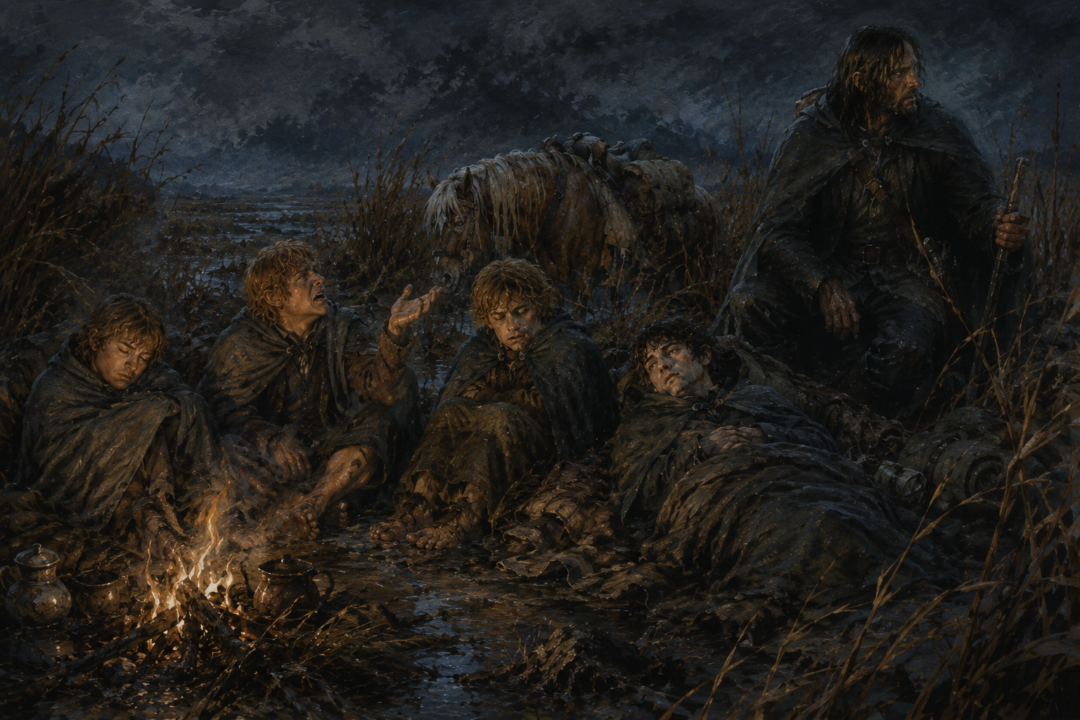
Their camping place is damp, cold, and uncomfortable. The biting insects continue to trouble them, and strange cricket-like creatures call relentlessly from the reeds and tussocks.
Sam names these creatures “Neekerbreekers” after their repetitive cries.
The hobbits are driven nearly frantic by the sound.
Again, nothing attacks.
Nothing has to.
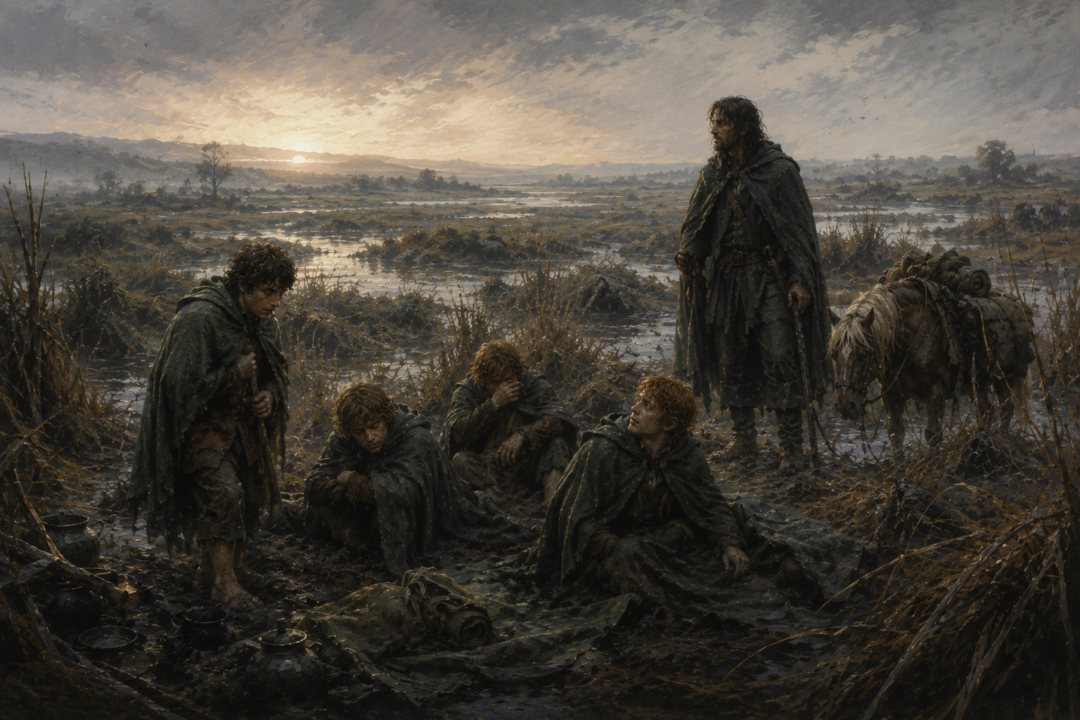
A normal night's camp should allow exhausted travellers to recover before the next day's march. Midgewater denies them that recovery. The party finishes a hard day only to spend a miserable night, and the next day is described as little better.
By the following night the Neekerbreekers have been left behind, but the midges remain. Frodo is tired and still unable to sleep.
This is the real mechanism by which the Marshes slow the party: hardship compounds.
Bad ground makes the day's travel difficult. Insects and damp make the night's rest poor. Poor rest means the next day's travel begins with travellers who have not fully recovered.
The landscape taxes both movement and recovery.
The Marshes Show the Difference Between Danger and Violence
Fantasy journeys often make danger visible through combat. Middle-earth repeatedly refuses to make things so simple.
Hunger can be dangerous. Cold can be dangerous. Mountains can be dangerous. Rivers can be dangerous. Losing the road can be dangerous.
And marshland can be dangerous without containing anything deliberately hostile.
Midgewater is especially effective because it comes soon after Bree. The hobbits know the Black Riders are hunting them, so readers naturally expect pursuit to provide the next crisis.
Instead, the landscape intervenes.
This makes the world feel larger than the conflict with Sauron. The Marshes are not presented as a trap constructed by the Enemy. They simply exist, with their pools, reeds, insects, birds, wet ground, and nocturnal noises.
Sauron's servants may be hunting Frodo, but Middle-earth does not reshape itself into a convenient battlefield around that hunt.
The travellers must deal with the world as well as the Enemy.
Strider's Route Is Still the Better Choice
Because Midgewater is so miserable, it is tempting to view the detour as a mistake.
The text gives little reason to do so.
Strider is intentionally avoiding the Road while the Black Riders are seeking the hobbits. His responsibility is not to provide the quickest comfortable journey to Rivendell. His first responsibility is to get Frodo there alive.
That changes the calculation.
A hard crossing through marshland may cost time, energy, and sleep. An encounter with the Nazgûl could cost everything.
The irony is that the absence of an attack can make Strider's choice look less necessary than it really is. We see the inconvenience of the route directly, while the disaster it is intended to help avoid remains hypothetical.
That is often the nature of good defensive decisions.
Their success is measured partly by what never happens.
Even the Detour Cannot Remove the Larger Threat
Midgewater also teaches a harsher lesson.
Avoidance can reduce danger, but it cannot guarantee safety.
After crossing the Marshes and moving toward the Weather Hills, the party eventually reaches Weathertop. There the Nazgûl do find them, and Frodo is wounded by the Witch-king.
That later attack does not make the Midgewater route pointless. Strider was trying to make pursuit more difficult, not claiming that wilderness could permanently hide the Ring from its hunters.
The distinction matters.
The Black Riders are persistent, mobile, and actively searching. Strider can choose terrain, conceal tracks where possible, avoid predictable roads, and keep moving. He cannot simply make Frodo disappear.
Midgewater therefore sits between two kinds of threat.
Behind the travellers lies the pursuit from Bree.
Ahead lies Weathertop.
Between them is a place where nothing attacks them—and yet they still lose precious strength and time.
The Quiet Lesson of Midgewater
The Midgewater Marshes are easy to overlook because greater horrors come later. Compared with Moria, Shelob's tunnels, the Dead Marshes, or Mordor, they can seem like little more than an unpleasant travel episode.
But their smallness is exactly what makes them revealing.
The party is not slowed because Strider fails. They are slowed because he is making a cautious choice under dangerous circumstances.
They are not exhausted because an enemy wounds them. They are exhausted because wet ground, insects, cold, noise, and poor sleep accumulate.
And they do not emerge with a dramatic victory. They simply continue east.
That is one of the most convincing features of travel in Middle-earth. Miles are not interchangeable. A road, forest, mountain, river, and marsh each impose different costs, and knowing the safer route does not make that route easy.
In Midgewater, Strider chooses uncertainty of terrain over predictability of road.
The choice probably makes the hobbits harder to pursue directly. It unquestionably makes their journey miserable.
That contradiction is the point.
Sometimes the safest road to Rivendell is not a road at all.
Sources & Notes
- The Encyclopedia of Arda — Midgewater Marshes: geographical reference for the wetland crossed by Aragorn and the hobbits east of Bree — https://www.glyphweb.com/arda/m/midgewater.html
- The Encyclopedia of Arda — Great East Road: context for the main route the travellers leave in order to avoid pursuit — https://www.glyphweb.com/arda/g/greateastroad.html
- The Encyclopedia of Arda — Bree: reference for the settlement from which the party begins the difficult eastward stage — https://www.glyphweb.com/arda/b/bree.html
- The Encyclopedia of Arda — Weathertop: reference for the landmark toward which the party is travelling across rough country — https://www.glyphweb.com/arda/w/weathertop.html
Sources document the key people, places, institutions, and chronology used in this interpretation.