Why the One Ring Was Gold: The Older Corruption Behind Sauron’s Masterpiece
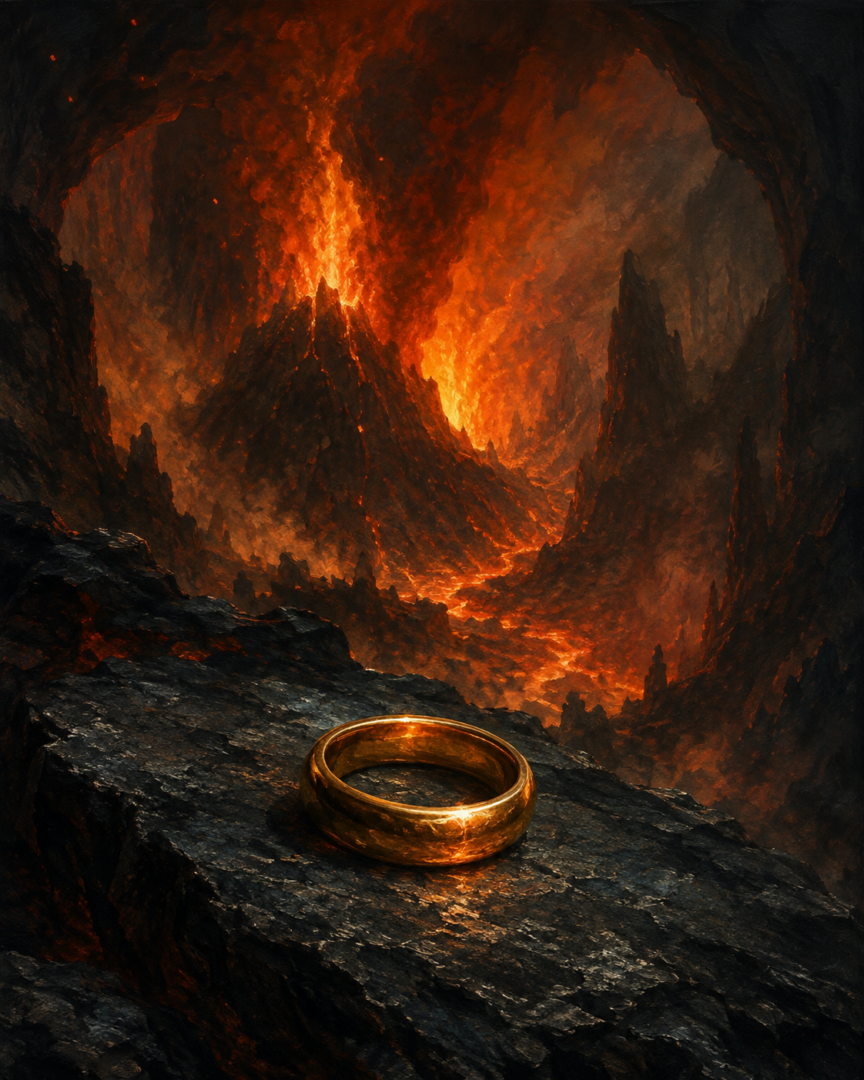
The One Ring looks almost disappointingly simple. No jewel crowns it. No elaborate setting announces its importance. To an uninformed observer it is merely a plain band of gold.
Yet that gold may be one of the most revealing details about the Ring.
The familiar story tells us that Sauron forged the One Ring in the fires of Orodruin and placed a great measure of his own power into it. But a much deeper strand of Middle-earth’s mythology suggests that the material he worked with was already connected to an older corruption. In writings published in Morgoth’s Ring, gold is singled out as a substance in which Morgoth’s dispersed power was especially present.
This does not mean that gold itself was evil, or that every golden object carried some automatic curse. The distinction matters. But it does mean that Sauron’s use of gold fits an unsettling principle running beneath the history of Arda: the Dark Lord did not create corruption from nothing. He learned how to exploit a world that had already been wounded.
The One Ring was Sauron’s creation. The conditions that made such works possible went back much further.
The Ring Really Is Gold
The material of the One Ring is not merely inferred from its color.
In The Fellowship of the Ring, gold is explicitly associated with it. Gandalf’s investigation also establishes the Ring’s extraordinary physical resilience. Ordinary fire cannot harm it, and even the best smithcraft available to the Free Peoples cannot simply melt it down.
Its outward simplicity is equally important.
When Gandalf recounts his encounter with Saruman, Saruman explains that the great Rings—the Three, Seven, and Nine—had their appropriate gems. The One did not. It was round and unadorned.
That makes the contrast remarkable. The most powerful of the Rings of Power is visually the least impressive.
Its greatness lies not in ornament but in what Sauron did to it.
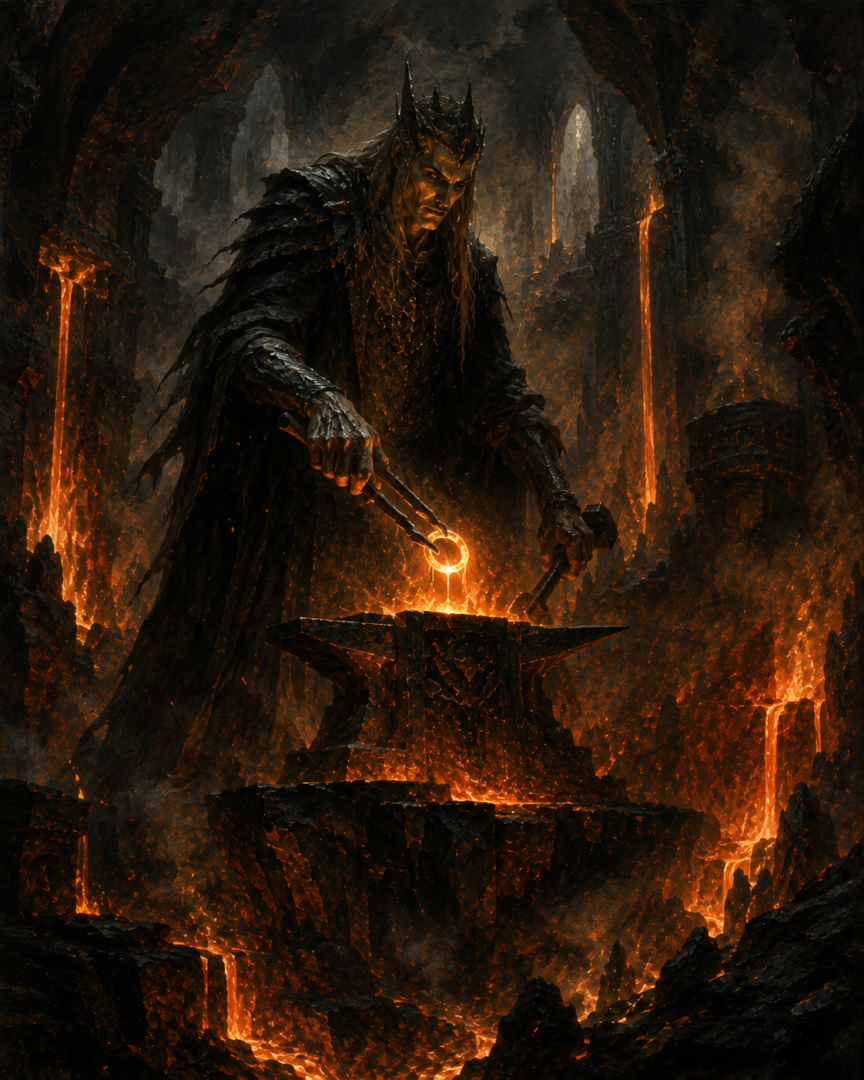
According to the account in The Silmarillion, Sauron secretly forged the Ruling Ring in the Fire of Doom after the Elven-smiths of Eregion had learned the craft of ring-making through knowledge he had supplied. His intention was to make their works subject to his own.
The One was therefore not simply a magical treasure. It was an instrument of control.
And Sauron paid for that control by investing the Ring with a substantial portion of his own inherent power.
Sauron Had Already Taught the Dangerous Craft
The One Ring did not appear in isolation.
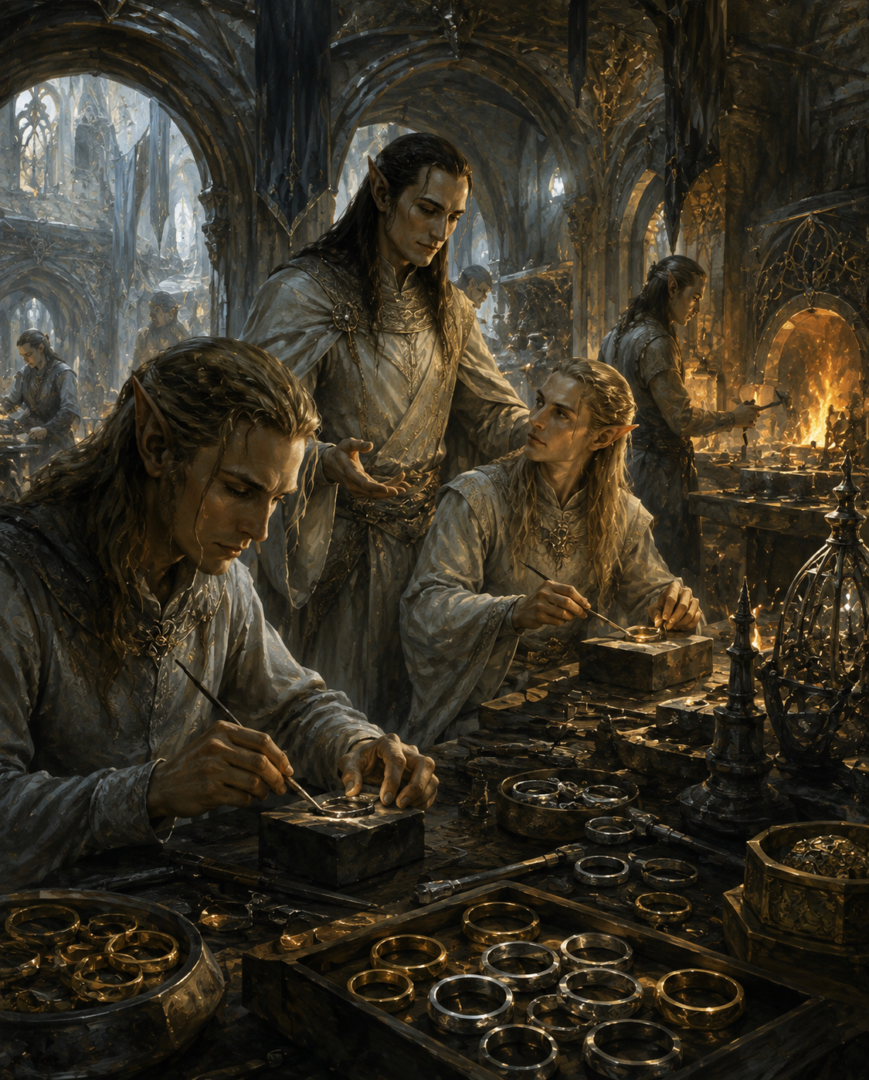
During the Second Age, Sauron approached the Elves of Eregion in a fair form. Gil-galad and Elrond distrusted him, but in Eregion he found an audience among extraordinarily skilled craftsmen.
Their ambition was not originally Sauron’s ambition.
The Elves desired knowledge capable of preserving the beauty of Middle-earth against change and decay. Sauron exploited that desire. As summarized in Letter 131, he instructed the smiths in the making of Rings of Power while secretly planning a master Ring through which their works could be governed.
The Three deserve an important qualification. Celebrimbor made them without Sauron’s direct participation, and Sauron never touched them. Nevertheless, because their craft derived from knowledge connected with him, they remained subject to the One.
That distinction reveals something fundamental about Sauron.
He is often most dangerous not when he destroys craftsmanship, but when he redirects it.
The Rings begin with genuine skill and, in the case of the Elves, an understandable longing to preserve what is beautiful. Sauron transforms that longing into a system vulnerable to domination.
The One Ring is the final expression of that philosophy.
But Sauron’s own relationship with matter has an even older background.

Before Sauron’s Ring, Arda Had Become Morgoth’s “Ring”
A late conceptual discussion published in Morgoth’s Ring offers one of the most striking explanations of evil in the legendarium.
Morgoth had expended his original power differently from Sauron.
Sauron concentrated an extraordinary measure of himself into one specific object. Morgoth dispersed his power throughout the physical substance of Arda itself.
This creates a deliberate parallel.
The One Ring became the vessel of Sauron’s concentrated power.
Arda had, in a much broader sense, become the vessel of Morgoth’s dispersed power.
This helps explain why destroying the One Ring could permanently reduce Sauron, whereas eliminating Morgoth’s influence from the world was a vastly greater problem. His corruption had become embedded in the matter of the world.
And within that corrupted world, not every material was described as equally affected.
Gold receives special attention.
Gold Had a Particular “Evil Trend”
In the notes collected in Morgoth’s Ring, gold is described as having a specially evil tendency in Middle-earth, in contrast to silver. Morgoth’s power is said to have been disseminated throughout gold, although never absolutely: Morgoth did not create gold and therefore could not possess it in the fullest creative sense.
That qualification prevents an easy misunderstanding.
Gold is not inherently a creation of evil.
Morgoth cannot truly create the substance. He corrupts what already exists.
Nor does the text establish that possessing gold automatically corrupts someone. Middle-earth contains many uses of precious metals that are not presented as manifestations of evil. The point is subtler: gold was especially affected by Morgoth’s long corruption of the material world.
The same passage connects this “Morgoth-element” in matter with the possibility of certain kinds of evil or “magic” practiced by Sauron.
That makes the One Ring’s material extraordinarily suggestive.
Sauron did not merely happen to make his masterwork from a valuable yellow metal. His Ring was made from a substance that, in this late conception of Arda, was particularly permeated by the ancient corruption of his former master.
The text does not explicitly say, “Sauron chose gold for this reason.”
We should therefore not claim that it does.
But it does explicitly connect the Morgoth-element in matter with the kinds of practices Sauron performed. The relationship between the golden Ring and the older corruption of gold is consequently much more than a coincidence invented by later readers.
Sauron Concentrated What Morgoth Had Scattered
Here the contrast between the two Dark Lords becomes especially revealing.
Morgoth spreads himself outward.
Sauron concentrates himself inward.
Morgoth diminishes himself by pouring power into the substance of the world, seeking to dominate Arda physically and permanently. Sauron creates a far smaller but more focused mechanism: one object designed to control other objects and, through them, their bearers.
The One Ring is therefore not literally a miniature version of Morgoth’s corruption of Arda, but the parallel is powerful.
Both acts involve a spiritual being investing native power into matter.
Both gain a form of external control through that investment.
Both also create vulnerability.
Morgoth becomes permanently diminished because so much of his strength has passed into the world. Sauron becomes catastrophically dependent upon the survival of the Ring into which he placed so much of himself.
Power has been converted into possession.
And possession can be lost.
Why the Ring Could Be Destroyed Only at Orodruin
The Ring’s material does not by itself explain its near-indestructibility.
Gandalf makes clear that the lesser Rings might potentially be harmed by sufficiently great forces, including dragon-fire, although he doubts that any surviving dragon could have melted the Ruling Ring. The One could be unmade only where it had been made: in the fires of Orodruin.
That points again toward the importance of craft rather than raw material alone.
Sauron’s power was not simply floating inside all gold waiting to become a Ring. The late notes explicitly distinguish his concentrated power from Morgoth’s dispersed corruption. Sauron’s power resided in this particular artifact—this particular form fashioned from a particular portion of matter.
The Ring mattered because Sauron had made it matter.
Gold provided the substance. Orodruin provided the place of forging. Sauron supplied the design, will, knowledge, and personal power.
The result was unique.
The Ring Is Not “Powered by Morgoth”
It is tempting to simplify the idea into a dramatic claim: the One Ring secretly contained Morgoth’s power.
That goes too far.
The Ring belongs fundamentally to Sauron. Its controlling will, purpose, and concentrated power derive from him. Its destruction ruins Sauron because he had invested so much of his own potency in it.
The Morgoth-element belongs to a different level of the mythology.
It concerns the damaged condition of Arda itself.
A better way to understand the relationship is that Sauron worked within a world already corrupted by Morgoth, using forms of power for which that corruption could provide the necessary material conditions.
Sauron was therefore both an innovator and an heir.
His Ring-making was his own terrible achievement, but the deeper possibility of manipulating matter through corruption belonged to the world Morgoth had already marred.
The Plain Gold Band Carries an Ancient History
That makes the appearance of the One Ring more disturbing, not less.
It does not look monstrous.
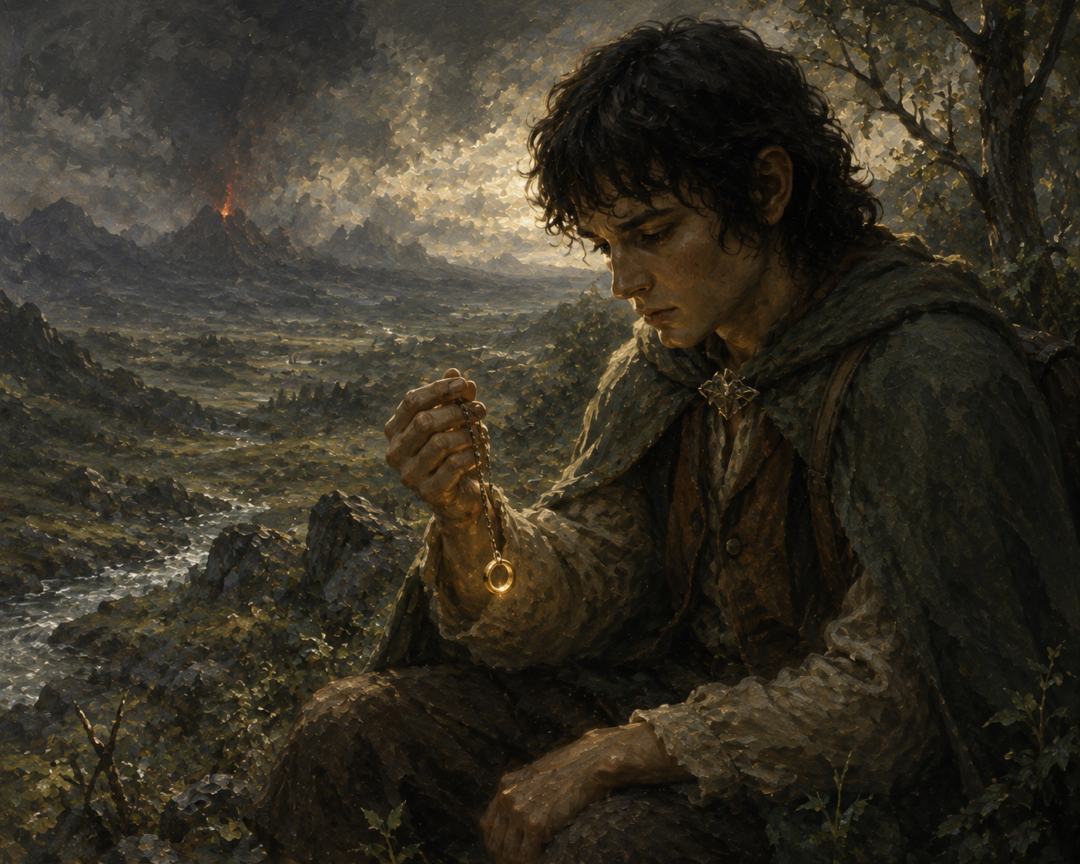
It does not need claws, black iron, a blazing jewel, or an outward sign of evil. It is smooth, desirable, precious, and beautiful enough that Déagol’s discovery immediately awakens Sméagol’s desire.
Its danger is hidden inside something attractive.
And behind that attraction lies an older pattern.
Morgoth corrupted what he did not create. Sauron learned to manipulate a world bearing that corruption. The Elven-smiths sought to preserve beauty, and their craft became vulnerable to domination. Sauron then concentrated his own strength into a golden circle meant to bind the wills of others.
The One Ring is therefore not powerful simply because it is gold.
But its gold is not an irrelevant decorative choice either.
In the deepest surviving explanations of Middle-earth’s metaphysics, gold stands unusually close to the ancient marring of Arda, and that “Morgoth-element” is specifically associated with the kinds of evil craft Sauron could practice upon matter.
The Ring on Frodo’s chain is thus the product of two histories at once.
One begins in the Second Age, in Eregion and the fires of Mount Doom.
The other begins before the Rings of Power existed at all, when Morgoth spent his strength trying to possess the world itself.
Sauron forged the One Ring.
But he forged it in a world already scarred by the first Dark Lord.
Sources & Notes
- The Encyclopedia of Arda — Rings of Power: overview of the Rings forged in Eregion and Sauron’s role in their making — https://www.glyphweb.com/arda/r/ringsofpower.html
- The Encyclopedia of Arda — Mírdain: reference on the jewel-smiths of Eregion who learned ring-lore through Sauron’s instruction — https://www.glyphweb.com/arda/m/mirdain.html
- The Encyclopedia of Arda — Celebrimbor: background on the chief ring-maker and his independent forging of the Three — https://www.glyphweb.com/arda/c/celebrimbor.html
- The Encyclopedia of Arda — Sauron: biographical reference covering his disguise as Annatar and transmission of ring-making lore — https://www.glyphweb.com/arda/s/sauron.html
Sources document the key people, places, institutions, and chronology used in this interpretation.