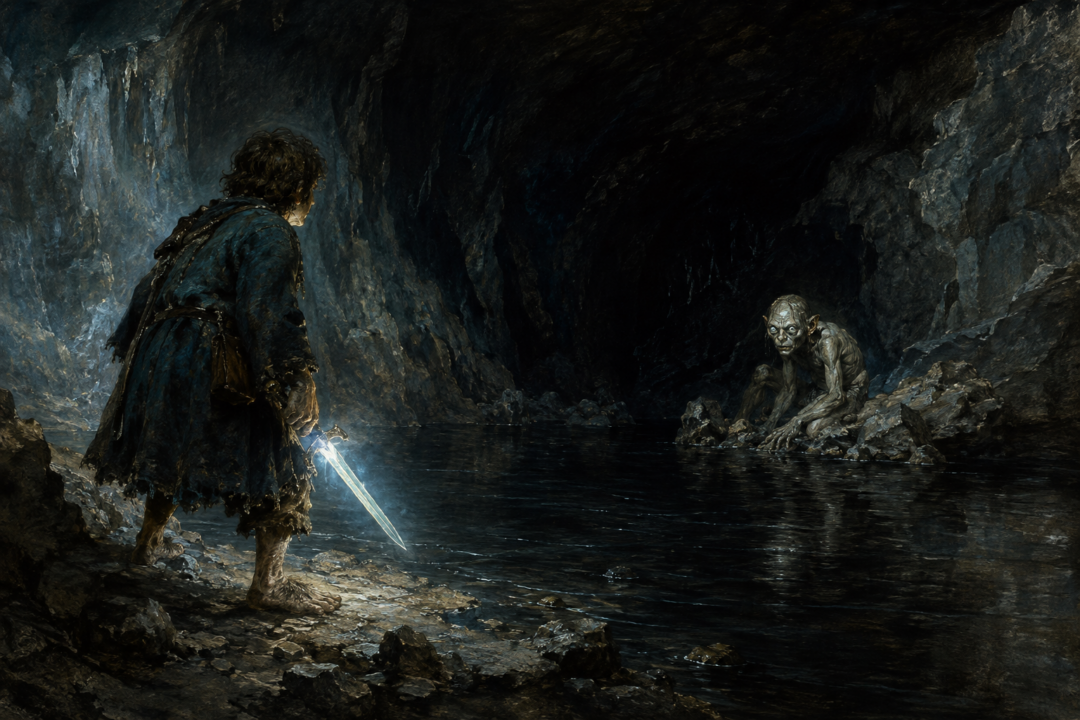
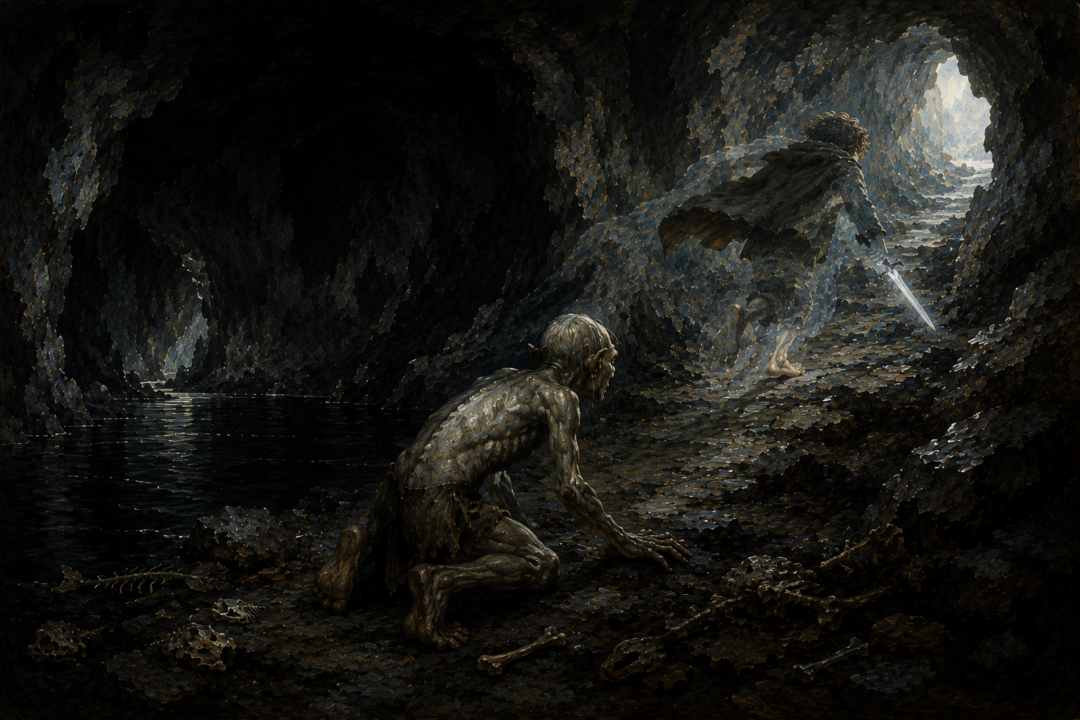
Bilbo Baggins has a sword in his hand when he first meets Gollum.
That detail matters.
He is lost beneath the Misty Mountains, separated from Gandalf and the dwarves, surrounded by goblins, and standing beside an underground lake whose depths he cannot see. Then a strange creature approaches out of the darkness. Bilbo does not know Gollum's history. He does not know what Gollum has done. He does not even know what kind of creature he is.
But Bilbo does know one useful thing: Gollum does not like his sword.
So why does the encounter become one of the most famous conversations in Middle-earth instead of a fight?
The answer is more complicated than Bilbo simply being merciful. At first, Bilbo is frightened, badly disadvantaged, and trying to survive. More importantly, the riddle contest is actually Gollum's suggestion.
Bilbo accepts because talking gives him something violence cannot: time, information, and perhaps a way out.
And beneath that practical decision lies something even more important. The encounter shows that Bilbo, when placed in a world where killing would often be easier, does not instinctively become a killer.
Bilbo Is Armed, but He Is Not in Control
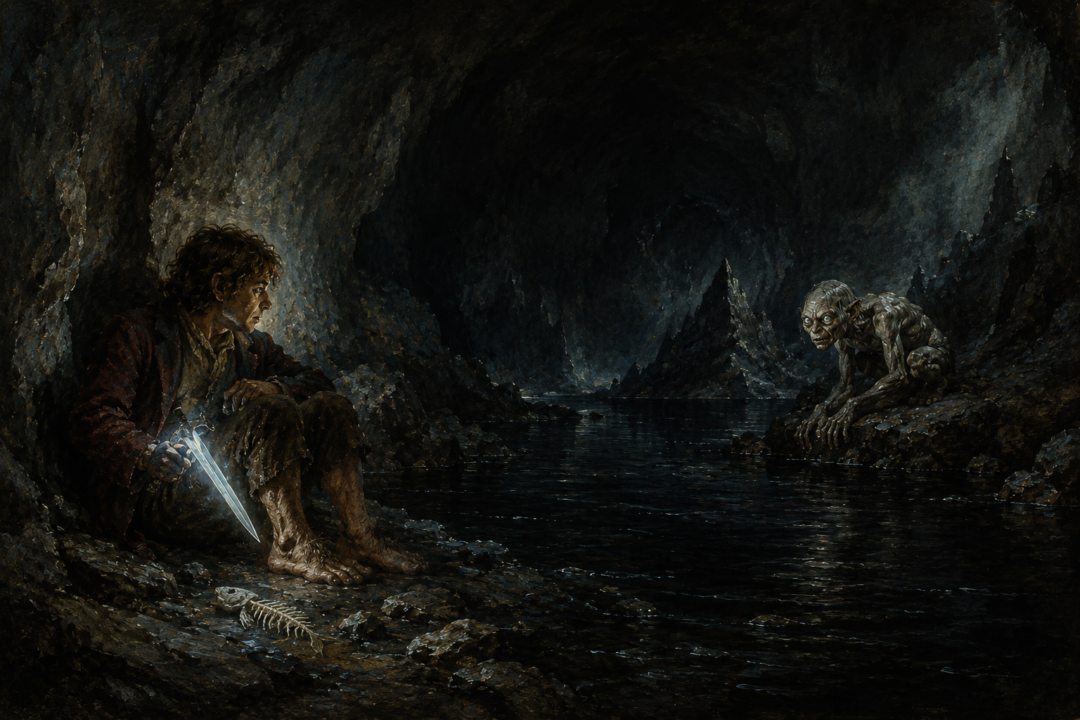
By the time Bilbo reaches Gollum's lake in The Hobbit, he has already found the Ring without understanding what it is. He has also discovered that the small sword taken from the trolls' hoard is an ancient Elvish blade from Gondolin.
The sword gives him courage.
But it does not give him command of the situation.
Bilbo is underground in complete darkness. He does not know the tunnels. He does not know where the exit lies. Gollum, by contrast, has lived beneath the mountains for centuries. He knows the lake, the passages, and the goblins above.
Simply killing Gollum—assuming Bilbo could manage it—would not solve Bilbo's central problem.
He would still be lost.
That makes their first exchange unusually tense. Gollum is curious about the stranger, while Bilbo keeps his sword ready. Gollum notices the weapon and becomes more cautious.
Neither side is eager to begin a straightforward fight.
For Bilbo, that restraint is sensible. Fighting an unknown creature beside a subterranean lake, in territory that creature knows intimately, would be extraordinarily dangerous.
For Gollum, the sword is a warning that his potential victim may not be helpless.
The result is a temporary space between violence and trust.
Into that space comes the riddle-game.
The Riddle Contest Is Gollum's Idea
It is easy to remember the scene as though Bilbo cleverly challenges Gollum to riddles. The text gives the initiative to Gollum.
Gollum has reasons for delaying.
He wants to discover more about Bilbo: what he is, whether he is alone, and whether he might be safe to eat. Bilbo's sword makes immediate attack less attractive. Gollum therefore falls back upon something deeply familiar to him—riddles.
The book explains that asking and guessing riddles had once been a game Gollum played long before his existence beneath the mountains.
This is an important clue about him.
The creature facing Bilbo is monstrous in habit, but he is not a creature without a past. Somewhere beneath the centuries of isolation and corruption remain fragments of older customs.
That makes the riddle-game more than a convenient plot device.
For a few moments, Gollum and Bilbo can interact according to rules inherited from a world of speaking, guessing, memory, and custom rather than predator and prey.
Bilbo accepts, but not because he considers the situation safe.
He effectively has little choice.
Bilbo Needs Something Gollum Possesses
The terms of the contest reveal why Bilbo is willing to play.
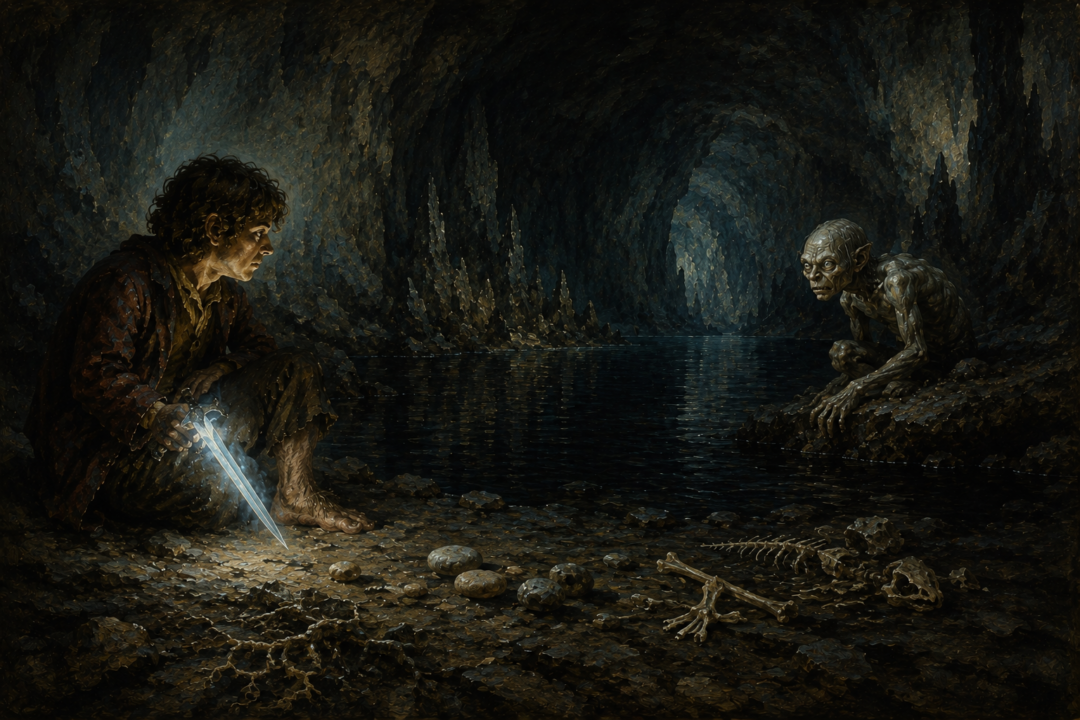
If Bilbo cannot answer Gollum's question, Gollum gets to eat him. If Gollum cannot answer Bilbo's, Gollum must show him the way out.
That second condition is everything.
Bilbo's greatest problem is not Gollum.
It is the mountain.
He needs a guide.
Violence might remove the creature in front of him, but it cannot reveal which twisting passage leads toward freedom. A successful riddle contest might.
So Bilbo's decision is not simply an ethical rejection of violence. It is also intelligent survival.
He turns an encounter in which Gollum possesses nearly every environmental advantage into a contest where Bilbo has a chance.
And riddles happen to be something a hobbit can understand.
Bilbo remembers riddles from home. His answers draw upon ordinary things—teeth, eggs, the natural world, familiar experiences. The cultural memory of the Shire becomes a survival tool in one of the darkest places he has ever entered.
That contrast is central to the scene.
Bilbo survives not by becoming more monstrous than the monster, but by carrying something of home into the darkness.
The Game Reveals a Strange Connection Between Them
There is another reason the riddle contest works at all.
Bilbo and Gollum share more cultural ground than Bilbo realizes.
Later, Gandalf concludes that Gollum's people were related to hobbits, specifically a branch associated with the Stoors. In The Fellowship of the Ring, Gandalf describes Gollum's distant beginnings among a people who lived near the Gladden Fields.
Bilbo cannot know this during their encounter.
Yet the riddles quietly expose the connection.
Both understand what a riddle-game is. Both recognize its structure. Both can draw upon traditional kinds of riddles and expected answers.
They appear to be complete opposites: Bilbo from the comfortable Shire, Gollum from a lightless island beneath a mountain.
But the contest hints that the distance between them is not absolute.
That becomes disturbing once the Ring is considered.
Bilbo is meeting a creature who represents, in one sense, a possible warning about possession, isolation, and corruption. He does not yet understand that. The reader of The Lord of the Rings eventually does.
Gollum Is Not Playing Innocently
None of this means Gollum has suddenly become honorable.
His motives remain dangerous.
As the contest progresses, he becomes increasingly hungry and hostile. After Bilbo wins with the accidental question about what is in his pocket—a question the narrative itself acknowledges is not a proper riddle—Gollum intends to retrieve his "Precious."
He plans to use its invisibility to gain the advantage over Bilbo.
Instead, he discovers that the Ring is gone.
Eventually he realizes the dreadful truth: Bilbo has it.
The riddle-game therefore does not permanently restrain violence. It postpones it.
But that postponement changes everything.
Without the conversation, Bilbo might never have gained the information and opportunity needed to escape. Gollum ultimately moves toward the passage leading to the goblins' back door, and the invisible Bilbo follows.
The strange contest that began as a delay becomes part of Bilbo's path to freedom.
The Greater Choice Comes After the Riddles
The most important moral moment does not actually occur when Bilbo agrees to play.
It comes later.
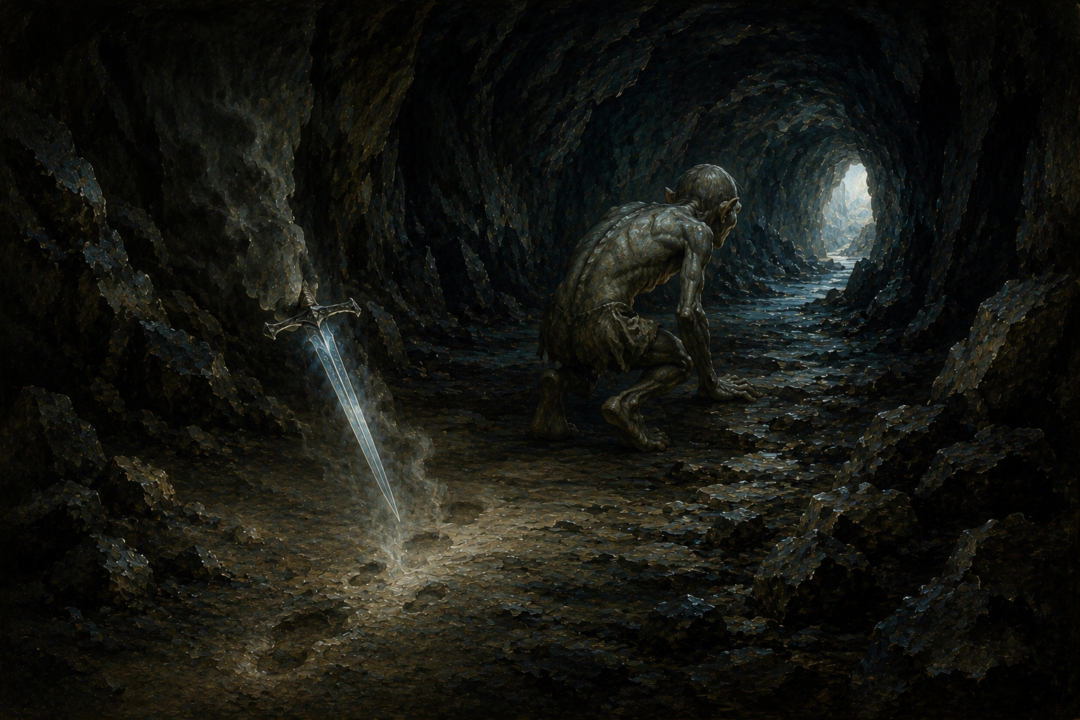
Bilbo has discovered that wearing the Ring makes him invisible. Gollum is blocking the route ahead and cannot see him.
Now the balance of power has completely reversed.
Earlier, Bilbo was lost and frightened while Gollum possessed knowledge of the caves.
Now Bilbo possesses an advantage Gollum cannot counter.
Bilbo considers killing him.
The thought is explicit and desperate. Gollum intends him harm, and Bilbo needs to escape.
But Bilbo recognizes something crucial about the situation.
It would not be a fair fight.
Bilbo is invisible. Gollum has no sword. And in that moment Bilbo suddenly perceives not merely a monster but the misery of the creature's existence: the endless darkness, loneliness, cold stone, and hopelessness.
Pity stops his hand.
Instead of stabbing Gollum, Bilbo leaps over him.
That decision becomes vastly more important than Bilbo can possibly understand at the time.
Mercy Accomplishes What Violence Could Not
Years later, Frodo hears Gollum's history from Gandalf and struggles to understand why Bilbo did not kill such a dangerous creature.
Gandalf's answer places extraordinary weight upon Bilbo's pity.
He argues that pity and mercy restrained Bilbo from striking unnecessarily and suggests that this matters even to Bilbo's relationship with the Ring.
The implication is not that Bilbo escapes all influence from the Ring. He plainly becomes attached to it.
But his possession begins with an act of mercy rather than murder.
That distinction becomes one of the great moral threads running through The Lord of the Rings.
Bilbo spares Gollum.
Frodo later repeatedly refuses to have Gollum killed.
And at the end of the quest, when Frodo himself cannot voluntarily destroy the Ring, Gollum's continued existence becomes essential to its destruction.
Bilbo could not have foreseen any of this.
That is precisely the point.
Mercy in Middle-earth is often valuable before anyone can prove that it will be useful.
The Riddle Contest Shows Who Bilbo Is Becoming
Bilbo's encounter with Gollum is often remembered because of the riddles and the discovery of the Ring.
But it is also one of the first moments in which Bilbo demonstrates the kind of courage that will define him.
Not the courage to attack.
The courage to remain himself when fear gives him reasons not to.
He talks when fighting would be reckless. He uses memory and intelligence rather than strength. Later, when violence becomes much easier and far safer for him, he refuses to kill a helpless opponent merely because doing so would simplify his escape.
The riddles begin because Gollum hesitates before Bilbo's sword.
They continue because Bilbo needs a way out.
But the encounter ends with something neither of them planned: Bilbo holding overwhelming power over Gollum and choosing not to use it lethally.
That is why the riddle-game matters beyond its clever answers.
Deep beneath the Misty Mountains, Bilbo discovers the most dangerous object he will ever possess.
Yet the more important discovery may be what he does when he finally has power over someone else.
He jumps over Gollum instead of killing him.
And the history of Middle-earth turns upon the difference.
Sources & Notes
- The Encyclopedia of Arda — Riddle-game: account of the contest between Bilbo and Gollum beneath the Misty Mountains — https://www.glyphweb.com/arda/r/riddlegame.html
- The Encyclopedia of Arda — Bilbo Baggins: biographical context for Bilbo’s encounter with Gollum and discovery of the Ring — https://www.glyphweb.com/arda/b/bilbobaggins.html
- The Encyclopedia of Arda — Gollum: background on Bilbo’s opponent, his isolation, and his possession of the Ring — https://www.glyphweb.com/arda/g/gollum.html
- The Encyclopedia of Arda — Ring of Rings: reference for the object Bilbo finds during the encounter and its later significance — https://www.glyphweb.com/arda/r/ringofrings.html
Sources document the key people, places, institutions, and chronology used in this interpretation.