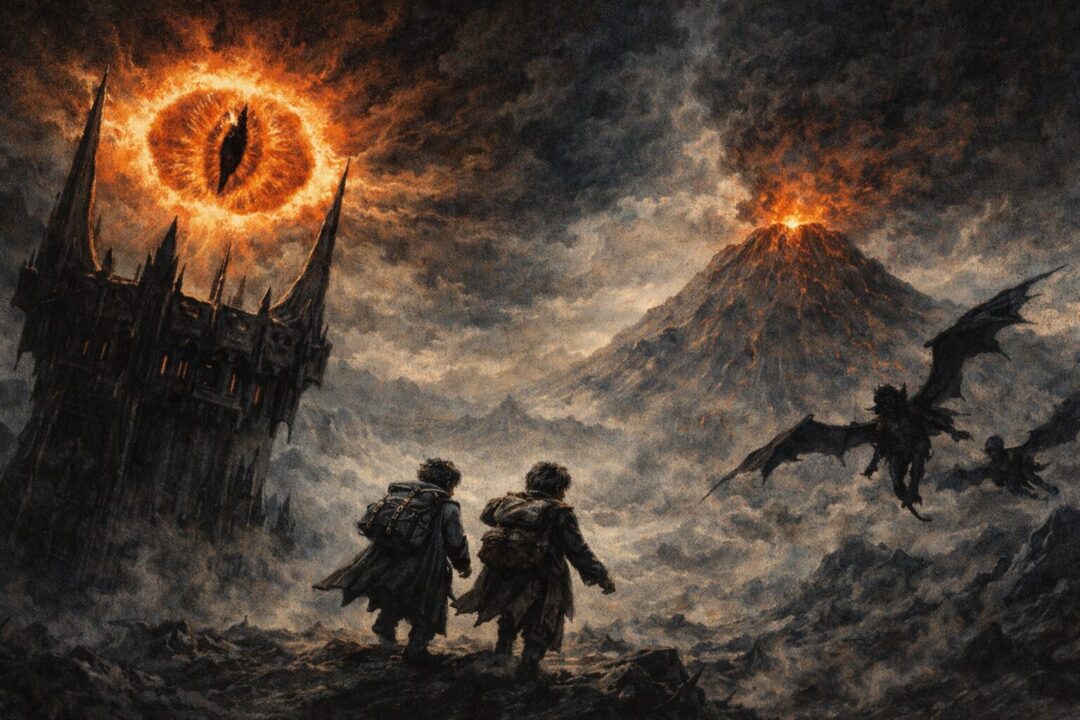
Sauron is often imagined as omniscient: an unblinking Eye stretching across Middle-earth, watching every road, probing every mind, anticipating every move of his enemies. From his dark tower in Mordor, he directs armies, bends wills, and manipulates events far beyond the reach of any mortal ruler.
And yet, the destruction of the One Ring—the single event that ends his dominion—hinges on a catastrophic failure of perception.
For most of the War of the Ring, Sauron does not know where the Ring is.
This is not because he is careless, inattentive, or weak. It is because his understanding of power, ambition, and motive is fundamentally incomplete. The Ring is destroyed not by overwhelming force, but by slipping through a blind spot Sauron never realizes he has—until the very end.
What Sauron Knows—and What He Assumes
By the time the Ring leaves Rivendell, Sauron is already actively hunting for it.
Through the torment of Gollum, he learns two crucial words: Shire and Baggins. He understands that the Ring has resurfaced after centuries of obscurity, and that it has passed into the hands of unlikely bearers. In response, he unleashes the Nazgûl, sending them west with relentless purpose.
From Sauron’s perspective, the logic is clear:
The Ring exists.
Someone has it.
Therefore, someone will try to use it.
This assumption is not foolish. It is entirely consistent with Sauron’s experience of the world.
Throughout the long history of Middle-earth, power has always been seized, wielded, and contested. From the forging of the Rings themselves to the rise and fall of kingdoms, ambition has been the engine of history. Sauron himself is the embodiment of this principle. He cannot imagine power being rejected, only taken from weaker hands and claimed by stronger ones.
The idea that the Ring might be destroyed—unmade in the very fire of its forging—is so alien to his worldview that it never fully enters his calculations.
Not as a strategy.
Not as a risk.
Not even as a remote contingency.
Why Sauron’s Eye Misses the Hobbits
Sauron’s perception is not evenly distributed across the world. His awareness sharpens around acts of will and domination.
He notices Aragorn not because Aragorn exists, but because Aragorn dares to challenge him openly through the palantír. That moment confirms Sauron’s deepest fear: that a rival strong enough to wield the Ring may be emerging.
He senses Gandalf most strongly when Gandalf acts decisively, leading armies, breaking spells, or standing openly against him.
He watches Galadriel closely because of what she could become—a rival queen, terrible and beautiful, should she take the Ring.
Power calls to power.
Hobbits, by contrast, barely register at all.
They do not seek authority. They do not project dominance. Even when Frodo carries the Ring, he resists using it whenever possible. He avoids drawing attention, avoids command, avoids exerting his will over others. As long as the Ring remains unclaimed—unasserted—its presence in the world is muted.
This is not mercy.
It is not chance.
It is not luck.
It is structural blindness.
Sauron is exquisitely attuned to ambition, but nearly blind to humility.
The Ring’s Strange Silence
One of the most subtle elements of the Ring’s nature is that it does not constantly announce itself. It tempts. It whispers. It waits.
As long as Frodo carries it without claiming it, the Ring remains strangely quiet. Its power is latent, coiled inward rather than flaring outward. This allows the Ring-bearer to move through the world without triggering Sauron’s full attention.
Ironically, this means that the closer Frodo comes to Mordor, the less suspicious Sauron becomes.
From Sauron’s perspective, no one would bring the Ring into the heart of his own realm unless they intended to use it against him. Such a move would require immense confidence, armies, and open defiance. Since none of that is visible, the idea simply never forms.

The Final March—and the Perfect Deception
When Aragorn leads the Host of the West to the Black Gate, Sauron believes he finally understands everything.
Here is the challenge he has been expecting.
Here is the moment when a new Ring-lord reveals himself.
Here is the desperate gamble of a weakened enemy hoping to overthrow him by force.
Every detail fits Sauron’s expectations.
So he responds accordingly.
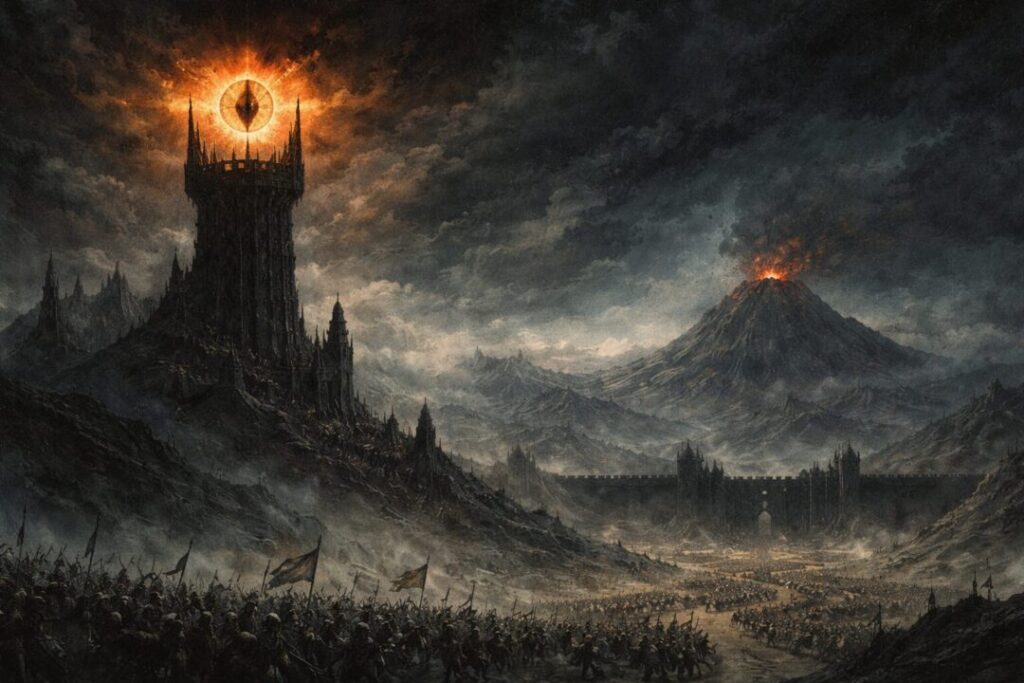
Mordor is emptied. Troops are drawn north and west. Attention is focused outward, toward the Gate, toward the armies, toward the threat that makes sense.
In doing so, Sauron unknowingly performs the final service that ensures his own destruction.
At the very moment his gaze is fixed on Aragorn, Frodo and Sam are already deep inside Mordor—moving through ash, shadow, and despair, unnoticed and unchallenged.
The Moment of Realization
Sauron does not realize the truth when Frodo enters Mount Doom.
He does not realize it when Frodo climbs the slopes of Orodruin.
He does not realize it when the Ring passes beneath his very mountain.
The realization comes only at one precise instant:
When Frodo claims the Ring for himself.
In that moment, the Ring’s nature changes. It is no longer hidden. It is no longer resisting. Frodo, overwhelmed by its power, asserts ownership—if only for a heartbeat.
And that is enough.
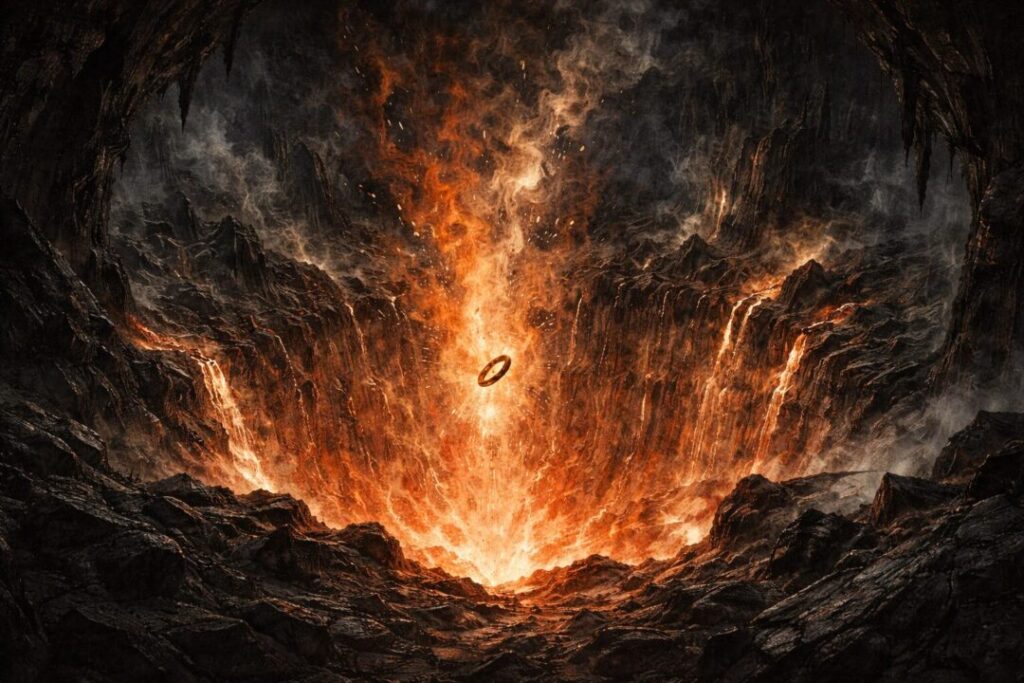
The Ring flares in the unseen world like a sudden blaze of fire. Sauron perceives it instantly and completely.
No confusion.
No doubt.
No gradual understanding.
The Ring is in Mount Doom.
The quest was real.
The threat was never a feint.
And he has already lost.
Panic in Mordor
Sauron reacts with terrifying speed. The Nazgûl are turned back at once, racing toward Orodruin with all the speed fear can drive into them. But Mordor is vast, and fate—long patient, long prepared—has narrowed the margin to moments.
There is no time.
The Ring slips from Frodo’s hand.
Gollum intervenes.
The fire claims what was forged within it.
Sauron’s will collapses not slowly, but catastrophically. His power disperses, his servants scatter, and the Eye that once watched the world is extinguished forever.
Why Sauron Could Never Win This Game
Sauron’s failure is not tactical.
It is philosophical.
He does not underestimate his enemies’ strength.
He overestimates their desire for power.
He believes that everyone, given the chance, will choose domination over sacrifice. That belief blinds him to the very qualities that ultimately defeat him: humility, endurance, pity, and the refusal to rule.
The Ring is not destroyed by clever planning or superior force. It is destroyed by exploiting the one weakness Sauron never corrects—the inability to imagine that someone might let absolute power go.
He cannot conceive of renunciation.
He cannot understand restraint.
He cannot imagine victory achieved through surrender.
And by the time he realizes that someone else can…
It is already too late.
Sources & Notes
- J.R.R. Tolkien, The Lord of the Rings, Book I, Chapter 2, “The Shadow of the Past” — Gandalf explains Gollum’s capture and Sauron learning the words “Shire” and “Baggins.”
- J.R.R. Tolkien, The Lord of the Rings, Book II, Chapter 2, “The Council of Elrond” — the Council chooses destruction of the Ring because using it would turn its wielder toward Sauron’s own mode of power.
- J.R.R. Tolkien, The Lord of the Rings, Book V, Chapter 10, “The Black Gate Opens” — Aragorn’s march draws Sauron’s attention to the expected threat of a rival attempting open challenge.
- J.R.R. Tolkien, The Lord of the Rings, Book VI, Chapter 3, “Mount Doom” — Sauron perceives Frodo only when the Ring is claimed in the Sammath Naur and sends the Nazgûl too late.
- J.R.R. Tolkien, Letter 131 — Tolkien describes Sauron’s defining desire for order and domination, helpful context for why renunciation of power lies outside his imagination.