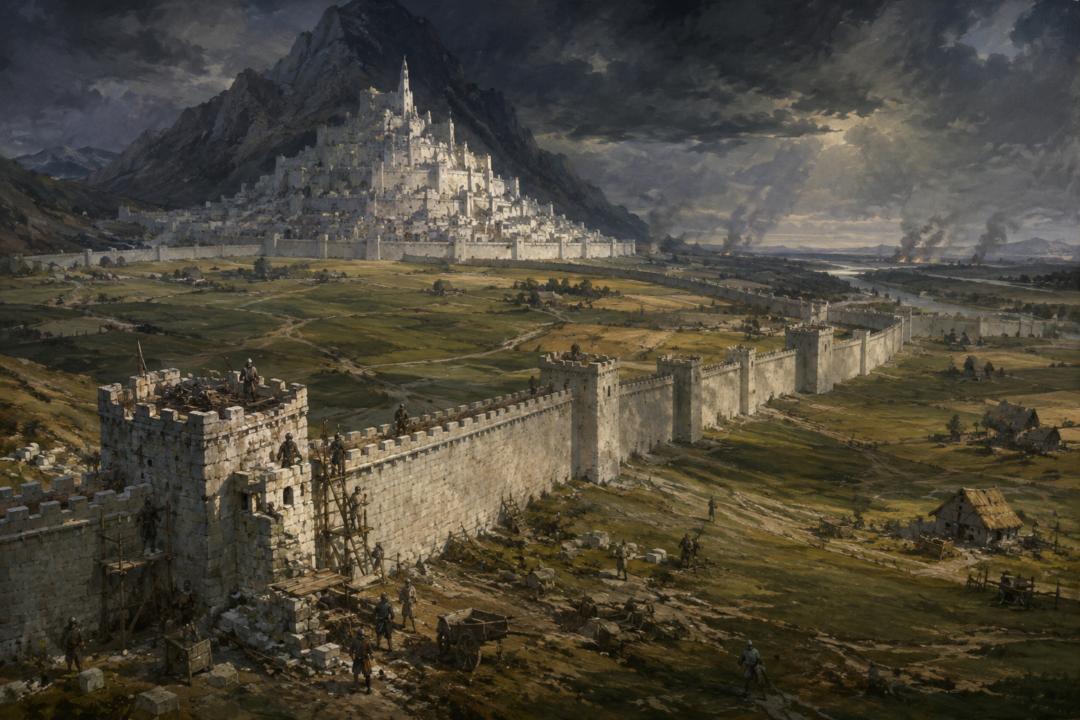
When Gandalf and Pippin reached the outer defenses of Minas Tirith, they did not immediately come to the White City. First they passed through the Rammas Echor: the long wall enclosing the Pelennor Fields, built by Gondor with immense labor after Ithilien had fallen under the Shadow.
Within days, that wall would be breached.
Measured as a perimeter defense, the Rammas Echor seems almost embarrassingly unsuccessful. The army of Mordor crossed the Anduin, broke the defenses at Osgiliath, smashed through the outer wall, and advanced across the Pelennor until Minas Tirith itself was under siege.
Yet that is not the whole military story.
The Rammas did not stop Sauron’s offensive. It was never strong enough to do so against the force ultimately committed to the assault. What it did was force the Enemy to fight through another defended position, buy time for Gondor’s retreating soldiers, and prevent the Pelennor from simply becoming open ground from the moment the Anduin crossings were lost.
Its failure was real. So was its value.
The Wall Around the Pelennor
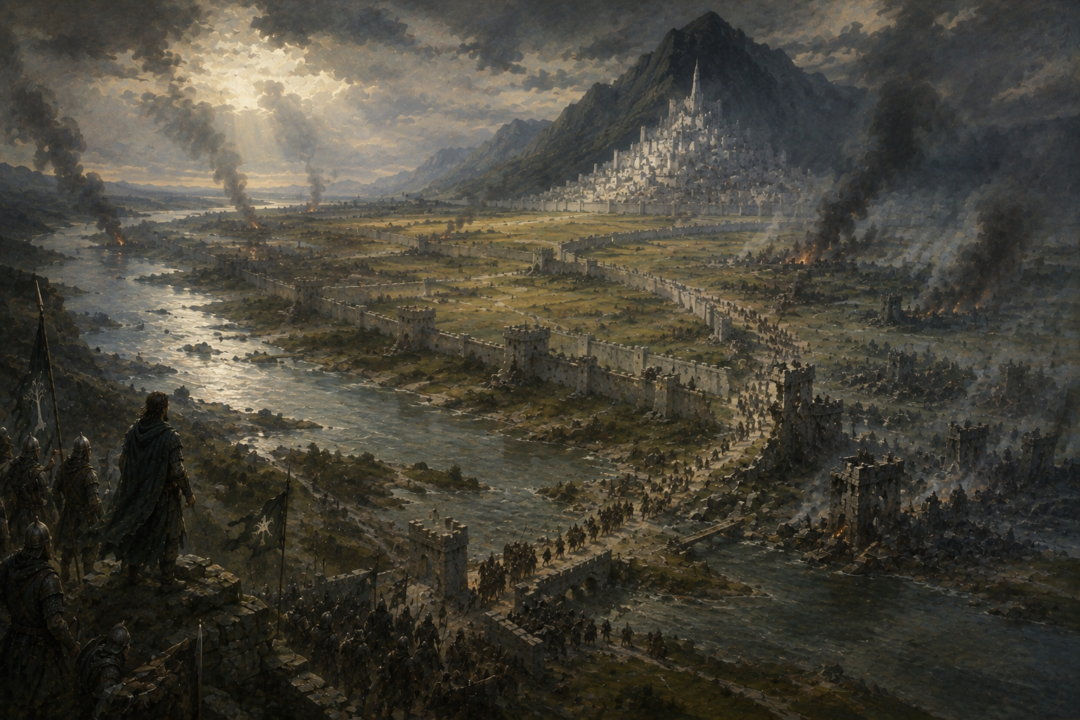
The Rammas Echor was not the wall of Minas Tirith itself. It was an outer enclosure surrounding the Pelennor Fields, the fertile townlands between the City and the Anduin.
When Gandalf enters the Pelennor in The Return of the King, the Rammas is described as running for ten leagues or more from the feet of the mountains and back again. At its farthest point northeast of the City, near the road from Osgiliath, it stood four leagues from the Great Gate.
This mattered because the Pelennor was not empty battlefield.
It contained fields, farms, roads, barns, livestock, and the agricultural landscape belonging to Minas Tirith. The wall therefore enclosed both an approach to the capital and part of the economic life immediately surrounding it.
The northeastern sector was especially important. There the road from Osgiliath entered through a guarded gateway between fortified towers, the Causeway Forts. An enemy advancing by the principal route from the Anduin could not simply march directly onto the Pelennor without confronting this position.
But there was an obvious weakness in the entire concept.
The Rammas was enormous.
A wall stretching for ten leagues or more required men to watch, maintain, and defend it. Gondor in the late Third Age possessed impressive fortifications, but it no longer possessed the population or military strength of its greatest centuries.
By the time Gandalf arrived, repairs were still being made to the wall.
The physical defenses remained formidable in places. The manpower available to hold such an extended perimeter was another question entirely.
Faramir’s Defense Was Already a Fighting Retreat
The crucial point is that Gondor’s defense east of Minas Tirith was layered.
The Rammas was not the first obstacle facing the Morgul-host.
Faramir had already been ordered back toward Osgiliath. Denethor wanted the crossings contested rather than surrendered without battle. Faramir understood the terrible arithmetic involved: the Enemy had overwhelming strength, and once the crossings were forced, the retreat across the open approaches toward Minas Tirith would become dangerous.
That is essentially what happened.
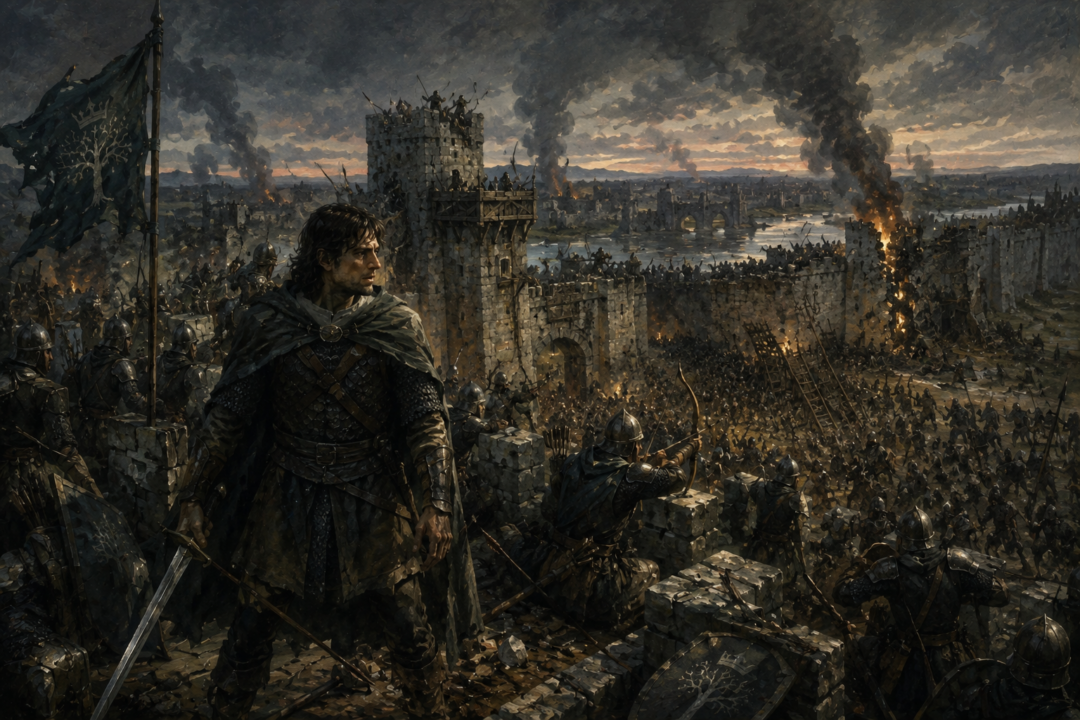
The forces of Mordor crossed the Anduin using boats and barges prepared for the assault. Faramir’s men withdrew from Osgiliath toward the Causeway Forts of the Rammas.
This changes how the outer wall should be judged.
Its purpose in that moment was no longer simply, “Keep Mordor outside the Pelennor forever.”
That was becoming impossible.
Instead, the Rammas became another position from which Gondor could resist before withdrawing toward the City’s vastly stronger defenses.
The distinction is important. A defensive line can fail to hold permanently and still impose time, casualties, disruption, and deployment upon an attacker.
The Rammas did exactly that.
Mordor Had to Break It
The Witch-king’s army did not merely discover an abandoned wall and walk through a convenient gate.
The outer defenses were attacked.
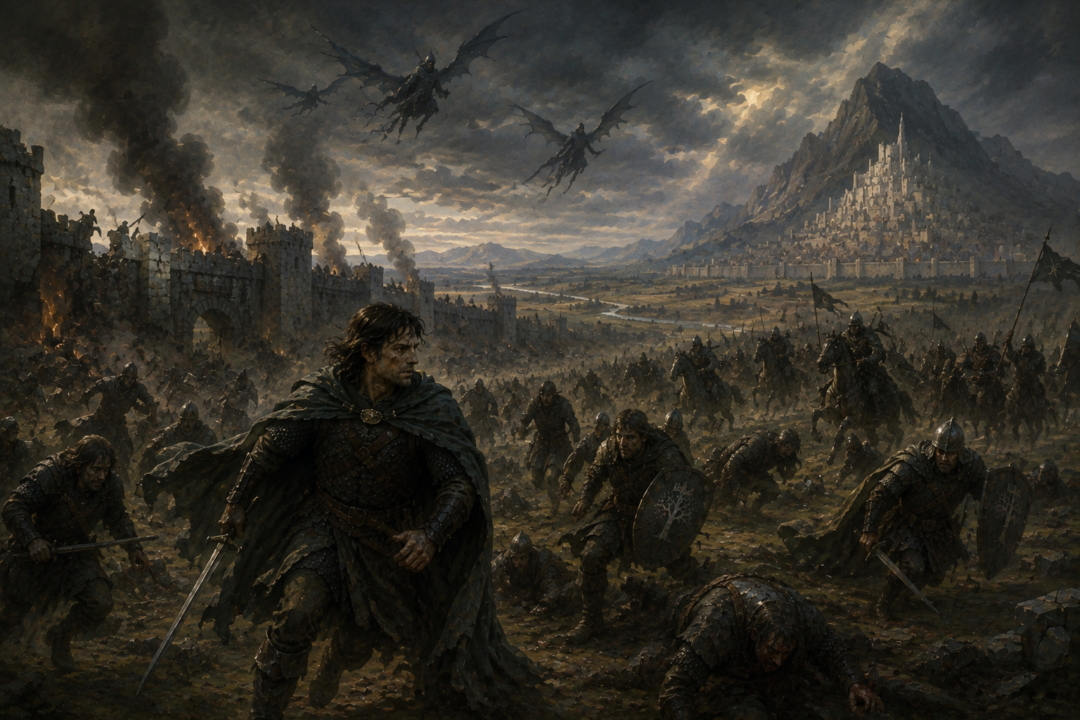
The Causeway Forts were overwhelmed, and breaches were blasted through the Rammas in multiple places. The defenders were forced back, and Faramir led the retreat across the Pelennor toward Minas Tirith.
This was a defeat for Gondor. There is no reason to disguise it as anything else.
The Enemy had crossed the Anduin, taken the outer defenses, and entered the enclosed lands surrounding the capital.
But the sequence matters.
Osgiliath had to be crossed.
The surviving defenders had to be pushed back.
The Causeway Forts had to be taken.
The Rammas had to be broken.
Only then could the main host spread across the Pelennor and begin its direct investment of Minas Tirith.
Each stage consumed part of the limited period before Sauron’s army could bring its full power against the City.
The Rammas therefore belongs to a pattern visible throughout the defense of Gondor: territory was yielded, but not freely.
The Cost Was Paid by Faramir’s Men
The danger of a delaying defense is that somebody must remain long enough to create the delay.
For Faramir’s soldiers, the Rammas was not an abstract strategic line on a map. Once it was breached, they still had to cross miles of exposed ground before reaching Minas Tirith.
The retreat became disastrous.
Enemy cavalry pursued the withdrawing Gondorians. The Nazgûl came down upon them, spreading terror. Faramir remained with the rearguard and was gravely wounded during the retreat.
Only a sortie from Minas Tirith prevented the withdrawal from becoming worse. Prince Imrahil and the mounted men of the City rode out, while Gandalf confronted the terror of the Nazgûl.
The surviving defenders reached Minas Tirith, but at severe cost.
This reveals the grim limitation of the Rammas as a defensive system. A perimeter four leagues from the City at its farthest point could provide strategic depth, but once penetrated it left its defenders with a long withdrawal across the Pelennor.
Faramir had recognized precisely this danger before the final assault.
A forward defense could hurt the Enemy.
It could also consume the defenders.
Why Denethor’s Decision Was Not Simply Foolish
It is tempting to read the fall of the Rammas as proof that Denethor’s entire defensive strategy was pointless.
The text supports a more complicated judgment.
Denethor knew that Mordor vastly outnumbered him. He also knew Minas Tirith could not afford to surrender every outer position without resistance. If the Anduin, Osgiliath, and the Rammas were abandoned immediately, the Witch-king could approach the City with less opposition and more time.
Faramir himself does not suggest that resistance outside the walls is militarily meaningless. His concern is the balance between the losses inflicted upon the Enemy and the danger of retreat.
That is the central problem.
A delaying position has value only while the cost of holding it remains proportionate to the time and damage gained.
Denethor pushed that calculation brutally hard.
His decision to send Faramir back into the outer defense after the earlier retreat is presented amid the deepening conflict between father and son, and Gandalf sharply questions the wisdom of spending lives merely because the Steward has authority to spend them.
The Rammas therefore exposes both sides of Gondor’s predicament.
They genuinely needed time.
They also had desperately few men to purchase it.
The Enemy Accidentally Opened the Wall for Rohan
Then the military meaning of the Rammas changed again.
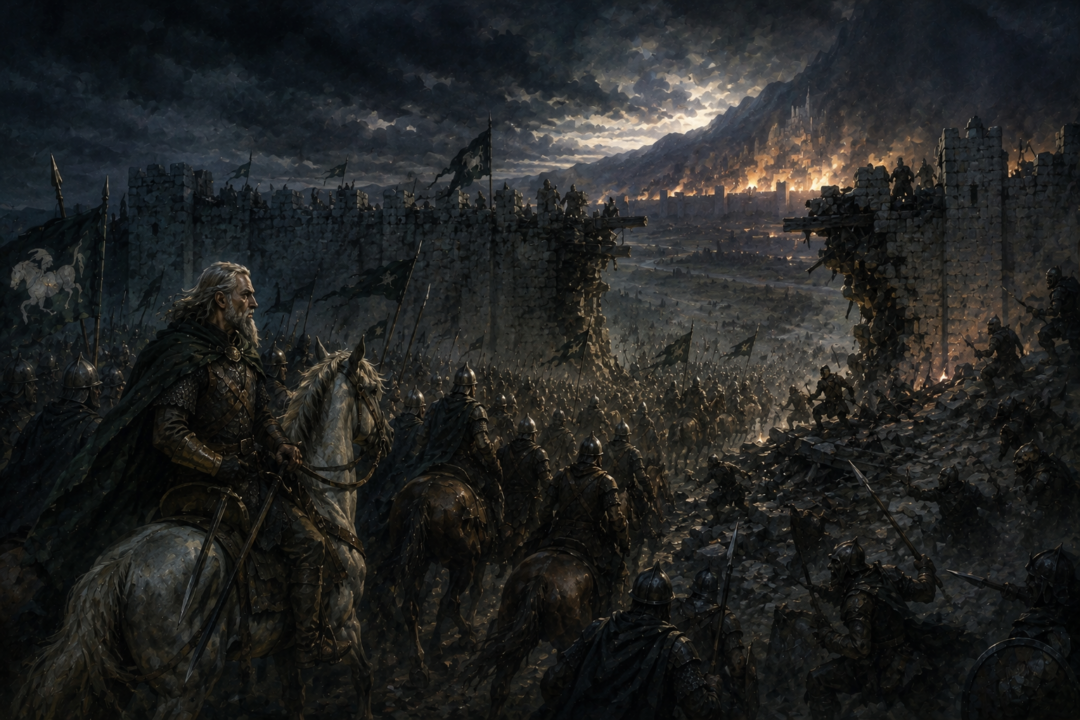
After breaking through the perimeter, Mordor’s forces began destroying sections of it. By the time the Rohirrim approached from the north, the wall that might have blocked them had already been compromised by the army that captured it.
This was no small detail.
As Théoden’s host approached the Pelennor, information from the Drúedain helped the Rohirrim avoid the Enemy forces watching the roads. Ghân-buri-Ghân’s people also brought news concerning the situation ahead.
Éomer had reason to worry about the Rammas. An intact and properly defended wall could have been a serious obstacle to thousands of horsemen trying to enter the Pelennor quickly.
Instead, when the Rohirrim reached the northern portion of the defenses before dawn, they found the gate ruined and a great breach nearby. The Orcs remaining there were occupied with destruction and were not prepared for a major attack arriving from that direction.
The Riders broke through.
The fortification built to keep enemies away from Minas Tirith had been opened by one enemy and then used as an entry point by Gondor’s rescuers.
There is a striking irony in that reversal.
Mordor had successfully destroyed the perimeter protecting the Pelennor.
In doing so, it ensured that the perimeter could not delay Rohan.
A Wall Can Fail Without Being Useless
The Rammas Echor is easy to overlook because the decisive struggle happens afterward.
The Great Gate of Minas Tirith receives the great battering ram Grond. The Witch-king enters the broken gateway. Théoden arrives with the Rohirrim. The Battle of the Pelennor Fields transforms the land inside the Rammas into the setting for one of the greatest reversals of the War of the Ring.
Against those events, an outer wall that lasted only briefly seems irrelevant.
It was not.
The Rammas demonstrates something fundamental about the defense of Minas Tirith: Gondor was fighting with space and time as much as with stone.
No single outer position could defeat the host assembled against it.
Osgiliath could fall.
The Causeway Forts could fall.
The Rammas could fall.
Even the Great Gate of Minas Tirith could be broken.
The strategic question was what each barrier cost the Enemy before it failed.
The texts never give us a calculation showing exactly how many hours the Rammas bought, nor do they explicitly declare that its primary purpose in the final campaign was delay. It would therefore go too far to claim that Gondor deliberately designed the entire defense as a perfectly calculated delaying system.
But the events show the practical effect.
The Morgul-host could not pass directly from the Anduin to the Great Gate without opposition. It had to overcome successive Gondorian positions, and the defenders of those positions repeatedly withdrew toward the next line.
The Rammas was one of those lines.
The Last Irony of the Rammas Echor
By dawn on the day of the great battle, the Rammas had failed at the task most visibly associated with a wall.
It no longer kept the Enemy out.
Orcs were inside it. Siege engines stood upon the Pelennor. Minas Tirith was under direct attack. Fires and trenches scarred the farmland the wall had enclosed.
Yet the wall had already done something less dramatic and perhaps more important than its ruined stones suggested.
It had made Mordor spend effort to get there.
And when another army finally came racing toward Minas Tirith, the broken wall could no longer keep that army out.
The Rammas Echor did not save Gondor.
Faramir’s soldiers could not hold it. Its towers fell. Its perimeter was breached.
But defenses do not have to survive a battle to have mattered in one.
Around Minas Tirith, where every mile surrendered brought the Shadow closer to the Great Gate, even a failed wall could purchase the one resource Gondor desperately needed and could never manufacture:
time.
Sources & Notes
- https://www.encyclopedia-of-arda.com/r/rammasechor.php — The Encyclopedia of Arda: Rammas Echor (the outer wall around the Pelennor, its rebuilding, and its breach during Mordor’s assault).
- https://www.encyclopedia-of-arda.com/p/pelennorfields.php — The Encyclopedia of Arda: Pelennor Fields (the defended townlands and battlefield enclosed by the Rammas).
- https://www.encyclopedia-of-arda.com/c/causewayforts.php — The Encyclopedia of Arda: Causeway Forts (the fortified road entrance where Gondor’s retreating defenders resisted).
- https://www.encyclopedia-of-arda.com/m/minastirith.php — The Encyclopedia of Arda: Minas Tirith (the capital whose layered eastern approaches culminated in the City’s own walls).
Sources checked for relevance and availability.