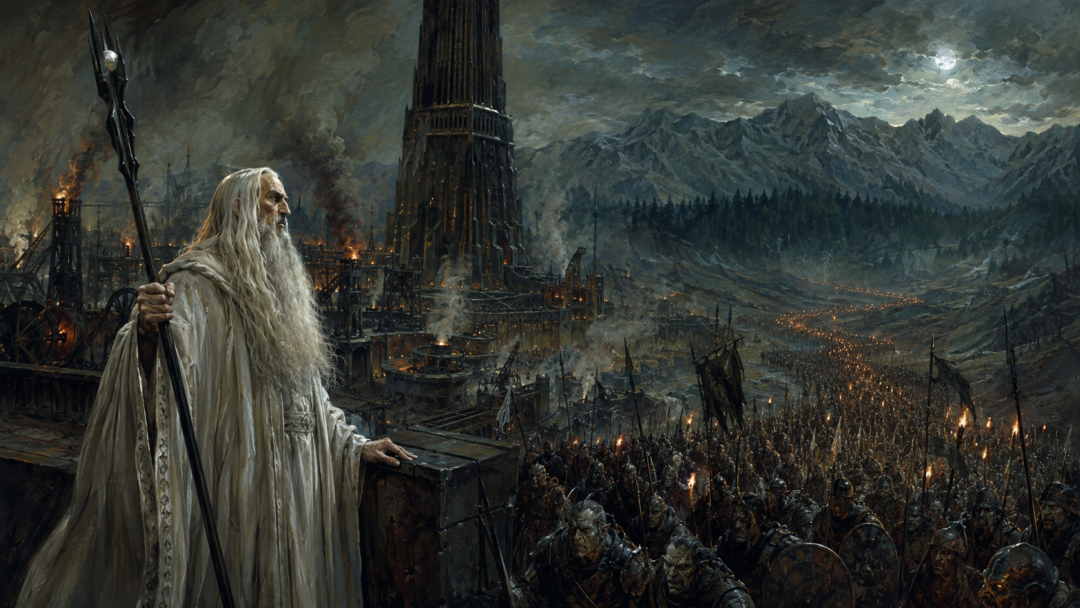
When Saruman’s great host pours out of Isengard toward Rohan, the fortress behind it is left astonishingly thinly defended. Within hours, Treebeard and the Ents arrive, tear apart the ring-wall, wreck the machinery of the valley, and trap Saruman inside Orthanc.
At first glance, it looks like an extraordinary military mistake. Why would a commander who had spent years transforming Isengard into a fortress send almost everyone away at once?
The answer is more revealing than simple carelessness. Saruman does not knowingly gamble Isengard against an enemy he considers dangerous. He fails because he is watching the threats he understands while ignoring one that has been beside him for years.
Gandalf identifies the heart of the mistake before the attack even happens: Saruman’s attention is fixed on Rohan, the Ring, and the movements of his rivals. Meanwhile, as Gandalf puts it in The Two Towers, he has “forgotten Treebeard.”
That forgotten danger destroys everything Saruman leaves behind.
Saruman’s Real Objective Is the Destruction of Rohan
By the beginning of March 3019, Saruman is no longer preparing for war. His war has already begun.
His forces have repeatedly attacked the Fords of Isen. Théodred, Théoden’s son, has been killed in the fighting. Rohan’s western defenses are under immense pressure, and Saruman has spent years weakening Théoden’s court through Gríma Wormtongue.
Then the situation changes rapidly.
Gandalf returns. Théoden is restored to strength. Gríma is driven from Edoras. The king rides west with armed men.
For Saruman, this creates an urgent strategic problem. Rohan, which he had tried to paralyze from within before destroying from without, is recovering at the worst possible moment.
His response is escalation.
In “The White Rider,” Gandalf explains that Saruman has returned to Isengard determined to increase his assault on Rohan. His thoughts are also consumed by the possibility that the One Ring may somehow have entered the struggle.
Saruman therefore has powerful reasons to commit his army quickly rather than hold a large reserve inside Isengard.
He believes the decisive contest is happening elsewhere.
The Army Leaving Isengard Is Not a Small Raiding Force
The force that marches south is the military strength Saruman has spent years creating.
Merry and Pippin witness its departure from concealment near Isengard. Their account in “Flotsam and Jetsam” describes a huge movement of Orcs, Men, and other troops leaving the fortress and heading down the valley.
Saruman apparently comes near the gates during the departure. Pippin later guesses that he may have been watching his magnificent army march away.
The important point is that the garrison afterward is tiny by comparison.
When the Ents attack, Pippin says only a few defenders remain. Once breaches appear, surviving Men flee where they can, while Orcs attempting escape face the Huorns surrounding the valley.
This was therefore not a conventional fortress defense defeated after a long siege.
Saruman had deliberately concentrated his fighting strength in the army sent against Rohan.
Against any enemy he expected, that decision may have seemed reasonable.
The problem was that the enemy approaching Isengard was one he had effectively removed from his calculations.
Saruman Does Not Expect the Ents to Attack
This is the central explanation.
There is no indication that Saruman knows the Entmoot has decided on war or that a force of Ents is marching toward his gates.
Quite the opposite is implied.
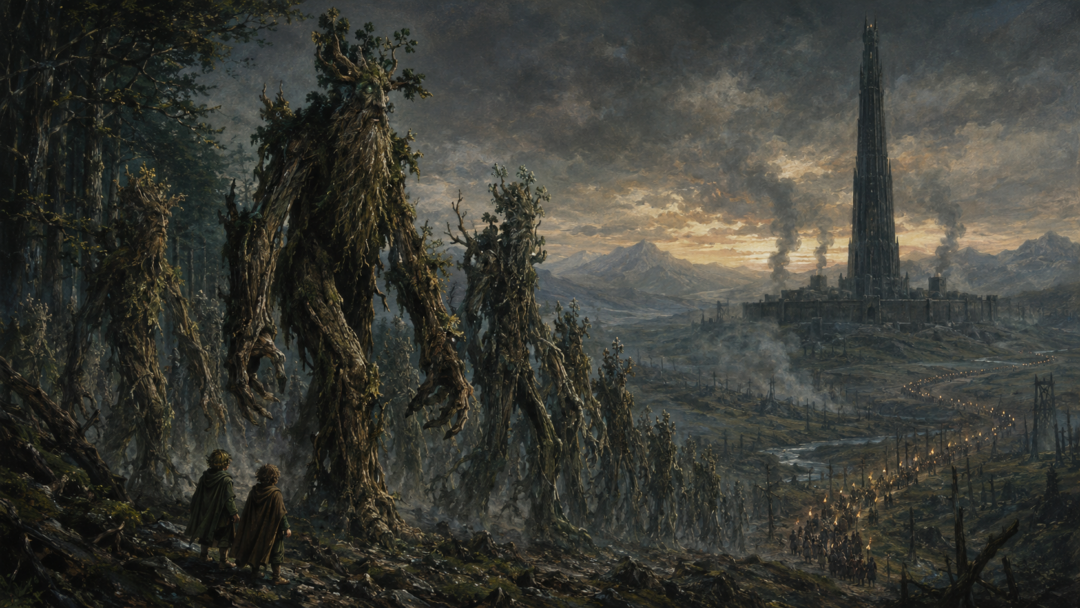
Gandalf understands the danger developing in Fangorn before Saruman does. He explicitly observes that while Saruman is occupied with his immediate plans, another danger stands close at hand and remains unseen.
Saruman certainly knows of Treebeard and the Ents. Treebeard remembers Saruman visiting Fangorn in earlier times, before his relations with the forest became openly hostile.
But knowing that Ents exist is not the same as believing they will launch an assault.
For long ages the Ents have become increasingly withdrawn from the affairs of other peoples. Treebeard himself initially shows little desire to become entangled in the wider war. Even after hearing Merry and Pippin, the Ents require an Entmoot before deciding collectively what must be done.
Saruman appears to have assumed that Fangorn would remain passive.
That assumption becomes fatal.
He Had Given Fangorn Every Reason to Hate Him
The irony is that Saruman himself creates the enemy he fails to anticipate.
Treebeard describes Orcs from Isengard cutting trees in Fangorn, sometimes destroying them without even using the timber. The devastation is especially personal for Quickbeam, whose trees have suffered from Orc axes.
Isengard itself has also been transformed.
The once greener circle surrounding Orthanc becomes increasingly dominated by pits, furnaces, workshops, smoke, machinery, and underground works. Saruman’s power is associated not merely with military expansion but with the consumption and destruction of the natural world around him.
Yet he apparently does not understand that this destruction can produce organized resistance.
That is a recurring feature of Saruman’s downfall. He is clever about mechanisms, armies, intelligence, persuasion, breeding, fortifications, and political manipulation. But his calculations repeatedly reduce other beings to pieces that should behave according to his expectations.
The Ents refuse to do so.
Their anger has accumulated slowly, which may help explain why Saruman overlooks it. But once they decide, their response is overwhelming.
Isengard Looked Much Safer Than It Really Was
Saruman also has reason to trust his stronghold.
Isengard is protected by a massive circular wall, while Orthanc itself is an extraordinarily formidable tower. Conventional attackers would face gates, walls, defenders, and the difficulty of forcing the inner fortress.
The Ents make those assumptions almost irrelevant.
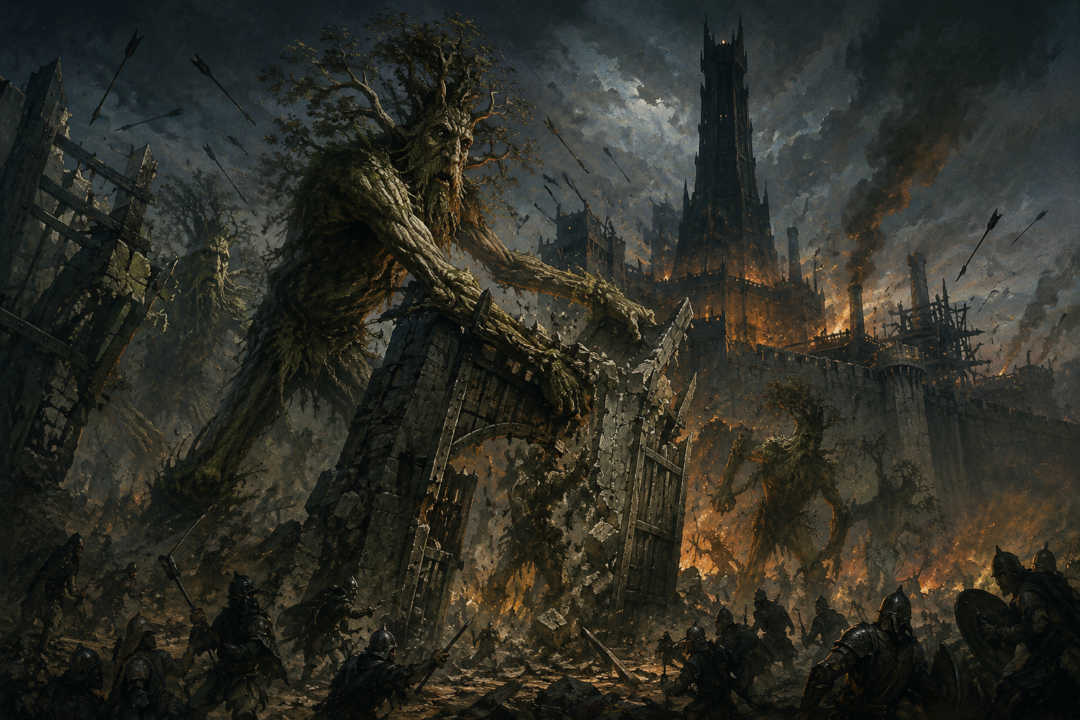
Treebeard first calls for Saruman to come out. The remaining defenders answer with missiles. Against ordinary soldiers that defense might matter. Against Ents, arrows prove insufficient to stop them.
The Ents then attack the structure of Isengard itself.
They tear at the gates and walls with a physical strength no human assault force could easily imitate. Sections of the defenses collapse. Saruman’s remaining servants begin fleeing.
Even then, Orthanc does not fall.
This distinction matters. The Ents destroy Saruman’s industrial and military base, but they cannot simply tear Orthanc apart. Saruman manages to reach the tower and remains secure inside it.
So Saruman was not completely mistaken in trusting Orthanc.
He was disastrously mistaken in believing possession of Orthanc meant control of Isengard.
The Timing Could Hardly Have Been Worse
The Ents arrive at almost the perfect moment.
They approach Isengard as Saruman’s army is marching away.
Crucially, they do not attempt to stop the host. They allow it to depart before beginning their own attack.
That creates two separate catastrophes for Saruman.
His army continues toward Helm’s Deep, where it encounters fierce resistance from Théoden’s forces. The Huorns that move south from Fangorn eventually become part of the terrifying barrier into which Saruman’s defeated Orcs flee after the battle.
Meanwhile, the Ents remaining at Isengard dismantle the fortress behind them.
Thus the army cannot simply retreat to a functioning secure base.
Saruman loses both his offensive force and his strategic center in the same sequence of events.
Neither disaster alone necessarily ends his power so completely. Together, they do.
Saruman Has No Prepared Answer Once the Ents Begin
Pippin’s account makes another important point: Saruman has no effective plan for dealing with the Ents once they attack.
The speed of events catches him unprepared.
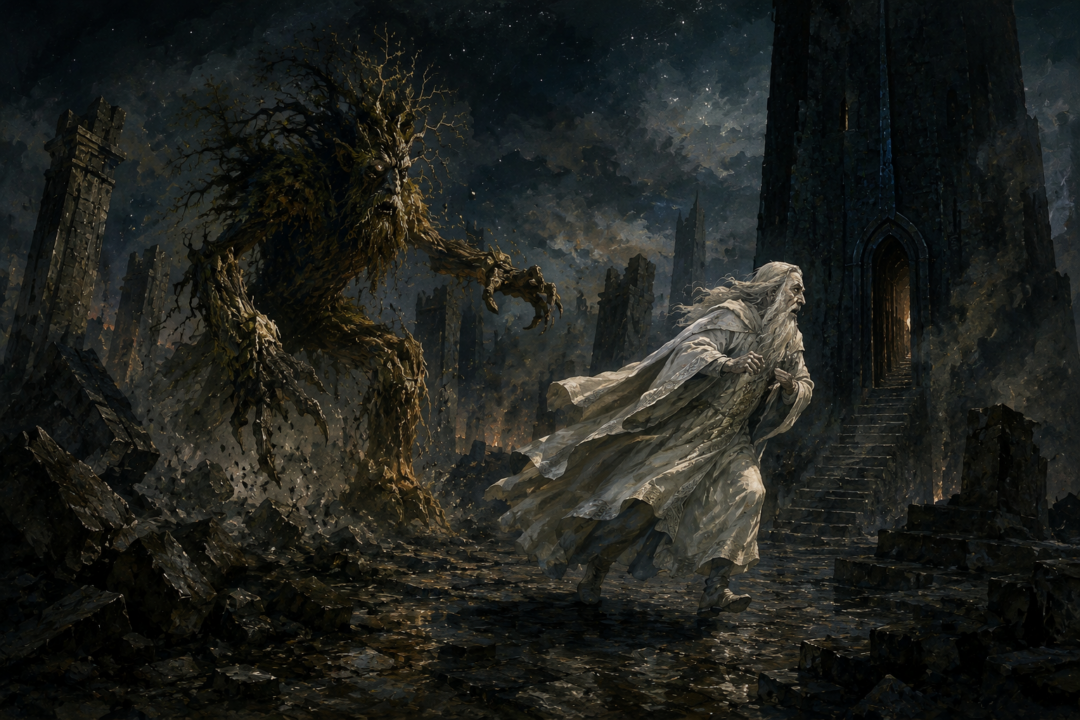
At one point Saruman himself nearly fails to reach Orthanc safely. Quickbeam spots him and pursues him with enough speed that the Wizard escapes into the tower only narrowly.
After that, Saruman attempts more destructive measures from within his stronghold, including fire.
Treebeard is enraged, and the Ents change tactics.
Rather than continue merely smashing buildings, they turn water against Isengard. They obstruct and redirect the waters of the Isen, eventually flooding the circle. The fires and furnaces are drowned beneath water and steam.
The imagery is fitting, but the military result is more important: Saruman’s war machine ceases to function.
He possesses an impregnable tower surrounded by the ruins of the power he had built.
His Greatest Mistake Was Not Leaving Too Few Guards
It is tempting to reduce the fall of Isengard to an elementary military lesson: Saruman should have kept more troops at home.
But that only explains part of what happens.
Would several hundred more Orcs have stopped the Ents? The text gives no basis for claiming that they would. A substantially larger defending force could certainly have made the assault more costly, especially with axes and fire, but the unusual strength of the Ents and the presence of the Huorns made this unlike an ordinary siege.
The deeper error comes before troop numbers.
Saruman misidentifies the battlefield.
He believes the dangerous pieces are Théoden, Gandalf, the Rohirrim, Sauron, and above all the uncertain location of the Ring. Those are rational concerns. But his obsession with immediate power struggles blinds him to the consequence of what he has done to Fangorn.
He has treated an ancient living power as scenery.
Then the scenery marches against him.
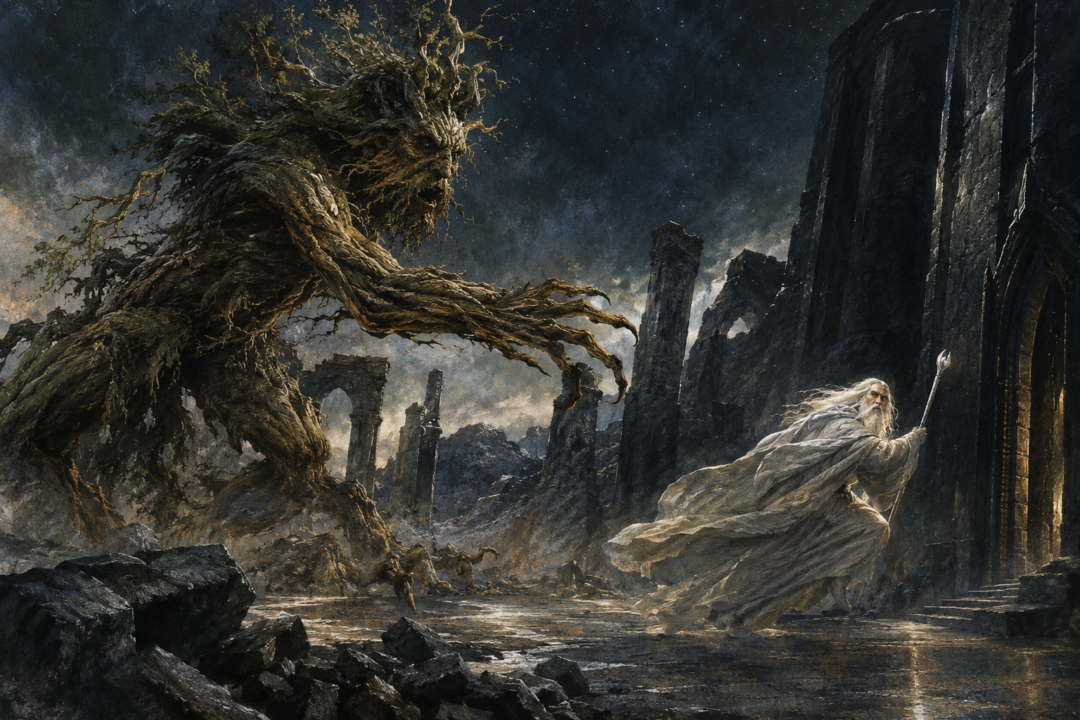
Isengard Falls Because Saruman Cannot Imagine the World Outside His Plans
Saruman’s defeat is therefore not simply the result of arrogance in the abstract.
It is a specific failure of perception.
He has become extraordinarily skilled at making plans involving armies, spies, fortresses, machines, and political pressure. Yet those skills encourage him to see Middle-earth as something that can be organized and controlled.
The Ents expose the weakness in that worldview.
They are old, slow to anger, and apparently remote from the war. None of those qualities means they are powerless.
Saruman understands their strength only after they are already breaking through his gates.
By sending his army south, he leaves Isengard vulnerable because he thinks the fortress is behind the real war.
Instead, the war comes to Isengard from the forest he had spent years injuring and then dismissed from his calculations.
That is why the fall feels so complete.
Saruman is not defeated by an enemy arriving from some distant unknown land. He is destroyed by a consequence that had been growing beside him all along.
Sources & Notes
- https://www.encyclopedia-of-arda.com/i/isengard.php — The Encyclopedia of Arda: Isengard (Saruman’s fortified base, its armies, and its capture by the Ents).
- https://www.encyclopedia-of-arda.com/s/saruman.php — The Encyclopedia of Arda: Saruman (his war against Rohan and strategic downfall).
- https://www.encyclopedia-of-arda.com/e/ents.php — The Encyclopedia of Arda: Ents (the Entmoot’s decision to attack Isengard and the force Saruman failed to anticipate).
- https://www.encyclopedia-of-arda.com/f/fangornforest.php — The Encyclopedia of Arda: Fangorn Forest (the neighboring power Saruman provoked through destructive tree-felling).
Sources checked for relevance and availability.