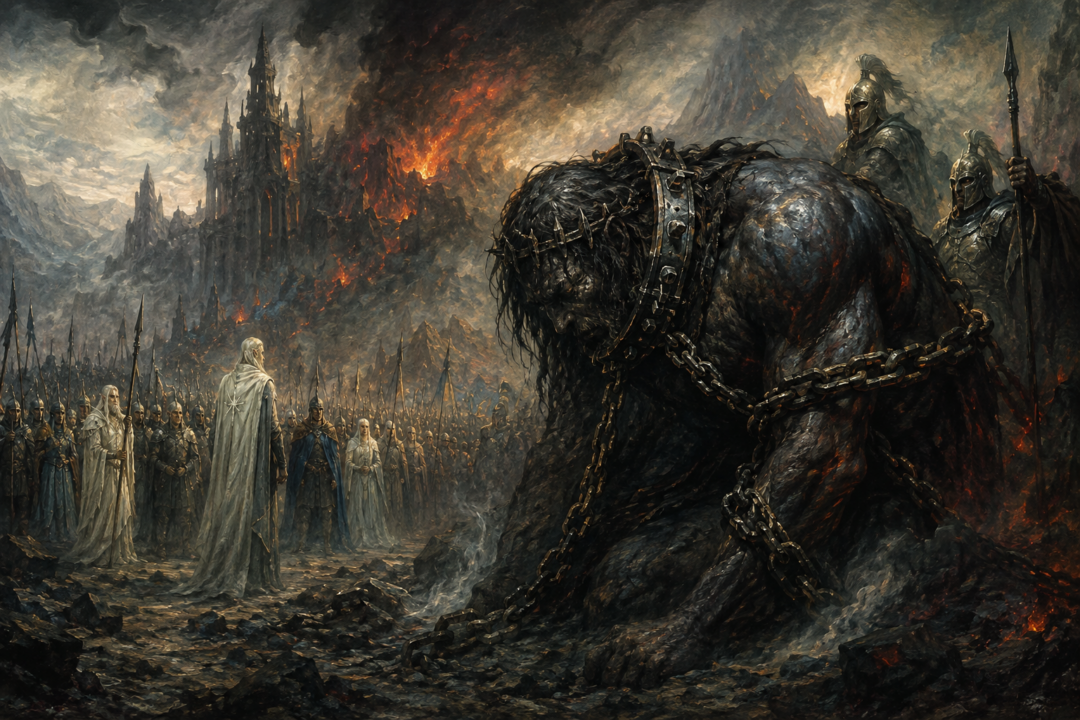
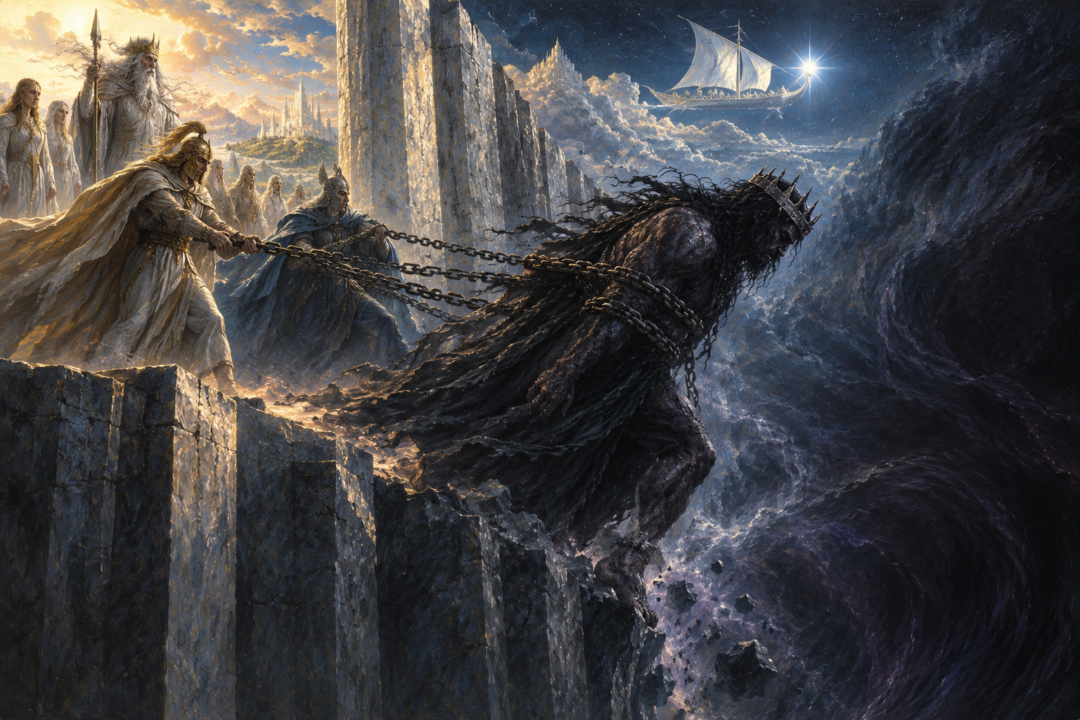
At the end of the War of Wrath, Morgoth is finally captured. Angband has been broken, his armies destroyed, and the Dark Lord who once challenged the Valar has retreated into the deepest places of his fortress. He is bound again with Angainor, the chain that had restrained him once before.
That detail makes what follows especially striking.
The Valar already possessed a place where Morgoth could be confined. They had imprisoned him in the Halls of Mandos after his first great defeat, and he had remained there for three ages. Yet after the War of Wrath, they do not simply repeat that sentence.
Instead Morgoth is expelled from the World.
The difference reveals something fundamental about his history. His first captivity had been followed by the possibility of repentance and restoration. By the end of the First Age, that possibility had proved catastrophically false. Morgoth was no longer merely a dangerous rebel who could be restrained inside Arda. He had become an enemy whose presence within the World was itself part of its continuing corruption.
The First Imprisonment Was Not Intended to Be Eternal
Long before the wars of Beleriand, the Valar had already fought Melkor directly.
When the newly awakened Elves were threatened by his power, the Valar launched the Battle of the Powers. Utumno was broken, Tulkas wrestled with Melkor, and the fallen Vala was bound with Angainor and brought to Aman.
His punishment was severe but finite.
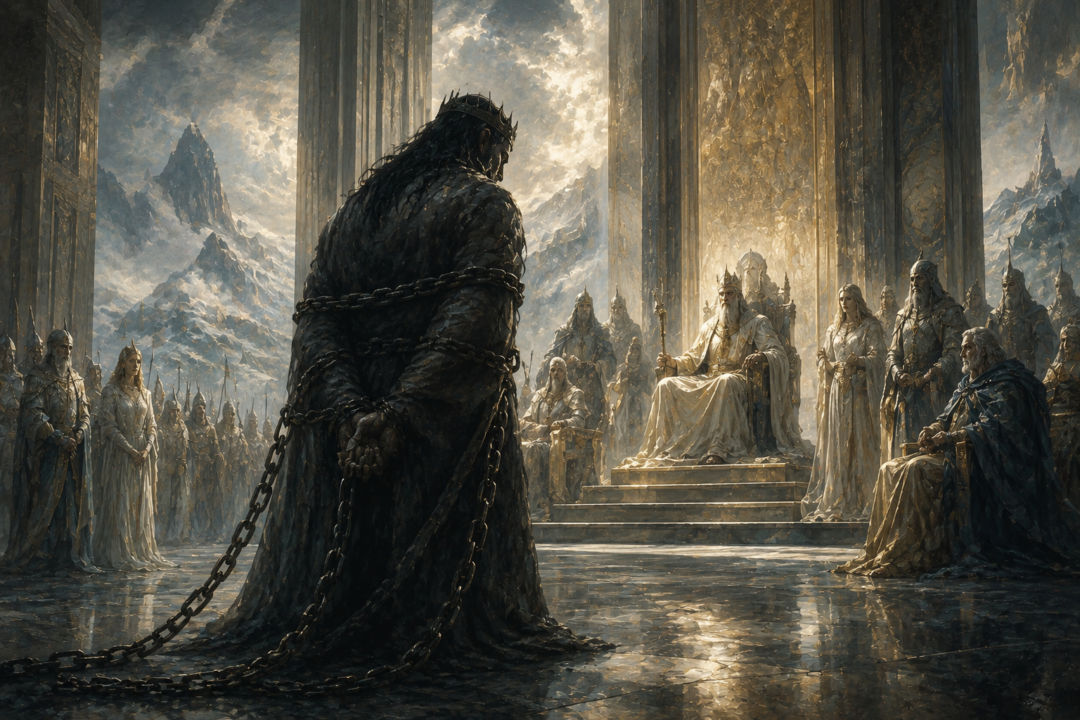
In The Silmarillion, Melkor is condemned to remain in the fastness of Mandos for three ages. Only afterward could he return before the Valar and seek pardon.
That provision matters. His captivity was not described as an eternal removal from existence. Judgment left open the possibility that Melkor might change.
Eventually he was brought before the Valar. He presented himself as repentant and begged forgiveness. Manwë granted his pardon.
This decision would have disastrous consequences, but the text does not portray Manwë as simply foolish. Manwë could not comprehend evil for its own sake because he himself was free from it, and he believed Melkor’s claim that he desired to aid the other Valar and the Children of Ilúvatar.
Melkor had learned something during his imprisonment.
Not repentance.
Deception.
Morgoth Turned Mercy Into a Weapon
Once released, Melkor behaved outwardly as though he had reformed.
He offered knowledge and assistance. Yet beneath that appearance he began working against the Valar and the Eldar. He exploited the pride and unrest of the Noldor, spreading falsehoods and suspicions among them.
Eventually the mask disappeared altogether.
Melkor and Ungoliant destroyed the Two Trees. Finwë was slain at Formenos, the Silmarils were stolen, and Melkor fled back to Middle-earth. There Fëanor named him Morgoth, the Black Enemy.
The significance is larger than a simple prison escape.
Morgoth had been defeated, restrained, given time, brought to judgment, and ultimately shown mercy. He then deliberately used his restored freedom to resume his rebellion on an even more destructive scale.
A second imprisonment in Mandos would therefore not merely have repeated an earlier punishment. It would have repeated a process whose central hope—Morgoth’s genuine amendment—had already failed.
The published Silmarillion never gives us a legal explanation in which the Valar explicitly announce why Mandos is no longer sufficient. But the contrast between the two judgments is difficult to miss.
The first leaves open a road back.
The second shuts the door.
By the War of Wrath, Morgoth Had Changed
There is another important difference between the Melkor captured at Utumno and the Morgoth defeated at the end of the First Age.
Morgoth had spent enormous amounts of his native power corrupting the physical substance and inhabitants of Arda.
This idea becomes particularly explicit in writings published in Morgoth’s Ring. Morgoth’s evil was not concentrated solely within his personal form. He had dispersed his power into the world in his attempt to dominate it.
That helps explain one of the great paradoxes of Morgoth.
The mightiest of the rebellious Ainur becomes personally diminished.
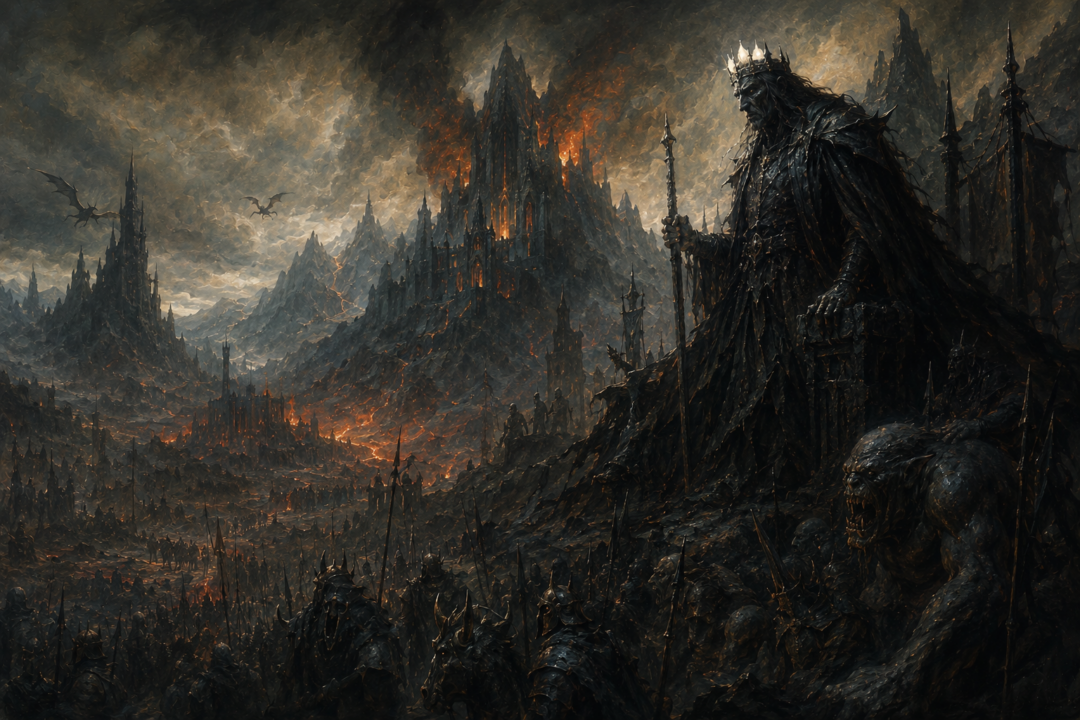
The being who once contended with the other Valar eventually hides underground in Angband. He creates and corrupts servants, raises armies, breeds monsters, and dominates vast territories, but his own native power has been spent in making the world more responsive to his will.
The result is what later writings describe conceptually as “Morgoth’s Ring”: Arda itself has been deeply infected by his corruption.
This does not mean Morgoth literally possesses the entire world in the manner that Sauron possesses the One Ring. The comparison has limits. Rather, Morgoth has invested his power into the matter of Arda so extensively that defeating his bodily presence cannot simply remove all the consequences of his evil.
That is why his final exile does not magically heal Middle-earth.
The War of Wrath Ends the Question of Containment
By the end of the First Age, ordinary containment has already failed once.
The consequences of that failure have become almost unimaginably large.
Morgoth’s return produced centuries of war. The kingdoms of the Noldor and Sindar were destroyed one after another. Dorthonion fell. Nargothrond was ruined. Gondolin was betrayed and destroyed. Doriath vanished amid the disasters of the age. Countless Elves and Men died or were displaced.
Finally Eärendil reached Aman and pleaded on behalf of Elves and Men.
The Host of the West came against Morgoth.
The resulting War of Wrath was so catastrophic that much of Beleriand was broken and sank beneath the sea. Morgoth’s armies were defeated, and his last release of the winged dragons was overcome when Eärendil and the great Eagles entered the battle.
Morgoth himself did not make a glorious final stand.
He fled into the deepest places of Angband.
There he was captured.
Angainor Returns—but Mandos Does Not
The manner of Morgoth’s capture deliberately recalls his earlier defeat.
His feet are cut from beneath him, and he is bound with Angainor once again. His iron crown is beaten into a collar around his neck, and the remaining Silmarils are taken from him.
Everything appears ready for history to repeat itself.
But it does not.
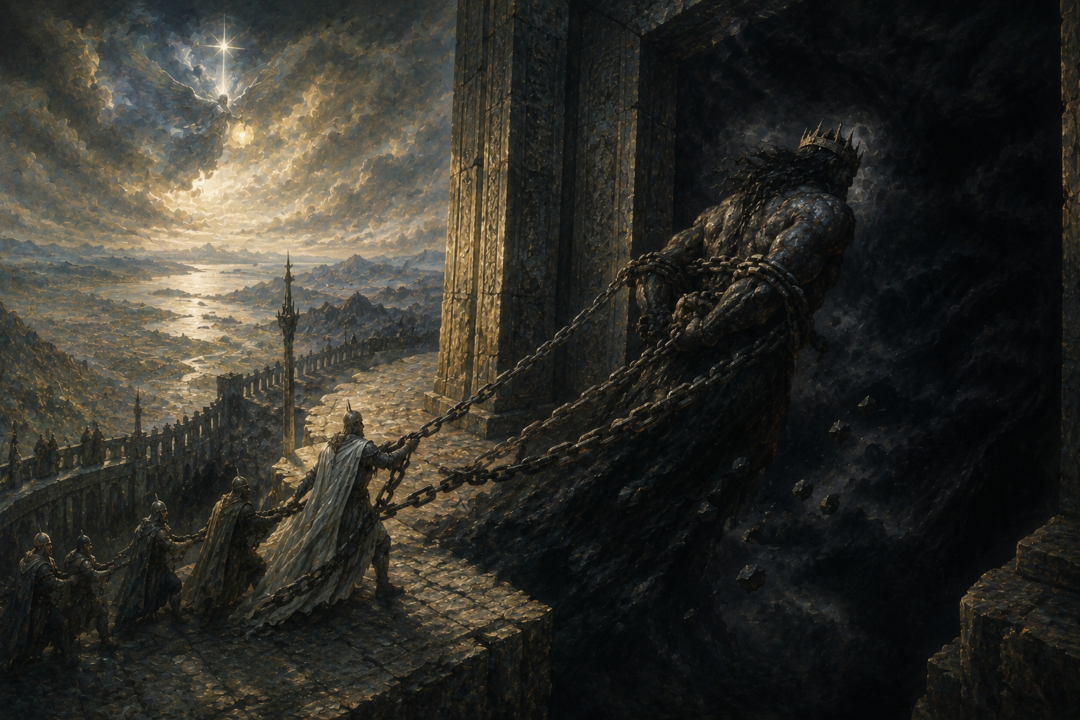
Rather than being carried back to Mandos for another term of imprisonment, Morgoth is thrust through the Door of Night, beyond the Walls of the World, into the Timeless Void.
The old chain returns.
The old prison does not.
That contrast marks the finality of the judgment within the history told in the published Silmarillion. Morgoth is no longer being held somewhere within the ordered world while awaiting another opportunity to plead his case. He is being removed from the World he has spent ages trying to possess.
A guard is established upon its boundaries, and Eärendil keeps watch.
The imagery is unmistakable: Morgoth is not simply incarcerated.
He is excluded.
Why the Timeless Void Is a Different Kind of Punishment
The cosmological language surrounding the Void varies across different stages of the mythology, so it is safest not to construct an overly precise map of its mechanics.
What the published narrative clearly emphasizes is separation.
Morgoth is thrust through the Door of Night, beyond the Walls of the World and into the Timeless Void.
Mandos lies within the realm governed by the Valar. Morgoth’s first imprisonment therefore kept him within the World to which the Valar themselves had entered and become bound.
His final punishment places him beyond its walls.
There is a grim appropriateness to this.
Melkor’s rebellion began with a desire to impose his own designs upon creation. He sought the Imperishable Flame and wanted the power to originate things independently. When he entered Eä, he continually tried to make the works of others subject to himself.
By the end, the being who wanted the World for himself loses his place within it.
He cannot rule Arda.
He cannot even remain inside it.
Yet Expelling Morgoth Does Not Expel His Evil
Here lies the darker part of the ending.
Removing Morgoth does not undo what Morgoth has done.
The closing passage of the Quenta Silmarillion stresses that the lies he planted in Elves and Men remain capable of producing evil long afterward.
That observation is essential for understanding the later ages.
Morgoth does not need to be physically present for hatred, domination, pride, fear, and the desire for power to continue. Sauron survives the First Age and eventually becomes the new Dark Lord, but even Sauron is not simply Morgoth reborn. He develops his own methods and his own catastrophic ambitions.
The victory over Morgoth is therefore real, but it is not the healing of Arda.
His person has been removed.
His damage remains.
That distinction helps explain why Middle-earth after the War of Wrath does not become a paradise. Evil is no longer concentrated beneath Thangorodrim, but the world is still marred.
The Door of Night Is the Final Answer to a Failed Mercy
Morgoth’s two defeats form one of the most revealing parallels in the history of Arda.
After the first, he is chained.
After the second, he is chained again.
After the first, he enters Mandos.
After the second, he passes beyond the Door of Night.
The difference is everything that happened between those moments.
The earlier judgment allowed for the possibility that Melkor might abandon his rebellion. Instead he feigned repentance, exploited mercy, destroyed the Trees, stole the Silmarils, returned to Middle-earth, and spent the First Age attempting to dominate its peoples.
The texts do not explicitly present his final banishment as a courtroom explanation for why Mandos could never hold him again. But the narrative progression strongly supports a more careful conclusion: the conditions surrounding his first imprisonment no longer apply.
There is no second period of rehabilitation described.
No second pardon.
No restored freedom.
Instead there is a guarded boundary between Morgoth and the World.
And that may be the most fitting punishment possible for the first Dark Lord. Morgoth spent the history of Arda trying to make creation belong to him.
At the end of the First Age, creation continues without him.
Sources & Notes
- https://www.encyclopedia-of-arda.com/m/morgoth.php — The Encyclopedia of Arda: Morgoth (his first captivity, false repentance, later defeat, and expulsion from Arda).
- https://www.encyclopedia-of-arda.com/w/warofwrath.php — The Encyclopedia of Arda: War of Wrath (the final First Age war that broke Angband and ended Morgoth’s rule).
- https://www.encyclopedia-of-arda.com/a/angainor.php — The Encyclopedia of Arda: Angainor (the chain used to bind Melkor after both of his great defeats).
- https://www.encyclopedia-of-arda.com/v/void.php — The Encyclopedia of Arda: the Void (the realm beyond the World into which Morgoth was cast).
Sources checked for relevance and availability.