
When Pippin looks into the palantír of Orthanc, he sees the terrible power of Sauron’s gaze and nearly brings disaster upon the Fellowship’s plans. Yet the consequence is not what many readers expect. Gandalf does not send him away, punish him, or leave him behind. Instead, the Wizard takes the frightened Hobbit with him to Minas Tirith.
At first glance, this decision seems strange. Pippin has just endangered everyone, while Merry — older in spirit, more thoughtful, and already proven in danger — is separated from the group and left to follow another path with the Rohirrim. Why does Gandalf choose the impulsive Took over the steadier Brandybuck?
The answer reveals one of the quieter themes of The Lord of the Rings: wisdom is not only about preventing mistakes. It is also about recognizing what can still be healed after a mistake has been made.
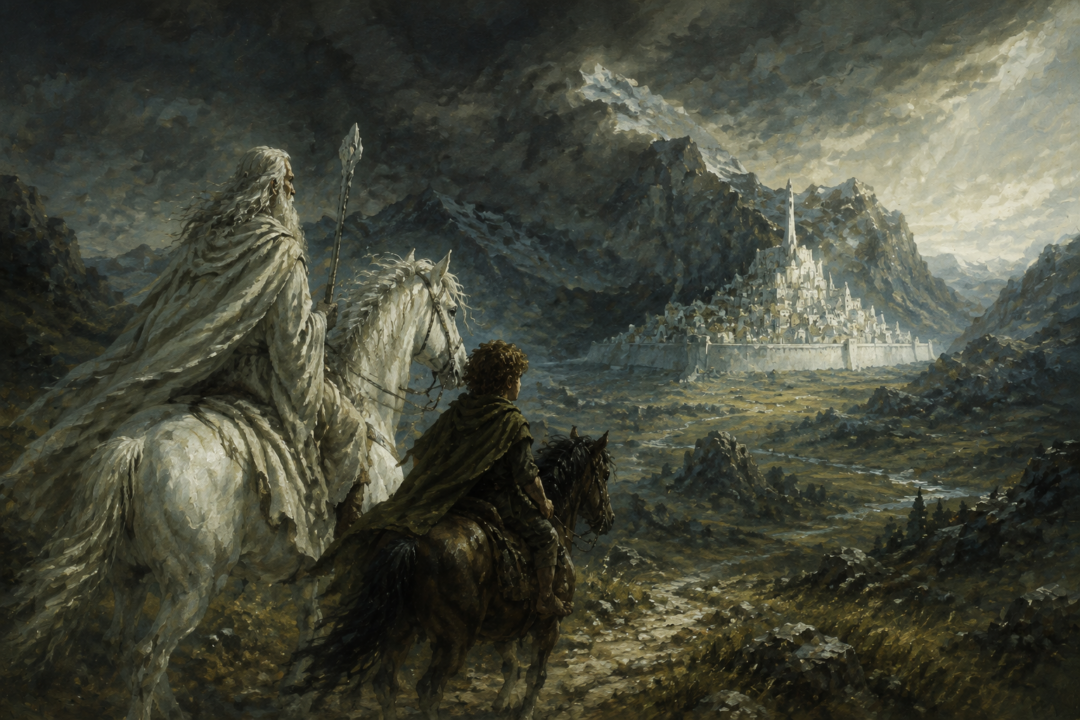
Pippin’s Error with the Palantír Changes Everything
After the Fellowship’s journey breaks apart, Gandalf and Aragorn travel with King Théoden’s people before the road turns toward Gondor. At Isengard, Pippin discovers the stone of Orthanc, a seeing-stone that Saruman had used. Unable to resist his curiosity, Pippin looks into it and is confronted by Sauron.
The event is dangerous because Sauron learns that the One Ring is still in the world and that the enemies of Mordor possess knowledge connected to the Ring’s fate. However, Pippin’s mistake also gives Gandalf crucial information. The Dark Lord believes the captured Hobbit may have been taken because of the Ring, revealing how deeply Sauron fears losing his power.
Pippin’s failure is real, but Gandalf does not treat him as a lost cause. The Wizard recognizes both the danger of the mistake and the innocence behind it. Pippin acted out of curiosity and impatience, not malice or ambition.
This distinction matters throughout Tolkien’s world. The greatest danger often comes not from simple weakness, but from the desire to dominate, possess, or control. Pippin’s flaw is childishness; Sauron’s flaw is the hunger for absolute mastery. They are not the same.
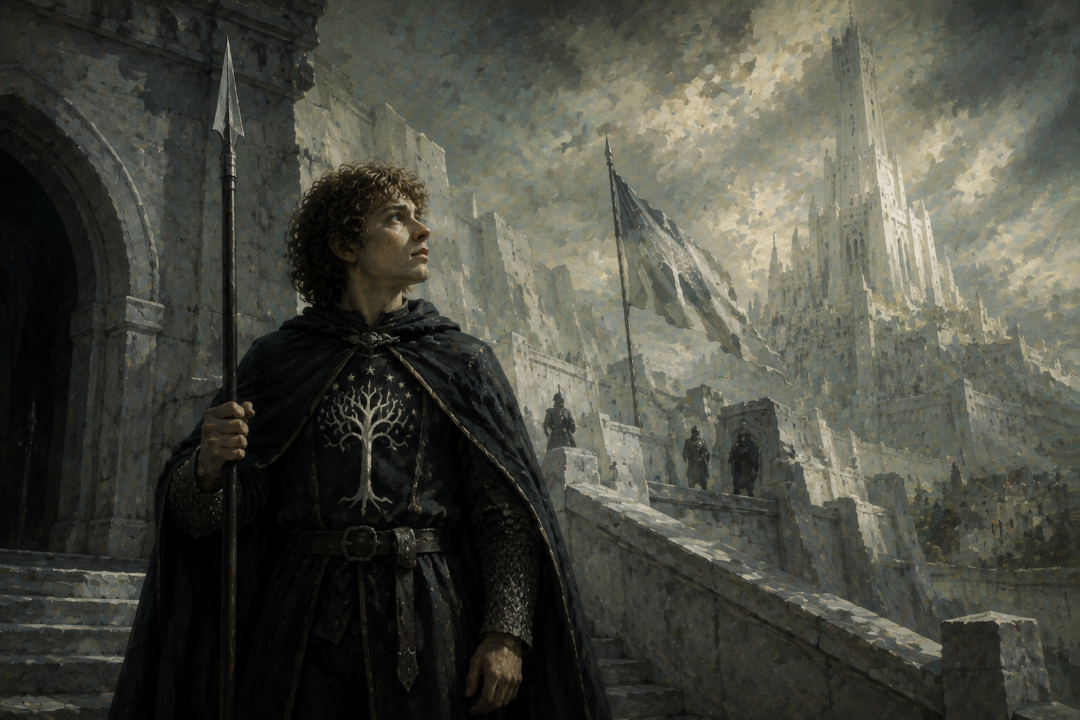
Gandalf’s Choice Is Also a Choice of Protection
After the incident, Gandalf decides that Pippin must leave with him rather than remain near Aragorn’s company. The reason is practical as well as compassionate.
Sauron has seen Pippin through the palantír. If the Dark Lord believes the Hobbit knows something important, then Pippin himself has become a target. Leaving him behind could expose others to danger and place Pippin in a vulnerable position.
Gandalf’s journey to Minas Tirith is urgent because Gondor is on the edge of war. Denethor, the Steward of Gondor, is facing the overwhelming threat of Mordor, and the city needs every source of wisdom and courage available. Pippin’s arrival there is not merely a burden Gandalf accepts; it becomes part of a larger chain of events.
The Hobbit who made a mistake in Isengard becomes the Hobbit who offers loyalty to Gondor.
Why Not Take Merry Instead?
Merry’s path after the breaking of the Fellowship is very different. After being separated from Aragorn, Legolas, and Gimli, Merry remains with Théoden and the Rohirrim. He is not forgotten or abandoned; he is drawn into another part of the war.
The difference between the two Hobbits is not that Gandalf values one above the other. Rather, their circumstances lead them toward different roles.
Merry has already begun developing through his experiences with the Riders of Rohan. He becomes connected with Théoden’s household and later plays a decisive role in the Battle of the Pelennor Fields. His courage emerges through loyalty, friendship, and a willingness to stand beside those who underestimate him.
Pippin’s growth happens differently. He enters Minas Tirith as someone who has failed and feels responsible for the danger he caused. Gandalf’s decision places him somewhere where he must mature quickly.
The two Hobbits are not substitutes for each other. Tolkien presents their journeys as parallel examples of ordinary people becoming capable of extraordinary courage.
Pippin and Denethor: A Meeting of Two Different Responses to Fear
One of the most important consequences of Gandalf taking Pippin to Minas Tirith is the Hobbit’s encounter with Denethor.
After arriving in the city, Pippin feels guilt over his earlier mistake and offers his service to Denethor’s household. He becomes a guard of the Citadel, honoring Boromir’s memory and attempting to repay what he believes he owes.
This places Pippin directly before one of the tragedy-filled figures of the story.
Denethor is not a simple villain. He is a powerful and intelligent leader who has carried the burden of defending Gondor while watching the strength of his realm decline. Yet his use of the palantír and his despair over the future lead him toward hopelessness.
Pippin and Denethor represent two opposite responses to fear.
Pippin sees his own failure and chooses service.
Denethor sees the suffering ahead and loses the ability to hope.
Their contrast is one of the reasons Pippin’s presence in Minas Tirith matters so much. The foolish Hobbit who once acted without thinking becomes a witness to the consequences of despair.
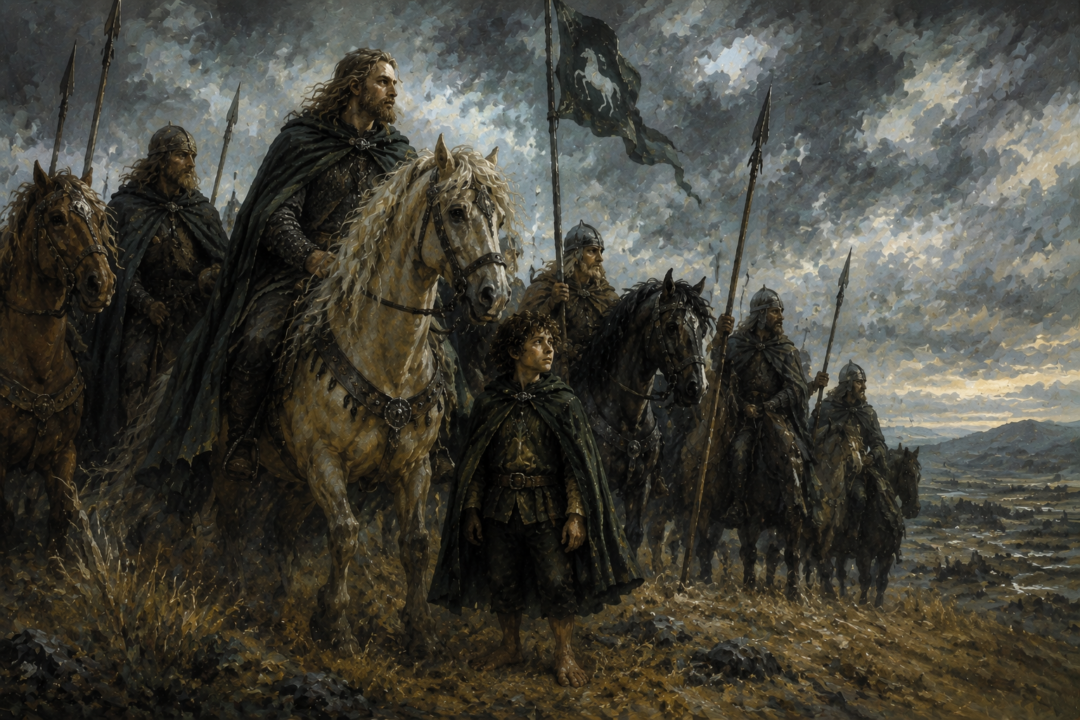
Gandalf Understands That People Must Be Allowed to Grow
Gandalf’s treatment of Pippin reflects a recurring pattern in Middle-earth. The wise do not always protect others by removing every danger. Sometimes they protect by allowing people to face responsibility.
Bilbo, Frodo, Sam, Merry, and Pippin all become important because someone trusts them despite their apparent limitations.
Pippin is not chosen because he is already wise. He becomes wiser because he is given the chance to act after failure.
Gandalf’s decision also shows that he sees beyond immediate usefulness. Pippin may have made a reckless choice, but Gandalf recognizes that his heart remains loyal. The Hobbit’s curiosity can become awareness; his fear can become courage; his regret can become responsibility.
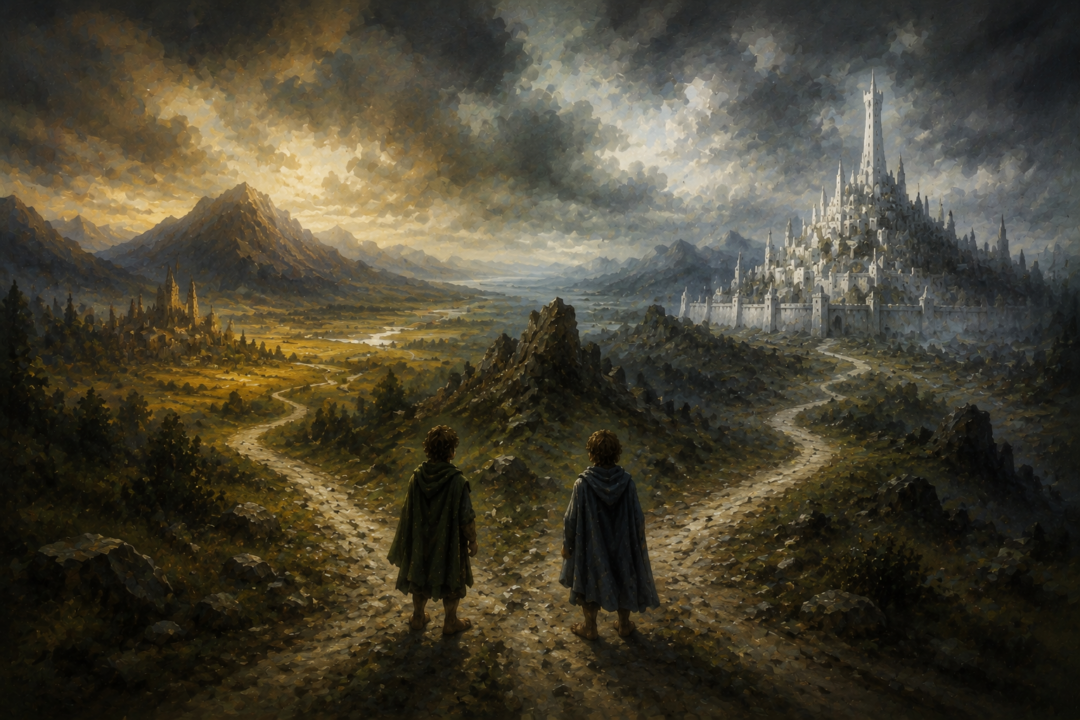
The Hidden Meaning Behind Gandalf’s Decision
The choice to bring Pippin to Minas Tirith is not simply a matter of travel arrangements. It is a reflection of one of Tolkien’s deepest ideas: the small and imperfect may still become essential.
Pippin arrives in Gondor carrying the weight of a mistake. He leaves that mistake behind by serving others during one of the darkest moments of the War of the Ring.
Merry’s journey shows another form of courage — the courage of companionship and sacrifice among the Rohirrim. Pippin’s journey shows the courage of someone who must live with his own failure and choose to do better.
Gandalf does not take Pippin because he is the better Hobbit.
He takes him because Pippin is the Hobbit who needs that road.
And in the end, that road leads him from a careless act beside a mysterious stone to a place where his loyalty, humility, and courage help preserve the future of Middle-earth.
Sources & Notes
- https://www.glyphweb.com/arda/p/peregrintook.html — The Encyclopedia of Arda: Pippin’s palantír encounter, journey with Gandalf, service in Minas Tirith, and wartime maturation
- https://www.glyphweb.com/arda/m/meriadocbrandybuck.html — The Encyclopedia of Arda: Merry’s separate path with Théoden and the Rohirrim and his role on the Pelennor Fields
- https://www.glyphweb.com/arda/g/gandalf.html — The Encyclopedia of Arda: Gandalf’s urgency after the Orthanc-stone incident and mission to aid Minas Tirith
- https://www.glyphweb.com/arda/p/palantiri.html — The Encyclopedia of Arda: the seeing-stones’ operation, Sauron’s influence, and Pippin’s dangerous use of the Orthanc-stone
Sources cover Pippin’s palantír encounter, Gandalf’s response, Merry’s separate Rohirrim path, and the seeing-stones.