The Party Tree’s Replacement: How a New Mallorn Connected the Shire’s Healing to the Fading of Lórien
The Party Tree was more than a famous tree standing on the Hill at Bag End. For generations of Hobbits, it represented celebration, memory, and the quiet stability of the Shire itself. Its loss after the troubles brought by Saruman’s servants was not simply the destruction of a landmark. It was a reminder that even the most peaceful corners of Middle-earth could be wounded by the conflicts of a much larger world.
Yet the story of the Party Tree does not end with its fall.
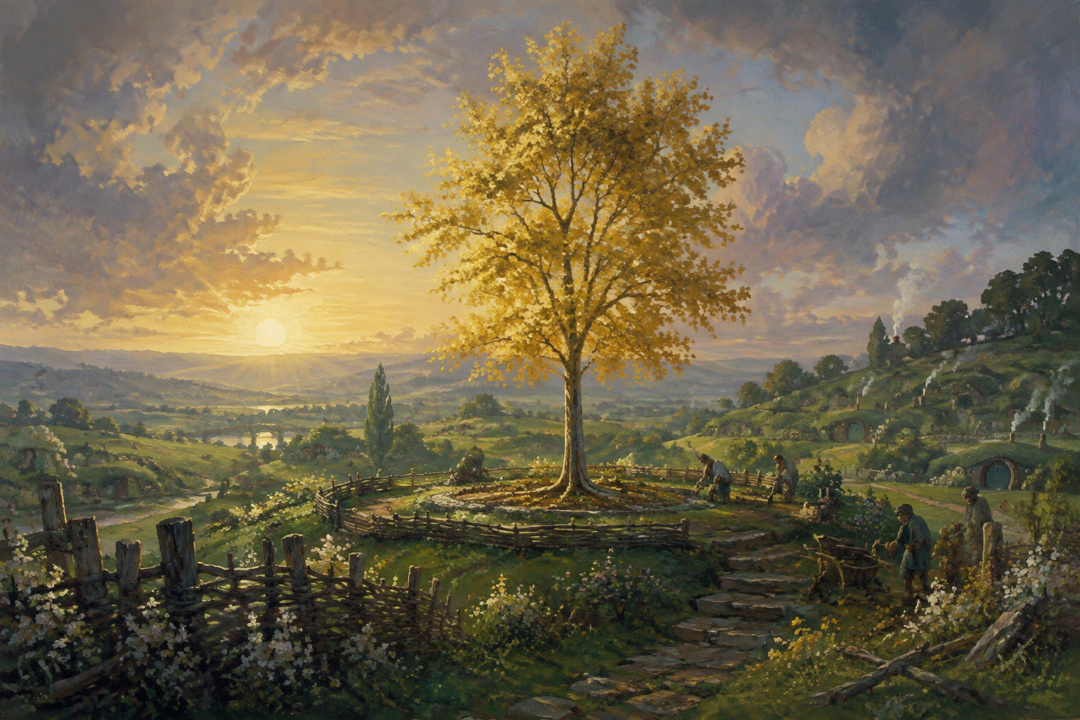
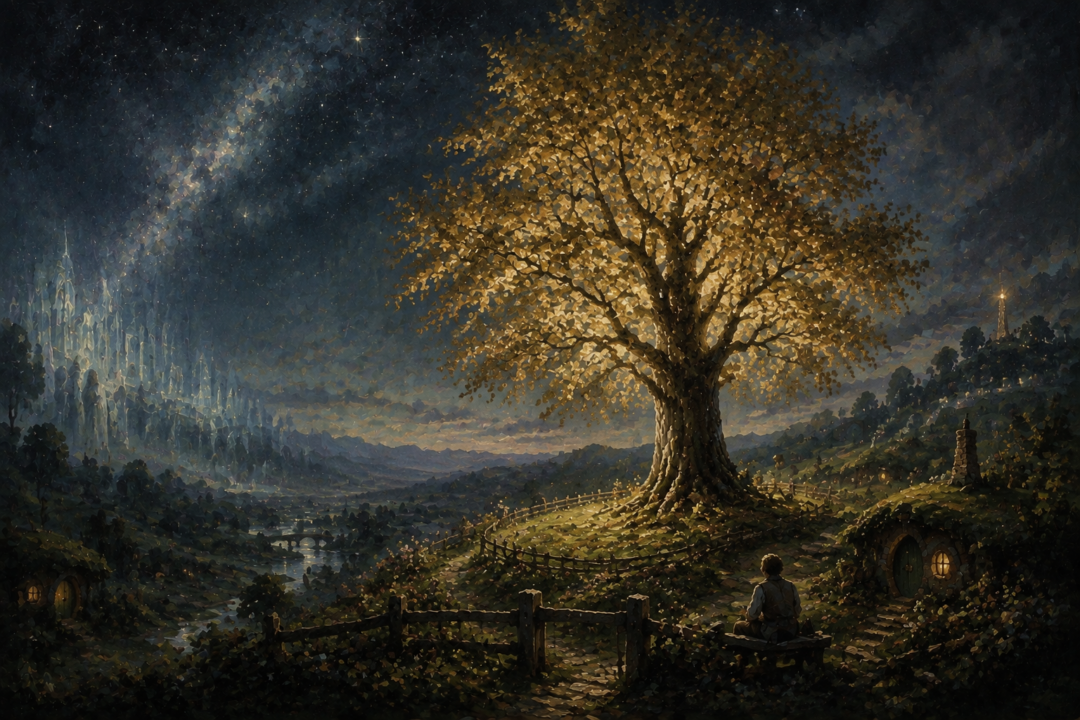
After the War of the Ring and the liberation of the Shire, a new tree began to grow in its place: a mallorn seedling given to Samwise Gamgee by Galadriel of Lórien. This replacement was not merely a restoration of something lost. It represented a deeper connection between the recovery of the Shire and the fading of the Elven realms of the Elder Days.
The new tree carried a gift from a land that was itself preparing to disappear.
The Fall of the Party Tree and the Wounds of the Shire
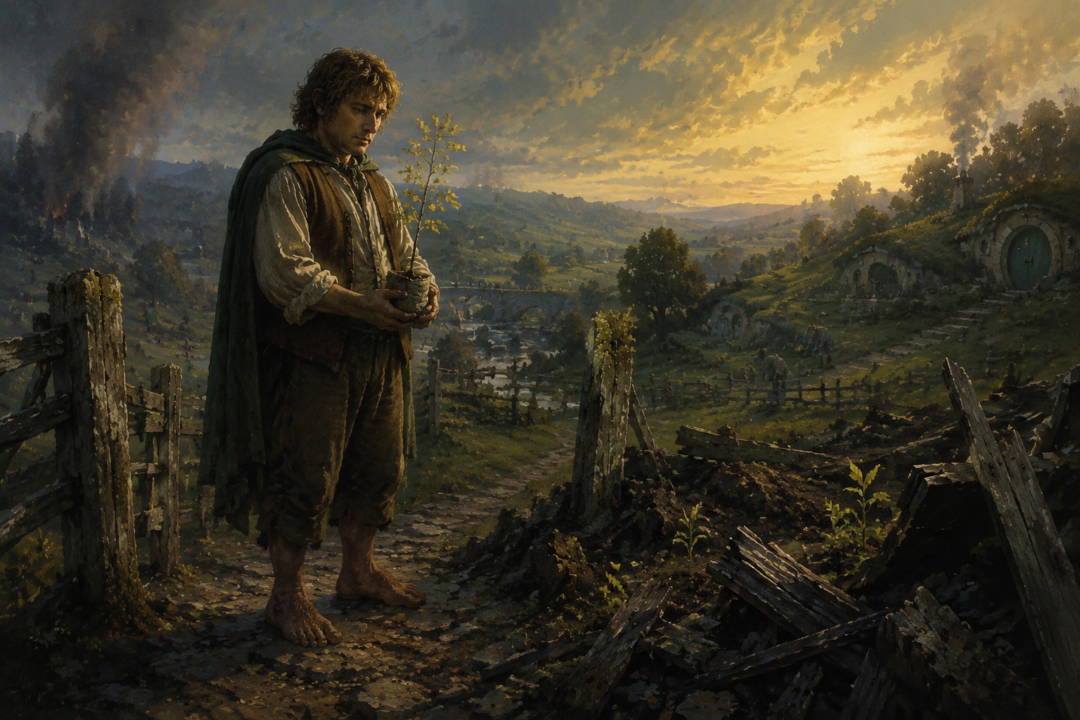
The Party Tree stood in the Party Field near Hobbiton and was central to Bilbo Baggins’ famous birthday celebration in The Fellowship of the Ring. Its destruction came later, during the occupation of the Shire by ruffians under the influence of Saruman.
The damage done to the Shire was deliberately symbolic. The invaders did not merely control roads, mills, and buildings; they disrupted the natural rhythms of Hobbit life. Trees were cut down, old ways were replaced by harsh systems of control, and the familiar landscape of the Shire was altered.
The Party Tree’s removal represented a particularly painful loss because Hobbits valued continuity. Their culture was built around gardens, family traditions, old houses, and remembered places. The destruction of a beloved tree showed that the Shire’s innocence had been touched by the darkness beyond its borders.
When Frodo, Sam, Merry, and Pippin returned, they found that victory over Sauron had not prevented suffering at home. The War of the Ring had saved the Shire from a far greater shadow, but it could not undo every wound.
Sam’s Gift from Lórien Becomes a Gift to the Future
During the Fellowship’s journey through Lórien, Sam received a special gift from Galadriel: a small box containing dust from the earth of Lórien and a mallorn seed. The Lady of Lórien told him that if he needed something beautiful to restore the Shire, he should use it.
After the scouring of the Shire, Sam used the gift to replace the Party Tree. The text describes the mallorn growing where the old tree had stood, becoming a sign that something precious had returned.
This moment is important because the new tree was not a simple copy of what had been lost. The original Party Tree was a native part of the Shire’s landscape. The replacement came from far away, from a realm shaped by ancient Elven memory.
The Shire was healed not by returning exactly to the past, but by receiving something new.
The Mallorn’s Meaning: Renewal Through Change
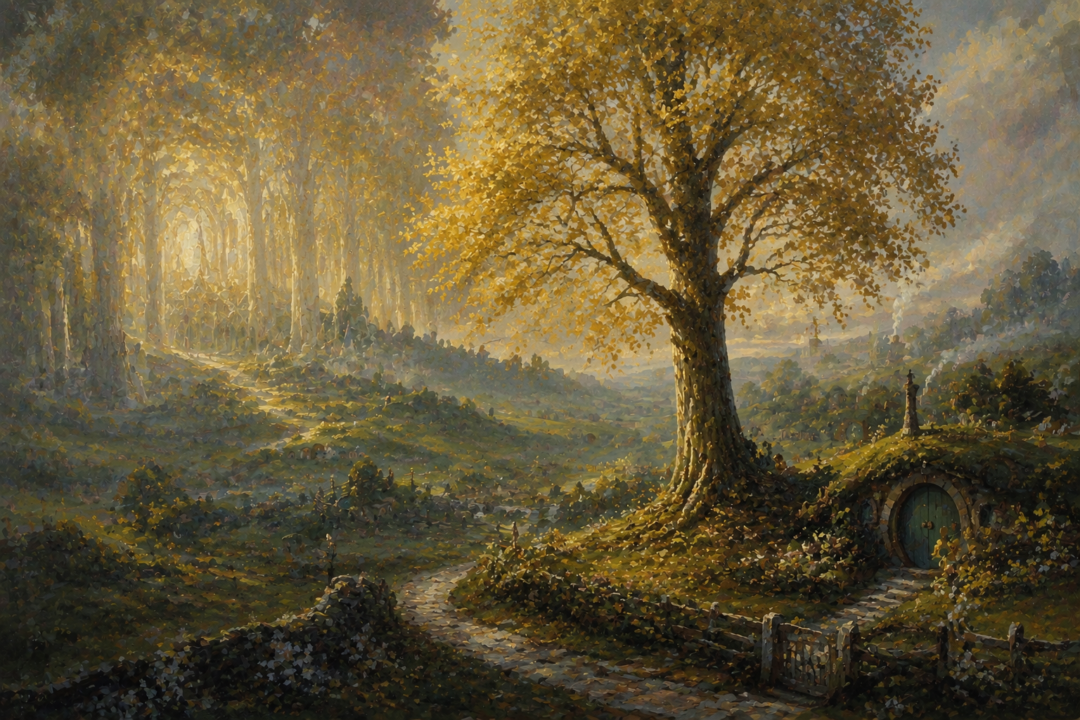
Mallorn trees were closely associated with Lórien, the golden wood ruled by Galadriel and Celeborn. In the books, they are described as rare and beautiful trees, especially suited to the land of the Elves.
The arrival of a mallorn in Hobbiton therefore carried unusual meaning. It showed that the Shire had become connected, however quietly, to the wider history of Middle-earth.
Sam had traveled far beyond the borders of Hobbiton and witnessed places that most Hobbits would never see. His return brought back not treasure or power, but a living thing. The greatest reward of his journey was not a weapon or title; it was the ability to restore life.
This reflects one of the central ideas of Tolkien’s work: healing often comes through patience, care, and preservation rather than conquest.
The mallorn was not a monument to victory in battle. It was a living reminder that destruction could be answered with creation.
Lórien’s Fading and the Last Gift of the Elves
The connection between the Shire’s new tree and Lórien carries a bittersweet meaning because the gift came at a moment when the Elves’ presence in Middle-earth was beginning to fade.
After the destruction of the One Ring, the power that sustained many of the great Elven realms declined. Lórien remained a place of beauty for a time, but the departure of the Elves from Middle-earth was inevitable. Galadriel herself eventually left over the Sea.
The mallorn planted in the Shire therefore preserved something that was disappearing elsewhere.
The texts do not state that the tree was intended specifically as a memorial to Lórien’s fading, but this interpretation follows naturally from the larger themes of The Lord of the Rings. The seed from Galadriel carried the memory of an Elven realm that would not remain unchanged forever.
While the Elves departed, their influence continued in smaller and quieter forms.
A single tree in Hobbiton became a surviving fragment of an ancient world.
Samwise Gamgee and the Restoration of What Was Nearly Lost
Sam’s role in the restoration of the Shire is especially significant because he represents a different kind of heroism from the warriors who fought in great battles.
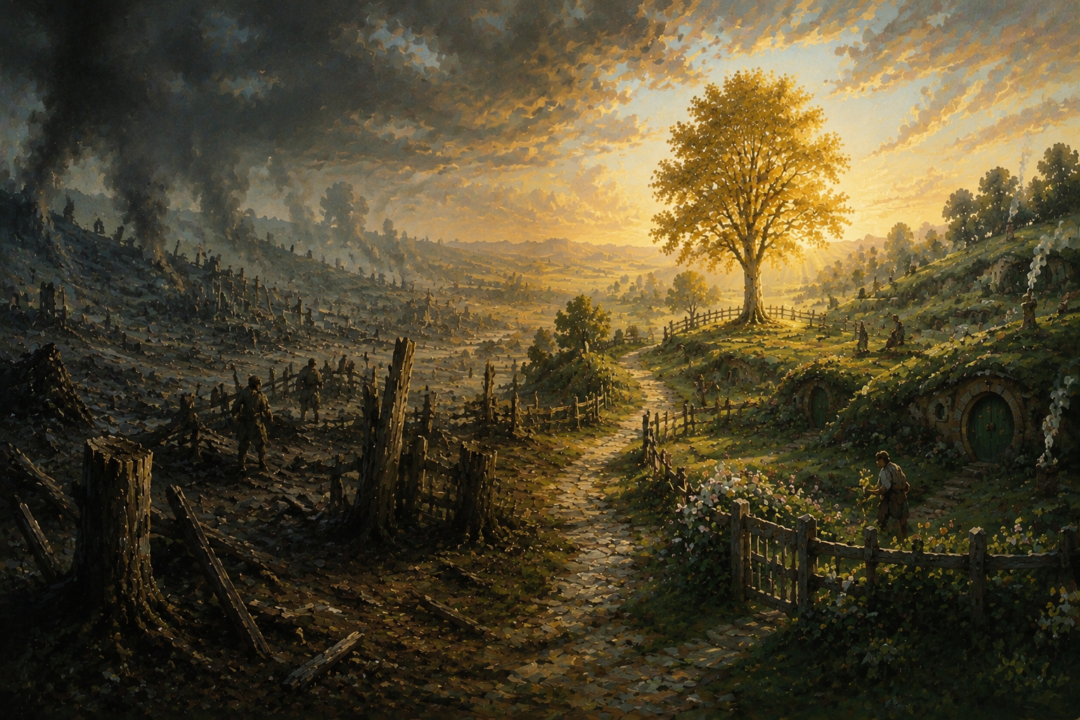
The destruction of the Party Tree was not undone by kings or armies. It was healed by a gardener.
Sam’s entire journey reflects this pattern. He carries the burden of the Ring when Frodo can no longer continue, but his greatest achievement after the war is not military. It is rebuilding homes, restoring gardens, and bringing life back to damaged places.
The mallorn seed allowed Sam to repair one of the Shire’s deepest losses. It also showed that the experiences of the Fellowship had permanently changed him. He returned home still a Hobbit, but one who carried the memory of distant lands and ancient peoples.
The Shire could remain the Shire because someone who loved it had seen what existed beyond it.
A Tree Between Two Ages
The replacement of the Party Tree stands at the meeting point between two eras of Middle-earth.
The Third Age was ending. The great powers of Elves and ancient kingdoms were passing away. The Fourth Age belonged increasingly to Men, while Hobbits returned to their quiet lives away from the great events of history.
The mallorn of Hobbiton symbolized this transition.
It was an Elven tree growing in a Hobbit land. It represented the survival of beauty after the departure of those who had created much of that beauty. It showed that the end of an age did not mean everything from that age vanished completely.
Memory could survive in living things.
The tree’s existence suggested that the gifts of the Elder Days were not meant to remain frozen in the past. They could take root somewhere unexpected and continue in a new form.
The Lasting Legacy of the New Party Tree
The replacement of the Party Tree is one of the quieter victories at the end of The Lord of the Rings. It does not involve armies, crowns, or the defeat of an enemy. Instead, it shows what peace is actually built from.
A battlefield victory can end a war, but a restored garden creates a home.
The mallorn planted by Samwise Gamgee joined two stories that might seem unrelated: the healing of the Shire and the fading of Lórien. One was a beginning; the other was an ending. Together, they revealed one of Middle-earth’s most enduring truths: what is lost may never return exactly as it was, but it can leave behind gifts that allow something new to grow.
The Party Tree’s replacement was therefore more than a tree.
It was a living memory of friendship between distant peoples, a reminder of the beauty that passed away, and a symbol that even after the darkest seasons, Middle-earth could still bloom.
Sources & Notes
- https://www.glyphweb.com/arda/p/partytree.html — The Encyclopedia of Arda: the Party Tree, its destruction during the Shire’s occupation, and Sam’s mallorn replacement
- https://www.glyphweb.com/arda/l/lorien.html — The Encyclopedia of Arda: Lórien’s mallorn landscape, Galadriel’s realm, and its fading after the One Ring’s destruction
- https://www.glyphweb.com/arda/g/galadriel.html — The Encyclopedia of Arda: Galadriel’s gifts to the Fellowship and departure as the Elven age ended
- https://www.glyphweb.com/arda/s/shire.html — The Encyclopedia of Arda: the Shire’s history, the Scouring, and its recovery under the returned Travellers
Sources cover the Party Tree, Sam’s mallorn, Lórien’s fading, Galadriel, and the Shire’s recovery.