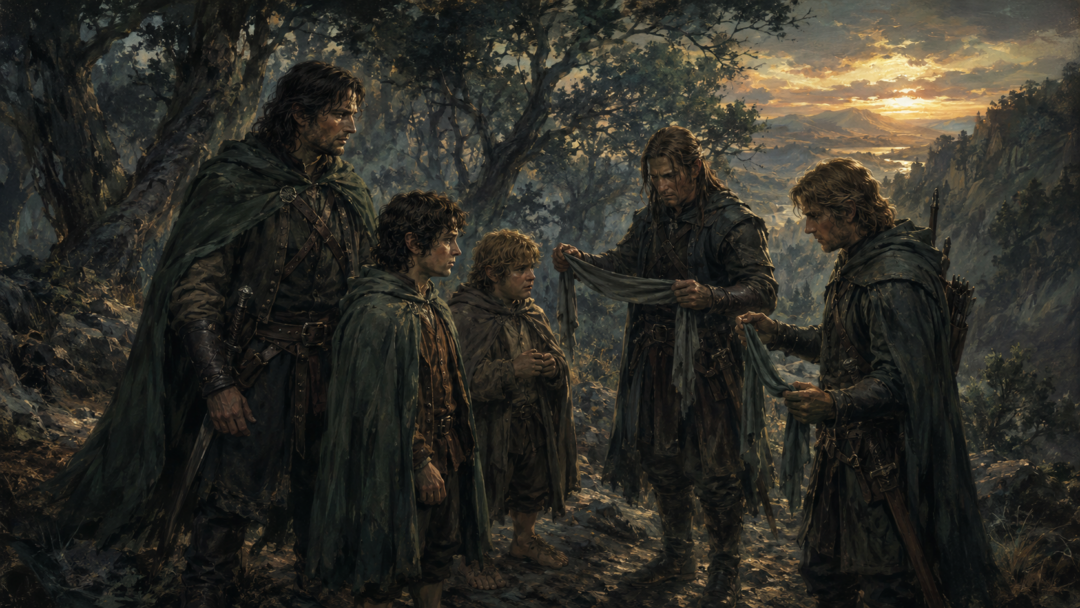
Faramir has already made one extraordinary concession when he leads Frodo and Sam deeper into Ithilien. He has not killed them. He has not bound them. He has listened to Frodo’s account, judged that the hobbits are more complicated than enemy spies, and increasingly treats them as guests rather than prisoners.
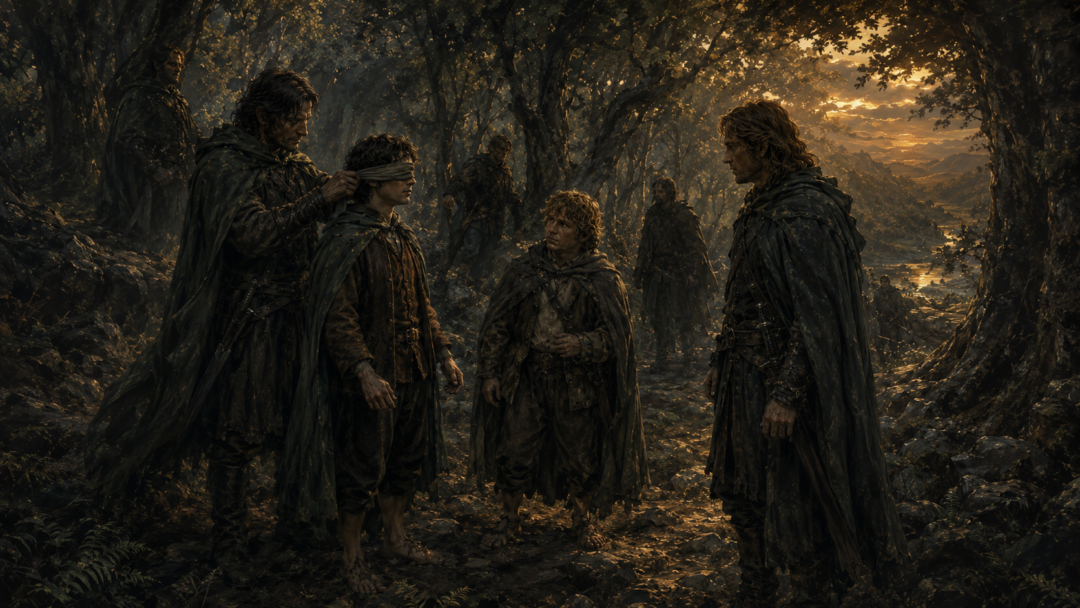
Then, just before reaching his hidden refuge, he orders them blindfolded.
At first glance, the decision can look contradictory. If Faramir believes Frodo and Sam are not his enemies, why conceal the road from them?
The answer reveals an important distinction in Faramir’s character. His growing trust in the hobbits is personal. The secrecy surrounding Henneth Annûn is not.
Faramir can show mercy without pretending that his military responsibilities have disappeared. In fact, the blindfolds demonstrate something central to the way he exercises authority: he is willing to bend harsh rules when conscience demands it, but he will not casually discard rules that protect other people.
Faramir Has Already Chosen Restraint
When the Rangers of Ithilien encounter Frodo and Sam, the hobbits are strangers wandering through a contested land dangerously close to Mordor.
Faramir therefore has legitimate reasons to be suspicious.
He questions Frodo closely about his companions, his purpose, and especially Boromir. Frodo answers carefully because revealing the Ring would be extraordinarily dangerous. Faramir recognizes that information is being withheld, yet he also recognizes qualities in Frodo that argue against treating him simply as an enemy agent.
By the time the company approaches Henneth Annûn, Faramir explicitly acknowledges the unusual mercy he has already shown. He tells Frodo that his orders have so far yielded to courtesy: the strangers have neither been slain nor bound.
That wording matters.
Faramir is operating under wartime authority, not encountering travelers on an ordinary road. The default rules governing unknown people in Ithilien are severe because Gondor's hidden forces survive in territory increasingly threatened by the Enemy.
Frodo and Sam have already received exceptional treatment.
The blindfold is therefore not the beginning of a harsher imprisonment. It is the remaining security measure Faramir believes he cannot responsibly waive.
Henneth Annûn Is Not Merely a Beautiful Cave
Henneth Annûn becomes one of the most memorable locations in Frodo and Sam’s journey because of its beauty.
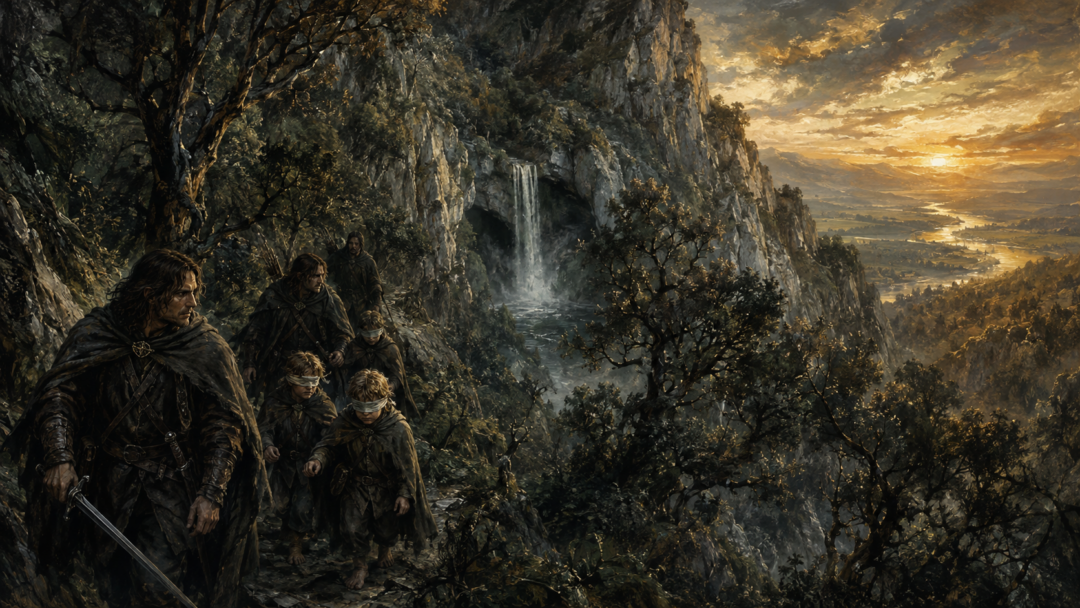
Behind falling water lies a hidden refuge of the Rangers, with the western light shining through what Faramir calls the Window of the Sunset. For the hobbits, after the dangers of Emyn Muil, the Dead Marshes, and the approach to Mordor, it temporarily becomes a place of food, conversation, and relative safety.
But militarily, Henneth Annûn is a secret stronghold.
The Rangers of Ithilien depend on concealment. They operate east of the Anduin in lands exposed to Sauron’s forces, striking enemies and disappearing again into wilderness that the Enemy does not fully control.
A hidden refuge remains useful only while its location remains hidden.
That makes knowledge of the road itself dangerous.
Faramir tells Frodo that no stranger may see the path they are taking with open eyes. Most significantly, he adds that the prohibition applies even to a man of Rohan fighting alongside Gondor.
That single detail largely explains the entire incident.
The rule is not directed specifically at Frodo.
It applies even to allies.
Trusting Someone Is Not the Same as Giving Them Every Secret
Faramir’s conduct draws a boundary modern readers may easily overlook.
He can believe Frodo is honorable without giving Frodo unrestricted access to Gondor’s military secrets.
Those two positions are perfectly compatible.
Faramir has only known the hobbits for a short time. He does not yet understand their entire mission, and Frodo has deliberately concealed important information. Even later, once Faramir learns the truth about the Ring, nothing suggests that knowledge of Henneth Annûn suddenly becomes something he should distribute freely.
Operational secrecy is larger than personal trust.
A traveler might be honest and still later be captured. Someone might reveal information unwillingly. Someone might misunderstand what they saw. Even trustworthy allies do not automatically need to know the location of a concealed wartime refuge.
The text does not present Faramir giving a detailed theory of military intelligence. But his stated rule makes the underlying principle clear: strangers are not permitted to learn the route.
Frodo’s character does not cancel that rule.
The Way Faramir Blindfolds Them Matters
Faramir does not merely order the blindfolds. He carefully limits the humiliation involved.
He tells Mablung and Damrod to blindfold the hobbits securely but without causing discomfort.
He specifically says their hands are not to be tied.
He also says that Frodo and Sam will give their word not to attempt to see where they are going.
This is a small scene, but it tells us a great deal about Faramir.
He maintains the necessary security measure while removing unnecessary coercion.
The Rangers could bind the hobbits as prisoners. Faramir chooses not to.
He could treat their blindfolding as evidence that they remain suspected enemies. Instead, he apologizes for the discourtesy.
He could rely only on physical force. Instead, he also relies upon their word.
Faramir even remarks that he could trust them simply to keep their eyes shut, except that a person may instinctively open his eyes if he stumbles.
That is unusually revealing.
The blindfold exists not because Faramir thinks the hobbits are waiting for an opportunity to betray him. It exists because the secret must remain protected regardless of intention.
Frodo Immediately Understands the Principle
Frodo does not protest.
Instead, he remembers another concealed realm where strangers were denied unrestricted sight: Lothlórien.
When the Fellowship first entered that land, the question of blindfolding caused tension, especially with Gimli. Eventually Aragorn insisted that if Gimli must be blindfolded, the whole Company should share the condition.
Frodo therefore already understands that secrecy does not necessarily mean hostility.
Communities living under threat may protect their borders even from people who ultimately become friends.
His calm acceptance also helps establish the growing respect between him and Faramir. Faramir is relieved that the hobbits accept the restriction willingly rather than forcing his men to impose it upon struggling prisoners.
The exchange becomes almost ceremonial: one honorable person explains a necessary boundary, and another accepts it.
Gollum Later Reveals Why the Secrecy Is So Severe
The following night gives the reader a much darker example of the same principle.
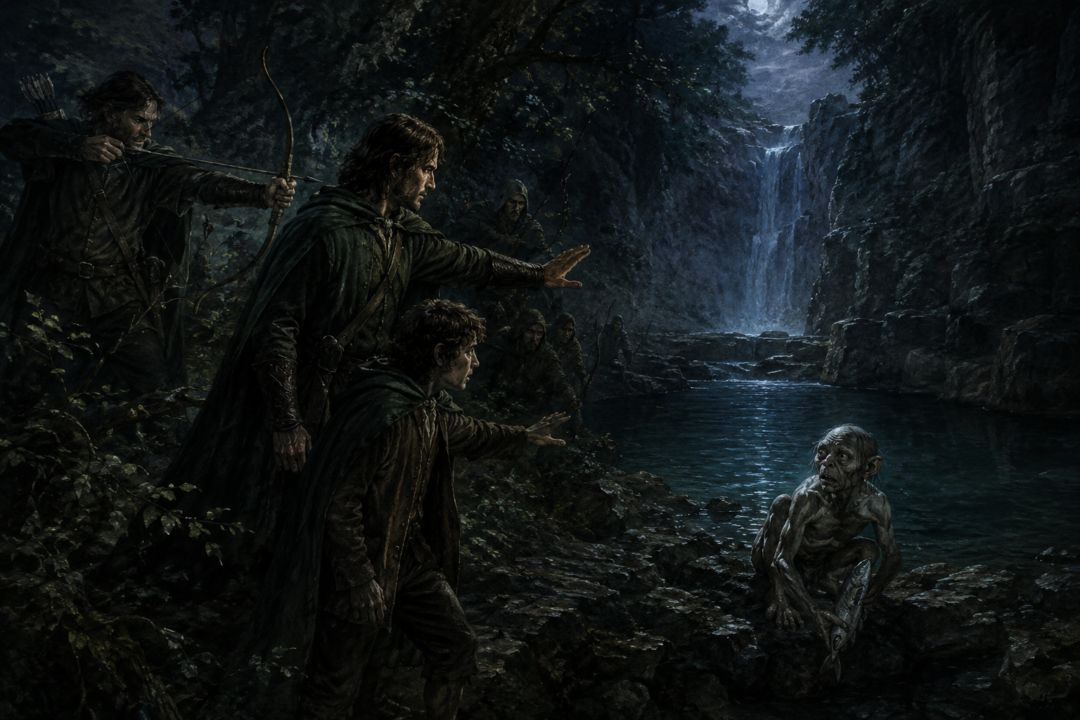
Gollum unknowingly enters the pool beneath Henneth Annûn while hunting fish.
This places him within the protected area of the refuge.
The penalty is death.
Anborn is ready to shoot him, and Faramir explains that Gollum’s life is forfeit for coming unbidden to that place. Frodo must intervene and argue for the creature’s life.
This episode shows that the secrecy surrounding Henneth Annûn is not ceremonial paranoia.
The Rangers regard discovery of the refuge as a potentially lethal military danger.
Faramir again chooses mercy, but importantly, he does not pretend the law is meaningless. He listens to Frodo, weighs circumstances, and finds a way to spare Gollum.
The pattern resembles his treatment of the hobbits.
Rules exist.
Circumstances matter.
Mercy remains possible.
But mercy does not require Faramir to behave as though danger no longer exists.
This Is One of the Clearest Differences Between Faramir and Boromir
The scene also quietly helps distinguish the two brothers.
Boromir’s great failure comes when urgent necessity persuades him that ordinary moral limits can be overridden. Gondor is in terrible danger; therefore, in his desperation, using the Ring begins to seem defensible.
Faramir faces the same threatened kingdom.
Yet his response to necessity is more disciplined.
He does not reject military duty. He commands Rangers, questions suspicious strangers, protects secret bases, and enforces wartime laws.
What he refuses is the idea that defending Gondor permits every action.
That balance matters.
Faramir is neither a sentimental pacifist nor a ruthless officer. His strength lies precisely in refusing that false choice.
He can be cautious without becoming cruel.
He can be merciful without becoming careless.
He can trust Frodo while still blindfolding him.
Faramir Separates Authority From Possession
This distinction becomes even more important once Sam accidentally reveals what Frodo carries.
Faramir finally understands that Isildur’s Bane is the Ruling Ring.
He has before him something that could be imagined as the ultimate weapon against Gondor’s enemy.
Yet he refuses it.
His famous declaration that he would not take such a thing even if he found it lying beside the road is not the declaration of someone uninterested in protecting Gondor. Everything else Faramir does proves how seriously he takes that duty.
Rather, he refuses to confuse responsibility with entitlement.
Being responsible for Gondor does not mean he is entitled to seize the Ring.
Trusting Frodo does not mean Frodo is entitled to know every Gondorian secret.
Commanding soldiers does not mean Faramir must apply every rule without judgment.
These are variations of the same moral discipline: power has boundaries.
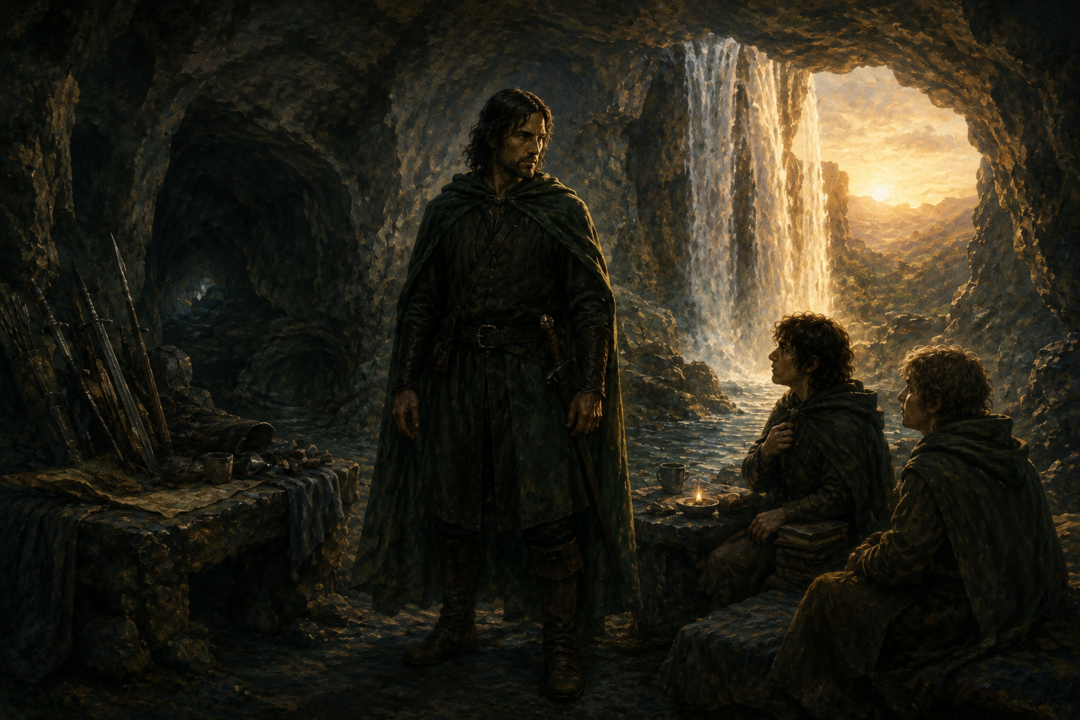
The Blindfold Is Evidence of Faramir’s Mercy, Not a Contradiction of It
The most revealing detail may be that Faramir describes the blindfold as a discourtesy.
He knows what he is doing to Frodo and Sam.
He recognizes the dignity of the people under his authority even when circumstances require him to restrict them.
That is very different from treating secrecy as an excuse for domination.
Faramir’s mercy is therefore not softness. It is controlled power.
He does not prove that he trusts Frodo by abandoning every precaution. He proves it by distinguishing necessary precaution from unnecessary violence.
Frodo and Sam arrive at Henneth Annûn unable to retrace the hidden path.
But they arrive unbound.
They are fed.
They are spoken with rather than merely interrogated.
And eventually, after Faramir learns the astonishing truth of their mission, they are allowed to continue toward Mordor.
The blindfold remains important because Faramir is responsible for more than his own feelings about two strangers. Somewhere behind that waterfall are men whose survival depends upon secrecy.
Sparing Frodo and Sam is Faramir’s choice.
Exposing Henneth Annûn is not his secret alone to give away.
That is why the blindfold stays.
Sources & Notes
- The Encyclopedia of Arda, “Faramir” — recounts Faramir’s encounter with Frodo and Sam, his questioning and mercy, and his responsibility as Captain of the Rangers. https://www.glyphweb.com/arda/f/faramir.php
- The Encyclopedia of Arda, “Henneth Annûn” — describes the concealed refuge behind the waterfall and the Rangers’ strict protection of its location. https://www.glyphweb.com/arda/h/hennethannun.php
- The Encyclopedia of Arda, “Rangers of Ithilien” — explains the company’s covert operations in enemy-threatened Ithilien and why secrecy was an operational necessity. https://www.glyphweb.com/arda/r/rangersofithilien.php
- The Encyclopedia of Arda, “Ithilien” — supplies the military setting east of Anduin in which Gondor’s hidden forces watched and ambushed Sauron’s movements. https://www.glyphweb.com/arda/i/ithilien.php
- The Encyclopedia of Arda, “The Window on the West” — summarizes the chapter in which the blindfolded hobbits are brought to Henneth Annûn and Faramir balances courtesy with duty. https://www.glyphweb.com/arda/t/thewindowonthewest.php
Sources added for Faramir's decision, Henneth Annûn's secrecy, and the Rangers' wartime mission.