When Frodo meets Galadriel in Lothlórien, she feels almost impossibly ancient. She remembers the West before the First Age as mortals reckon it, speaks of crossing mountains before the fall of Nargothrond and Gondolin, and carries the authority of someone who has watched entire civilizations disappear.
The natural assumption is that somewhere behind this Third Age figure lies one settled biography.
There does not.
Galadriel presents one of the most striking cases in the legendarium where several serious, developed conceptions of a character’s past cannot simply be fitted together. The difficulty is not merely that a date moved or a family relationship changed. Her route into Middle-earth, her relationship with the rebellion of the Noldor, her connection to the Kinslaying, the identity of Celeborn, and even the place where they first met were repeatedly reconsidered.
The result is something more interesting than a continuity error. There are multiple recognizable Galadriels behind the Galadriel of The Lord of the Rings—and each gives a different meaning to her eventual refusal of the One Ring.
The Galadriel Most Readers Know
The most familiar First Age trajectory is the one represented by the published Silmarillion.
Galadriel is the daughter of Finarfin and Eärwen. Through her mother she is closely related to the Teleri of Alqualondë, while through her father she belongs to the royal house of the Noldor.
When Fëanor rebels after the theft of the Silmarils, Galadriel joins the departure from Aman. But she is not simply one of Fëanor’s followers. The tradition distinguishes her ambitions from his. She desires Middle-earth and dreams of lands where she might exercise her own will.
Then comes Alqualondë.
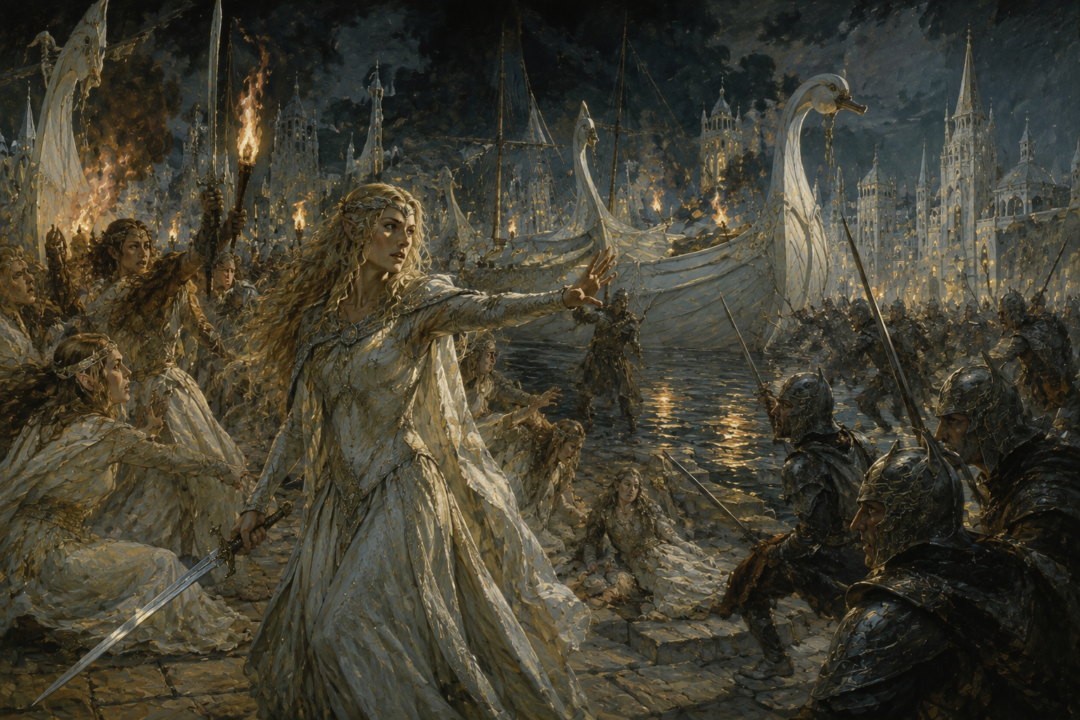
Fëanor attempts to seize the ships of the Teleri, violence erupts, and the first Kinslaying follows. The hosts of the Noldor become divided by deeds whose consequences will poison the history of the First Age.
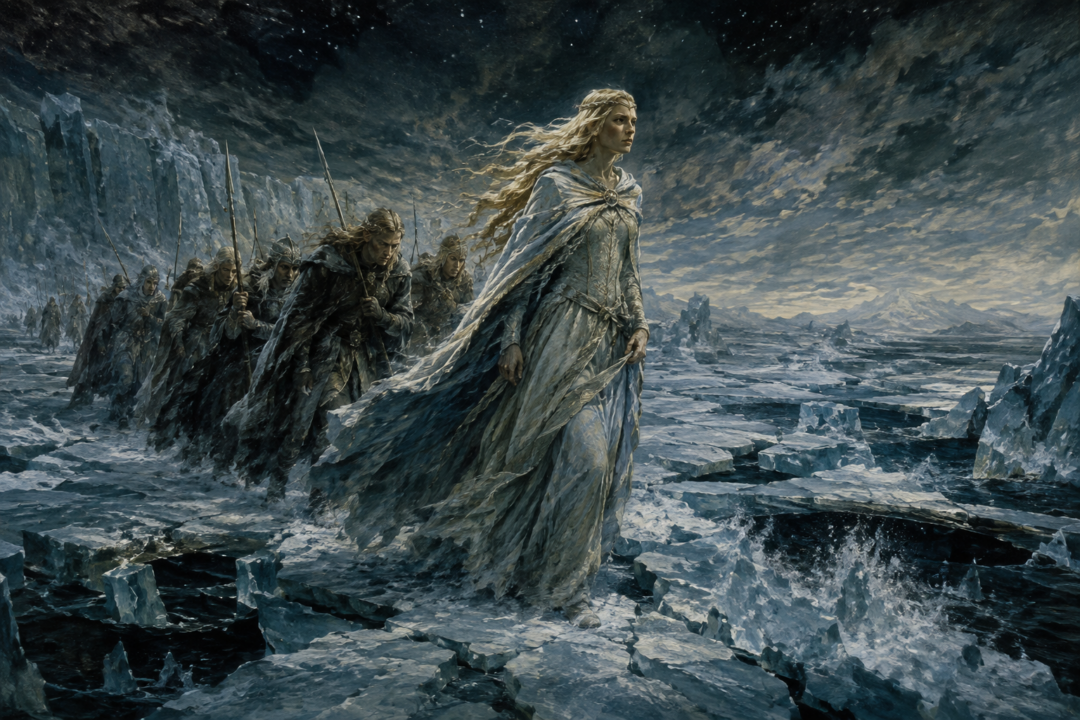
Fëanor subsequently takes the ships and abandons the followers of Fingolfin. Galadriel is among those who endure the terrible crossing of the Helcaraxë into Middle-earth.
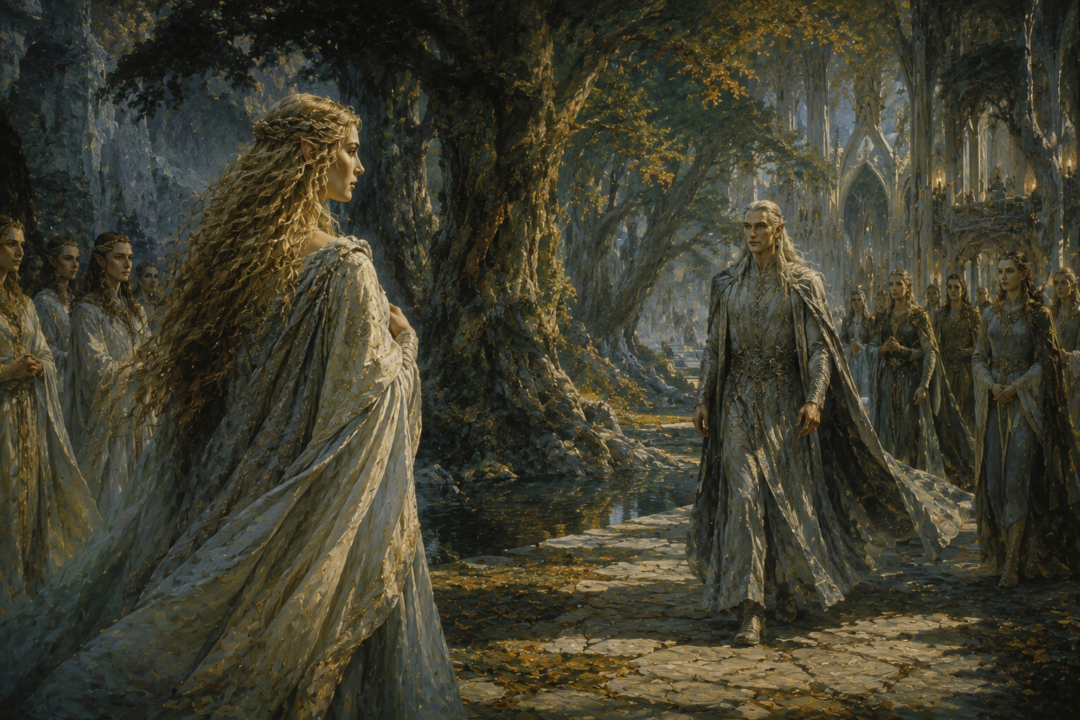
In Beleriand she eventually comes to Doriath, the kingdom of Thingol and Melian. There she meets Celeborn, who in this conception is a prince of the Sindar and a kinsman of Thingol.
This version creates an elegant bridge between the great Elven houses. Galadriel belongs by ancestry to both Noldorin and Telerin worlds; Celeborn connects her directly to Doriath.
It also places her inside the tragedy of the Exile.
She wanted Middle-earth. She participated in the great departure. She endured its consequences. By the Third Age, her desire to possess and govern has been tested across thousands of years.
That matters enormously when Frodo finally offers her the Ring.
A Later Galadriel Becomes an Opponent of Fëanor
A later conception sharpens an important distinction: Galadriel can rebel against the Valar without morally belonging to Fëanor.
In the late material commonly known as “The Shibboleth of Fëanor,” her hostility toward Fëanor is much more explicit. Her desire to leave Aman does not originate with his rhetoric. She already wants wider lands and greater freedom.
This makes her departure simultaneously parallel to and opposed to his.
She shares something of the pride and restlessness that drives the Noldor eastward, but she does not share Fëanor’s cause.
Most dramatically, this tradition places Galadriel at Alqualondë fighting against Fëanor’s people in defense of her mother’s Telerin kin.
That is a substantial alteration.
Instead of asking how deeply Galadriel was implicated in the rebellion that produced the Kinslaying, this version gives her a clear moral position during the battle itself. She still goes onward rather than returning obediently to the Valar, but her continued journey is not an endorsement of what Fëanor has done.
The contradiction within her becomes more precise.
Galadriel can oppose a monstrous act and still be proud.
She can recognize Fëanor as an enemy and still desire something the Valar have not given her: an independent life in Middle-earth.
That distinction helps explain why her story cannot be reduced to a simple progression from sinful rebellion to repentance. Her problem is subtler. She does not need to become good after having been evil. She must eventually surrender a desire for dominion that can coexist with courage, wisdom, and resistance to evil.
The Ring confronts exactly that weakness.
Celeborn Creates an Even Bigger Continuity Problem
The identity of Celeborn is one of the clearest signs that Galadriel’s early biography never reached a completely fixed form.
In the familiar First Age narrative, Galadriel reaches Doriath and meets Celeborn there. He belongs to the Sindarin royal family, and their relationship roots Galadriel deeply in Beleriand.
But that was not the only conception.
An earlier underlying idea associated with the development of their history appears to have had Galadriel pass eastward over the mountains before the end of the First Age and encounter Celeborn in Lórien. In such a scheme, Celeborn was not the Sindarin prince of Doriath familiar from the published Silmarillion.
That creates a radically different First Age Galadriel.
Doriath is no longer necessarily the decisive place where her personal story becomes joined to Celeborn's. Her movement eastward becomes more important. Galadriel begins to look less like a surviving member of Beleriand’s interconnected royal families and more like the great wandering Elven figure later remembered in The Lord of the Rings.
But another conception changed the story even more dramatically.
Celeborn could be a Telerin Elf of Aman.
And if that is true, Galadriel does not meet him in Doriath at all.
The Most Radical Trajectory Begins at Alqualondë
In a very late outline, Galadriel and Celeborn are already together in Aman.
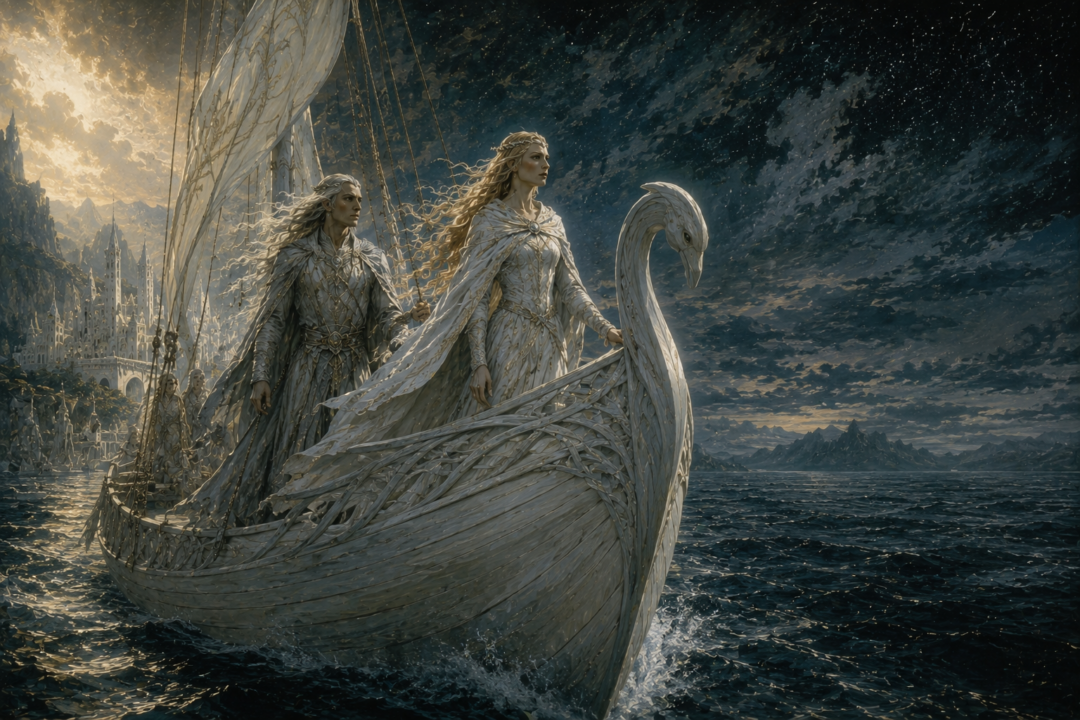
Here Galadriel wishes to leave Valinor, but her departure is fundamentally separated from Fëanor’s rebellion. She and Celeborn intend to sail east independently. When Fëanor attacks the Teleri at Alqualondë, they resist him.
Afterward, they sail to Middle-earth themselves.
This cannot simply be layered onto the Helcaraxë story.
In one trajectory, Galadriel joins the great Noldorin movement out of Aman, is abandoned by Fëanor, crosses the Grinding Ice, and later encounters Celeborn in Beleriand.
In another, Celeborn is already her companion in Aman and they cross the Sea by ship.
Those are not different perspectives on the same journey. They are alternative histories.
The moral architecture changes with them.
The Helcaraxë Galadriel is deeply entangled with the rebellion even while standing apart from Fëanor.
The independent-voyage Galadriel is much more decisively detached from his rebellion. Her desire for Middle-earth remains, but the circumstances through which she reaches it are transformed.
This very late conception was not developed into a complete replacement narrative reconciling all the surrounding histories. It therefore should not be treated as though it straightforwardly overrides every other surviving account.
But neither is it insignificant.
It shows how far Galadriel's past could still be reconsidered.
Why These Versions Cannot Be Forced Into One Timeline
It is tempting to build a “master chronology” by taking favorite details from every account.
Galadriel opposes Fëanor. She fights for the Teleri. She crosses the Helcaraxë. She meets Celeborn in Doriath. Perhaps other traditions can somehow be squeezed around those events.
Some combinations are possible.
Others are not.
Celeborn cannot simultaneously be a Sindarin prince first encountered in Doriath and Galadriel’s Telerin companion from Aman unless one rewrites the sources beyond what they actually say. Galadriel cannot make the Helcaraxë crossing as part of Fingolfin’s host and also make her original crossing to Middle-earth independently by ship with Celeborn.
The safest approach is therefore to treat these as distinct textual trajectories rather than pieces of a hidden puzzle that readers are expected to solve.
This is especially important because The Lord of the Rings gives us a remarkably powerful final-state Galadriel without requiring a detailed account of how she reached that state.
Her deep past was open to development precisely because the Third Age character was already so compelling.
The Strange Constant Across the Different Galadriels
Yet something survives nearly every major reconstruction.
Galadriel wants Middle-earth.
The circumstances change. Her relationship with Fëanor changes. Celeborn’s origin changes. Her route east changes.
But her extraordinary independence remains.
She is not merely swept into history by the decisions of male relatives. She possesses her own desires, judgments, ambitions, and refusals. Even when later conceptions increasingly separate her from Fëanor’s crimes, they do not simply turn her into someone who always wanted nothing except peaceful obedience.
That would destroy the tension at the heart of her Third Age story.
When Frodo offers Galadriel the Ring, she briefly imagines what accepting supreme power could mean. Then she refuses it.
The scene works particularly well against the traditions in which the young Galadriel desired a realm of her own. The connection should not be exaggerated into a mechanically planned character arc across every surviving text, because her history changed too much for that. But the thematic relationship is difficult to miss.
The ancient Lady of Lórien is confronted with the ultimate form of something she once desired: the power to order Middle-earth according to her own will.
She lets it go.
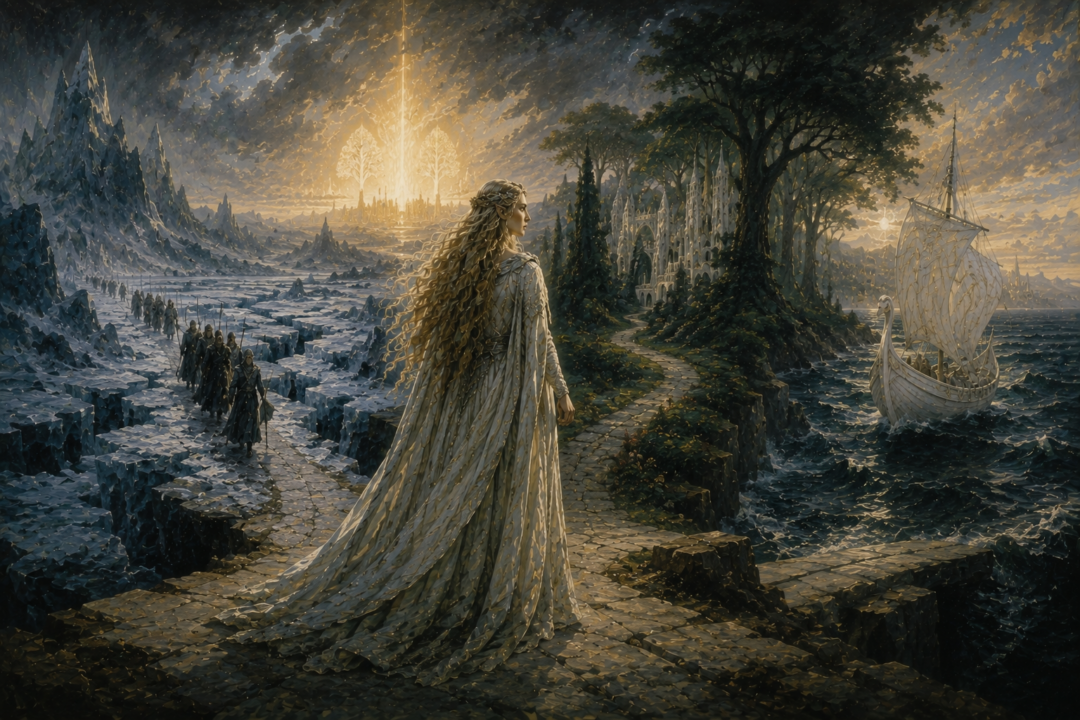
Galadriel's Contradictions Reveal What Makes Her Interesting
There is no single perfectly harmonized First Age biography hiding behind all the surviving Galadriel material.
There are instead several mature directions.
One gives us the proud Noldorin exile who crosses the Helcaraxë and later meets Celeborn in Doriath.
Another intensifies her independence from Fëanor and makes her an active defender of the Teleri at Alqualondë while preserving her own rebellious desire for Middle-earth.
Another relocates Celeborn and alters the geography of her First Age life.
And the most radical late trajectory makes Celeborn a Telerin companion already present in Aman and gives the couple an independent voyage to Middle-earth rather than Galadriel’s famous passage across the Grinding Ice.
They cannot all have happened.
But they repeatedly circle the same character.
Galadriel is powerful without being power-hungry in the manner of Fëanor. Proud without being incapable of wisdom. Rebellious without being reducible to the rebellion around her. Opposed to evil while still needing to overcome something within herself.
That is why the uncertainty in her First Age history does not make the Galadriel of The Lord of the Rings feel weaker.
In an unexpected way, it makes her final choice even more revealing.
Across radically different roads into Middle-earth, the same destination keeps emerging: an Elf who once desired freedom, lands, and authority finally standing before the greatest instrument of domination ever offered to her—and choosing to remain Galadriel.
Sources & Notes
- The Encyclopedia of Arda, “Galadriel” — surveys Galadriel’s ancestry, exile, meeting with Celeborn, later rule, and the differing accounts Tolkien devised for her departure from Aman. https://www.glyphweb.com/arda/g/galadriel.php
- The Encyclopedia of Arda, “Celeborn” — discusses the incompatible traditions that make Celeborn Sindarin, Nandorin, or a Telerin Elf of Aman and consequently relocate the couple’s meeting. https://www.glyphweb.com/arda/c/celeborn.php
- The Encyclopedia of Arda, “Kinslaying at Alqualondë” — provides the central event against which Galadriel’s participation, opposition to Fëanor, and later exile are differently framed. https://www.glyphweb.com/arda/k/kinslayingatqualonde.php
- The Encyclopedia of Arda, “Helcaraxë” — documents the Grinding Ice crossed by Fingolfin’s host in the published exile narrative that includes Galadriel. https://www.glyphweb.com/arda/h/helcaraxe.php
- The Encyclopedia of Arda, “Doriath” — covers Thingol and Melian’s realm, where the published account places Galadriel’s First Age life and meeting with Celeborn. https://www.glyphweb.com/arda/d/doriath.php
Sources added for Galadriel's variant history, Celeborn traditions, Alqualondë, Helcaraxë, and Doriath.