One of Gandalf’s earliest victories in The Hobbit looks almost absurdly simple.
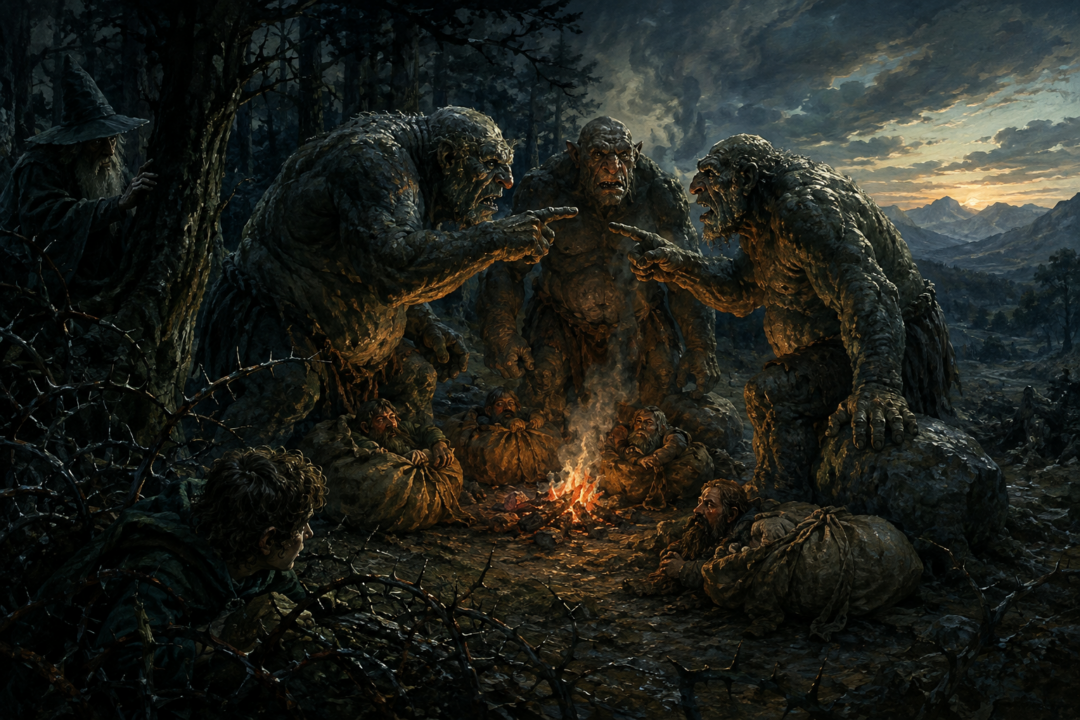
Bilbo and the thirteen dwarves have fallen into the hands of three trolls: William, Bert, and Tom. The company is trapped, the trolls are hungry, and a direct rescue would mean confronting three creatures strong enough to capture Thorin’s entire party. Yet Gandalf does not burst into the clearing with fire or challenge the trolls to battle.
He hides.
Then he starts an argument.
By imitating voices and slipping remarks into the trolls’ conversation, Gandalf turns their existing quarrels against them. They accuse one another, contradict one another, and waste the remaining hours of darkness until dawn finally comes.
Then the sunlight does what Gandalf never needed to do himself.
The trolls become stone.
It is a comic episode, but beneath the comedy is something important about Gandalf. He wins because he understands the enemy’s nature, recognizes the one condition under which their physical strength becomes useless, and patiently steers them toward it.
The Company Has Already Lost the Fight
The encounter begins badly long before Gandalf intervenes.
Bilbo sees the trolls’ fire and approaches them as part of his still very uncertain attempt to become the burglar Thorin’s company expects him to be. He tries to pick William’s pocket, only to discover that the troll’s purse can speak. Bilbo is caught.
The dwarves then arrive separately and are captured in turn. Thorin resists more fiercely than the others, but eventually he too is overcome.
By the time Gandalf returns, brute force is a terrible option.
The trolls are physically formidable. The dwarves are prisoners rather than useful allies, and Gandalf would have to protect them while confronting their captors.
More importantly, he does not need to fight.
The trolls have a weakness more decisive than any sword.
They cannot survive the coming daylight in their present form.
What Sunrise Actually Does to These Trolls
The rule is stated plainly in The Hobbit.
These trolls must be underground before dawn. If daylight catches them, they return to the substance of the mountains from which they are made and become immobile stone.
That makes time the central fact of the encounter.
Gandalf does not need to defeat William, Bert, and Tom before sunrise. He needs to prevent them from finishing their grisly plans before sunrise.
Those are very different problems.
If Gandalf attacks, the trolls immediately understand that they have an enemy.
If he openly warns them, they can retreat.
If he attempts an obvious rescue, they can react.
Instead, he creates delay without making the trolls understand that someone is deliberately delaying them.
The brilliance of the plan is not merely that Gandalf knows sunlight will destroy them. The trolls know dawn is dangerous too. Near the end of the episode, they themselves become conscious that the night is passing.
Gandalf therefore has to keep them distracted despite a danger they already understand.
He succeeds because their greatest weakness is not sunlight alone.
It is their own quarrelsome nature.
Gandalf Does Not Create the Trolls’ Weakness
William, Bert, and Tom are already arguing before Gandalf manipulates them.
They quarrel about Bilbo. They quarrel about what to do with their captives. They insult one another and repeatedly allow irritation to overwhelm whatever practical decision they are trying to make.
Gandalf does not magically transform disciplined enemies into fools.
He finds enemies who are already divided and gives their division carefully chosen pushes.
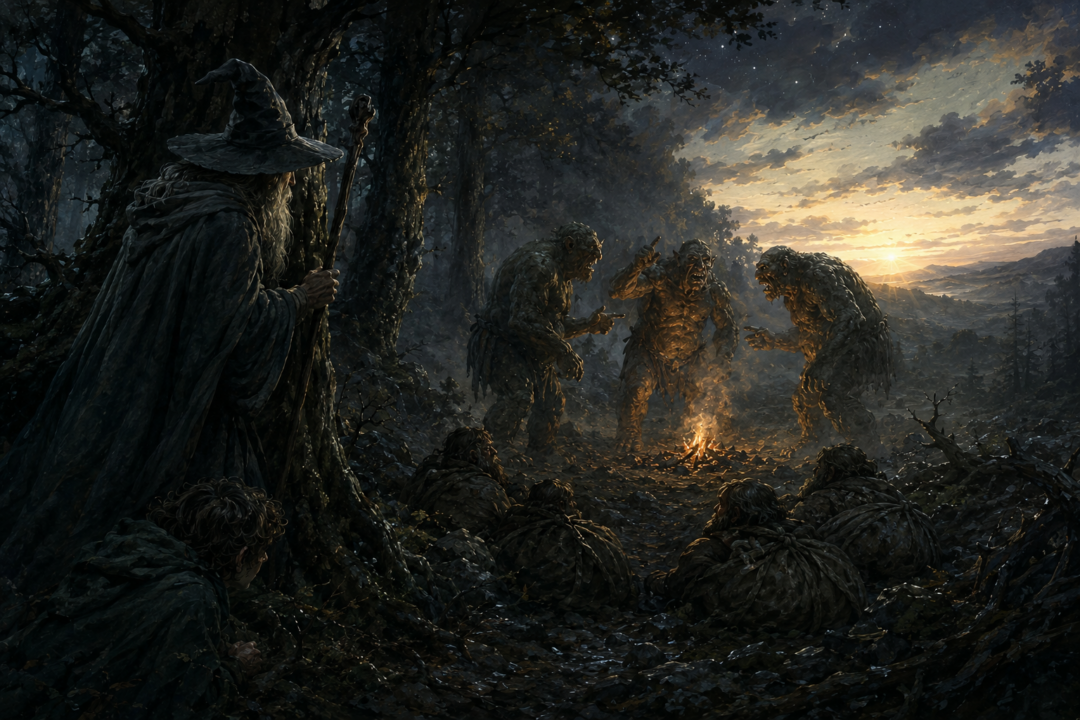
His concealed interventions sound like remarks made by the trolls themselves. One voice contradicts another. A troll denies saying something. Another insists that he did. Suspicion turns into anger, and anger generates further delay.
This matters because Gandalf’s tactic depends on amplification rather than domination.
He does not control their minds.
The text does not say that he enchants them into arguing.
What it explicitly shows is Gandalf using his voice so effectively that the trolls mistake his interventions for remarks from one another. Their own tempers do the rest.
Gandalf supplies sparks.
The trolls provide the fuel.
Why He Uses Their Voices
There is another advantage to Gandalf’s method: the trolls never acquire a clear external enemy.
Imagine the difference if a mysterious wizard simply shouted insults at them from the forest.
The trolls might search for him.
They might gather their prisoners and flee.
They might realize immediately that someone was deliberately keeping them occupied.
Instead, Gandalf makes each troll believe that the source of the irritation is standing beside him.
A disagreement about the captives becomes a disagreement about who said what. Every attempt to settle the argument creates another argument.
It is an elegant trap because the victims participate in maintaining it.
Whether Gandalf’s mimicry here should be classified as supernatural power is less certain than the event itself. The Hobbit simply presents his voice as convincingly resembling the trolls’ voices. The safest conclusion is therefore not that Gandalf uses a specifically defined spell, but that he deliberately disguises or projects his voice well enough to deceive them.
The mechanism remains wonderfully understated.
The important thing is what he accomplishes with it.
Gandalf Is Fighting With Time
The scene reveals a pattern that appears repeatedly in Gandalf’s actions: knowledge can matter more than raw power.
Gandalf possesses formidable abilities, but he does not automatically use the greatest force available to him.
Here, the environment already contains the weapon he needs.
Dawn is approaching.
The trolls cannot change what sunlight does to them.
So Gandalf turns the battle into a contest over minutes.
Every accusation matters.
Every denial matters.
Every pointless dispute brings the eastern sky closer to light.
This also explains why Gandalf continues the deception rather than ending it as soon as the trolls begin fighting among themselves. A temporary quarrel is not enough. They must remain distracted until the danger becomes unavoidable.
Near the end, Tom and Bert finally recognize that the night is nearly gone and try to return to business.
They are almost in time.
Then Gandalf supplies the final provocation.
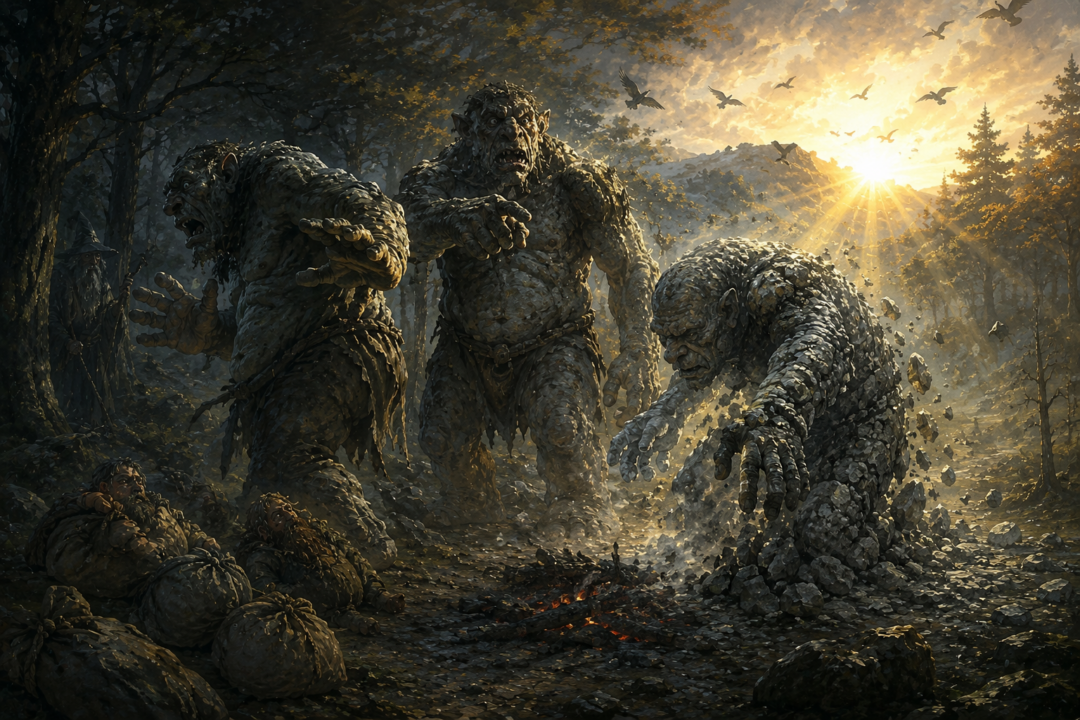
At precisely that moment, daylight comes over the hill.
The birds begin calling.
The trolls are caught outside.
William is petrified where he stands, and Tom and Bert become stone with him.
The confrontation ends not with Gandalf overpowering three monsters, but with Gandalf arranging circumstances so that their own nature defeats them.
The Trolls’ Fate Reflects Something Deeper About Their Kind
Later writings give the stone transformation additional resonance.
In The Lord of the Rings, Treebeard says that trolls were made in mockery of Ents, just as Orcs were associated in his account with mockery of Elves. This should not be treated as a complete technical explanation of troll origins, but it places them within a broader pattern: the Enemy corrupts, imitates, and counterfeits rather than producing the world’s highest forms independently.
A letter discussing trolls goes further, describing them as counterfeits and connecting their return to stone in darkness-dependent conditions with that artificial nature.
That idea fits strikingly well with what The Hobbit already shows.
William, Bert, and Tom appear terrifyingly alive at night. They eat, argue, capture travellers, hoard treasure, and exercise enormous physical strength.
But sunrise exposes a limit built into what they are.
Their strength cannot negotiate with daylight.
No amount of muscle changes the rule.
Gandalf wins because he knows the rule and they fail to act before it overtakes them.
The Victory Also Changes Bilbo’s Journey
The consequences extend beyond surviving the night.
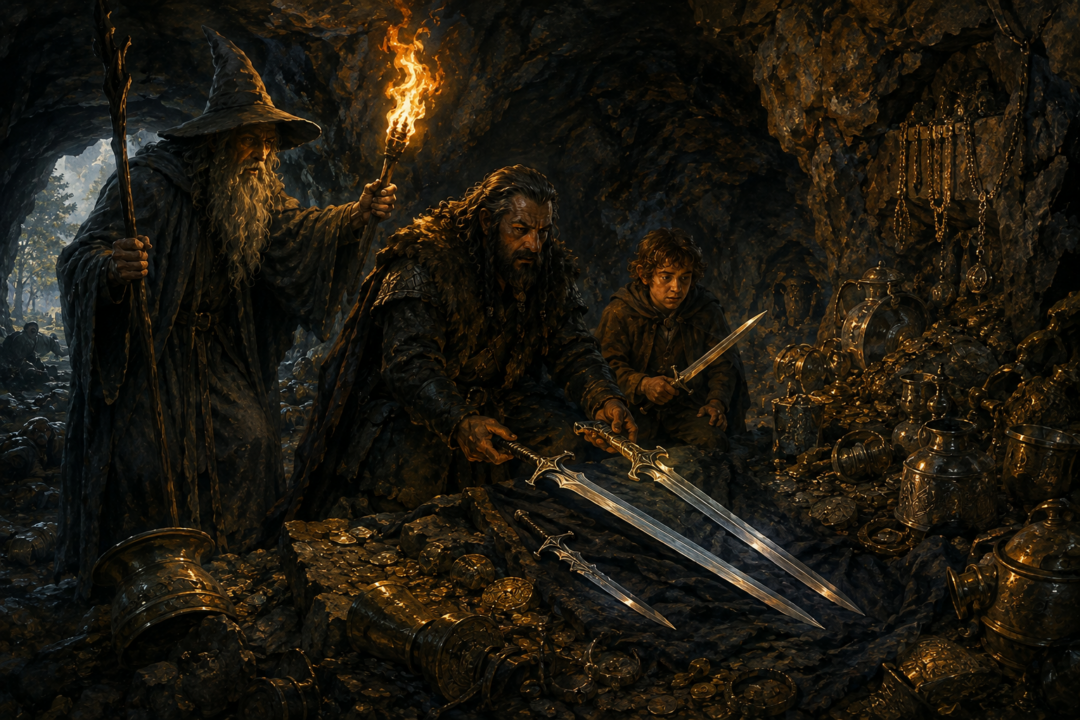
After the trolls are destroyed, Gandalf and the company discover their hidden cave. Inside is treasure accumulated from previous victims, including ancient swords of extraordinary quality.
Gandalf takes Glamdring.
Thorin takes Orcrist.
Bilbo receives a smaller blade suitable for someone of his stature, though he will only later give it the name Sting.
At Rivendell, Elrond identifies Glamdring and Orcrist as swords made in Gondolin, the lost Elven city of the First Age.
So an apparently comic encounter beside a woodland fire unexpectedly connects Bilbo’s adventure to the deep history of Middle-earth.
The trolls themselves probably do not understand the true significance of what they possess. The text gives no reason to think they know the blades’ ancient identities.
They are merely hoarding stolen things.
Yet among those stolen things are weapons that will matter throughout the journey.
Gandalf’s victory therefore does more than save the company. It indirectly arms them for dangers still ahead.
The Stone Trolls Outlast the Adventure
The episode receives an unusual echo decades later.
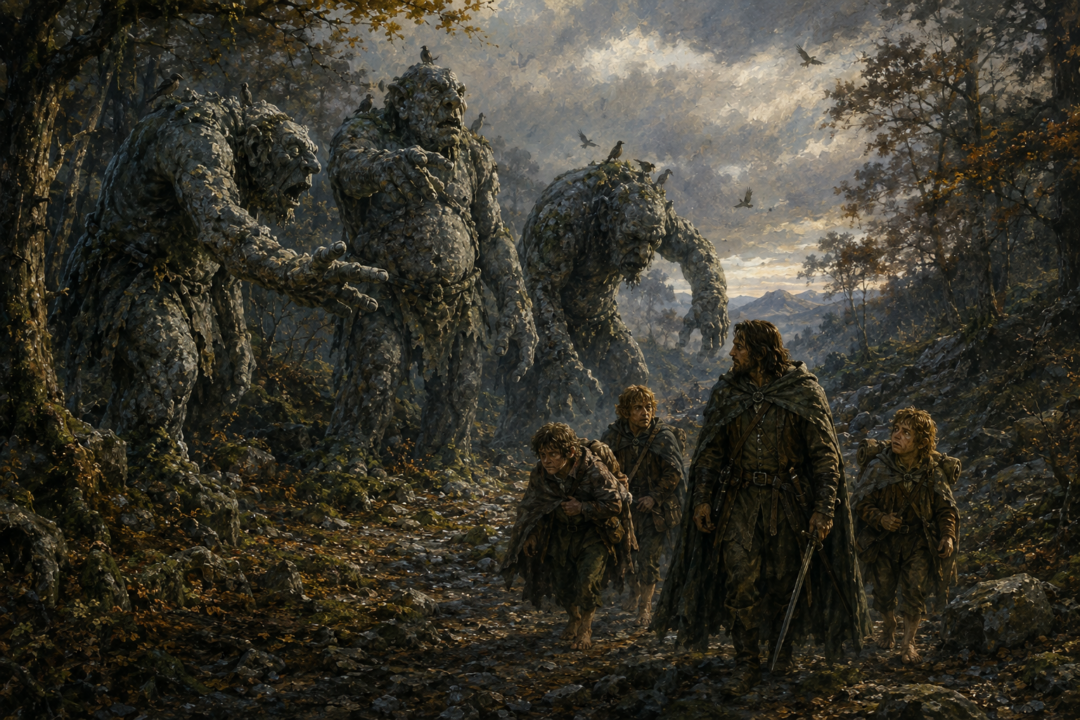
In The Fellowship of the Ring, Aragorn and the hobbits encounter the same petrified trolls while travelling toward Rivendell after Frodo has been wounded on Weathertop.
Bilbo’s old adventure has become part of the landscape.
The trolls are still there.
What once seemed like a humorous story about a young hobbit’s disastrous first attempt at burglary has left physical evidence behind.
That continuity gives the original scene more weight in retrospect. The Hobbit often moves lightly between danger and comedy, but Middle-earth remembers what happened. William, Bert, and Tom remain frozen beside the road long after Thorin’s quest has ended.
They have effectively become their own monument.
Not to Gandalf’s strength, but to their failure to recognize when the argument had become more dangerous than the enemy.
Gandalf Wins Without Needing the Final Blow
That may be the most revealing part of the entire encounter.
Gandalf could be spectacular when circumstances demanded it. Elsewhere he uses fire, confronts supernatural enemies, and eventually stands against powers far beyond three woodland trolls.
But wisdom in Middle-earth is not measured by how dramatically power is displayed.
Against William, Bert, and Tom, Gandalf sees that violence is unnecessary.
The trolls are strong, but strength cannot save them from sunrise.
They are dangerous, but their tempers make them manipulable.
They know that dawn is coming, but they cannot stop fighting long enough to act on that knowledge.
Gandalf needs only to understand all three facts at once.
So he stays behind the trees and lets the trolls believe they are fighting one another.
Minute after minute disappears.
Then the world itself changes around them.
Night ends.
Birds stir in the branches.
Light crosses the hill.
And three creatures powerful enough to capture Thorin Oakenshield and his entire company discover, too late, that Gandalf was never trying to beat them in a fight.
He was simply making sure they were still arguing when the sun arrived.
Sources & Notes
- The Encyclopedia of Arda, “Roast Mutton” — summarizes the chapter’s capture sequence and Gandalf’s concealed imitation of the trolls’ voices until sunrise turns them to stone. https://www.glyphweb.com/arda/r/roastmutton.php
- The Encyclopedia of Arda, “Trolls” — explains the nature of Tolkien’s trolls and the sunlight rule that causes the three stone-trolls’ defeat. https://www.glyphweb.com/arda/t/trolls.php
- The Encyclopedia of Arda, “Trollshaws” — locates the encounter and records the lasting stone forms of William, Bert, and Tom. https://www.glyphweb.com/arda/t/trollshaws.php
- The Encyclopedia of Arda, “William Huggins” — details the speaking purse, the company’s capture, the trolls’ quarrelling, and William’s petrification at dawn. https://www.glyphweb.com/arda/w/williamhuggins.php
- The Encyclopedia of Arda, “Gandalf” — provides the broader account of the wizard’s guidance of Thorin’s Company and preference for wit and timely intervention. https://www.glyphweb.com/arda/g/gandalf.php
Sources added for the troll encounter, Gandalf's voice trick, and the sunlight vulnerability.