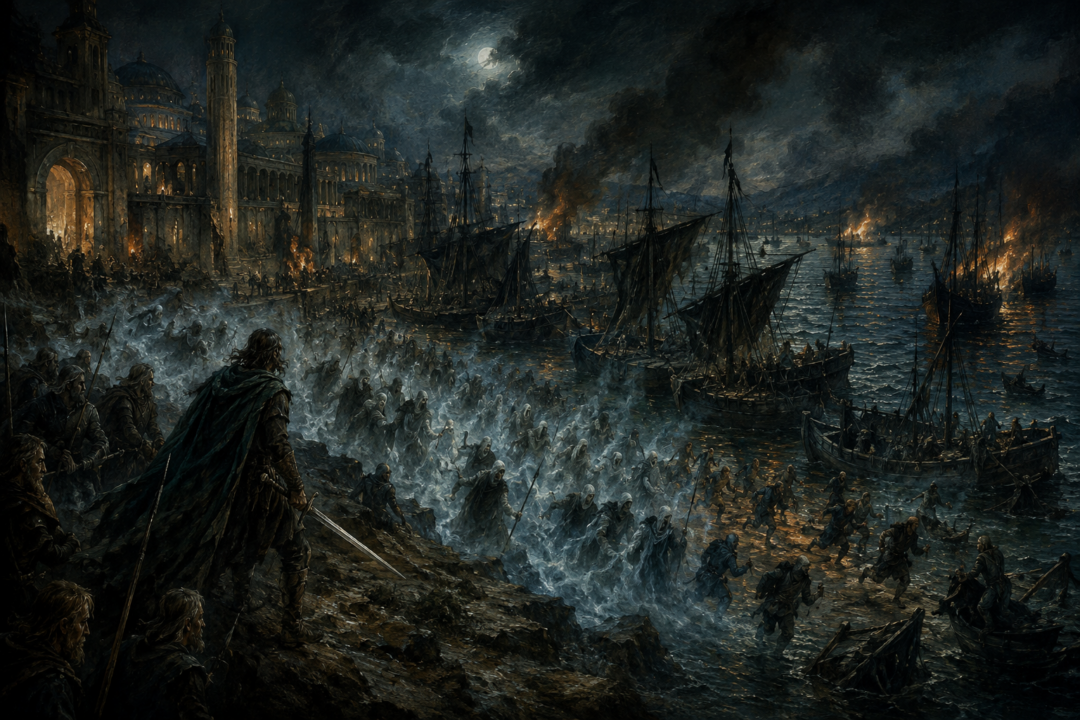
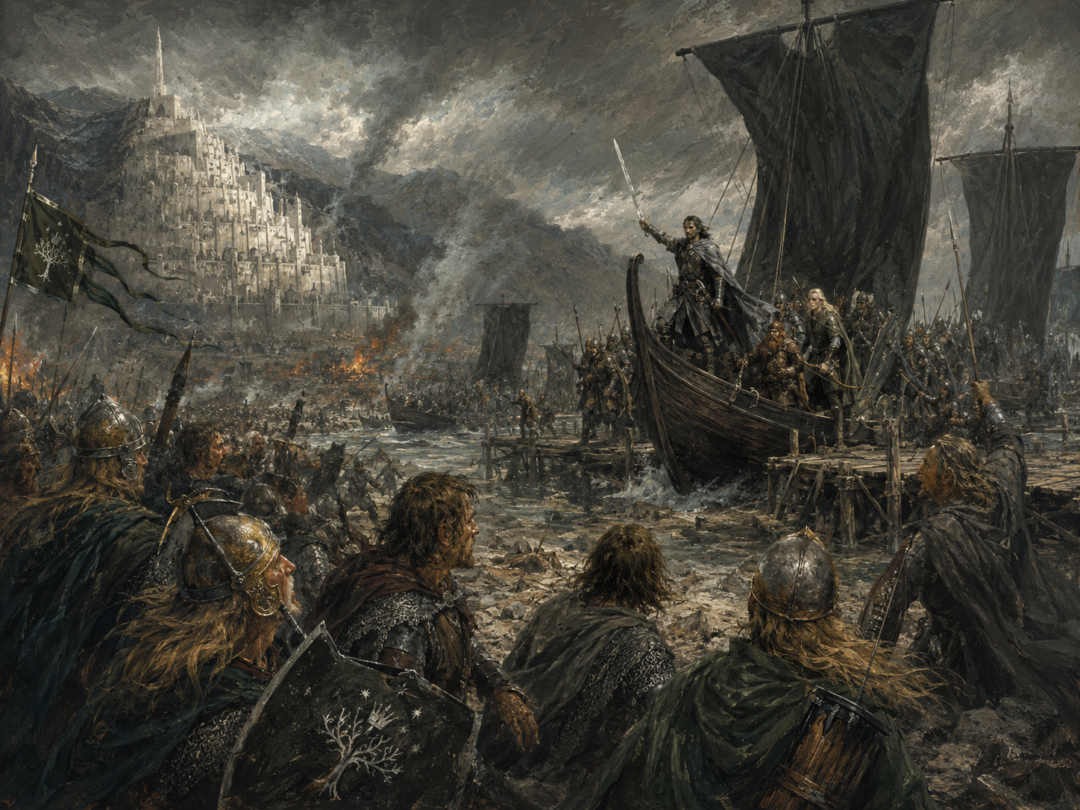
When black sails appeared on the Anduin during the Battle of the Pelennor Fields, the defenders of Gondor believed the worst had happened.
They knew a Corsair fleet was coming from the south. They knew southern Gondor had already been threatened. And when those ships finally approached the Harlond beneath Minas Tirith, the obvious conclusion was terrifying: Umbar had broken through, and another enemy army was about to land behind them.
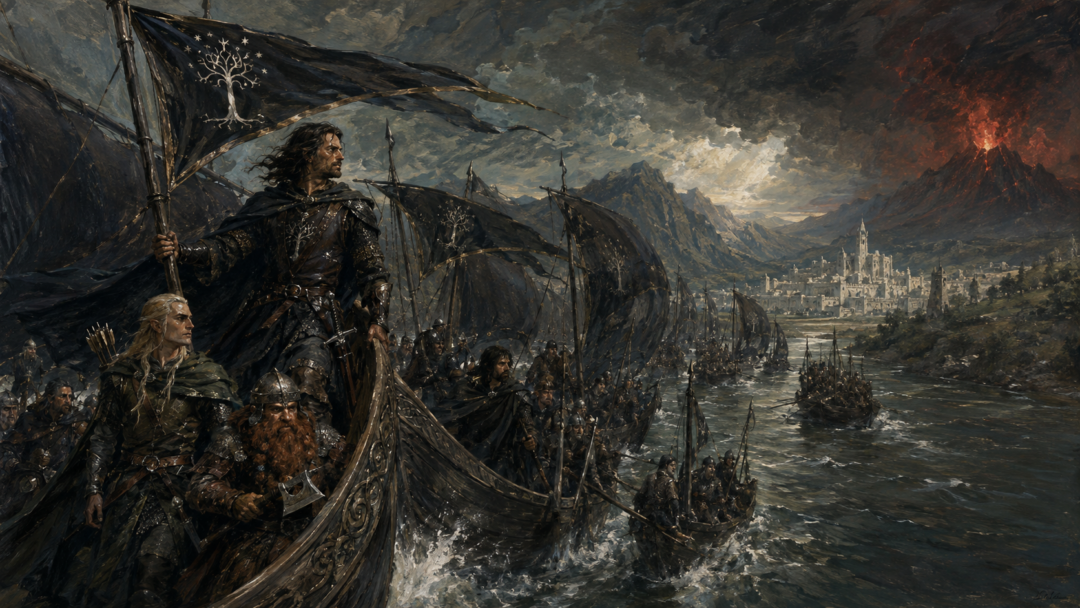
Instead, Aragorn stood aboard the captured fleet.
That reversal is one of the great battlefield surprises of the War of the Ring, but the importance of Pelargir goes deeper than dramatic timing. Aragorn did not merely seize enemy ships. He captured the transport system that had been keeping Gondor’s southern strength away from Minas Tirith.
The Black Fleet gave him something his small company desperately lacked: strategic speed, carrying capacity, and access to thousands of potential allies who had previously been trapped fighting for their own homes.
Aragorn’s Real Problem Was Distance
When Aragorn left Rohan for the Paths of the Dead, he did not command a conventional army.
The Grey Company consisted of a small body of Rangers from the North, joined by Elladan and Elrohir, while Legolas and Gimli accompanied Aragorn personally. Their strength was formidable, but numerically they were nowhere near enough to alter the siege of Minas Tirith by themselves.
Aragorn understood that the decisive danger was coming from southern Gondor.
After using the Orthanc-stone, he became aware of the threat posed by the Corsairs of Umbar. The southern fiefs could not simply send all their fighting men north because hostile forces were attacking their own lands. Lebennin, Lamedon, and the regions toward the Mouths of Anduin were therefore not merely distant reserves waiting to march. They were under direct pressure.
That distinction matters.
Gondor possessed manpower in the south, but much of that manpower was strategically immobilized. The Corsairs were accomplishing two things at once: preparing forces that could reinforce Sauron’s assault while forcing Gondorian troops to remain far from Minas Tirith.
Aragorn’s southern campaign broke that arrangement.
The Dead Solved the First Problem: Breaking the Corsairs
The Oathbreakers summoned by Aragorn were terrifying precisely because conventional resistance collapsed before them.
At Linhir, forces from Umbar and Harad were fighting the Men of Lamedon. When the Shadow Host approached, fear scattered men on both sides. Angbor of Lamedon alone among the nearby defenders remained, and Aragorn instructed him to gather what forces he could and follow.
From there Aragorn drove toward Pelargir.
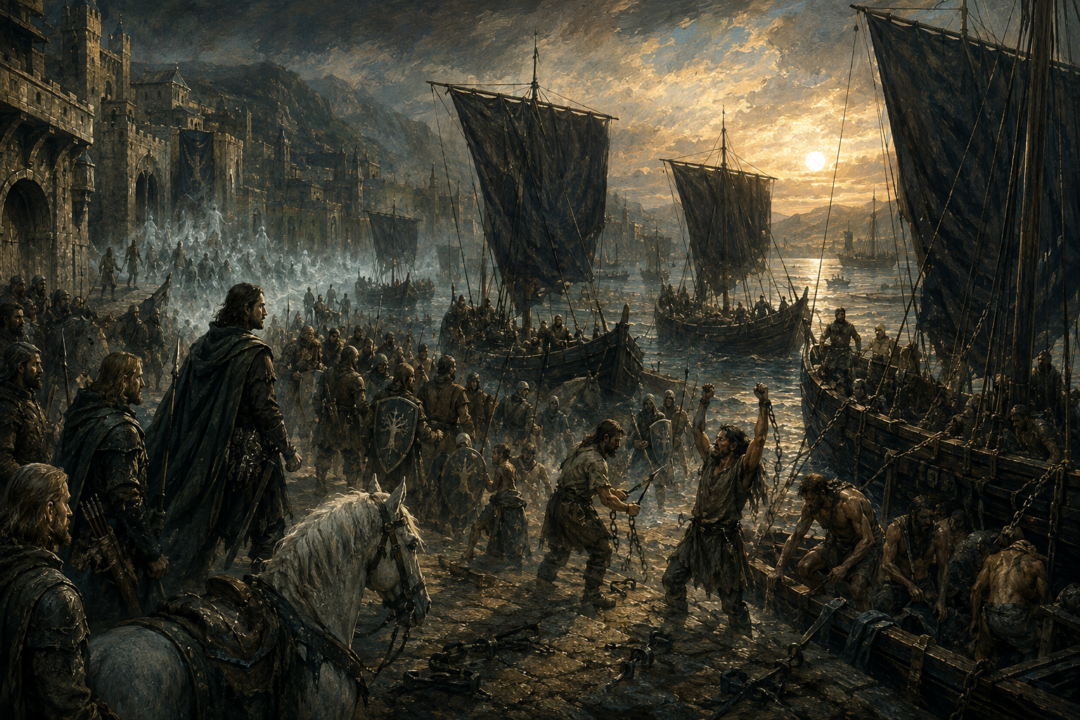
The chronology emphasizes the urgency. He passed through the Paths of the Dead on March 8, reached Linhir on March 11, drove the enemy toward Pelargir on March 12, and captured the Corsair fleet there on March 13. The next morning his new fleet began moving north. On March 15 it reached the battle before Minas Tirith.
At Pelargir waited the main fleet of Umbar: fifty great ships and smaller vessels described as beyond counting. Some vessels tried to escape; others were already burning. The Haradrim and Corsairs still represented a considerable force, but the Dead overwhelmed their ability to resist through terror. Mariners abandoned their ships, while slaves chained to the oars could not flee. ESL Bits
Then Aragorn did something crucial.
He released the Dead.
They did not sail with him to Minas Tirith. Their oath was judged fulfilled at Pelargir, and the Shadow Host departed.
That means the force that later landed at the Harlond was a living army.
Capturing the Fleet Turned Enemy Logistics Into Aragorn’s Logistics
Destroying the Corsair fleet would already have been a major victory.
Capturing it was far more valuable.
Before Pelargir, Aragorn’s company was moving largely overland through southern Gondor. Every additional soldier gathered along the way created another logistical problem: more men had to travel hundreds of miles toward Minas Tirith, while the battle there was already beginning.
The captured ships changed the geometry of the war.
The Anduin became a military highway.
Instead of forcing a newly assembled southern host to march north through Gondor, Aragorn could place men aboard ships already designed to transport large numbers along the river. The very fleet intended to carry Gondor’s enemies toward the capital became the means by which Gondor’s defenders reached it first.
The text never provides a precise sailing speed or troop capacity for each captured vessel, so any attempt to calculate exact numbers would be speculative. What it does make clear is the operational result: ships were prepared and manned during the night after Pelargir, the fleet departed the following morning, and Aragorn reached the Pelennor in time to influence a battle that was already dangerously close to disaster. SpaceBattles Forum
That is the transformation in speed.
Aragorn did not suddenly make his soldiers faster. He acquired transportation that allowed an entire southern fighting force to move at the speed of a river fleet rather than an army on foot.
Pelargir Also Unlocked Manpower
The ships alone would have been useless without men to sail and fight from them.
Pelargir supplied those too.
The Corsair vessels contained captives and enslaved Gondorians taken during raids. After the Corsairs fled, these men were freed. Meanwhile, once the terror of the Dead had passed and the southern threat was broken, inhabitants of Lebennin, the Ethir, Lamedon, and other southern regions began gathering around Aragorn.
Science Fiction & Fantasy Stack Exchange
This is perhaps the most important strategic consequence of the victory.
Before Aragorn arrived, southern Gondor’s fighting strength was fragmented by invasion.
After Pelargir, the invading fleet no longer existed as an effective enemy force.
Men who had previously been needed to defend their own lands could now move north.
The Battle of the Pelennor Fields explicitly describes Aragorn landing with the Rangers of the North at the head of a substantial body drawn from Lebennin, Lamedon, and the southern fiefs. These were the troops who surged from the Harlond and joined the fighting against Mordor’s forces. silmarillionwritersguild.org
The Dead therefore won Aragorn access to Pelargir.
The fleet gave Aragorn access to Gondor.
That distinction is essential.
Aragorn Did Not Take Every Southern Soldier With Him
The victory also reveals that Aragorn was thinking beyond the immediate battlefield.
Not every available man was packed aboard his first wave of ships.
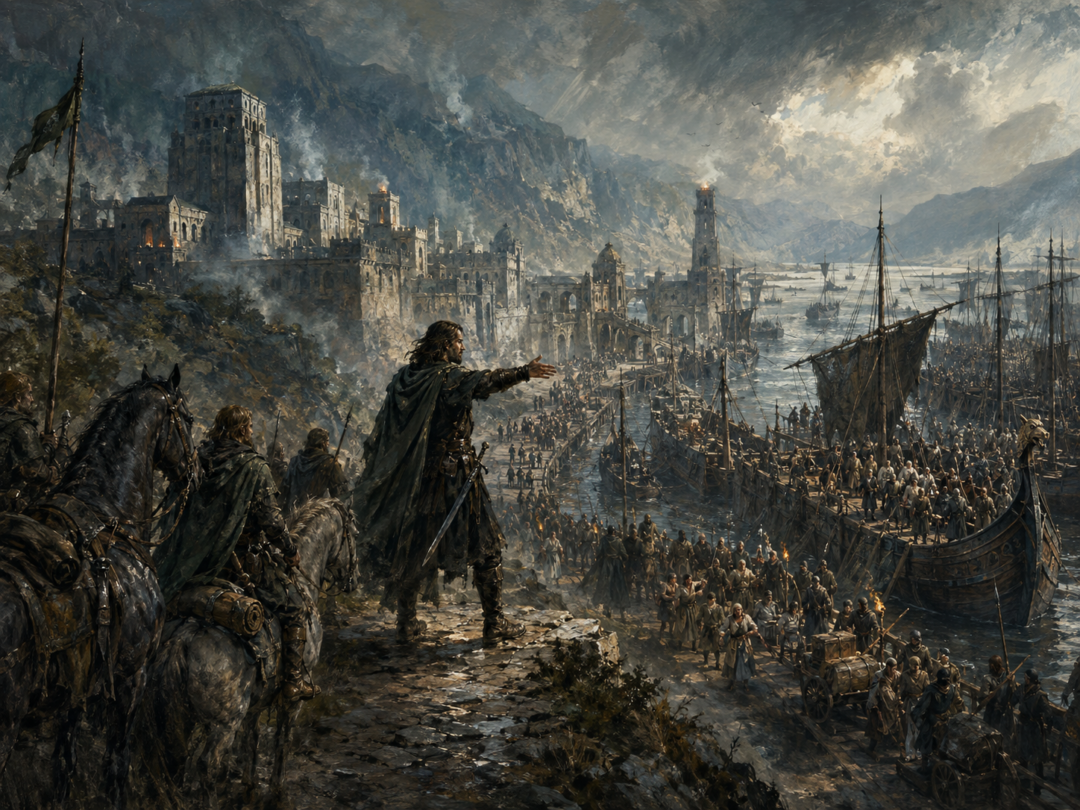
Angbor and additional forces remained part of a broader movement through southern Gondor, and later Aragorn refers to thousands whom he had sent northward by land while still more men followed by river in whatever craft could be gathered. This suggests a layered reinforcement system rather than one single dramatic transport. mikealexander.substack.com
The captured Black Fleet was therefore not merely a one-time ride to Minas Tirith.
It became the core of a larger mobilization.
Aragorn could send the fastest useful force ahead while directing additional manpower toward the capital by other routes. Once Umbar’s immediate threat had been removed, the entire military balance of southern Gondor began turning northward.
That is what Sauron’s strategy had been designed to prevent.
The Enemy Had Accidentally Delivered Aragorn’s Transport
There is a brutal irony in the episode.
The Corsairs came north because Gondor’s weakness seemed exploitable.
Their fleet threatened the southern fiefs, tied down defenders, and offered Sauron the prospect of reinforcement from the Anduin. Had those ships reached the Harlond still under enemy control, the defenders of Minas Tirith would have faced an even darker situation.
Instead, Aragorn took possession of them.
The result was almost a complete inversion of their strategic purpose.
Ships meant to carry enemies carried Gondorians.
Captured slaves became free men.
Southern troops who had been forced to defend scattered homes were concentrated into an expeditionary force.
And the black sails that should have announced catastrophe became the disguise beneath which unexpected aid approached the battlefield.
When Mordor’s soldiers eventually realized that their own allies’ ships were filled with enemies, the psychological effect echoed what had already happened at Pelargir. The apparent logic of the battlefield suddenly reversed. GameFAQs
Why Aragorn Needed the Ships More Than the Dead
The Army of the Dead is the most supernatural element of Aragorn’s southern campaign, but militarily its role was surprisingly specific.
It broke resistance.
It did not replace Gondor’s armies.
Once the Corsairs had been driven from Pelargir, Aragorn dismissed the Oathbreakers. The men who fought on the Pelennor were living soldiers: Rangers, Gondorians from the southern fiefs, and Aragorn’s companions.
That makes Pelargir a story not simply about supernatural intervention but about exploiting the opportunity that intervention created.
Aragorn transformed fear into mobility.
He transformed liberated territory into manpower.
He transformed captured enemy assets into transport.
And he transformed a small, fast-moving company into the spearhead of a much larger southern relief force.
Without the Dead, taking Pelargir so quickly may have been impossible.
But once Pelargir was taken, it was the Black Fleet that made the victory useful at the exact place and time that mattered most.
The Black Sails Changed the War Twice
The Corsair fleet influenced the War of the Ring before Aragorn ever captured it.
Its existence helped keep southern Gondor divided and afraid. Men who might otherwise have reinforced Minas Tirith had to protect their own lands.
Then Aragorn seized the ships, and the same strategic mechanism began working in reverse.
The south was relieved.
Captives were freed.
Local forces rallied.
Ships were manned.
A substantial living army was carried rapidly up the Anduin.
By the time the black sails appeared near Minas Tirith, the fleet had already changed allegiance, function, and meaning.
That is why Aragorn’s arrival at the Pelennor is more than a heroic entrance.
It is the visible end of a remarkably efficient campaign.
He had not simply found reinforcements.
He had captured the machinery that allowed those reinforcements to arrive in time.
Sources & Notes
- The Encyclopedia of Arda, “Black Fleet” — describes the Corsair armada at Pelargir, its capture by Aragorn, and its use to carry southern reinforcements rapidly to Minas Tirith. https://www.glyphweb.com/arda/b/blackfleet.php
- The Encyclopedia of Arda, “Pelargir” — covers the port where Aragorn and the Dead routed the Corsairs and seized their vessels. https://www.glyphweb.com/arda/p/pelargir.php
- The Encyclopedia of Arda, “Corsairs of Umbar” — explains the maritime threat that held Gondor’s southern fiefs under pressure and supplied the captured fleet. https://www.glyphweb.com/arda/c/corsairsofumbar.php
- The Encyclopedia of Arda, “Grey Company” — follows Aragorn’s small original company through the Paths of the Dead and southern Gondor, clarifying the manpower problem before Pelargir. https://www.glyphweb.com/arda/g/greycompany.php
- The Encyclopedia of Arda, “Battle of the Pelennor Fields” — records the defenders’ fear at the black sails and Aragorn’s arrival with reinforcements aboard the enemy fleet. https://www.glyphweb.com/arda/b/battleofthepelennorfields.php
Sources added for the Black Fleet, Pelargir, Corsairs, Grey Company, and Pelennor campaign.