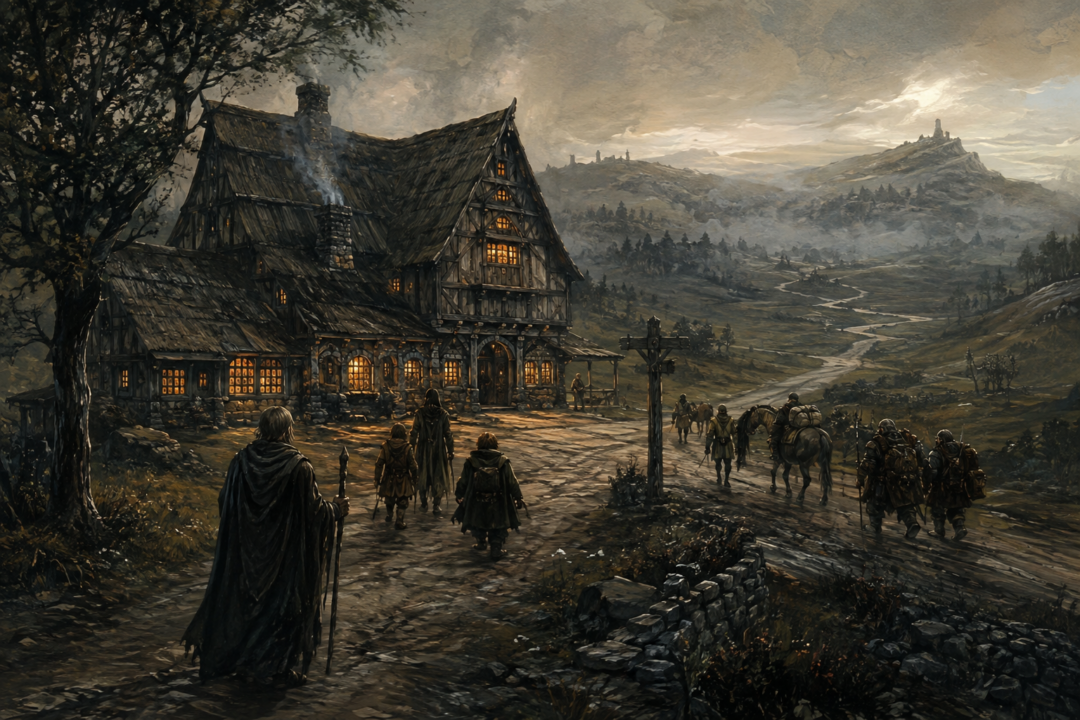
The Prancing Pony seems built for a dangerous world.
It stands at Bree, where the East Road meets the old north-south route called the Greenway. Rangers appear out of the wild. Dwarves pass through. Strange Men arrive from distant lands. News travels slowly, and travelers are never entirely sure what waits beyond the next hill.
That uncertainty gives the inn much of its atmosphere in The Fellowship of the Ring. Frodo reaches it while Black Riders are hunting him. Aragorn sits unnoticed in a dark corner. Gandalf has left an urgent message there because Bree is one of the few dependable points of contact between the Shire and the wider world.
So it might seem that peace would make the Prancing Pony less important.
The opposite is implied.
At the end of the War of the Ring, Gandalf describes a future in which the Greenway will reopen, royal messengers will travel north, dangerous things will be driven from the wilderness, and settlement will return to lands that have long stood empty.
That changes the meaning of the Prancing Pony.
In the dangerous Third Age, it survives because travelers need refuge.
In the restored kingdom, it may prosper because people finally have reasons to travel.
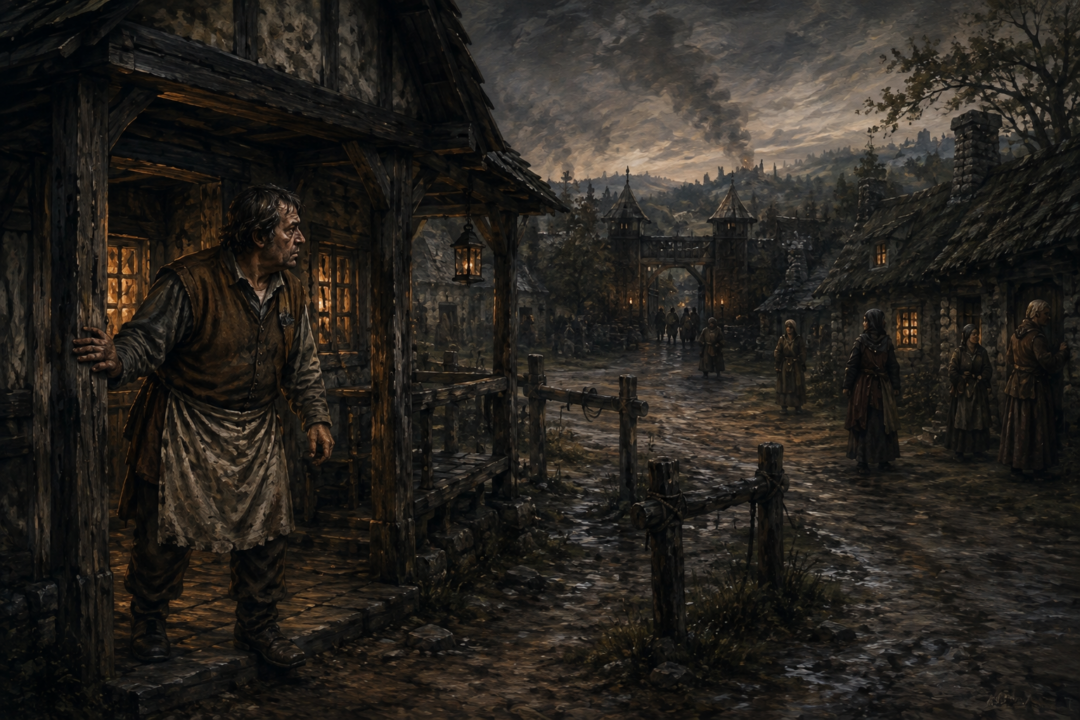
Bree Is Sitting on a Road Network That Has Almost Died
Bree's importance is easy to underestimate because the surrounding country is so empty.
The village is not isolated geographically. Quite the reverse. It stands near the meeting of two historically important roads.
The East Road runs west toward the Shire and east toward Rivendell and beyond. The Greenway runs southward and also points north toward the ruins of the old North-kingdom.
The problem is not Bree's location.
The problem is what happened to the lands around it.
Arnor, the northern kingdom founded by Elendil, had disappeared centuries before Frodo's journey. Its successor realms also fell. Fornost became a ruin. Large stretches of Eriador became thinly inhabited wilderness.
The roads remained, but much of the civilization that had made those roads useful was gone.
That is why the name "Greenway" is so revealing. It is still recognizable as a road, but in Frodo's time it is no longer functioning as the great artery of a healthy kingdom.
Bree therefore occupies something like an abandoned crossroads.
The infrastructure remembers a busier world.
The population does not.
The Prancing Pony Is Already More Than a Tavern
Even before the restoration of the kingdom, the Prancing Pony performs several functions at once.
It provides beds, food, drink, stabling, company, news, and a reasonably trustworthy stopping place. Its common room brings together Bree-folk and travelers. Hobbits and Men mingle there, and Dwarves are familiar visitors.
More importantly, people use the Pony as a point of contact.
When Gandalf cannot meet Frodo as planned, he leaves a letter with Barliman Butterbur. Gandalf explicitly tells Frodo that Butterbur can be trusted, despite the innkeeper's disastrous tendency to forget things.
That makes the Pony something more significant than a place to buy ale.
It is a node in an informal communications network.
There is no functioning postal system linking the Shire, Rivendell, the wandering Rangers, and the distant peoples of Eriador. Information instead travels with people.
An inn at a crossroads is therefore valuable partly because travelers carry news into it and carry news away again.
But this system depends on travelers actually using the roads.
And by the end of the War of the Ring, that has become increasingly difficult.
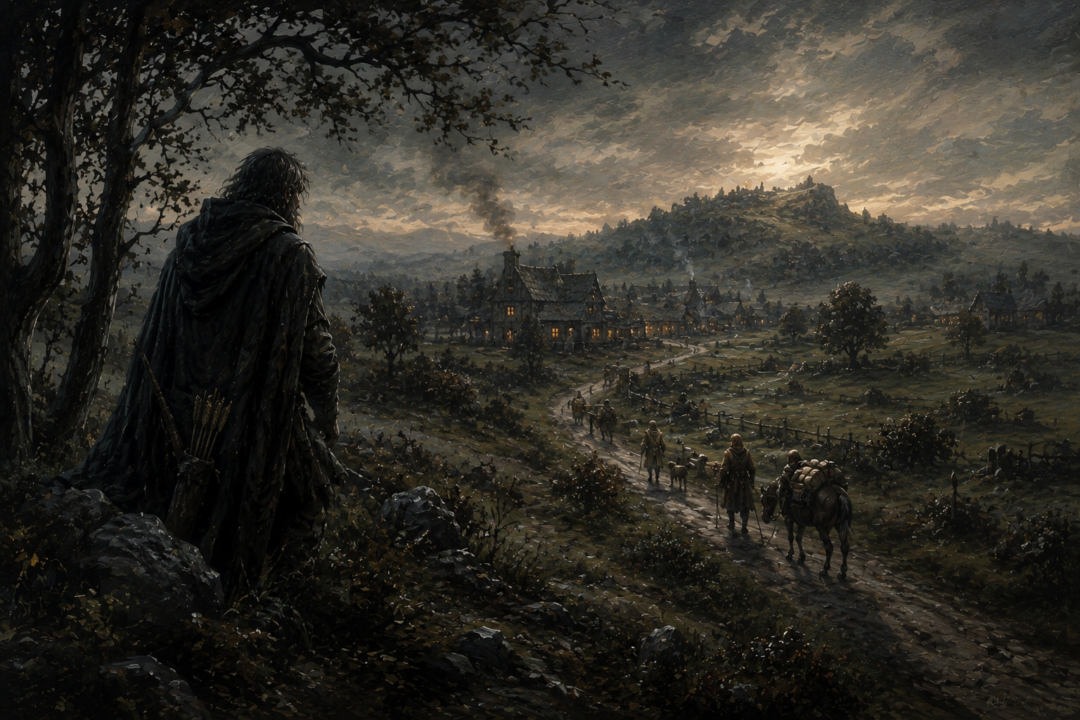
Butterbur Learns What Unsafe Roads Really Cost
When the hobbits return to Bree in The Return of the King, the Prancing Pony is not enjoying the romantic benefits of a dangerous frontier.
It is suffering.
Butterbur describes violence around Bree and explains that there have been few travelers. Ruffians have appeared. Robbers remain in the wild. Bree has become defensive, with guarded gates and anxious inhabitants.
He has also learned something important about the Rangers.
For years, Bree-folk had regarded Aragorn's people with suspicion. The Rangers looked rough, wandered without obvious occupation, and rarely explained themselves.
Only when they departed did Bree discover what their presence had been accomplishing.
Without them, the surrounding country became more dangerous.
That detail overturns a common assumption about places like the Prancing Pony. Danger does not automatically make an inn more valuable simply because travelers need shelter.
Too much danger destroys travel itself.
A merchant who fears robbery may stay home. A family will not casually move along a road haunted by violent men. Messengers become rarer. Settlers avoid empty regions. Trade shrinks.
An inn cannot profit from travelers who never begin their journeys.
Safety therefore does something that thicker walls and stronger locks cannot.
It creates traffic.
Aragorn's Victory Changes the Economics of Bree
This is where Gandalf's prediction becomes so important.
He tells Butterbur that better times are coming because the Rangers have returned and there is once again a king.
The Greenway, he says, will be opened again.
Messengers will travel north.
There will be more movement along the roads.
Dangerous creatures and hostile forces will be driven from the wastelands, and lands that have long stood empty will eventually contain people and fields again.
This is not merely a prediction that Bree will be safer.
It is a prediction that Bree's geography will become valuable again.
A crossroads matters only when the roads lead somewhere people want to go.
Under the restored kingship of Aragorn, the old north-south connection suddenly has a political purpose once more. The King rules Gondor in the south while also inheriting the kingship of Arnor in the north.
The ancient northern lands are no longer merely ruins beyond Bree.
They are part of a restored realm.
Fornost itself illustrates the change.
Butterbur knows it by the ominous name Deadmen's Dike and regards the country as haunted and useless. Gandalf corrects that perspective by recalling its true identity: Fornost Erain, the former royal city.
The difference is larger than a name.
One description belongs to a landscape of abandonment.
The other belongs to a kingdom.
The King Who Sat in Butterbur's Common Room
There is also a wonderful irony hidden inside Butterbur's worries about the future.
He imagines a king as someone remote from ordinary life: a ruler sitting far away in a great castle, drinking from a golden cup.
What could such a person possibly care about Bree or the Prancing Pony?
Then Gandalf reveals that Butterbur already knows him.
The King is Strider.
The suspicious Ranger who once sat quietly in Butterbur's inn is Aragorn.
That revelation matters because Aragorn's restoration is not simply the return of distant government. The man who becomes King has personally traveled these roads.
He knows Bree.
He knows the Pony.
He spent years protecting the lands around them as one of the Rangers whom the Bree-folk barely understood.
The protection that once existed secretly can now become part of an openly restored political order.
That is one of the quiet transformations at the end of The Lord of the Rings: the hidden guardian becomes the acknowledged king.
For Butterbur, the consequences are practical.
The roads outside his door can become roads of a kingdom again.
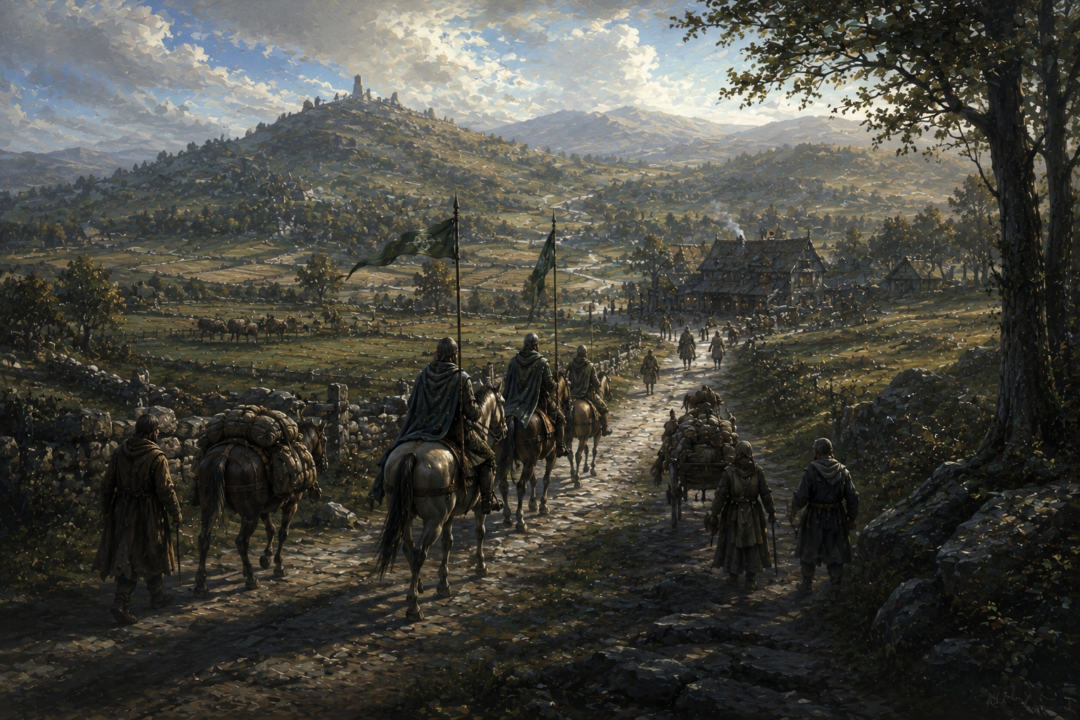
Safer Roads Mean More Strangers — Which Is Exactly What Butterbur Fears
Butterbur's reaction is not uncomplicated enthusiasm.
When Gandalf predicts renewed settlement and travel, the innkeeper immediately worries about outsiders.
This is completely consistent with Bree.
Bree survives because it is connected to the wider world, yet its inhabitants are wary of that world. Butterbur likes respectable travelers but does not want Bree overwhelmed by newcomers.
Gandalf reassures him that there is plenty of empty land elsewhere for settlement.
The exchange exposes the central contradiction of the Prancing Pony.
Butterbur wants peaceful roads without disruptive strangers.
But peaceful roads inevitably produce movement.
Messengers come through. Travelers return. Settlements grow. Trade revives. People who once avoided the wilderness begin crossing it.
The very success of Aragorn's peace threatens to make Butterbur's comfortable little corner of Bree busier.
And that is precisely why the Pony becomes more valuable.
The Inn Becomes Infrastructure for Peace
During Frodo's first stay, the Prancing Pony functions almost like a fortress of normality.
Outside are Black Riders, spies, suspicious strangers, and the wilderness.
Inside are firelight, beer, supper, conversation, and beds.
Its value comes from contrast with the darkness outside.
But the Fourth Age offers another possibility.
The Pony can become useful not because civilization is disappearing, but because civilization is returning.
Royal messengers traveling north need stopping places.
Merchants and ordinary travelers need food and lodging.
Dwarves moving along the East Road already have reason to stop at Bree.
If the northern lands are resettled, the old Greenway can connect communities again.
The texts do not provide a later commercial history of the Prancing Pony, so we cannot say exactly how prosperous Butterbur's inn eventually became. Gandalf's prediction, however, clearly points toward increased traffic, and Butterbur himself recognizes that this should be good for business.
The distinction matters.
War creates refugees.
Peace creates travelers.
The first may temporarily fill an inn, but it also destroys the conditions that allow regular movement. The second creates repeatable, ordinary journeys: trade, messages, visits, migration, administration, and simple curiosity.
Those are the journeys from which a crossroads inn can build lasting importance.
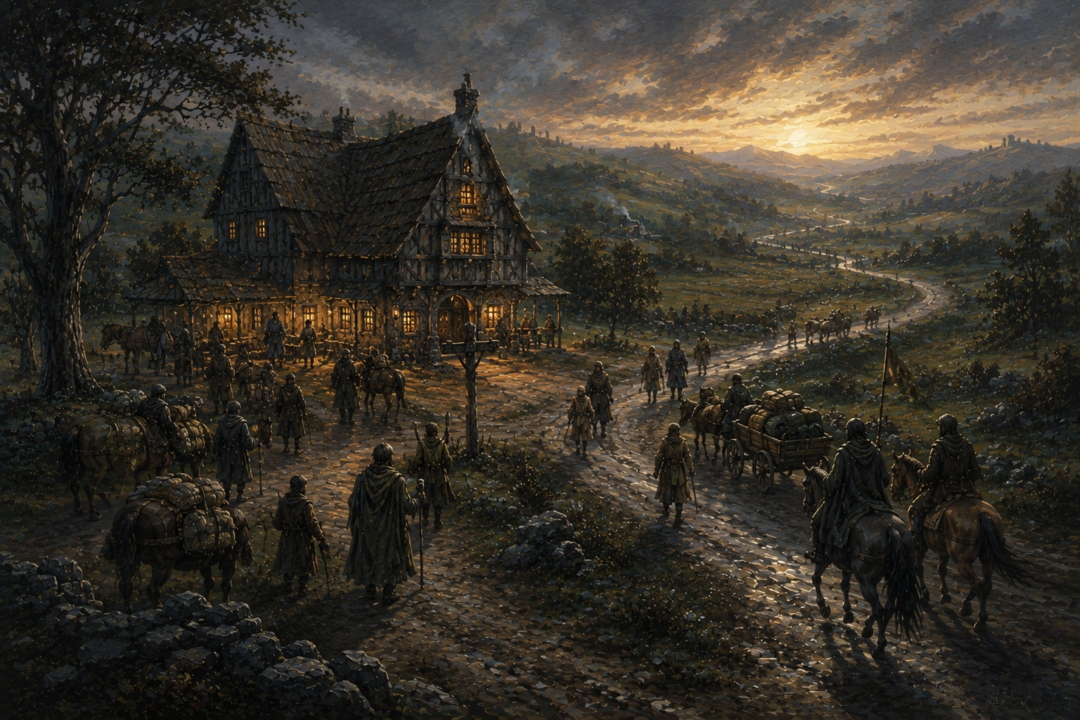
The Prancing Pony Is a Tiny Measure of Aragorn's Victory
The restoration of the King is usually imagined on a grand scale.
Minas Tirith celebrates. The White Tree flowers again. Aragorn receives the crown. Gondor survives.
But the Prancing Pony shows what kingship means far away from the throne.
It means a road can be traveled without expecting robbers.
It means wilderness can become farmland.
It means an old royal road can carry messengers again.
It means an innkeeper can worry about having too many respectable strangers rather than too few customers.
That may be one of the most grounded measures of victory anywhere in The Lord of the Rings.
Sauron's defeat does not merely save famous cities.
It makes ordinary movement possible again.
And that is why the Prancing Pony becomes more valuable when the roads get safer.
The inn was never truly sustained by danger.
It was sustained by connection.
For centuries, Bree had been standing beside the surviving bones of a fallen world: an old road south, an old road east, ruined kingdoms to the north, and Rangers quietly keeping watch over lands whose inhabitants scarcely knew what they owed them.
Aragorn's return begins reversing that decline.
The roads no longer need to lead only toward ruins.
And when roads begin leading somewhere again, the old inn at their crossroads is suddenly standing in exactly the right place.
Sources & Notes
- The Encyclopedia of Arda, “The Prancing Pony” — describes Butterbur’s inn as Bree’s chief meeting place and a stopping point for travellers on the East Road and Greenway. https://www.glyphweb.com/arda/p/prancingpony.php
- The Encyclopedia of Arda, “Bree” — covers the settlement’s mixed population and strategic position near the meeting of the Great East Road and Greenway. https://www.glyphweb.com/arda/b/bree.php
- The Encyclopedia of Arda, “Greenway” — explains the old North-South Road’s decline after the loss of the North-kingdom and its later revival under King Elessar. https://www.glyphweb.com/arda/g/greenway.php
- The Encyclopedia of Arda, “Arnor” — supplies the history of the lost northern realm whose depopulation left Bree’s surrounding road network largely empty. https://www.glyphweb.com/arda/a/arnor.php
- The Encyclopedia of Arda, “Reunited Kingdom” — documents Aragorn’s restoration of the northern and southern Dúnedain realms, the political basis for renewed roads, messengers, and settlement. https://www.glyphweb.com/arda/r/reunitedkingdom.php
Sources added for the Prancing Pony, Bree's crossroads, the Greenway, Arnor, and the restored kingdom.