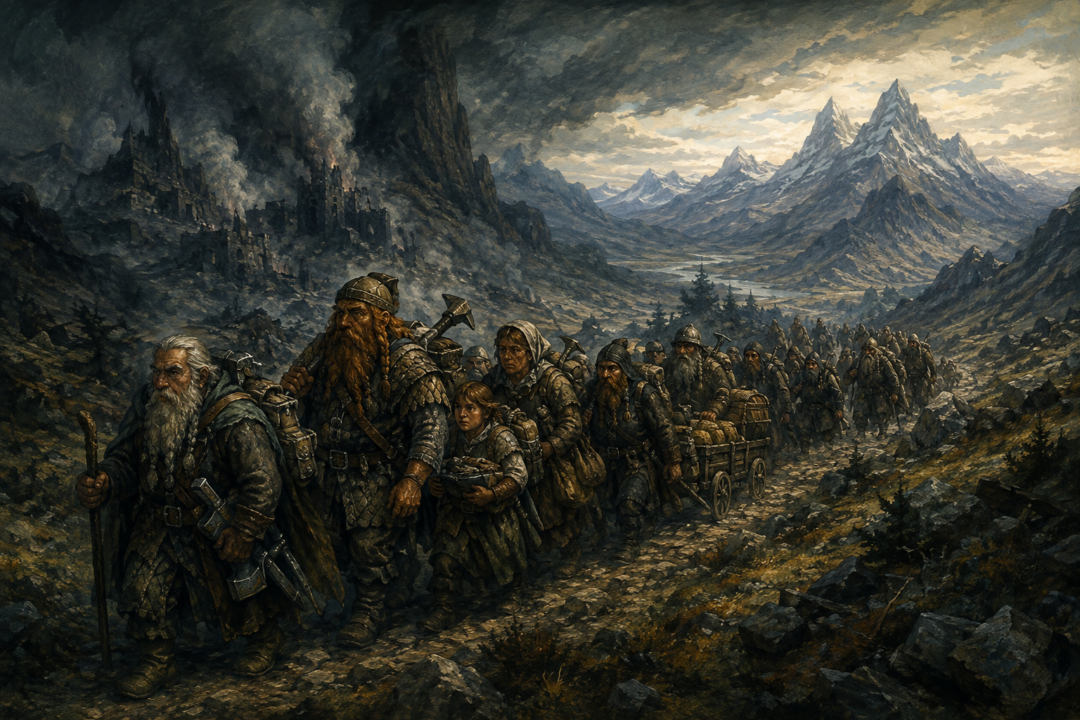
When the Fellowship enters Moria, it finds a dead kingdom: black halls, abandoned chambers, shattered gates, and memories of a greatness that seems almost impossible to recover. Yet Khazad-dûm had once been more than the ancient home of Durin’s Folk. At the beginning of the Second Age, it became the refuge of Dwarves whose own great cities had been broken by the catastrophe that ended the First Age.
Those newcomers came chiefly from Belegost and Nogrod, the famous Dwarf-cities of the Blue Mountains.
The migration is easy to overlook because it occupies only a small place in the surviving histories. But its consequences were enormous. Appendix A of The Lord of the Rings states that after the First Age the power and wealth of Khazad-dûm increased greatly when people from the ruined western cities came there, bringing both population and accumulated knowledge of craft.
Khazad-dûm did not merely survive the destruction of the First Age.
It inherited part of another Dwarven world.
Belegost and Nogrod Were Great Powers Before Moria’s Golden Age
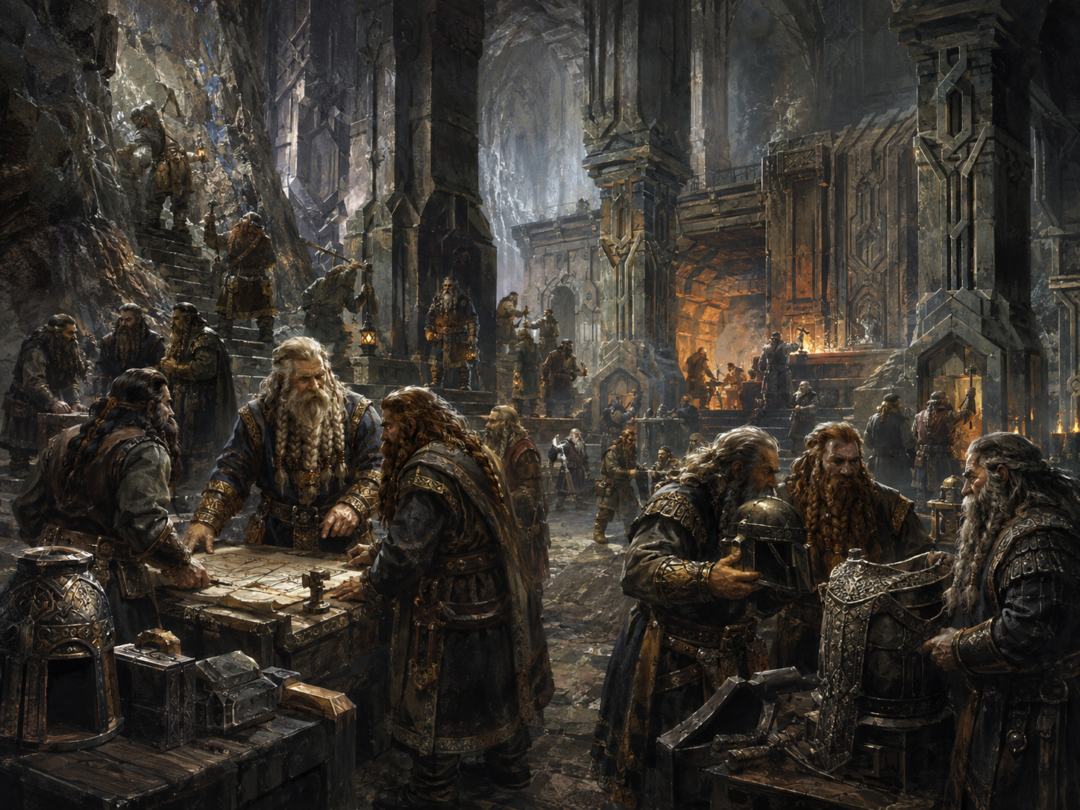
Long before the kingdoms familiar from The Lord of the Rings arose, Belegost and Nogrod stood in the Blue Mountains on the eastern frontier of Beleriand.
They were not minor mining settlements.
Their Dwarves had dealings with the Sindar before the return of the Noldor to Middle-earth, and their craftsmen became deeply involved in the history of Beleriand. The Dwarves of the Blue Mountains helped Thingol create the vast underground halls of Menegroth. Trade passed between Dwarves and Elves, especially through eastern Beleriand, despite the mistrust that often existed between the two peoples.
Their technical achievements could be extraordinary.
The Dwarves of Belegost were renowned for armour. In The Silmarillion, their warriors at the Nirnaeth Arnoediad prove unusually resistant to dragon-fire, and their lord Azaghâl confronts Glaurung himself before dying beneath the dragon.
Nogrod possessed its own celebrated tradition of craftsmanship. Telchar of Nogrod was remembered among the greatest Dwarven smiths of the Elder Days. Works associated with him entered the legends of Elves and Men.
This matters because the refugees who later travelled east were not emerging from culturally insignificant settlements.
They represented peoples with centuries of accumulated mining, smithcraft, masonry, trade, warfare, and underground construction behind them.
When their cities failed, much of that experience did not necessarily vanish with the stone.
The End of the First Age Broke the Blue Mountains
The War of Wrath transformed the geography of northwestern Middle-earth.
Beleriand was shattered during the overthrow of Morgoth, and most of the land eventually disappeared beneath the Sea. The upheaval also damaged the Blue Mountains. Belegost and Nogrod were ruined in the devastation associated with the breaking of Thangorodrim and the end of the First Age.
The surviving Dwarves therefore faced the same terrible question that confronted many peoples after the war:
What remains of a civilization when its homeland no longer offers security?
Some Dwarves continued to dwell in the Blue Mountains in later ages, so the texts do not support the idea that every inhabitant abandoned the region. But many departed.
The Second Age chronology records that many Dwarves leaving their old cities in Ered Luin went to Moria and increased its population.
Their destination was significant.
They did not establish an entirely new great mansion in the west. Instead, large numbers went east toward an older Dwarven power whose foundations had survived the destruction.
Khazad-dûm.
Khazad-dûm Was Already Ancient
It would be misleading to imagine that refugees from Belegost and Nogrod created Khazad-dûm.
The city was vastly older.
Durin the Deathless had founded his mansion beneath the Misty Mountains in the distant Elder Days. The Longbeards—Durin’s Folk—had developed it long before the ruin of the Blue Mountain cities.
Its position was also unusually secure. Khazad-dûm lay beneath the three mountains later called Caradhras, Celebdil, and Fanuidhol, far east of the battlefield where the final destruction of Morgoth reshaped Beleriand.
So when western Dwarven communities were devastated, there already existed a powerful Dwarven realm capable of receiving survivors.
The texts describe the effect directly: after the First Age, the power and wealth of Khazad-dûm increased greatly because it gained both people and “lore and craft” from Nogrod and Belegost.
Those three elements—population, knowledge, and craftsmanship—are the key to understanding the transformation.
The Refugees Brought More Than Additional Hands
Population alone mattered.
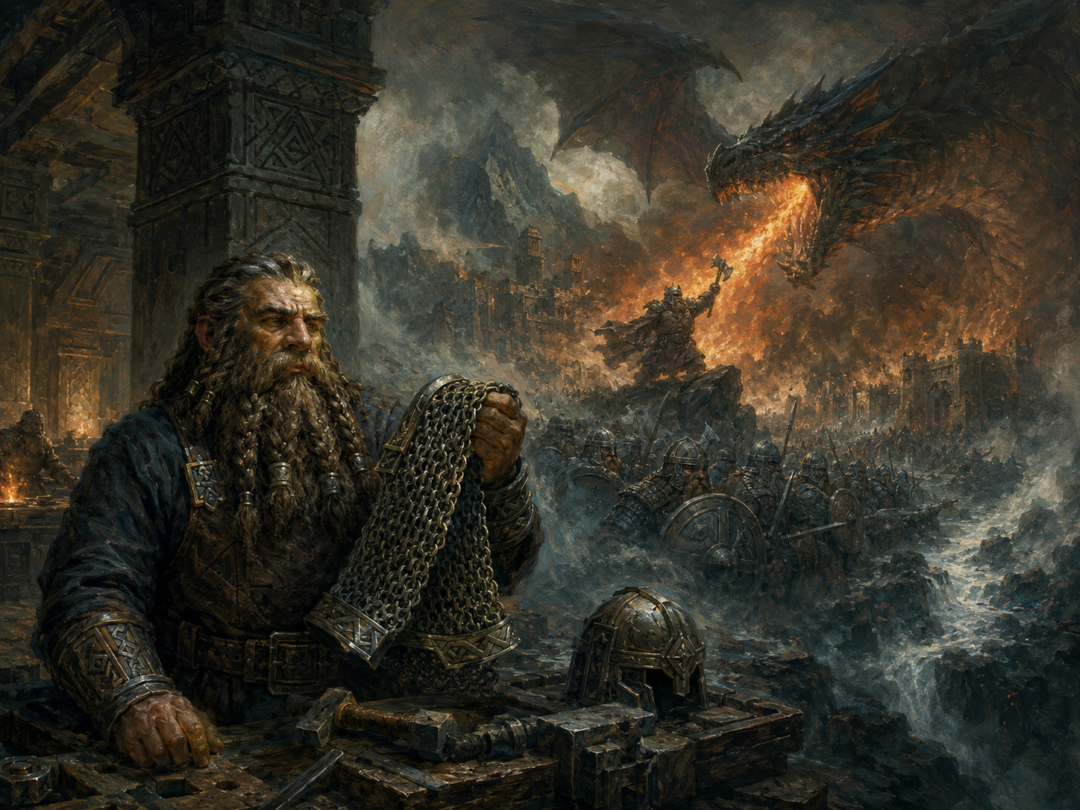
A subterranean kingdom depended upon miners, smiths, masons, engineers, merchants, guards, carters, craftsmen, and countless other workers. An influx from two established Dwarven societies could enlarge both the productive capacity and defensive strength of Khazad-dûm.
But the surviving description emphasizes more than numbers.
The newcomers brought lore.
In this context, that should not be treated as merely stories or historical memory. The text joins “lore” directly with “craft,” suggesting accumulated knowledge and skill were part of what enriched Khazad-dûm.
Exactly which techniques came from which city is never catalogued, and it would be speculation to assign particular later works in Moria to refugees from Belegost or Nogrod.
Yet the broader implication is remarkably clear.
Khazad-dûm absorbed craftsmen formed by traditions that had produced Menegroth’s great delvings, famous weapons, extraordinary armour, and generations of experienced stoneworkers and smiths.
The disaster in the west therefore produced an unexpected concentration of Dwarven expertise in the Misty Mountains.
A civilization had lost two great centres.
Another gained their surviving knowledge.
Belegost Brought a Tradition of Engineering and War
The record of Belegost provides an especially striking picture of what such migrants may have represented.
Its Dwarves had participated in the construction of Menegroth, working with the Sindar to create one of the most elaborate underground dwellings of the First Age.
Their warriors also possessed equipment formidable enough to withstand conditions that broke other troops during the Nirnaeth Arnoediad. When Glaurung attacked, the Dwarves of Belegost endured his fire better than the surrounding forces because of their nature and their protective gear.
It would go beyond the evidence to claim that their arrival directly produced any particular architectural or military feature of Khazad-dûm.
But it is reasonable to see why their presence could strengthen an already mighty underground kingdom.
These were people accustomed to working stone, forging armour, organizing a mountain-city, and maintaining an independent Dwarven society in a dangerous age.
Khazad-dûm gained survivors shaped by one of the greatest Dwarven traditions in western Middle-earth.
Nogrod’s Legacy Was Darker, but Its Craft Was Still Exceptional
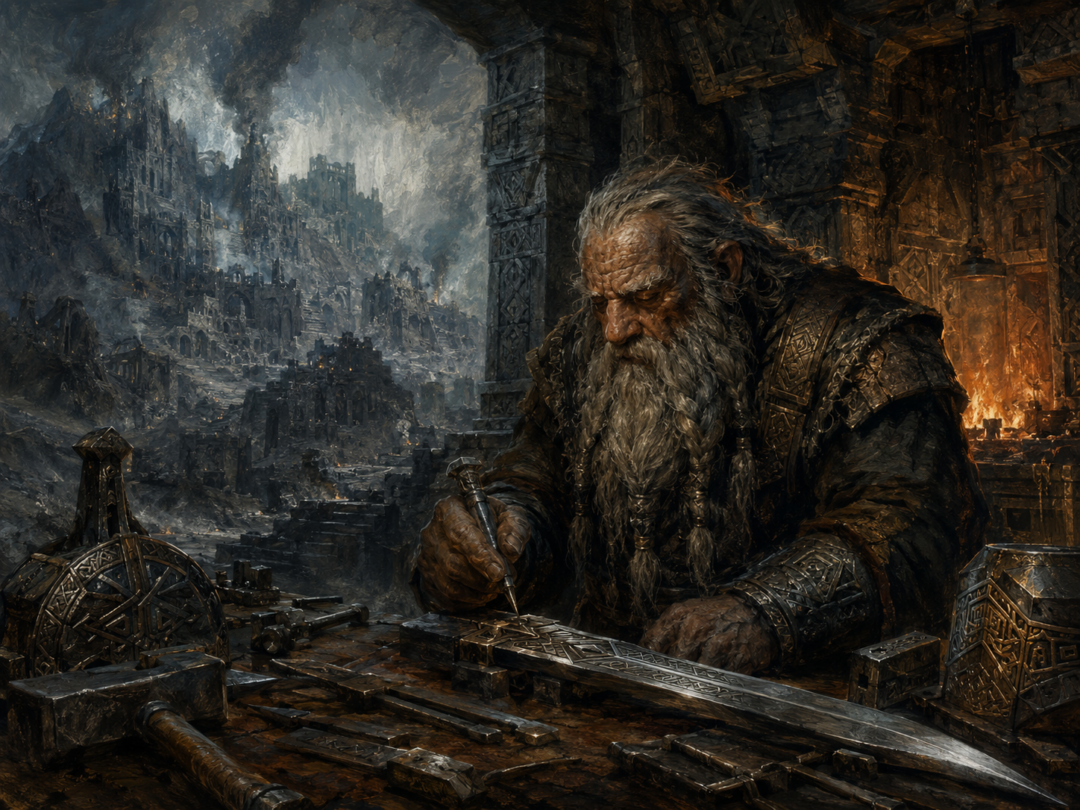
Nogrod reached the end of the First Age under a far darker shadow.
After the death of Thingol, Dwarves of Nogrod became involved in the violent struggle surrounding the Nauglamír and the Silmaril. A host from Nogrod later attacked Doriath and was destroyed during its retreat at Sarn Athrad by forces associated with Beren and the Green-elves.
The surviving traditions therefore remember Nogrod not only for craftsmanship but also for one of the bitterest ruptures between Elves and Dwarves.
Yet that tragedy should not erase the city’s technical reputation.
Nogrod had produced master craftsmen long before its final disasters. Telchar’s fame alone shows the level to which its smithcraft could rise.
The migration to Khazad-dûm consequently represents something more complicated than the transfer of an unblemished heroic tradition.
Refugees could carry achievements, memories, rivalries, grief, and the consequences of old catastrophes together.
The texts never describe how the people of Nogrod were socially absorbed into Durin’s realm, so any detailed reconstruction would be invented. What can be said is that people from the ruined cities increased Khazad-dûm’s strength and brought their craft with them.
Their past became part of a larger Dwarven future.
Different Dwarven Peoples Were Now Concentrated in One Realm
Later writings identify the Dwarven peoples associated with the Blue Mountains as the Broadbeams and Firebeards, although the surviving material does not securely assign one of those clans exclusively to Belegost and the other to Nogrod.
Durin’s Folk were the Longbeards.
That means the migration was not simply movement between settlements belonging to a single political community. It brought descendants of other Fathers of the Dwarves into the greatest mansion of Durin’s line.
How much separate clan identity survived inside Khazad-dûm is not explained.
The histories continue to treat the kingdom primarily as the realm of Durin’s Folk, so there is no evidence that the refugees displaced the Longbeard dynasty or transformed Khazad-dûm into a federation of equal Dwarven kingdoms.
But its population was now broader than the descendants of Durin alone.
That helps explain the extraordinary concentration of Dwarven life in Khazad-dûm during the Second Age.
The Timing Could Hardly Have Been More Important
The strengthening of Khazad-dûm occurred just as a new political world was forming.
Beleriand was gone. Lindon arose west of the Blue Mountains. Later, Noldorin craftsmen established Eregion immediately west of Khazad-dûm.
The Dwarves of Khazad-dûm and the Elves of Eregion developed an unusually productive relationship. The friendship between Celebrimbor’s smiths and the Dwarves became one of the most important examples of cooperation between the two peoples.
It cannot be proved that refugees from Belegost and Nogrod caused this relationship.
But Khazad-dûm entered that period wealthier, more populous, and richer in accumulated craftsmanship precisely because those ruined western communities had contributed people and knowledge.
Its great Second Age prosperity therefore rested partly upon something profoundly tragic.
The destruction of two ancient cities helped enlarge a third.
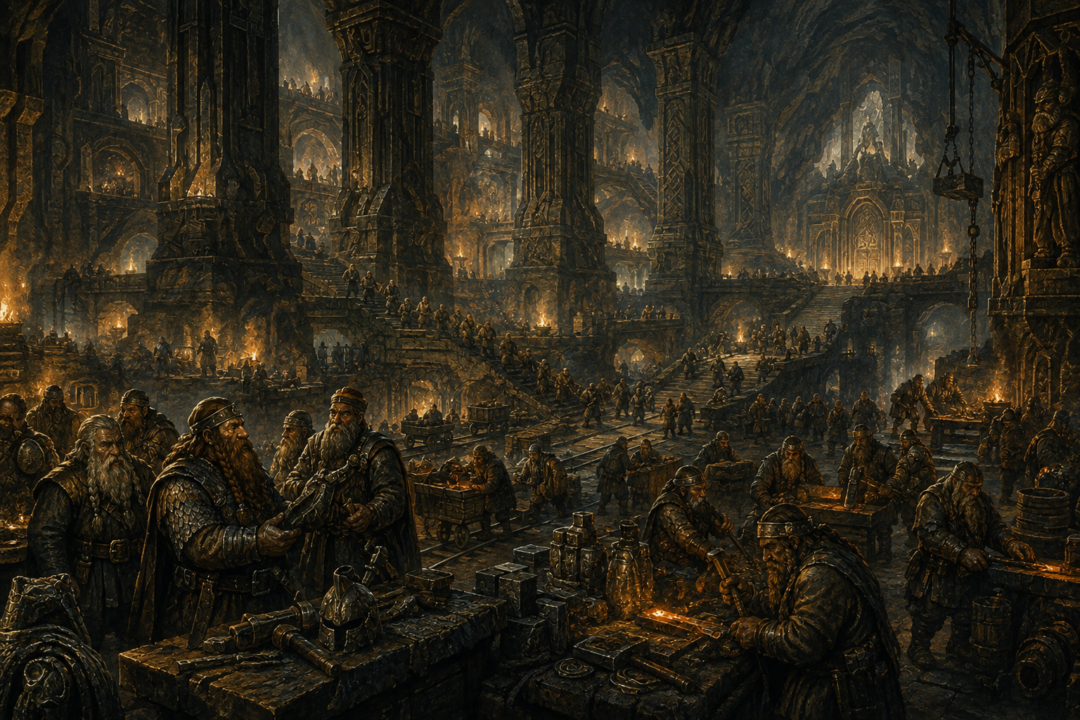
Khazad-dûm Became the Heir of a Lost Dwarven West
This is the deeper significance of the migration.
Belegost and Nogrod effectively disappear as great political powers after the First Age. Their cities were ruined, their populations dispersed, and their independent histories cease to dominate the record.
Khazad-dûm endured.
For thousands of years afterward it remained the greatest name in Dwarven civilization, until the awakening of Durin’s Bane finally drove its people into exile in the Third Age.
But its glory had not been built by the Longbeards in complete isolation.
Behind part of its Second Age greatness stood refugees carrying skills learned beneath different mountains.
That is one of Middle-earth’s quieter patterns: destruction rarely leaves only emptiness. Peoples move. Knowledge survives. Crafts cross borders. The memory of ruined kingdoms can continue inside places that remain standing.
Belegost and Nogrod were broken.
Yet their surviving people did not simply vanish from history.
In Khazad-dûm, some of their strength endured—and helped make the greatest Dwarven mansion greater still.
Sources & Notes
- The Encyclopedia of Arda, “Belegost” — covers the Blue Mountain city, its armourers and masons, Azaghâl and the dragon-resistant warriors at the Nirnaeth Arnoediad, and its ruin at the end of the First Age: https://www.glyphweb.com/arda/b/belegost.html
- The Encyclopedia of Arda, “Nogrod” — documents Nogrod’s location and smithcraft (including Telchar), its First Age history, destruction in the War of Wrath, and the migration of survivors to Khazad-dûm: https://www.glyphweb.com/arda/n/nogrod.html
- The Encyclopedia of Arda, “Khazad-dûm” — describes Durin’s ancient mansion and explains that refugees from ruined Belegost and Nogrod increased its wealth and brought their skills in the early Second Age: https://www.glyphweb.com/arda/k/khazaddum.html
- The Encyclopedia of Arda, “War of Wrath” — provides context for the catastrophic end of the First Age, the breaking of Beleriand, and the ruin of the ancient Dwarf-cities in the Blue Mountains: https://www.glyphweb.com/arda/w/warofwrath.html
References for the histories and craft traditions of Belegost and Nogrod, their ruin at the end of the First Age, the migration of survivors, and the resulting growth of Khazad-dûm. The article’s synthesis about institutional and cultural integration is interpretive.