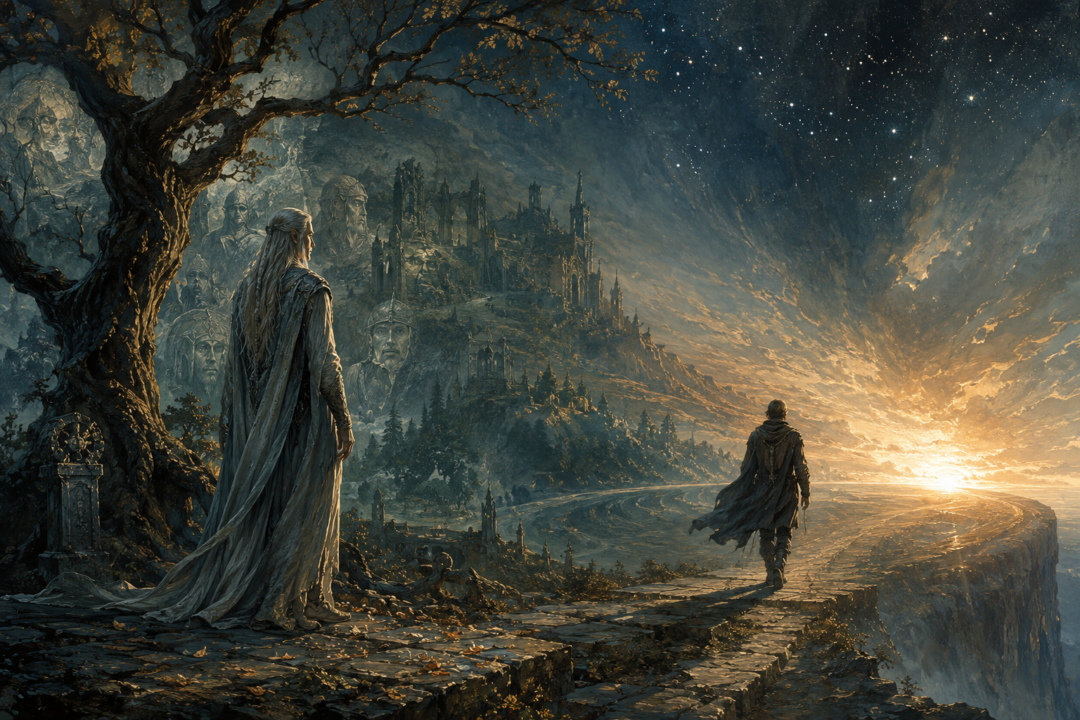
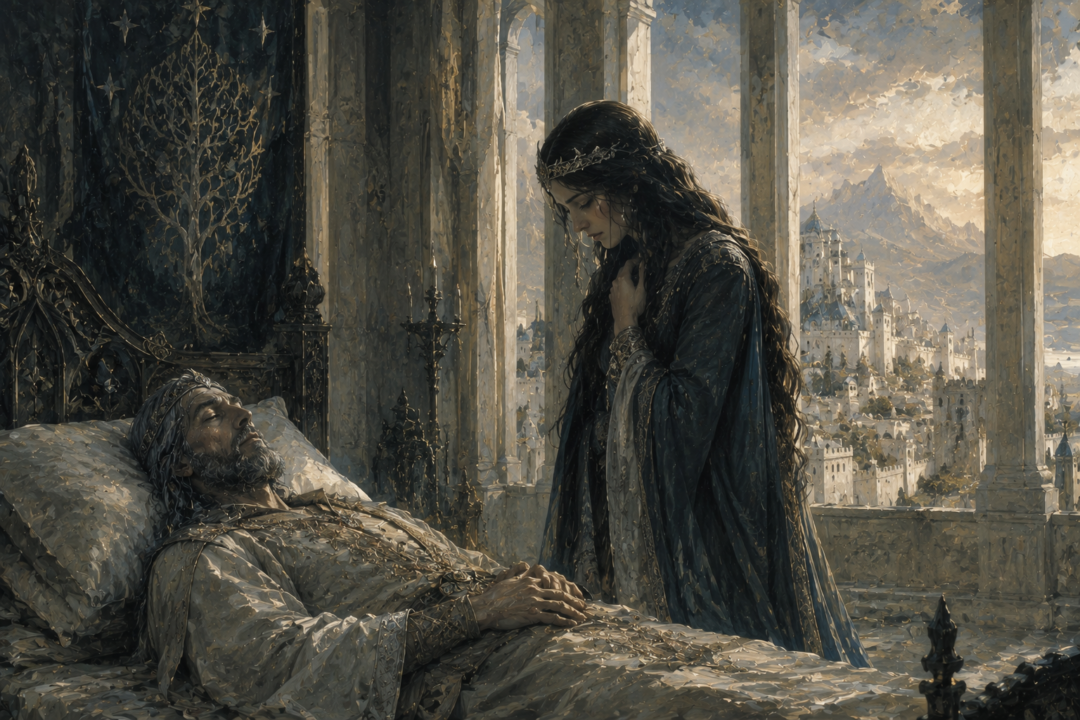
When Aragorn finally surrendered his life, Arwen discovered something that even centuries among the Eldar could not make easy to understand.
Aragorn was going somewhere she could not follow by any road through Middle-earth or across the Sea. His death was not merely the ending of a body. It belonged to the strange fate given to Men: after death, they ultimately pass beyond the circles of the world.
For Elves, the situation is profoundly different. They can be slain. Their bodies can perish. They can suffer grief so terrible that body and spirit are separated. Yet their spirits remain bound to Arda while Arda lasts.
That difference between the Children of Ilúvatar is one of the deepest rules beneath the history of Middle-earth. It explains why Elves and Men experience time differently, why the Undying Lands cannot make mortals immortal, why Númenor’s search for deathlessness was doomed, and why death can paradoxically be called the Gift of Men.
The immortal-looking Elves are prisoners of the world’s lifespan.
The mortal Men are its guests.
Two Kindreds, Two Different Fates
Elves and Men are both Children of Ilúvatar, but they were never intended to experience existence in precisely the same way.
The Elves are the Firstborn. Their lives are tied to Arda. They do not naturally die from old age as Men do, although they can be slain or otherwise suffer the separation of body and spirit.
Even then, an Elf does not escape the world.
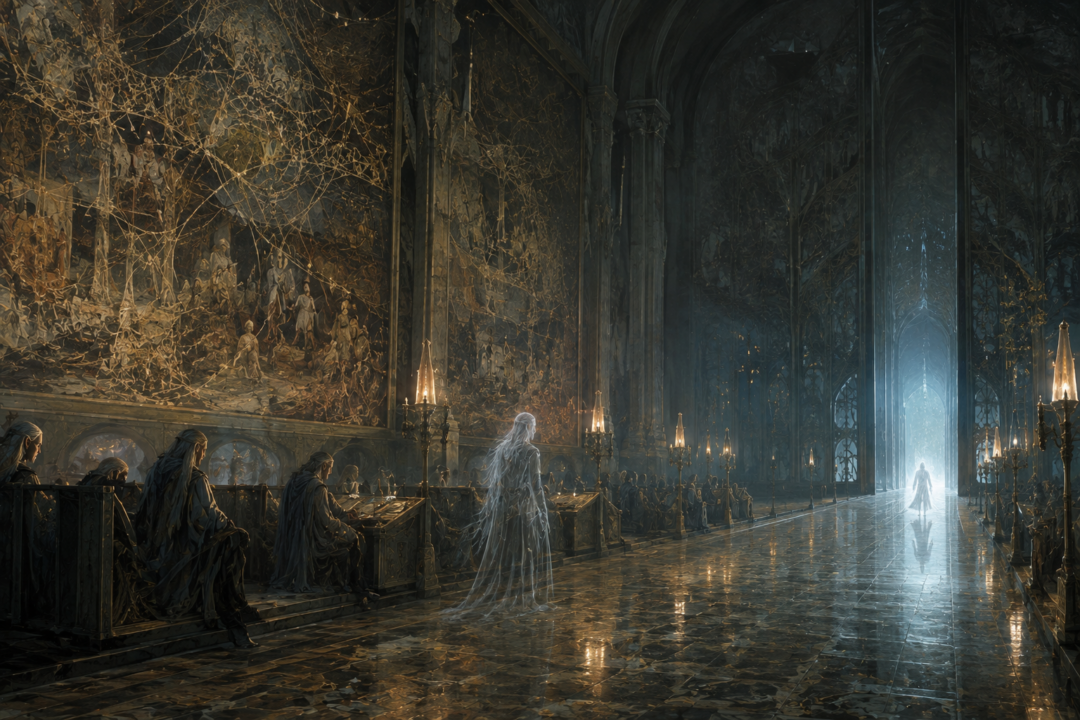
The spirits of dead Elves are summoned to the Halls of Mandos in Aman. Re-embodiment is possible, subject to the judgment and ordering of the Valar. Whatever happens to an individual Elf, however, the fundamental rule remains: the Elvish spirit belongs within the life and duration of Arda.
Men are different.
In The Silmarillion, mortality is presented not simply as a weakness but as a special gift from Ilúvatar. Men live briefly within the world and then depart from it.
Exactly where they go is deliberately mysterious.
Even the Valar do not possess complete knowledge of the ultimate destination appointed for Men. Elvish tradition held that the spirits of Men might briefly come to Mandos, but they do not remain there as Elves do. They depart beyond the world.
So the apparent disadvantage of Men hides an extraordinary freedom.
They can leave.
Why Death Is Called the Gift of Men
Calling death a “gift” sounds almost cruel when viewed from ordinary mortal experience. Middle-earth is filled with people mourning the dead, fearing death, and struggling desperately to survive.
The point is not that suffering, murder, disease, or premature death are good.
Rather, the Gift concerns the ultimate destiny of Men.
The Music of the Ainur shaped the great design of the world, and the Elves are deeply bound to the history unfolding within it. Men were granted a different relationship to that design. The Silmarillion describes them as having a special freedom connected with their ability to pass beyond the world.
Their mortality therefore has two sides.
Men lose everything they know in Arda.
But Arda cannot keep them forever.
That is why the Gift becomes easier to understand when seen from an Elvish perspective. An Elf may survive the death of kingdoms, forests, languages, friendships, and entire landscapes. Memory does not simply preserve beauty; over immense spans of time it preserves grief as well.
Men are released from that burden.
Elves are not.
Elvish Immortality Has a Hidden Cost
Calling Elves “immortal” can therefore be misleading.
They are immortal relative to the lifespan of the world. Their spirits endure within Arda while the world lasts. This gives them extraordinary continuity, but it also ties their fate to a world damaged by evil.
The concept becomes especially important when considering Arda Marred: the world as wounded by Melkor’s corruption.
Elves love Arda intensely. They are closely associated with memory, craftsmanship, beauty, preservation, and the desire to maintain things against decay. Yet they must watch the world change around them.
That tension appears throughout the history of Middle-earth.
Beautiful realms rise and disappear. Beleriand sinks beneath the Sea. Elven kingdoms are destroyed. Forests diminish. Peoples scatter. Even victories rarely restore what existed before.
An Elf can remember the lost thing with terrifying clarity.
This helps explain the melancholy surrounding the Eldar in the later ages. Their long life is not simply endless youth beneath beautiful trees. It means carrying thousands of years of memory through a world that continually changes.
Mortality prevents Men from experiencing that burden indefinitely.
Why Aman Could Never Make Men Immortal
This distinction also explains one of the great mistakes behind the downfall of Númenor.
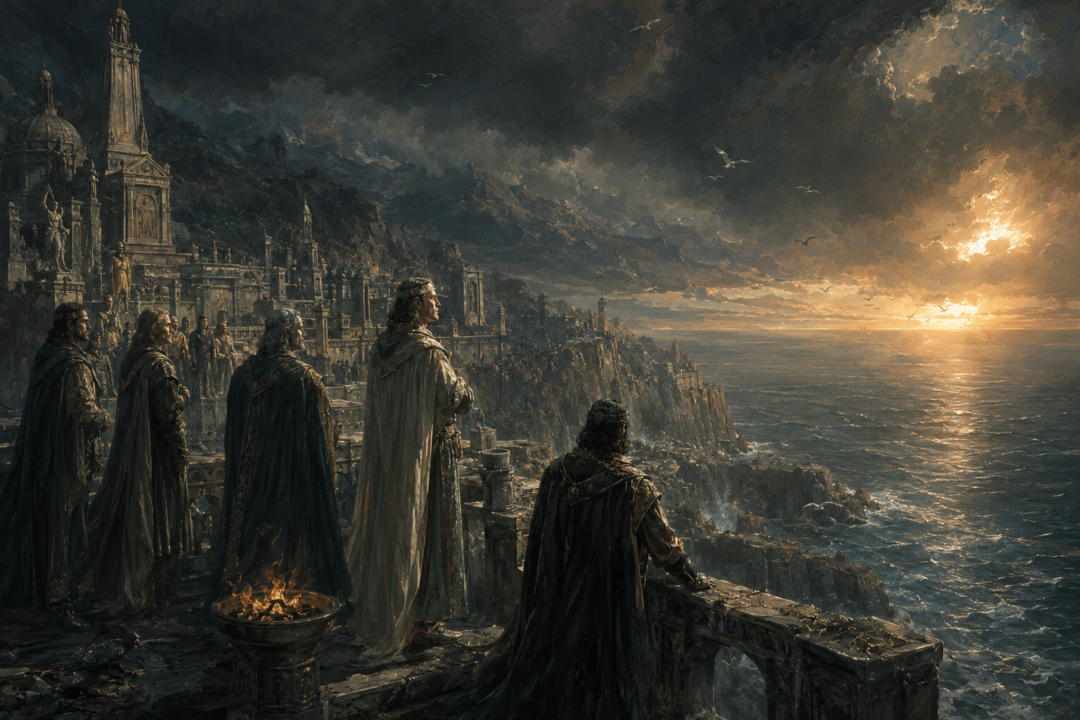
The Númenóreans knew that the Eldar lived in Aman, the Blessed Realm, and they increasingly associated that land with immortality. Eventually many began to resent the Ban that prevented them from sailing west to dwell there.
But they misunderstood cause and effect.
Elves do not live without aging because they inhabit Aman.
They inhabit Aman without aging because they are Elves.
Aman is called the Undying Lands because immortal beings dwell there, not because the land itself grants immortality to anyone entering it.
A mortal brought to Aman would remain mortal. Indeed, The Silmarillion makes the point that mortals would not gain everlasting life there. The contrast between their brief lives and the enduring beauty around them would only make mortality more painful.
This means Ar-Pharazôn’s invasion of Aman could never have achieved its true purpose.
No conquest could seize immortality.
No army could overthrow the Gift of Ilúvatar.
The tragedy of Númenor was therefore rooted partly in a misunderstanding of what mortality actually was.
Morgoth Turned the Gift Into a Fear
Why, then, do Men almost universally fear something supposedly given for their benefit?
The legendarium treats that question seriously.
In The Silmarillion, death is the Gift of Ilúvatar, but the Shadow turns Men against that Gift. Later writings explore the matter in greater philosophical depth, particularly the Athrabeth Finrod ah Andreth, where Finrod and the mortal woman Andreth discuss death, the nature of body and spirit, and the ancient traditions of Men.
Those traditions are complicated and should not simply be treated as an objective historical account. Andreth preserves Mannish beliefs concerning an ancient catastrophe and the corruption of humanity by the Enemy. Finrod does not accept every implication without question.
What is clear across the wider mythology is that fear becomes one of the Enemy’s most effective weapons against Men.
Once death is regarded only as annihilation, mortality becomes intolerable.
Then the desire for more life can become a desire for limitless life.
That is exactly the weakness Sauron exploited in Númenor. He did not create the Númenóreans’ fear of death from nothing. He manipulated an anxiety already consuming them, eventually persuading Ar-Pharazôn that the promised immortality withheld in the West could be taken by force.
Their refusal to accept mortality helped destroy the very civilization they hoped to preserve.
The Strange Case of Lúthien
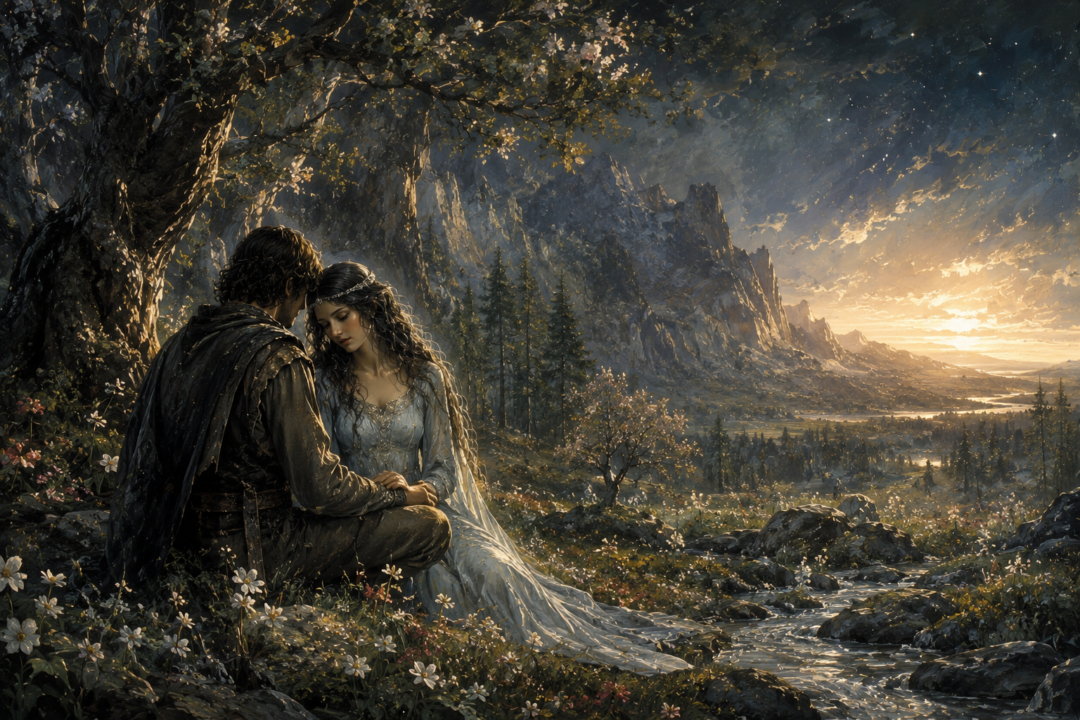
Few stories reveal the difference between the two kindreds more clearly than that of Beren and Lúthien.
Beren was a Man.
Lúthien was the daughter of the Maia Melian and the Elf-king Thingol and belonged to the immortal kindred.
After Beren’s death, Lúthien herself died of grief and came before Mandos. Her song moved Mandos to pity, and through the extraordinary judgment that followed she was given a choice.
She could remain among the immortal Elves, separated from Beren.
Or she could return with Beren to Middle-earth, become mortal, and eventually share his fate.
She chose mortality.
This was not merely choosing a shorter lifespan.
Lúthien surrendered the fate of the Elves.
After her final death, she would pass from the world with Beren. The separation was so complete that The Silmarillion emphasizes that she was lost to her own people.
Her story reveals something essential about the Gift: mortality is not simply the number of years someone possesses.
It determines whether Arda ultimately has a claim upon them.
Arwen Eventually Faced the Same Choice
Generations later, the same mystery returned through Arwen and Aragorn.
As a descendant of Eärendil, Arwen inherited the consequences of the special choice granted to his line. By choosing Aragorn and accepting mortality, she eventually entered the fate of Men.
For many years that decision could remain almost abstract.
Then Aragorn grew old.
In Appendix A of The Lord of the Rings, he chooses to surrender his life while still possessing dignity and clarity rather than cling desperately to his remaining days. Arwen, confronted with his approaching death, finally understands the bitterness of mortality from within.
She asks him to remain longer.
He cannot.
Aragorn can offer hope, but not knowledge of what lies beyond the world. That uncertainty is fundamental. The fate of Men is not presented as a mapped country waiting beyond death.
It requires trust precisely because its destination remains hidden.
Arwen’s choice therefore carries enormous weight. She abandons the long fate of the Eldar without being shown exactly what will replace it.
Men Are Guests, Elves Are Residents
The Elves gave Men many names, and some reflect this fundamental difference between them.
Men could be regarded as Guests and Strangers.
The names capture something easy to miss when reading stories dominated by mortality.
From a human perspective, Elves seem free because they do not grow old as we do.
From an Elvish perspective, Men possess the freedom.
A Man enters Arda, lives briefly, shapes some part of its history, and departs beyond its boundaries.
An Elf awakens within Arda and remains tied to it.
Even Aman does not change that fundamental destiny. Sailing West can remove an Elf from many of the sorrows and decay of Middle-earth, but it does not release the Elf from the world itself.
The Elves belong to Arda.
Men pass through it.
The Great Paradox of Middle-earth
This creates one of the most powerful reversals in the mythology.
Men envy Elves because Elves seem immortal.
Elves may eventually envy Men because Men can die.
Neither perspective is foolish. Each kindred sees what the other possesses and feels the cost of its own nature.
Elves receive memory, continuity, and a profound participation in the history of Arda, but they also endure its wounds.
Men receive brevity, uncertainty, and the pain of separation, but their final destiny is not chained to the world’s lifespan.
That is why the great mistake of Númenor was deeper than wanting to avoid death. The Númenóreans increasingly interpreted the difference between Men and Elves as an injustice that could somehow be corrected.
But mortality was never an inferior version of Elvish immortality.
It was a different destiny entirely.
And this is why the ending of Aragorn and Arwen is so important. Aragorn does not conquer death. Arwen does not discover what waits beyond it. Neither receives proof that makes separation painless.
They encounter the mystery exactly where every mortal eventually must.
Beyond the borders of Arda lies something the Wise cannot chart, the Valar cannot simply grant, and the Elves cannot follow while the world endures.
The seemingly immortal are bound to the world.
The dying are the ones who are allowed to leave it.
Sources & Notes
- The Tolkien Estate, “Letter to a reader, Rhona Beare, Oct 1958” — Tolkien directly distinguishes Elvish longevity coextensive with Arda from mortal Men’s Gift of Ilúvatar and describes death as release from the circles of the world. https://www.tolkienestate.com/letters/letter-to-a-reader-rhona-beare-oct-1958/
- The Encyclopedia of Arda, “Gift of Men” — summarizes Men’s mortality as Ilúvatar’s gift, their departure from Arda, and the corruption of that gift into fear under Morgoth’s shadow. https://www.glyphweb.com/arda/g/giftofmen.php
- The Encyclopedia of Arda, “Halls of Mandos” — explains that Elvish and mortal spirits await different fates there, including possible re-embodiment for Elves and departure from the world for Men. https://www.glyphweb.com/arda/h/hallsofmandos.php
- The Encyclopedia of Arda, “Elves” — provides reference context for the Firstborn’s near-immortality, their binding to the world, and their fate after bodily death. https://www.glyphweb.com/arda/e/elves.php
Sources document Tolkien’s explicit distinction between Elvish life bound to Arda and the mortal Gift, plus the different post-death fates of Elves and Men.