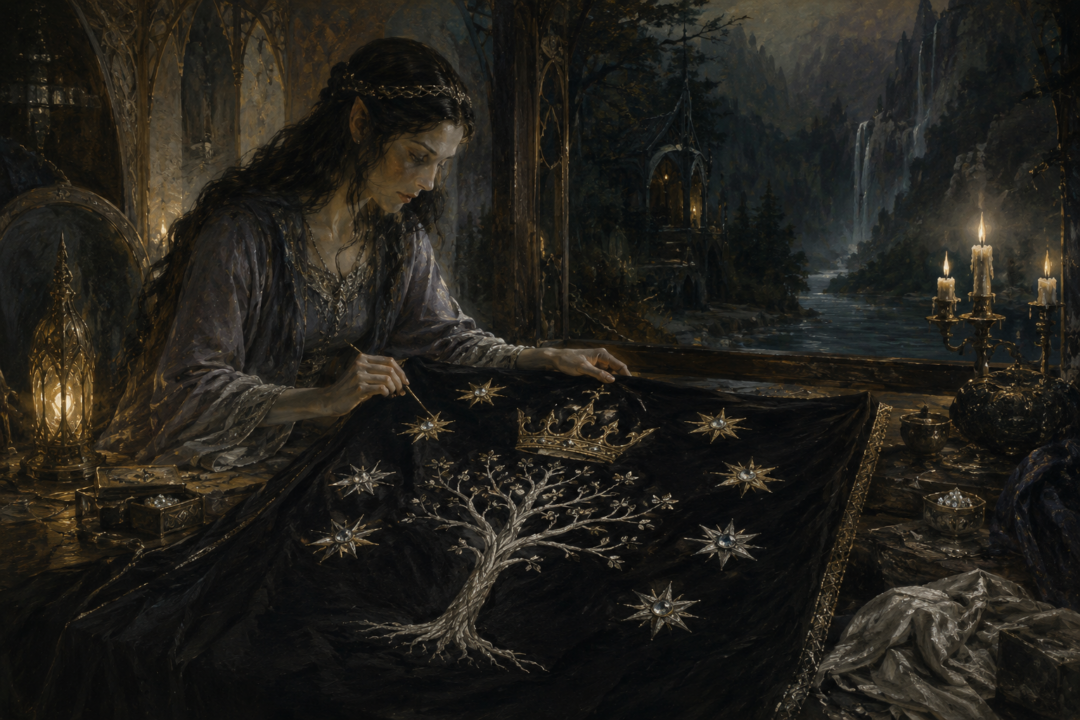
Arwen does not ride into the War of the Ring beside Aragorn. She does not pass through the Paths of the Dead, fight at Pelargir, or stand upon the Pelennor Fields. Yet one of the most important objects accompanying Aragorn on that desperate road south is something she made with her own hands.
It is a great standard, carried furled by Halbarad of the Grey Company.
By the time it finally flashes in the sunlight before Minas Tirith, its meaning seems obvious: the White Tree, Seven Stars, and Crown announce the return of the heir of Elendil. But that famous revelation can obscure something more interesting.
The standard has already been doing its work.
Before Minas Tirith ever sees it, Arwen’s banner accompanies Aragorn through a sequence of increasingly explicit claims about who he is. It arrives when he must choose a dangerous road. It is unfurled before the Dead when he summons them in Isildur’s name. It travels south as the hidden emblem of a kingship not yet publicly acknowledged in Gondor.
The standard is therefore more than decoration for Aragorn’s victory. It is part of the process by which the hidden Chieftain of the Dúnedain begins openly acting as Elendil’s heir.
Arwen Makes a Banner for a King Who Does Not Yet Rule
Appendix A gives the standard a significance that reaches well beyond the Battle of the Pelennor Fields.
During Aragorn’s long years of wandering, Arwen watches over him “in thought,” and in hope makes for him a great kingly standard. The text explicitly associates it with a claim to the lordship of the Númenóreans and the inheritance of Elendil.
That matters because Aragorn’s royal identity has existed for decades without becoming an established political reality.
He is Isildur’s heir and Chieftain of the Dúnedain, but Gondor is still governed by its Steward. His lineage alone has not placed a crown upon his head.
Arwen therefore creates an object representing a future that has not yet arrived.
The act is especially significant because her marriage to Aragorn is bound to that same future. Elrond has told Aragorn that Arwen will not become his bride unless he achieves the kingship of both Gondor and Arnor.
Her standard consequently joins the personal and political dimensions of Aragorn’s destiny without reducing either to the other.
Arwen is not merely anticipating her wedding.
She is preparing the emblem of the king Aragorn must become.
The Standard Arrives at the Moment of Decision
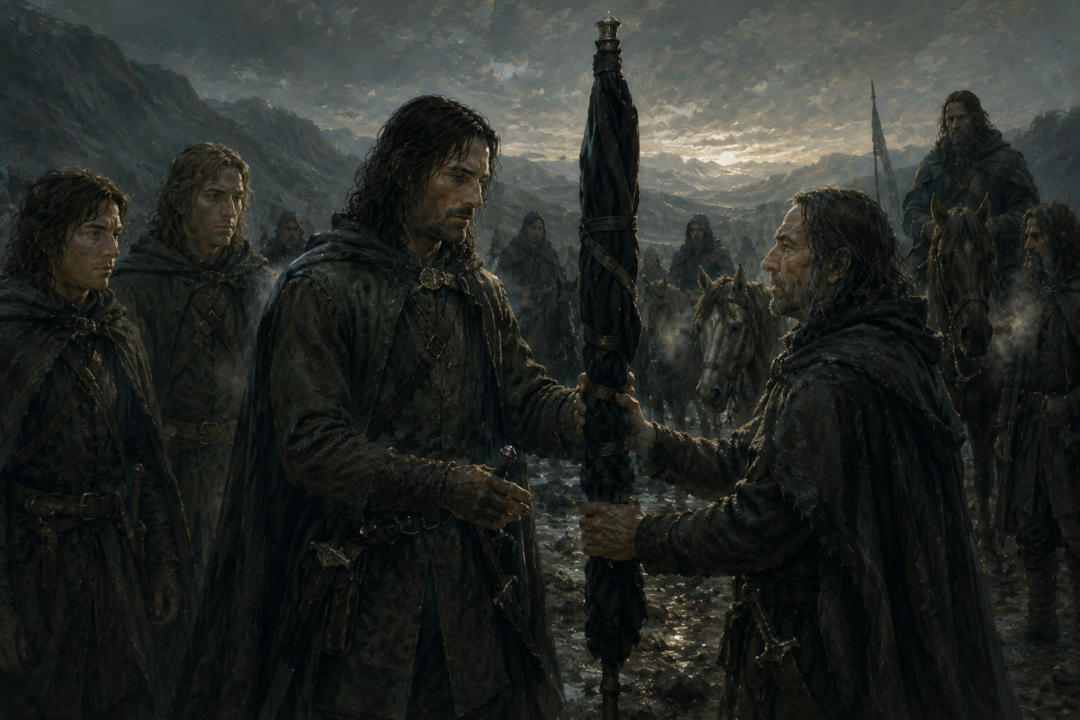
When the Grey Company catches Aragorn in Rohan, Halbarad carries something unusual instead of a spear: a tall staff wrapped in black cloth and tightly bound.
It is Arwen’s gift.
She has made it secretly, and its making has taken a long time.
Her accompanying message is urgent. The remaining days are short; either their hope will come to fulfilment, or hope itself will end.
Almost simultaneously, Elrohir brings Aragorn counsel from Elrond concerning the Paths of the Dead.
The standard does not magically tell Aragorn what to do, and the text does not say that Arwen possesses detailed foreknowledge of his coming journey. It would therefore go too far to treat the banner as a supernatural command directing him toward Dunharrow.
Its significance is subtler.
At precisely the moment when Aragorn must stop merely travelling with other armies and begin acting decisively upon his own inheritance, he receives the visible emblem of that inheritance.
The timing is extraordinary.
He has carried Narsil reforged as Andúril since Rivendell. Soon he will reveal himself to Sauron through the palantír. Then he will take the road beneath the mountain that only Isildur’s heir can fully exploit.
Arwen’s standard belongs to the same transformation.
The concealed heir is becoming impossible to conceal.
Before the Living See It, the Dead Do
The standard’s first great ceremonial appearance is not before Gondor’s soldiers.
It is before ghosts.
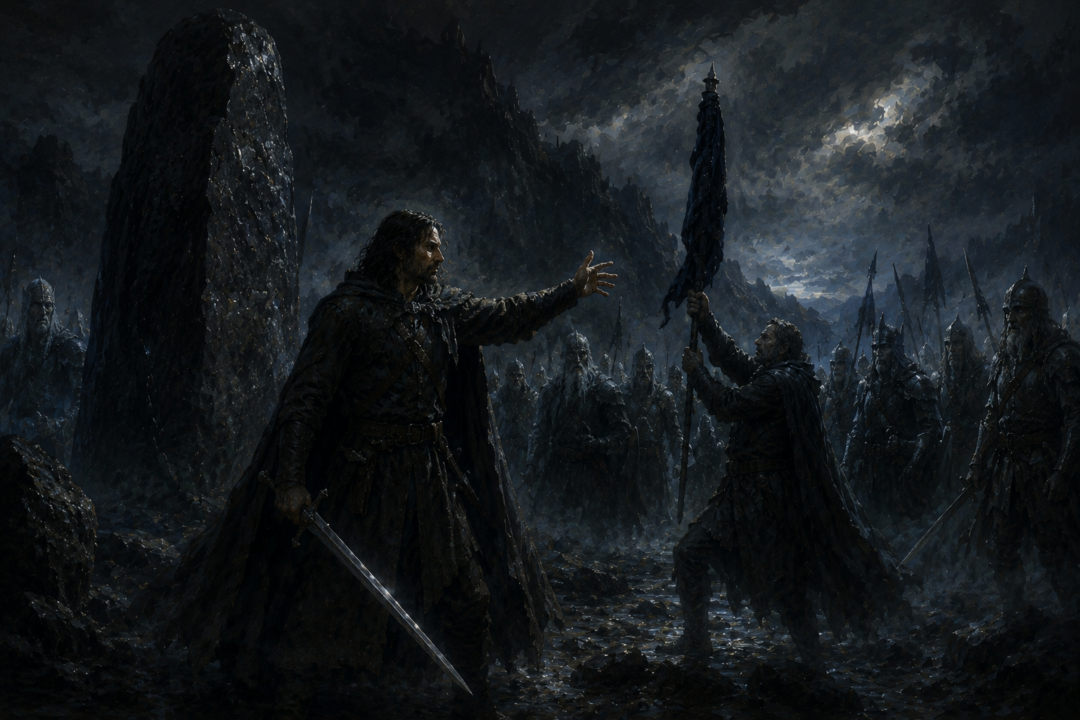
At the Stone of Erech, Aragorn confronts the Dead Men of Dunharrow, whose ancestors swore allegiance to Isildur and then broke their oath when summoned to fight Sauron.
This is exactly the kind of moment for which Arwen’s standard was made.
Aragorn identifies himself as Isildur’s heir and summons the Oathbreakers to fulfil their ancient promise. He then commands Halbarad to unfurl the standard.
Yet darkness conceals its device.
The banner appears black.
That visual detail creates one of the most powerful ironies in Aragorn’s journey. The royal emblems are physically present, but they cannot yet be seen.
The claimant has declared himself. The standard has been raised. The Dead answer the heir of the king to whom their oath was sworn.
But the living kingdom has not yet witnessed any of it.
Aragorn’s kingship is being exercised before it is publicly celebrated.
The Banner Is Not What Gives Aragorn Authority
There is an important distinction here.
The standard does not make Aragorn Isildur’s heir.
Nor does simply carrying it prove that Gondor must accept him as king.
Aragorn’s claim rests upon his descent and the history of the Dúnedain, and the eventual restoration of the monarchy involves more than displaying royal symbols. The standard represents that claim; it does not manufacture it.
That makes the scene at Erech more meaningful, not less.
Aragorn can command the Dead because he stands in the line of Isildur. The banner gives visible ceremonial form to the identity under which he commands them.
This is what Arwen has prepared.
Long before crowds can acclaim Aragorn, she has created an object suitable for the moment when he begins openly acting as the inheritor of Elendil.
It Travels Through a Kingdom That Does Not Yet Know Its King
From Erech the company races through southern Gondor toward Pelargir.
The Dead terrify those who encounter their passage. Aragorn reaches the Corsair fleet, uses the oath-bound host to overcome his enemies, and then releases the Dead after their oath has been fulfilled.
The ships themselves become the next great deception of the story.
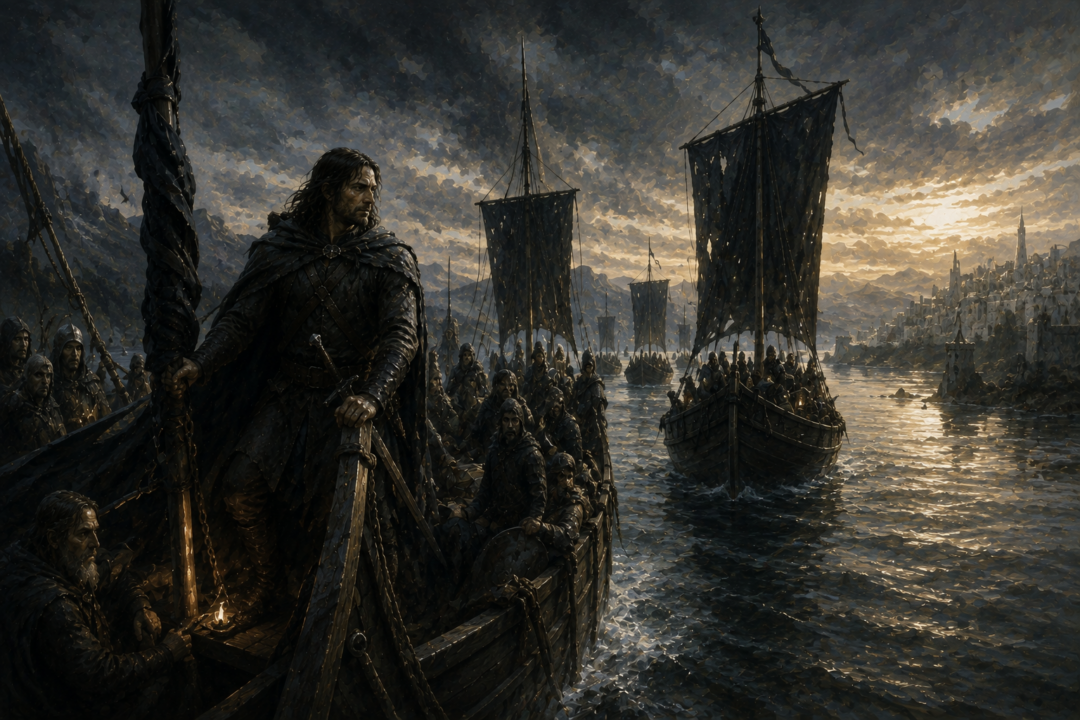
When black-sailed vessels later approach the Pelennor, the defenders initially have every reason to fear disaster. The Corsairs were expected as enemies.
Instead, Aragorn is aboard.
So is Arwen’s standard.
There is a remarkable progression here.
At Erech, Aragorn publicly claims Isildur’s inheritance before the Dead, but darkness hides the standard’s symbols.
At Pelargir, he defeats the enemies controlling the ships that could have reinforced Mordor’s assault.
Then those same ships carry him north.
The claimant is approaching the capital aboard vessels that appear to announce its doom.
Only when the standard opens in daylight is the truth revealed.
The Standard Changes the Meaning of the Ships
Éomer’s experience on the Pelennor shows exactly how powerful that revelation is.
The battle has reached a terrible point. Théoden is dead. Éomer believes Éowyn dead as well, and the arrival of the Corsair fleet seems to close the trap.
Then the leading ship turns toward the Harlond.
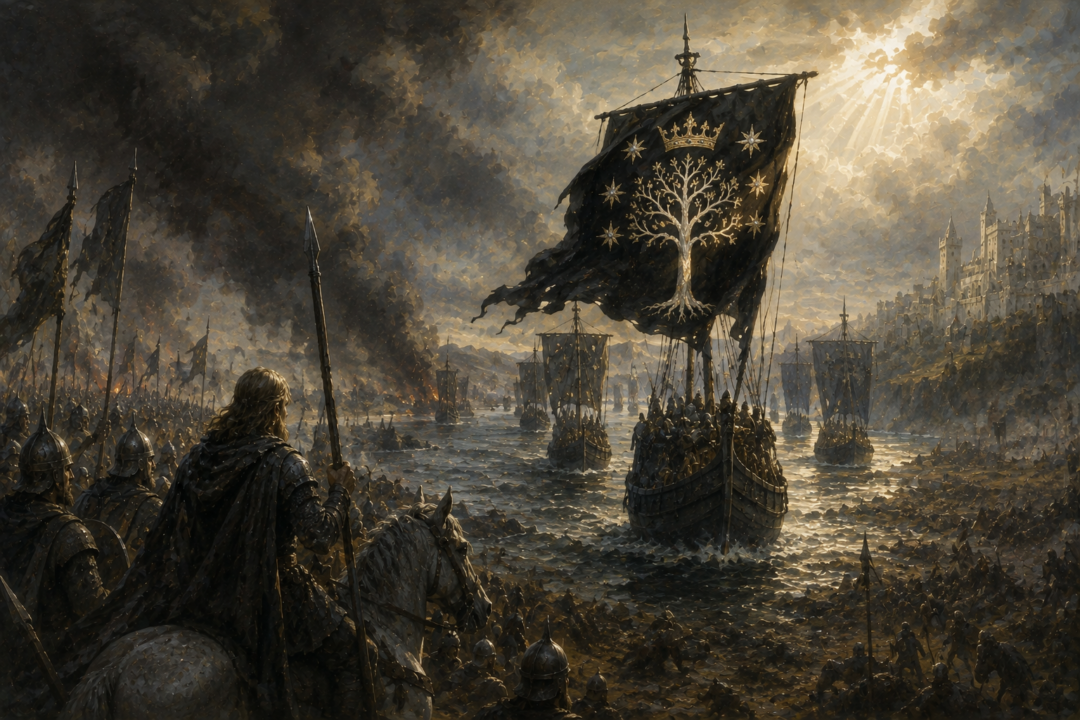
A great standard breaks open in the wind.
Now its hidden devices can finally be seen: the White Tree for Gondor, Seven Stars, and a high Crown—the signs associated with Elendil. The stars blaze because Arwen has wrought them with gems, while the crown shines with mithril and gold.
Éomer’s despair becomes wonder and joy.
The banner does not merely identify Aragorn.
It reverses the meaning of everything around it.
Enemy ships become reinforcements.
An apparent catastrophe becomes deliverance.
A mysterious northern Ranger becomes visibly associated with the ancient royal house.
And the woman who is still far away in Rivendell becomes present on the battlefield through the object she made.
Arwen’s Work Reaches the City Before Arwen Does
This is perhaps the most easily overlooked part of the standard’s story.
Arwen herself reaches Minas Tirith only after the victory and Aragorn’s coronation, when Elrond brings her south for their marriage.
Her standard arrives first.
That sequence matters.
The banner passes into the war while Arwen remains physically outside it. It accompanies Aragorn into the darkest stage of his claim, from the Paths of the Dead to the captured fleet and finally the Pelennor.
Appendix A later compresses the event beautifully: in the hour of defeat Aragorn comes from the sea, unfurls Arwen’s standard, and is first hailed as king.
The standard therefore connects two futures that have always been intertwined.
Aragorn becoming king.
Arwen becoming his queen.
Neither is completed on the Pelennor. Aragorn will still approach Minas Tirith cautiously after the battle rather than simply seize the throne, and his formal coronation comes later. Arwen’s marriage comes later still.
But something irreversible has happened.
The hidden inheritance has entered public sight.
A Banner Made in Hope
Arwen’s standard is easy to remember as a beautiful piece of royal imagery: black cloth, silver and gold, gems flashing beneath the sun.
Its deeper importance lies in when it was made and when it was revealed.
Arwen creates it before victory is certain.
She sends it before Aragorn has taken the Paths of the Dead.
It is carried furled while his future remains unresolved.
It is first opened where darkness prevents anyone from seeing its royal devices.
And only at the moment when defeat seems imminent does sunlight finally reveal what has been there all along.
That is why the standard works so well within Aragorn’s story.
It does not suddenly turn a Ranger into a king.
Instead, it makes visible a kingship toward which Aragorn has been moving for years—and which, during the final days of the Third Age, he can no longer afford to leave hidden.
Arwen has not yet reached Minas Tirith.
But her hope has.
And on the Pelennor, at precisely the moment hope seems lost, everyone can finally see it.
Sources & Notes
- Tolkien Gateway, “Arwen” — summarizes Arwen’s making of Aragorn’s royal standard, its delivery by the Grey Company, and its emblems of the White Tree, Seven Stars, and crown: https://tolkiengateway.net/wiki/Arwen
- Tolkien Gateway, “Grey Company” — documents Halbarad’s company bringing the furled standard to Aragorn, accompanying him through the Paths of the Dead, and carrying it during the southern campaign: https://tolkiengateway.net/wiki/Grey_Company
- Tolkien Gateway, “Stone of Erech” — covers Aragorn’s summons of the Oathbreakers as Isildur’s heir and the ceremonial unfurling of his standard at Erech: https://tolkiengateway.net/wiki/Stone_of_Erech
- Tolkien Gateway, “Aragorn” — provides the broader chronology of Aragorn’s royal claim, the Paths of the Dead, the campaign through southern Gondor, and his arrival at the Pelennor under the standard: https://tolkiengateway.net/wiki/Aragorn
References for Arwen’s making and delivery of the standard, Halbarad and the Grey Company’s role, its unfurling before the Dead at Erech, and its eventual public revelation at the Pelennor. The article’s argument that the still-concealed banner progressively enacts Aragorn’s royal claim is interpretive.