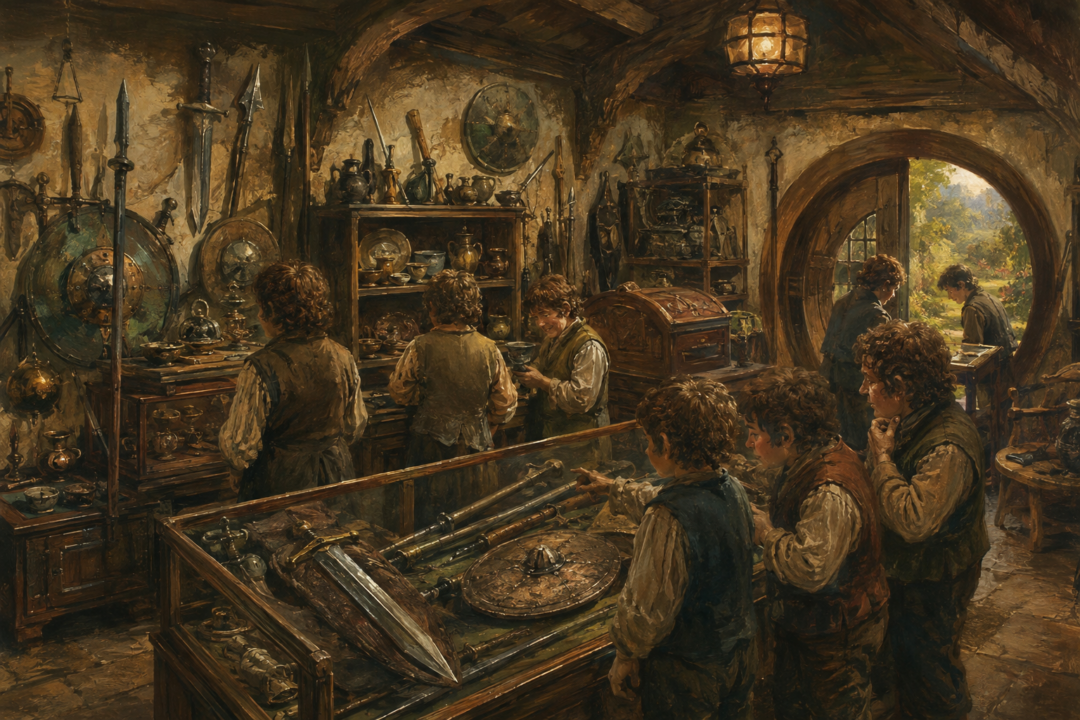
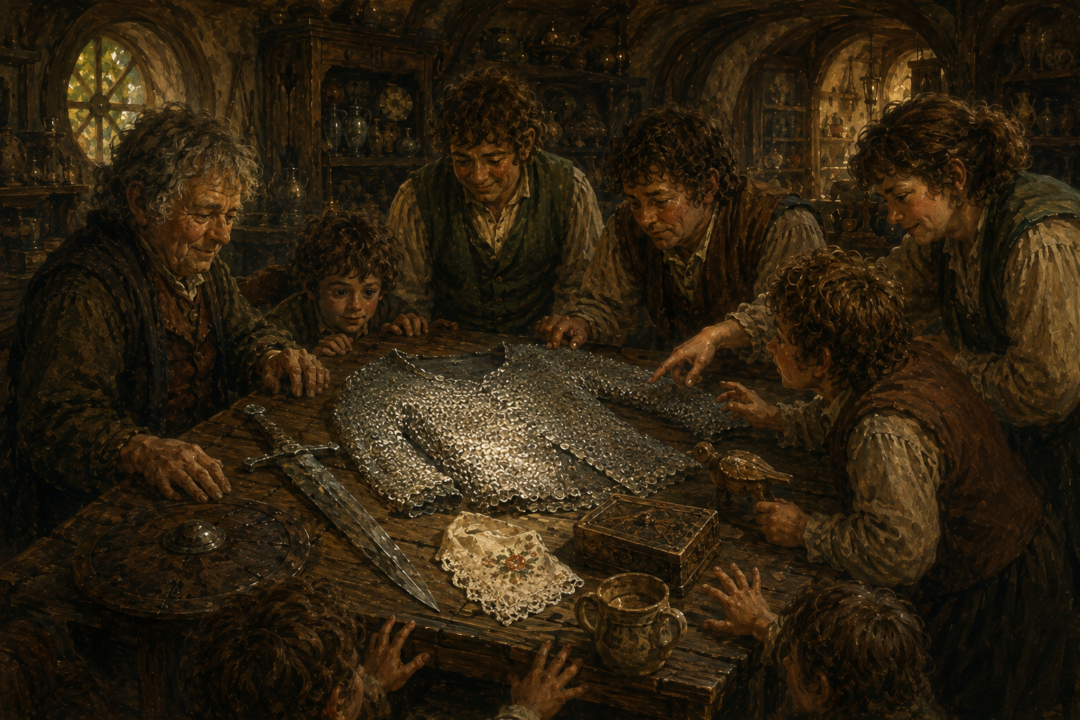
A coat of mithril made for an Elven-prince, worth more than almost anyone in the Shire could imagine, once ended up in a Hobbit museum.
That detail is easy to treat as a joke. Bilbo Baggins returned from Erebor with treasures out of legend, and among them was the extraordinary mail-shirt Thorin had given him. Yet for years the coat was kept in the Mathom-house at Michel Delving, among the Shire’s collection of curiosities and objects no longer needed for ordinary life.
But the Mathom-house reveals something deeper about Hobbit culture. It shows what can happen when an object stops being measured mainly by what it can buy.
A sword can become a reminder of an ancient battle. A strange heirloom can pass from private possession into communal keeping. Even an almost priceless coat of mithril can cease, temporarily, to function as treasure and become something people preserve and look at.
The Hobbits have not abolished ownership, money, inheritance, or status. Far from it. Yet the Mathom-house suggests another category of value alongside them: objects can matter because they connect the present Shire to a past its inhabitants would otherwise scarcely encounter.
What a Mathom Actually Is
The word “mathom” belongs specifically to Hobbit usage. In the Prologue to The Lord of the Rings, mathoms are described as things for which Hobbits have no immediate use but which they are unwilling to discard.
That combination matters.
A mathom is not simply rubbish. If it were rubbish, it could be thrown away. Nor is it necessarily a valuable treasure in the conventional sense. The defining tension is that the object has lost its practical purpose while retaining enough significance to survive.
Hobbit homes consequently became crowded with such things, and mathoms frequently circulated as presents.
This makes the concept slightly comic, but also revealing. Hobbit society has developed a way of acknowledging that usefulness and worth are not identical.
Something may no longer be useful and still deserve to remain.
Michel Delving turns that domestic instinct into something communal.
The Mathom-house is essentially the Shire’s museum: a place where noteworthy objects could be gathered rather than merely cluttering individual homes. The texts do not provide a catalogue of its collections, nor do they explain its administration in detail, so it would be wrong to imagine a modern museum system where none is described.
What we do know is enough.
The Shire preserved objects there, including old weapons and, for a time, Bilbo’s mithril coat.
That makes the Mathom-house one of the clearest examples of organized historical memory in Hobbit society.
The Weapons That No Longer Had a Purpose
The most revealing objects in the Mathom-house may not be Bilbo’s treasure at all.
They are the weapons.
The Prologue explains that Hobbits had once been forced to fight in a harder world. By the end of the Third Age, however, such struggles had receded into distant memory. The Battle of Greenfields, in which Bandobras Took defeated an Orc invasion, lay centuries in the past.
Weapons still existed in the Shire, but many had ceased to be instruments of survival. They became trophies displayed over hearths and on walls, or were gathered at Michel Delving.
This is a remarkable transformation.
A weapon begins as an object whose meaning is intensely practical. Its purpose is violent and immediate. Once the danger disappears, however, the object can outlive the conditions that made it necessary.
The Shire does not have to melt every old blade down or keep every sword ready for war. Some survive as witnesses to a different Shire.
For a Hobbit looking at such a weapon generations later, the object could represent a world almost impossible to reconcile with peaceful lanes, gardens, inns, and farms.
That does not mean the texts explicitly tell us what individual museum visitors thought about the collection. They do not.
But the preservation of the weapons itself creates a bridge between peaceful Hobbit life and the dangerous history behind it.
The weapon is no longer primarily an asset.
It has become evidence.
Bilbo Put Something Astonishing There
Then there is Bilbo’s coat.
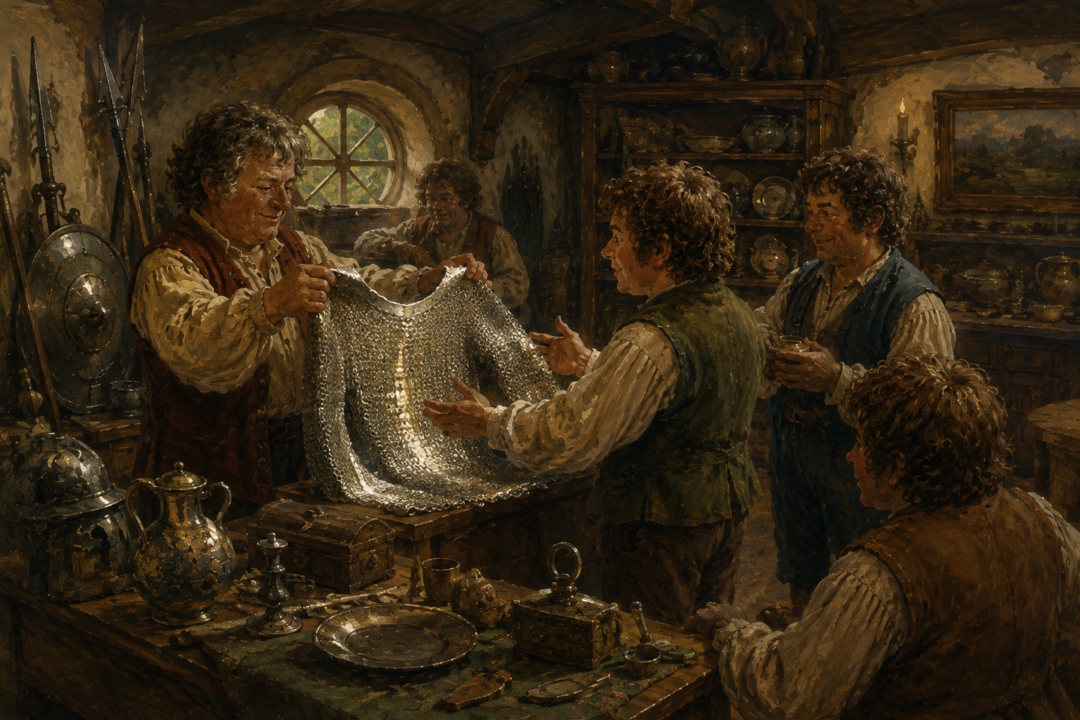
During the journey to Erebor, Thorin gives Bilbo a coat of mail made of mithril, described in The Hobbit as wrought for an Elven-prince long before. Bilbo eventually brings it back to the Shire.
There, something almost absurd happens.
He lends it to the museum at Michel Delving.
The later account in The Lord of the Rings makes the scale of this object clearer. When Gandalf discusses mithril in Moria, he tells Frodo that Bilbo’s coat was worth more than the value of the Shire and everything in it.
That statement makes its presence in the Mathom-house extraordinary.
Bilbo possessed an object of staggering material value. Yet instead of treating it solely as financial capital, he allowed it to become part of a public collection.
This should not be exaggerated into a claim that Bilbo rejected wealth. He returned from Erebor wealthy, retained treasure, gave generously, and remained a Hobbit living within a society where property certainly mattered.
But the mithril coat demonstrates that monetary value did not determine every decision about an object.
For decades, something almost beyond price could sit among the mathoms.
Its importance was detached from commerce.
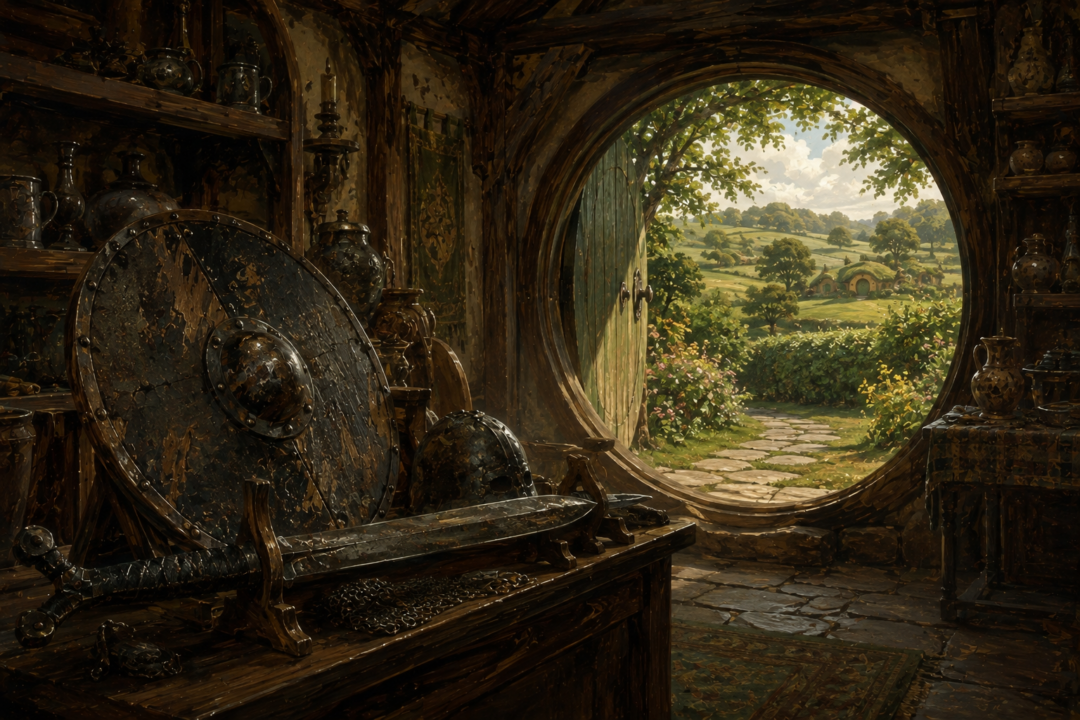
A Treasure Can Become a Story
The coat also exposes the strange flexibility of the word “mathom.”
Calling something a mathom does not tell us what that object truly is in the wider world. It tells us about its relationship to its current owner and circumstances.
Bilbo had no immediate need to wear mithril armour while living at Bag End.
So the mail could become a museum piece.
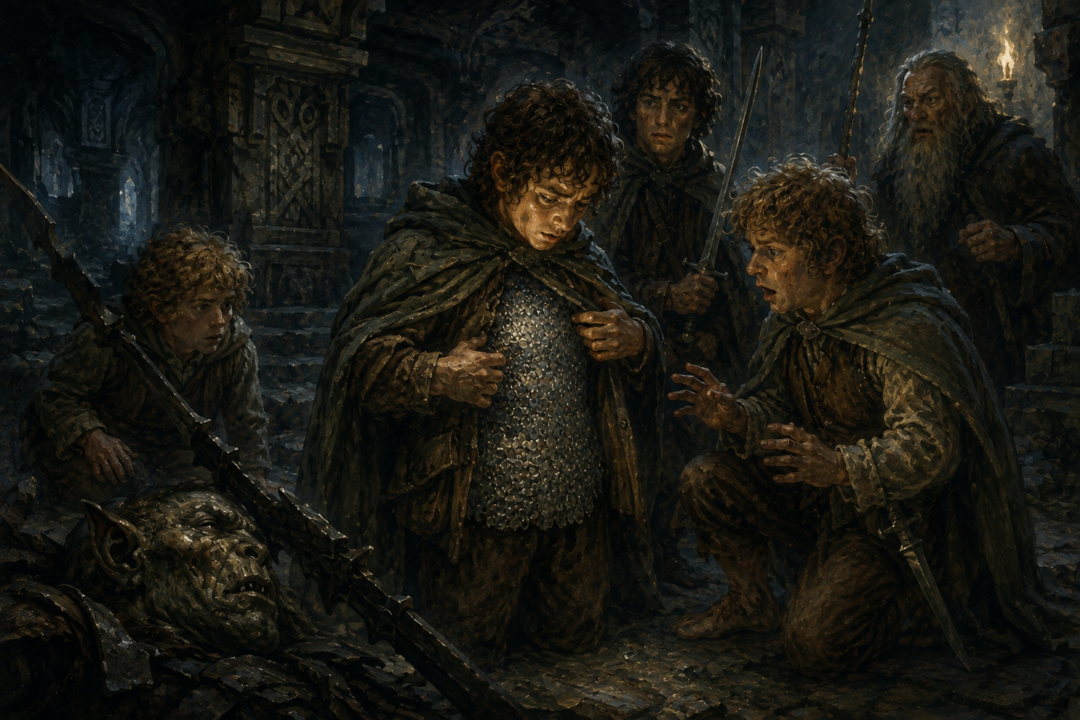
Later, Bilbo reclaimed it before leaving the Shire, and eventually gave it to Frodo at Rivendell. Suddenly the object had practical importance again.
Frodo wore it beneath his clothes during the Fellowship’s journey. In Moria it saved him when an Orc thrust a spear at him. What had once rested in Michel Delving as a curiosity became protective equipment in one of the most dangerous journeys of the age.
That sequence is important because it prevents us from misunderstanding the Mathom-house.
The museum does not magically strip objects of their original identities.
A sword in a display remains a sword. Armour remains armour. If circumstances change, their practical functions may return.
The Mathom-house instead preserves things during the interval when those functions have faded from everyday life.
In that sense, the institution quietly admits something the Shire often forgets:
peace is historical too.
The fact that Hobbits no longer need old weapons does not mean weapons were never needed.
Private Possession Becomes Shared Memory
There is another transformation happening in Michel Delving.
Objects normally belong to somebody.
A family heirloom belongs to a family. A gift belongs to its recipient. A trophy hangs in someone’s home. Even mathoms commonly pass from Hobbit to Hobbit as presents.
But an object placed in the Mathom-house becomes accessible in a different way. It can become part of what the community preserves.
We should be careful here. The texts do not describe the legal ownership arrangements of the museum or tell us that every mathom was permanently donated. Bilbo’s coat, indeed, could be retrieved by him.
Yet culturally, the effect is still significant.
While an object is there, its meaning is no longer confined to one household.
An old weapon can become part of the Shire’s remembered past. Bilbo’s coat can become evidence that the eccentric Hobbit who disappeared on an adventure really did return carrying wonders from beyond the borders.
Objects become physical links to stories.
And that matters especially in the Shire, where the great events of Middle-earth can seem impossibly remote.
The Shire Is More Historical Than It Looks
Hobbits are not generally portrayed as a people obsessed with grand history.
Their interests are famously local: families, food, birthdays, property, gardens, gossip, genealogy, and familiar places. Their records and traditions can be remarkably detailed, but they are often concerned with the Shire itself rather than the great political histories of Elves and Men.
The Mathom-house fits that culture perfectly.
It is history at Hobbit scale.
Not monumental statues of kings.
Not vast tombs.
Not captured kingdoms displayed as imperial glory.
Things.
A blade.
A coat.
An heirloom.
An object somebody could not quite bear to discard.
That makes the Mathom-house unusually intimate. Its historical material grows out of the same instinct that fills Hobbit homes with old possessions.
Public memory begins with private reluctance to throw something away.
The Irony of the Mathom-house
There is also a gentle irony at the heart of the institution.
Hobbits preserve objects partly because they have ceased to be useful.
But the story of the Ring takes place precisely when the peaceful assumptions behind that uselessness begin to fail.
Old dangers return.
The outside world reaches the Shire.
Four Hobbits who have grown up in a land where weapons are largely trophies eventually carry swords themselves. Merry’s blade from the Barrow-downs helps bring about the downfall of the Witch-king. Sam bears Sting after Frodo’s capture. The returning Travellers eventually confront armed ruffians inside the Shire itself.
The old world had not disappeared.
It had merely become distant enough to look like history.
That gives the Mathom-house a melancholy dimension. A weapon behind a museum wall can represent success: the society has become peaceful enough not to need it.
But it can also represent forgetfulness.
The object remembers dangers that living people no longer understand.
Wealth That Cannot Explain Value
The Mathom-house therefore offers a distinctly Hobbit answer to the problem of possessions.
Not every valuable thing must remain financially productive.
Not every useless thing is worthless.
Not every inheritance has to stay hidden inside one family.
And not every treasure has to be converted into wealth.
The Shire certainly contains greed, possessiveness, social competition, and arguments over inheritance. Bilbo’s relatives famously descend upon Bag End expecting his possessions after his disappearance, and the distribution of his belongings at the beginning of The Lord of the Rings is full of sharp observations about Hobbit attitudes toward property.
The Mathom-house does not contradict that.
It complicates it.
The same culture that can squabble over spoons can also preserve objects whose practical usefulness has vanished.
That contradiction feels deeply appropriate.
When an Object Outlives Its Use
Perhaps that is the real purpose of a mathom.
An ordinary possession answers the question: “What can I do with this?”
A commodity can answer: “What is this worth?”
An heirloom asks something else:
“Why have we kept this?”
At Michel Delving, that final question becomes communal.
The old weapons remain after the battles have been forgotten by living memory. Bilbo’s mithril coat remains after his adventure has become the astonishing story of one peculiar Hobbit. Objects pass beyond their immediate function without passing entirely out of significance.
The Mathom-house does not prove that Hobbits consciously developed a philosophy of public memory. The texts never say that.
But its existence shows a culture making room for things whose value cannot be reduced to present usefulness.
And that may be why the almost priceless mithril coat belongs there so perfectly.
For a while, it is neither armour nor merchandise.
It is a remembered wonder.
Then history begins moving again, Bilbo takes it back, and the old mathom becomes armour once more.
Sources & Notes
- The Encyclopedia of Arda, “Mathom-house” — describes Michel Delving’s museum, its collection and display of otherwise unused objects, its store of weapons, and its temporary custody of Bilbo’s mithril coat: https://www.glyphweb.com/arda/m/mathomhouse.html
- The Encyclopedia of Arda, “Mathoms” — explains the Hobbit meaning of mathom, their circulation as gifts, and Bilbo’s retrieval of the mithril coat before giving it to Frodo: https://www.glyphweb.com/arda/m/mathoms.html
- The Encyclopedia of Arda, “Michel Delving” — provides context for the Shire’s chief township and identifies the Mathom-house among its civic institutions: https://www.glyphweb.com/arda/m/micheldelving.html
- The Encyclopedia of Arda, “Mithril” — documents mithril’s extraordinary properties and history, including the mail-coat given by Thorin to Bilbo, kept at the Mathom-house, and later worn by Frodo: https://www.glyphweb.com/arda/m/mithril.html
References for the definition and social use of mathoms, the Mathom-house as Michel Delving’s museum, its preserved weapons, and the history and exceptional material value of Bilbo’s mithril coat. The article’s larger argument about public memory is interpretive.