Mirkwood’s Corruption Reached Beyond the Trees
When Bilbo Baggins enters Mirkwood with Thorin’s company, the forest does not merely look dark. It behaves differently.
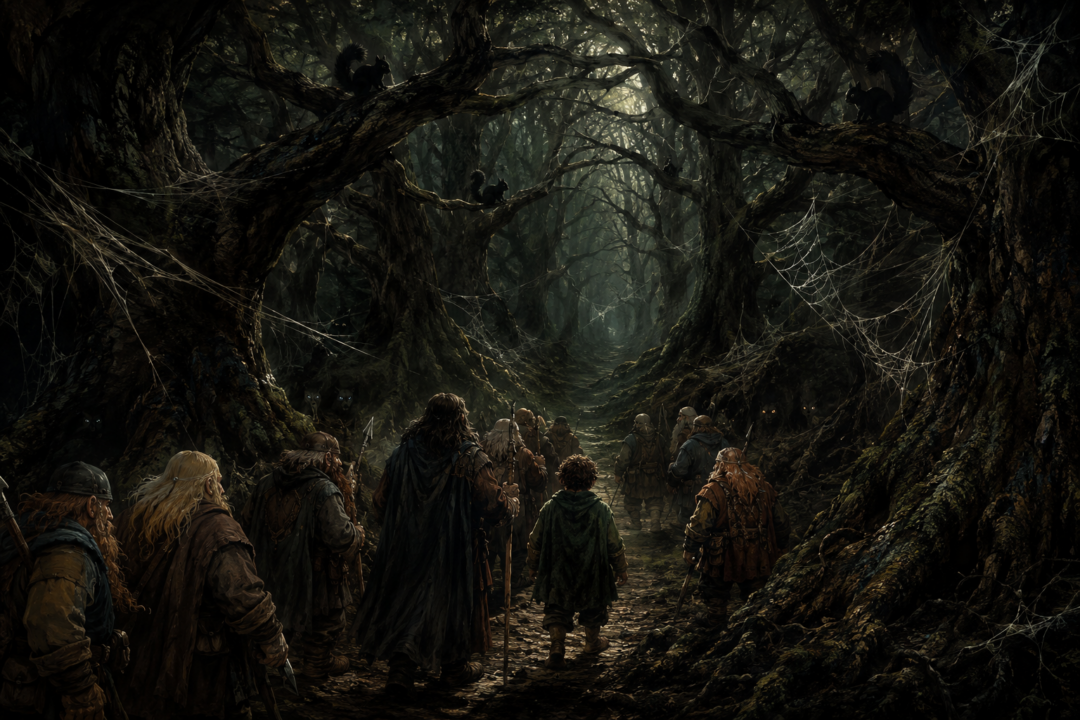
Squirrels vanish among black branches. Strange eyes watch from the night. Insects swarm beneath the canopy. Deer appear suddenly and disappear almost as quickly. Most dangerously, enormous spiders do not behave like oversized wildlife at all: they speak, cooperate, capture travelers, bind them, and plan to eat them.
That distinction matters.
Mirkwood was once Greenwood the Great, and the darkness that later defined it was connected directly with the growing power of Sauron at Dol Guldur. Yet the texts never say that Sauron magically transformed every animal in the forest or deliberately altered their instincts.
What they show is subtler and perhaps more disturbing. Under the Shadow, an entire landscape has become unhealthy. The change can be felt not only in darkness, vegetation, and fear, but in the creatures encountered beneath its branches.
Mirkwood is therefore more than a frightening forest. It is one of Middle-earth’s clearest examples of evil becoming environmental.
Mirkwood Was Not Always Mirkwood
The first important fact is easy to overlook because the sinister name feels so permanent.
The forest had once been Greenwood the Great.
According to the chronology in The Lord of the Rings, around the year 1050 of the Third Age a shadow fell upon Greenwood, and people began calling it Mirkwood. The source of that shadow was ultimately Sauron, who had secretly established himself at Dol Guldur in the southern forest.
The transformation was gradual.
Sauron did not conquer the entire woodland with armies and replace every tree. Instead, his presence became a center from which fear and darkness spread. By the late Third Age, the forest crossed by Bilbo and the Dwarves has become oppressive enough that simply remaining on the path is treated as a matter of survival.
That gives the strange animal life encountered in The Hobbit an important context.
These creatures inhabit an ecosystem that has existed under the influence of the Shadow for centuries.
But caution is necessary: the books do not establish that every unusual creature was physically corrupted by Sauron. Some may simply be native animals seen under extraordinary conditions. Others, especially the great spiders, belong to a much darker tradition.
The strongest conclusion is not that Sauron personally enchanted Mirkwood’s wildlife.
It is that the Shadow changed what kinds of life could flourish there and what traveling through that living world felt like.
The Forest Feels Alive — But Not Welcoming
The company’s earliest encounters are remarkably restrained.
There are black squirrels. There are webs among the trees. At night, countless eyes seem to stare at the travelers from the darkness. Moths and other creatures move through the oppressive woodland.
None of this alone proves supernatural corruption.
A black squirrel is not necessarily an evil squirrel. Tolkien never tells us that Sauron changed their color, allegiance, or nature. Treating every dark-colored creature as a servant of the Necromancer would go beyond the evidence.
Yet their presentation matters.
Normal signs of forest life no longer reassure the travelers. Movement in the trees means uncertainty. Eyes in the darkness mean surveillance. Webs mean danger. The thick canopy hides the sky so completely that the company begins to lose its sense of the world beyond the forest.
Animal life has become part of Mirkwood’s psychological pressure.
The forest is populated, yet the travelers feel isolated.
That is an important contradiction. Mirkwood is not dead. It is disturbingly alive.
Even the Butterflies Belong to the Darkness
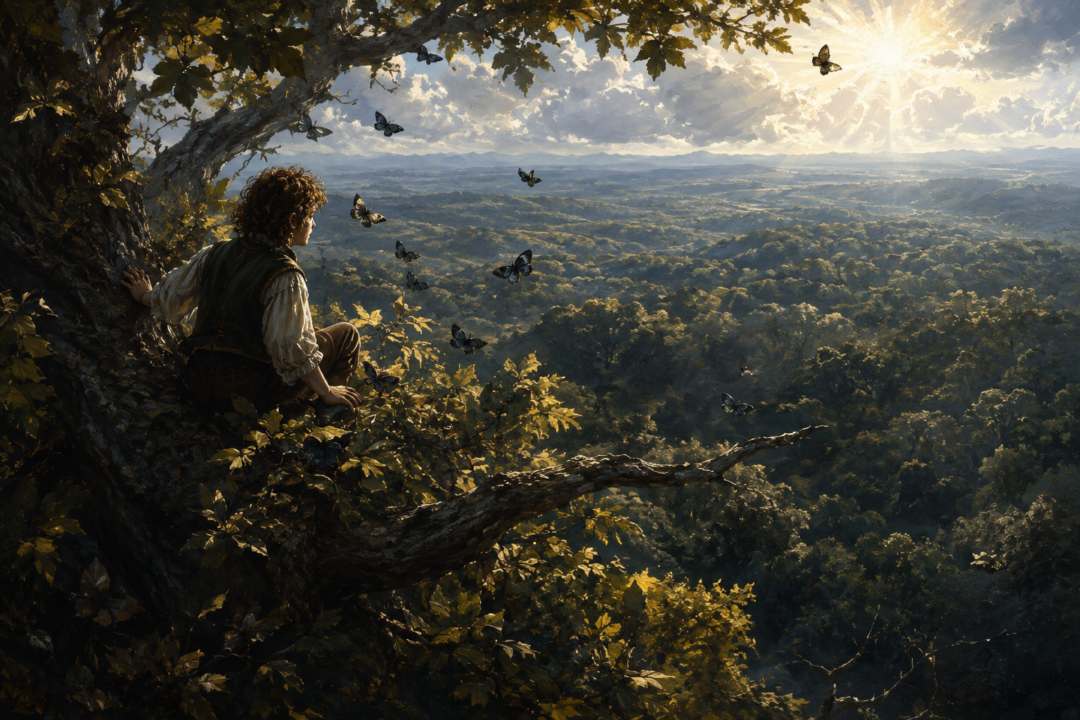
One of Bilbo’s strangest moments comes when he climbs a great tree to discover how far the forest extends.
After forcing his way upward through the canopy, he finally reaches sunlight and fresh air. For a moment, he escapes the oppressive world below.
There he encounters butterflies above the treetops.
They are described as dark, almost black against the light, and the sight is beautiful enough to provide a rare moment of relief.
Again, nothing states that these butterflies have been corrupted.
Indeed, the scene works partly because they remain beautiful.
But their presence reinforces something larger about Mirkwood. Even when Bilbo reaches the bright upper surface of the forest, the life he encounters visually belongs to the same dark palette as the woodland below.
More importantly, Bilbo discovers that the forest appears to continue endlessly in every direction.
The butterflies offer beauty without escape.
That is characteristic of Mirkwood. Natural things have not vanished, but ordinary nature no longer provides the security it should.
The Deer Are Different From the Spiders
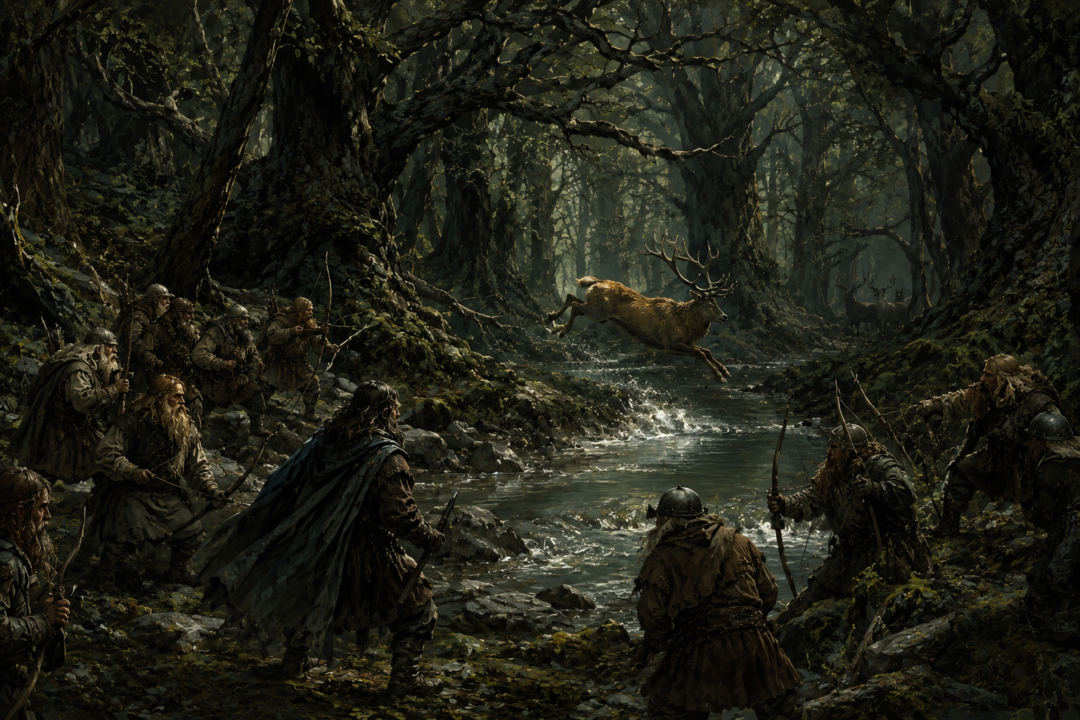
The company also encounters deer while attempting to cross the enchanted stream.
A great hart suddenly appears and leaps across their path. The Dwarves shoot at it, but it disappears into the darkness. Later they hear what seems to be a hunt passing through the forest, and other deer are glimpsed.
These episodes are eerie, but they should not be overinterpreted.
There is no textual basis for claiming that the deer have become evil, aggressive, or servants of Sauron. Their strange quality comes largely from the conditions of Mirkwood itself: poor visibility, exhaustion, hunger, enchantment, and the travelers’ inability to understand what is happening around them.
That distinction is valuable.
Mirkwood’s corruption does not mean every creature becomes monstrous.
Instead, the Shadow destroys the travelers’ ability to trust their environment.
An animal suddenly emerging from the trees becomes a crisis. A distant sound cannot be identified. Food cannot easily be found. Water may be dangerous. Leaving the path risks becoming hopelessly lost.
Normal wilderness uncertainty has been magnified into something almost existential.
The Spiders Are Something Far Worse
Then the company meets the great spiders.
Here the evidence changes dramatically.
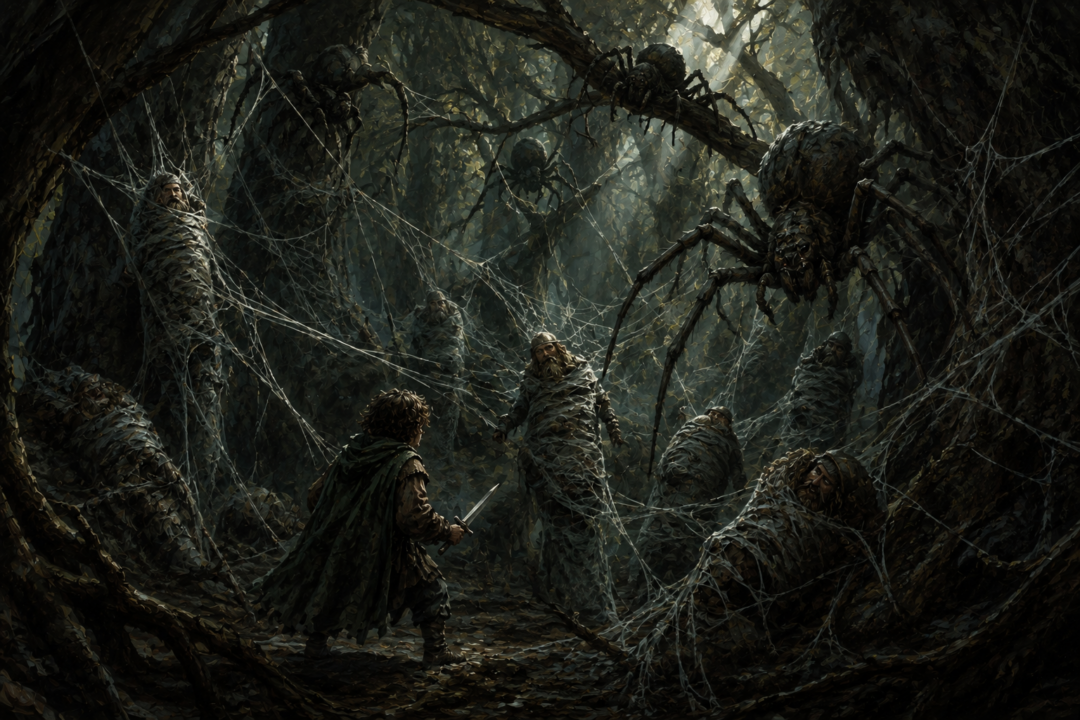
These are not ordinary animals made frightening by nervous travelers. They are intelligent predators capable of speech and coordinated action. They capture the Dwarves, bind them in webs, discuss their prisoners, and intend to consume them.
Bilbo’s battle with them becomes one of the defining moments of his journey.
Their presence also belongs to a wider mythology of monstrous spiders in Middle-earth.
The Lord of the Rings identifies the spiders of Mirkwood with the terrible lineage associated with Shelob. Shelob herself was an offspring of Ungoliant, the ancient devouring being whose darkness reaches back into the First Age.
This means the spiders should not simply be described as woodland animals mutated by Dol Guldur.
They are representatives of an older evil.
What Sauron’s Shadow appears to have done is create conditions in which such creatures could spread and prosper.
That is arguably more revealing than direct magical transformation.
Evil does not always need to manufacture monsters.
Sometimes it makes a place where monsters thrive.
The Woodland Elves Are Fighting an Ecological War
The spiders are not merely a problem for Bilbo.
Legolas later explains at the Council of Elrond that the people of his father’s realm had long struggled against the creatures of Mirkwood. The forest surrounding Thranduil’s northern kingdom remained dangerous even though the Elves themselves resisted Sauron.
This shows that Mirkwood was never uniformly conquered.
There were pockets of resistance.
Thranduil’s realm endured in the north. Woodmen lived around parts of the forest. Radagast dwelt near its western borders. During the War of the Ring, Sauron’s forces attacked the Woodland Realm directly.
The forest was therefore contested territory.
That makes its ecology especially interesting. The Shadow had spread deeply enough for hostile creatures and fear to dominate enormous regions, yet it had not erased every good people or natural thing.
Mirkwood is a damaged landscape rather than a completely fallen one.
Corruption in Middle-earth Often Works Through Domination
This pattern fits a broader principle visible throughout Middle-earth.
Evil repeatedly damages existing things rather than creating genuinely independent life from nothing. It enslaves, twists, breeds, poisons, frightens, and dominates.
Mirkwood reflects that pattern at the level of landscape.
The trees become oppressive.
Roads become dangerous or abandoned.
Water can no longer automatically be trusted.
Predatory creatures multiply.
Travelers become disoriented.
Communities retreat into defended regions.
Even ordinary animals become difficult to interpret because the relationship between traveler and environment has broken down.
Not every effect requires a separate spell.
The forest has become a place shaped by prolonged proximity to a power devoted to domination.
The Cleansing of Mirkwood Reveals What the Shadow Had Done
The strongest evidence that Mirkwood’s condition was connected to Sauron comes at the end of the Third Age.
During the War of the Ring, the Woodland Realm and Lórien are attacked. After Sauron falls, Celeborn’s forces cross the Anduin, and Galadriel throws down the walls of Dol Guldur and lays its pits bare.
Soon afterward, Celeborn and Thranduil meet within the forest.
Mirkwood receives a new name: Eryn Lasgalen, the Wood of Greenleaves.
The renaming matters because it mirrors the forest’s history.
Greenwood became Mirkwood when the Shadow fell upon it.
When that Shadow was finally defeated and its stronghold destroyed, the forest could again be named for living leaves rather than darkness and fear.
The texts do not provide a catalogue explaining what happened to every spider, squirrel, deer, moth, or stream after the cleansing. We should not invent one.
But the symbolic direction is unmistakable.
The forest itself is understood as something capable of being freed.
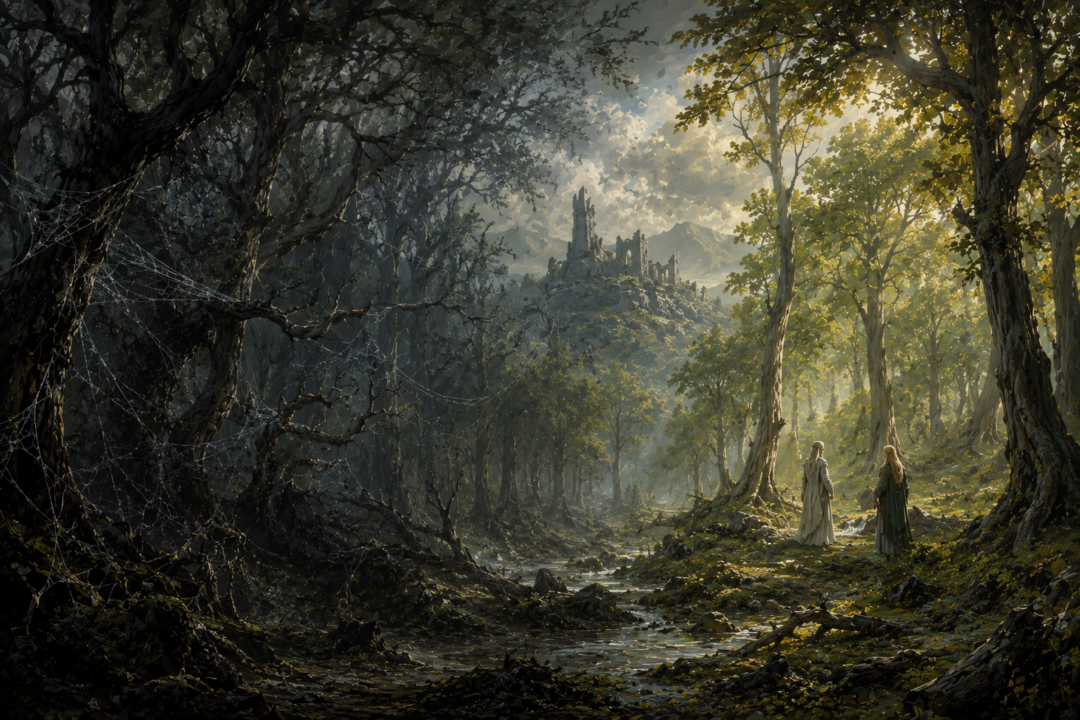
Mirkwood Shows What Evil Does to a Living World
That may be the most unsettling thing about Bilbo’s journey through Mirkwood.
Sauron does not need to appear.
For most travelers, Dol Guldur is distant and unseen. Yet its influence can be experienced through everything around them: darkness, exhaustion, webs, watching eyes, dangerous water, hostile creatures, lost roads, and the constant fear of stepping away from the path.
The animal behavior described in Mirkwood should therefore be handled carefully.
Tolkien never explicitly confirms that Sauron altered ordinary animals such as squirrels, deer, or butterflies. The great spiders have a much older and explicitly sinister origin.
But the texts strongly support a broader reading.
The Shadow changed the ecological character of Greenwood. Dangerous creatures prospered. Ordinary creatures became part of an environment that travelers could no longer easily read or trust. Communities were pushed back while predators occupied the darkness between them.
Mirkwood’s corruption was never just gloomy weather beneath thick branches.
It was what happened when a living place remained beneath the Shadow for generations.
And that is why the forest feels so threatening before Bilbo ever sees his first giant spider.
The danger is not simply hiding somewhere among the trees.
The danger has become part of the forest.
Sources & Notes
- The Encyclopedia of Arda, “Mirkwood” — traces Greenwood’s darkening into Mirkwood, Sauron’s occupation of Dol Guldur, and the forest’s spiders and other dangers. https://www.glyphweb.com/arda/m/mirkwood.html
- The Encyclopedia of Arda, “Spiders” — summarizes the giant spiders’ descent from Ungoliant and the colony encountered by Bilbo and the Dwarves in Mirkwood. https://www.glyphweb.com/arda/s/spiders.html
- The Encyclopedia of Arda, “Dol Guldur” — documents Sauron’s secret stronghold in southern Mirkwood and the long growth of the Shadow from that location. https://www.glyphweb.com/arda/d/dolguldur.html
- The Encyclopedia of Arda, “Greenwood the Great” — gives the woodland’s earlier identity and its later transformation under the shadow centered on Dol Guldur. https://www.glyphweb.com/arda/g/greenwoodthegreat.html
Sources cover Mirkwood’s renaming and chronology, Sauron at Dol Guldur, and the great spiders’ origin and behavior.