How Mordor Controlled Its Orc Companies: Numbers, Captains, Whips, and Reports
When Frodo and Sam finally entered Mordor, they faced a danger that had little to do with swords.
They looked like Orcs.
That disguise had helped them leave the Tower of Cirith Ungol, but on the road across Mordor it created a new problem. An Orc recognized them not as enemies, but apparently as soldiers who were somewhere they were not supposed to be.
His threat is one of the most revealing little details in The Lord of the Rings: if they did not fall in with the marching troops, he would have their “numbers” and report them.
It is easy to pass over the line. Yet behind it lies something surprisingly important about Sauron's military power.
Mordor was not simply an enormous mob of Orcs driven toward battle. Its armies had companies, captains, patrols, reporting chains, assigned movements, deadlines, and mechanisms for identifying soldiers. There is even evidence of troops being checked for whether they belonged where they were supposed to be.
But one distinction matters immediately: the books do not describe the formal “inspection” scene familiar from the film adaptation. What they reveal is subtler—and arguably darker.
Mordor's army worked because individual Orcs lived inside a system of surveillance, punishment, identification, and fear.
“I'll Have Your Numbers and Report You”
The clearest evidence appears in The Return of the King, in “The Land of Shadow.”
After escaping Cirith Ungol, Frodo and Sam acquire Orc clothing and equipment and attempt to cross Mordor unnoticed. Near the road from Durthang they encounter a marching body of Orcs.
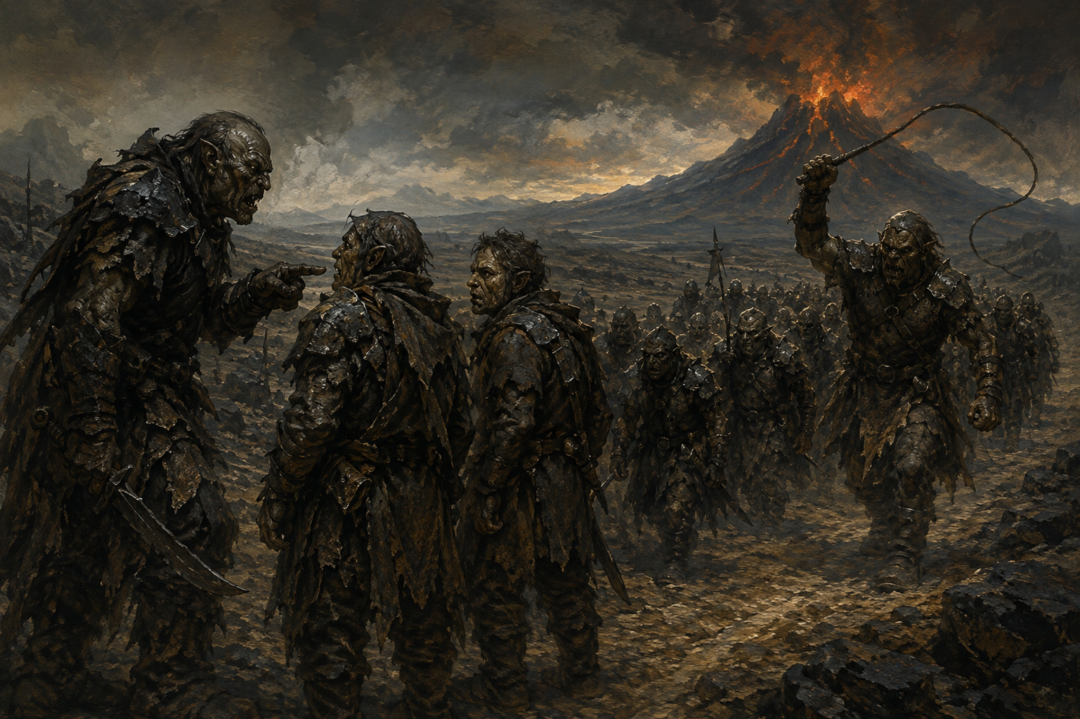
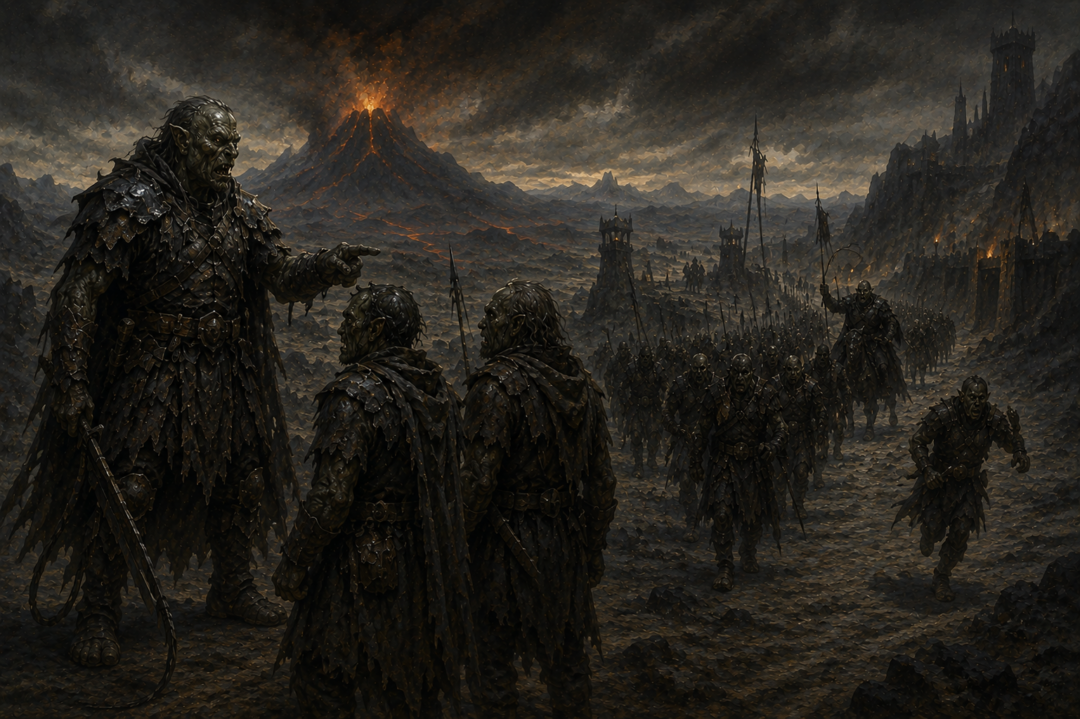
These are described as smaller Orcs being driven unwillingly toward Sauron's war. Two larger Uruks run beside the column, using whips and shouting at the troops.
When one of these drivers notices Frodo and Sam, he assumes they are Orcs trying to desert or avoid duty. He tells them that their people should already have been inside Udûn, orders them into the line, and threatens to take their “numbers” and report them.
That word is crucial.
The text does not explain what form these numbers took. It never says that Orcs carried metal identity tags, wore numbered uniforms, bore tattoos, or belonged to units designated by modern-style numerical titles. Any such details would be invention.
What can safely be said is that the threat assumes some identifiable number associated with the Orcs—or at least a system by which the offenders could be recorded and reported.
The machinery behind the threat is left undescribed.
But the machinery clearly exists.
Orc Companies Were Real Military Organizations
The terminology elsewhere reinforces the point.
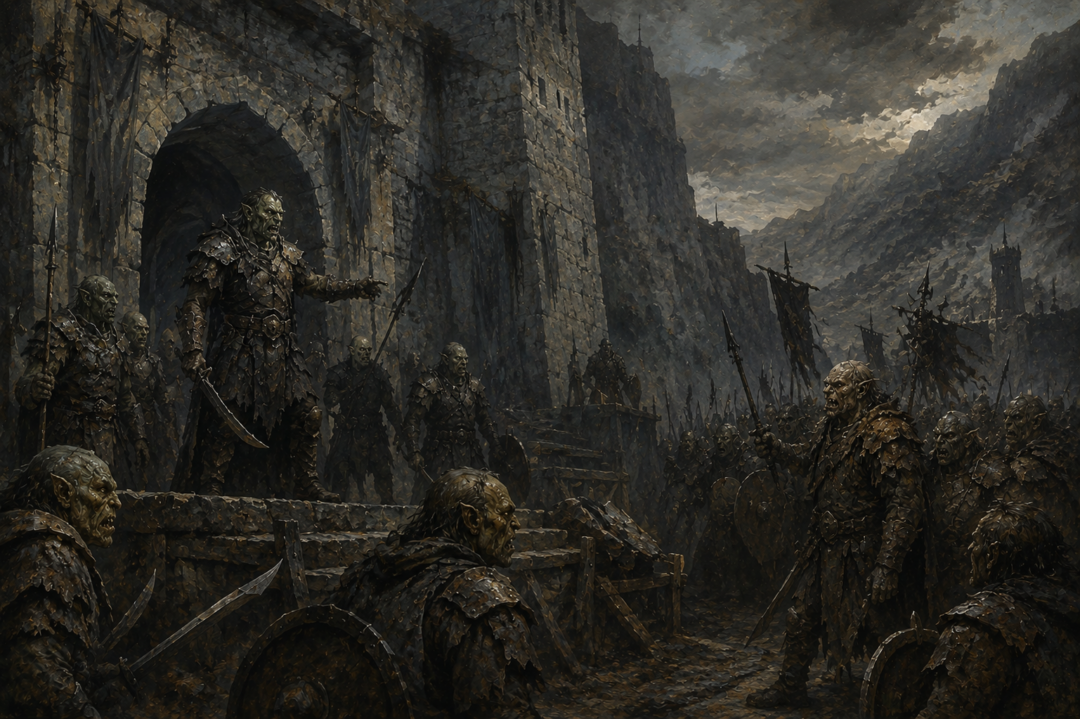
Orcs repeatedly operate in organized groups described as companies. One of the best examples occurs around Cirith Ungol, where Shagrat and Gorbag command separate bodies of Orcs.
Shagrat is Captain of the Tower of Cirith Ungol and commands its garrison. Gorbag leads Orcs associated with Minas Morgul. When their forces meet near Shelob's tunnels after Frodo has been stung, the distinction between the groups matters.
Later Sam estimates that Shagrat's company encountered outside the Tower had numbered roughly forty, while Gorbag's was more than twice as large. Sam also realizes that Shagrat's patrol represented only part of the Tower's full garrison.
That gives us several overlapping levels of organization: a fortified post with a garrison, a captain responsible for it, a patrol sent from that garrison, and another company arriving from a different command.
These are not interchangeable Orcs wandering wherever they please.
They have commanders and stations.
They receive orders.
And they know when another Orc belongs to a different body of troops.
Captains Had Real Authority—But It Rested on Fear
Shagrat provides the clearest portrait of an Orc officer.
His authority at Cirith Ungol is not ceremonial. He understands orders from higher command and expects his subordinates to obey him.
Most importantly, Shagrat knows exactly what must happen when Frodo is captured.
The prisoner's belongings are not simply loot available to whichever Orc reaches them first. They are to be secured and sent upward to Barad-dûr, while Frodo himself is to be kept alive and intact.
Failure carries lethal consequences.
That is significant because it shows that Sauron's command system could impose priorities contrary to normal Orcish greed. Gorbag wants Frodo's mithril coat. Other Orcs are equally capable of fighting over valuable possessions.
Yet official orders say that the captured items belong to the investigation of higher authority.
Shagrat understands the distinction perfectly.
The system ultimately breaks down into violence when Shagrat and Gorbag quarrel, but the breakdown is revealing precisely because there was a chain of command to break.
Reports Travel Upward
Mordor's military administration also depended on information.
When Shagrat speaks with the surviving smaller Orc in the Tower after the massacre, getting news to Barad-dûr becomes urgent. The disaster cannot simply disappear because most of the witnesses are dead.
Shagrat understands that higher authority will expect a report.
Earlier, his conversation with Gorbag shows the same pattern on a larger scale. The Orcs discuss messages, orders, reports of intruders, and information moving between commands. Gorbag remarks on the extraordinary speed with which messages can travel, while prudently avoiding curiosity about how the Dark Lord's communications work.
The exact mechanisms are not always explained.
The hierarchy is unmistakable.
Information moves through Mordor because somebody above wants to know what is happening below.
That makes the threat to “have your numbers and report you” much more meaningful. Reporting an Orc was dangerous because reports could climb into a system whose punishments were terrifying.
Was There an Orc “Inspection System”?
Here lore accuracy requires caution.
There is no textual basis for describing a standardized Mordor-wide inspection corps comparable to a modern military police or administrative inspection service.
The famous visual of Frodo and Sam trapped in an Orc formation while troops are formally inspected belongs to the film adaptation, not to the corresponding scene as written.
The book gives us something different.
Frodo and Sam are caught because an Uruk supervising a marching column sees what he takes to be two soldiers out of position. He knows where their people ought to be, threatens to record their numbers, and forces them into the column.
That is evidence of military control and accountability, but not proof of a dedicated inspection bureaucracy.
A safer description would be that Mordor's forces possessed mechanisms of supervision.
Troops could be questioned.
Their movements could be checked.
Their identities could apparently be reported.
Captains were answerable for orders.
And soldiers who failed to reach their assigned destinations faced punishment.
The Whip Was Part of the Command Structure
There is another uncomfortable detail: many Orcs do not appear enthusiastic about Sauron's war.
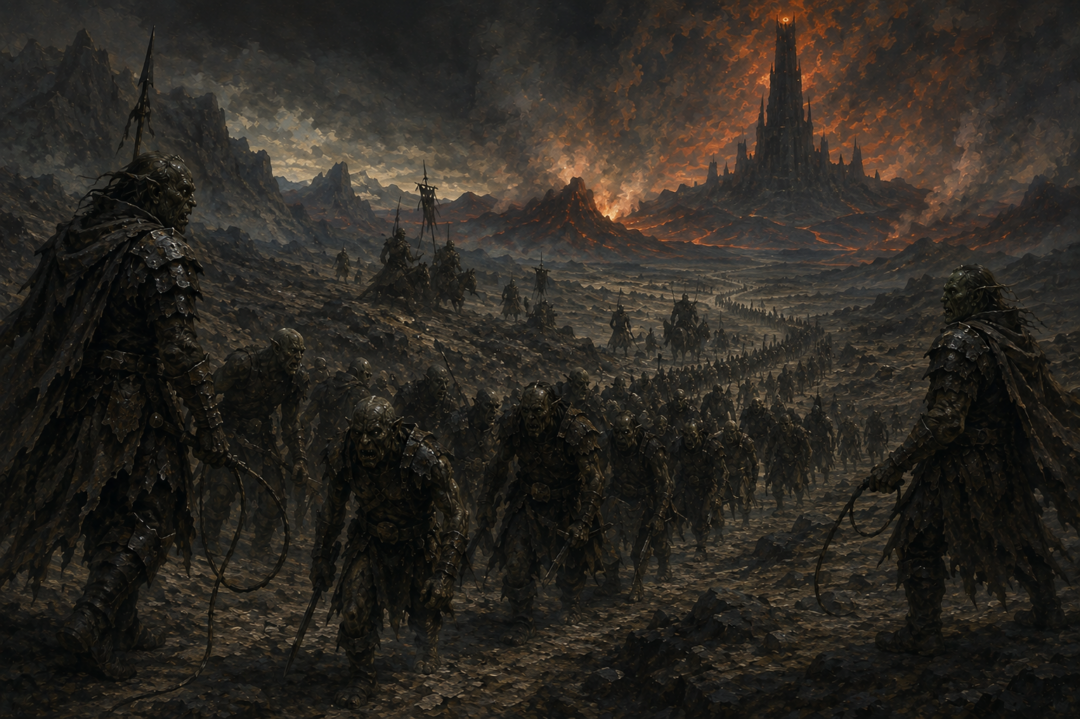
The smaller Orcs encountered by Frodo and Sam are explicitly being driven forward unwillingly. Their immediate concern is getting through the march and escaping the whip.
That matters enormously.
Sauron's armies are terrifying from outside because they seem like an endless tide of creatures united by hatred. From inside, the picture is less stable.
The Orcs complain about commanders.
They fear the Nazgûl.
They resent dangerous assignments.
They consider desertion.
Gorbag even dreams of escaping with Shagrat and a handful of reliable followers after the war, returning to a freer life of independent raiding without the “big bosses.”
Mordor therefore has a fundamental military problem: many of its soldiers need coercion.
The whip is not incidental cruelty. In scenes such as the march across Mordor, it functions as an instrument of discipline.
Where loyalty is weak, fear supplies the missing obedience.
Sauron's Army Was Organized Without Being Harmonious
This distinction helps explain one of the apparent contradictions of Mordor.
Its Orcs are quarrelsome, selfish, violent, suspicious, and often cowardly.
Yet Sauron can deploy enormous armies.
Those facts are not mutually exclusive.
The texts suggest that the Dark Lord does not transform Orcs into disciplined comrades who willingly sacrifice themselves for a common cause. Instead, his power imposes organization upon creatures who would often prefer to pursue their own interests.
Companies have captains.
Garrisons hold strategic positions.
Patrols investigate threats.
Messages travel between commands.
Orders specify what must happen to prisoners and captured objects.
Troops are expected at particular places by particular times.
Stragglers can be identified and reported.
Whips keep columns moving.
Above all of it stands the fear of higher authority.
The result is military organization without fellowship.
Cirith Ungol Shows the Weakness in the System
The massacre inside the Tower demonstrates what happens when that imposed order fails.
Shagrat and Gorbag are both officers serving the same Dark Lord. Their companies are supposedly fighting the same war. Frodo is an extraordinarily important prisoner whose capture should have been an intelligence triumph.
Instead, greed and rivalry destroy almost everyone involved.
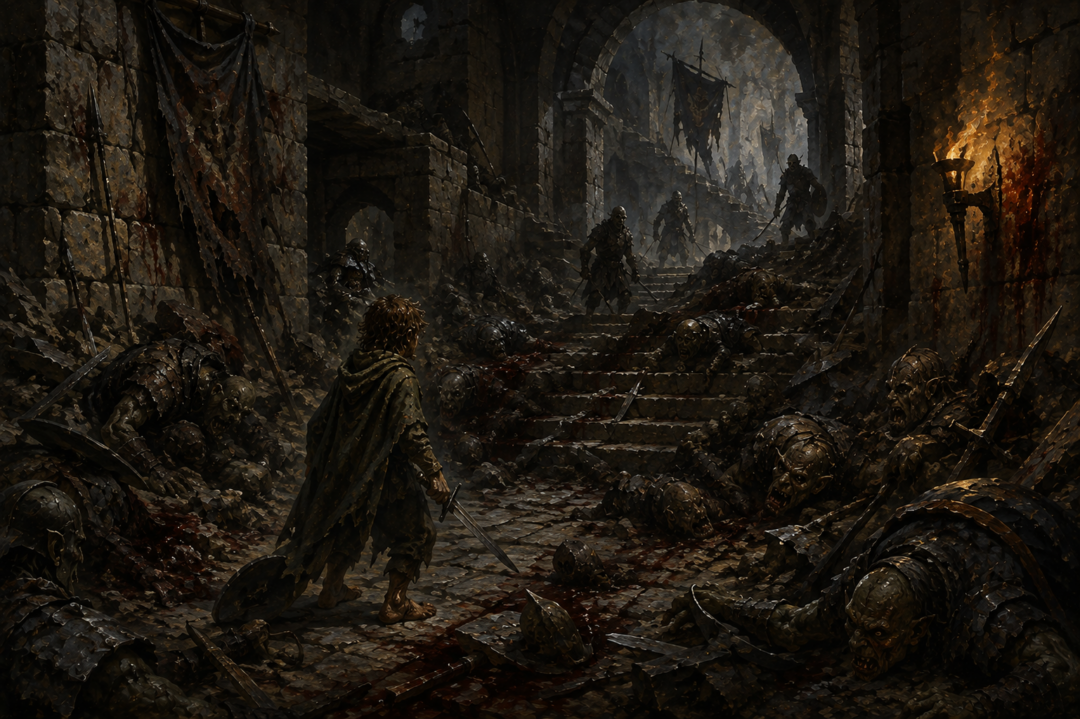
The Orcs turn their weapons on one another.
The garrison is effectively annihilated from within.
Sam arrives to discover that his enemies have done much of his work for him.
This is not evidence that Mordor lacked organization. It reveals the limits of an organization based largely on domination.
Sauron can command obedience while his pressure remains effective. He cannot create genuine trust among servants whose relationships reproduce the cruelty of the system above them.
Shagrat obeys Barad-dûr while brutalizing Orcs beneath him.
The Uruks on the road obey their own orders while whipping smaller Orcs into formation.
The lower ranks obey because disobedience is worse.
Every layer pushes fear downward.
What the Orcs' “Numbers” Really Tell Us
We never learn what Frodo and Sam's supposed Orc numbers would have looked like.
That mystery should remain a mystery.
But the existence of the threat tells us enough.
Somewhere inside the apparent chaos of Mordor was a system capable of distinguishing who was supposed to be serving where—and of turning an individual soldier into something that could be recorded in a report.
That small administrative detail changes the atmosphere of the Land of Shadow.
Sauron's power was not only expressed through Nazgûl, siege engines, trolls, fortresses, and vast armies.
It also appeared in deadlines.
Orders.
Reports.
Captains.
Assigned movements.
And an Uruk on a dusty road who could threaten two exhausted strangers with the terrifyingly mundane consequence of having their numbers taken.
The Orcs may have dreamed of escaping the “big bosses,” but until Sauron's fall they lived inside a hierarchy built to make escape difficult.
That may be the most revealing feature of Mordor's military organization: beneath the spectacle of the Dark Lord's armies was a system designed not merely to command Orcs, but to keep watch over them.
Sources & Notes
- The Encyclopedia of Arda, “Tower of Cirith Ungol” — account of the Mordor fortress, its Orc garrison, and the clash between Shagrat’s and Gorbag’s companies: https://www.glyphweb.com/arda/t/towerofcirithungol.html
- The Encyclopedia of Arda, “Shagrat” — profile of the captain commanding the Tower of Cirith Ungol and his orders concerning Frodo and the captured gear: https://www.glyphweb.com/arda/s/shagrat.html
- The Encyclopedia of Arda, “Gorbag” — profile of the Minas Morgul Orc-captain whose company met Shagrat’s patrol near Shelob’s lair: https://www.glyphweb.com/arda/g/gorbag.html
- The Encyclopedia of Arda, “Orcs” — overview of Orc organization and service in the armies of Sauron and other Dark Lords: https://www.glyphweb.com/arda/raceorcs.html
References for Mordor’s company structure, the Cirith Ungol garrison, and the command roles of Shagrat and Gorbag; the primary wording about numbers and reporting is in The Return of the King, “The Land of Shadow.”