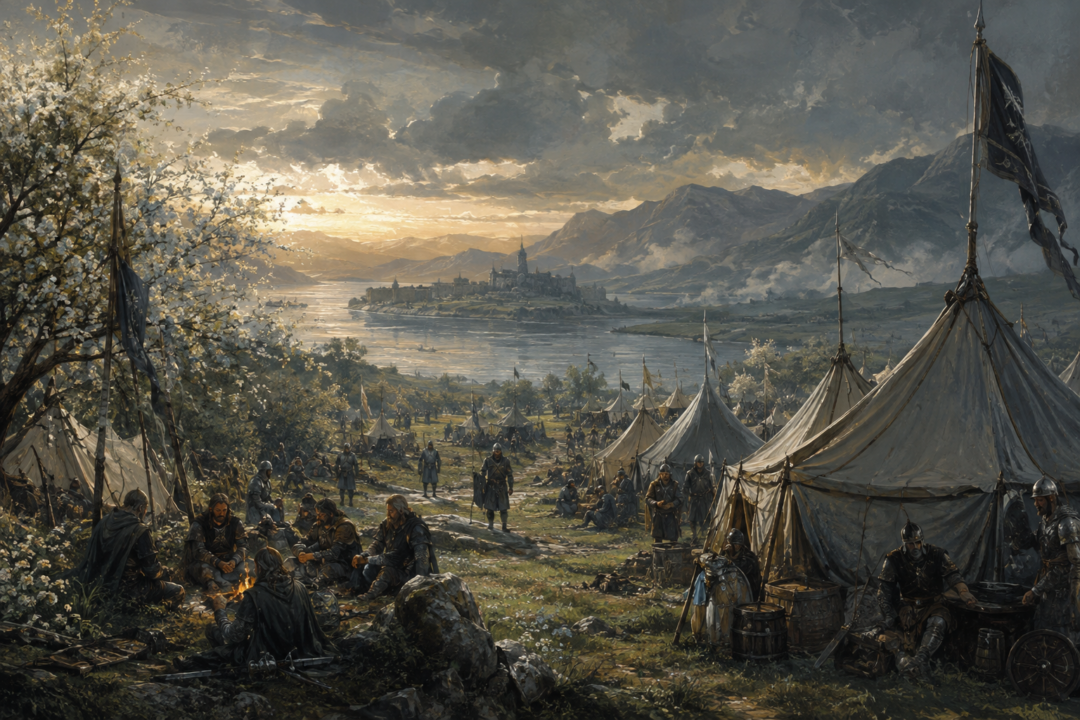
When Frodo and Sam awaken after the destruction of the Ring, they do not wake in Minas Tirith.
They wake in Ithilien.
That geographical detail is easy to overlook because “The Field of Cormallen” is remembered for reunion, celebration, and the extraordinary honour paid to two hobbits who expected to die on Mount Doom. But Cormallen also quietly reveals something about the final campaign against Mordor: the Captains of the West had not simply marched east until their food ran out and hoped for a miracle.
Behind their desperate advance stood a surviving Gondorian line of movement through Osgiliath, Cair Andros, and northern Ithilien. After victory, supplies travel along that same corridor toward Cormallen.
This does not mean Cormallen is explicitly called a military supply base in the text. It is not. Nor are we given a detailed logistical plan for the march to the Morannon.
But the geography and the movement of provisions after Sauron’s fall reveal something important. The final gamble was strategically desperate, yet it was not logistically thoughtless.
The March to the Black Gate Was Meant to Look Suicidal
At the Last Debate, the Captains understand that they cannot defeat Sauron by conventional military strength.
Their purpose is distraction.
Aragorn, Gandalf, Éomer, Imrahil, and the other leaders intend to draw Sauron’s attention away from his own land. If he believes that Aragorn has gained the One Ring and has become recklessly confident, then a small western army approaching the Black Gate might appear exactly as Sauron expects: a new Ring-lord challenging him before fully mastering his power.
The army therefore marches openly toward Mordor.
Its weakness is part of the deception.
Yet the plan still requires real soldiers to survive long enough to reach the Morannon and hold Sauron’s attention. Men and horses require food. The wounded must be dealt with. Roads, crossings, and defensible positions still matter.
The strategy depends upon appearing irrational to Sauron without actually abandoning every practical requirement of campaigning.
That distinction becomes visible during the march.
Cair Andros Was More Than a Place on the Map
The western army did not move through an empty landscape.
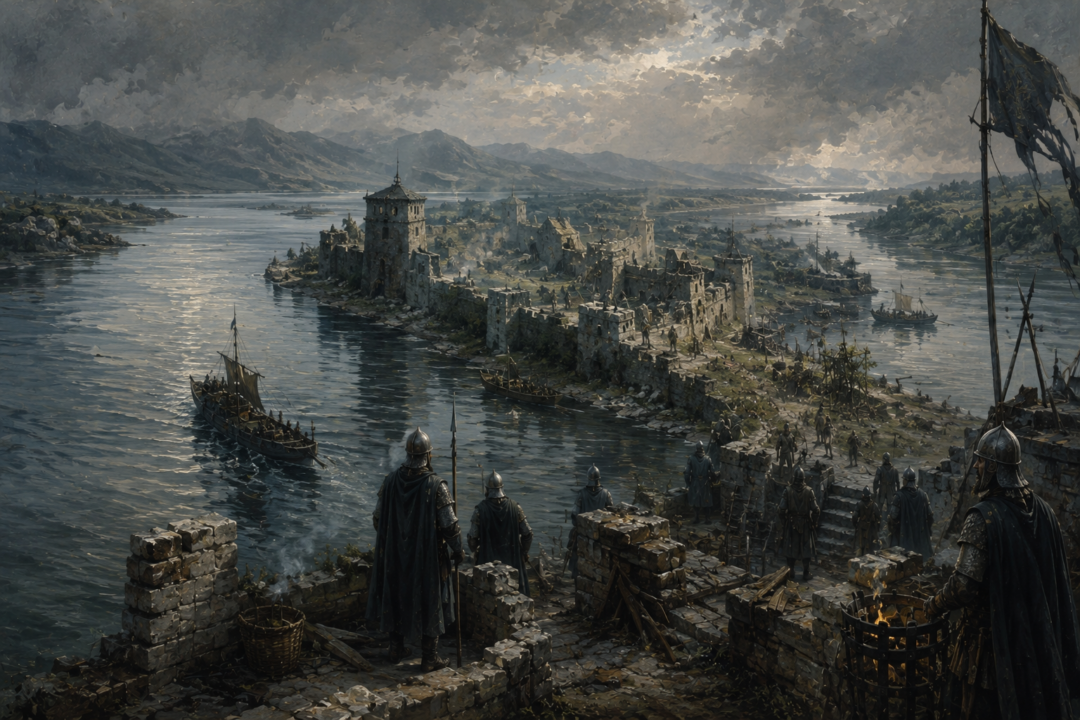
Cair Andros, the fortified island in the Anduin north of Osgiliath, had been captured by Sauron’s forces during the war. On the march toward the Black Gate, Aragorn sent a force to retake it.
This was significant for more than prestige.
At the Cross-roads, the Captains also made a deliberate decision concerning men who had become overwhelmed by fear as Mordor drew nearer. Aragorn did not simply send them home. He assigned them another useful task: they were to move toward Cair Andros and recover the island from the enemy forces there.
The decision shows that even during the final diversion, the Captains were thinking about the territory behind them.
Cair Andros lay on the Anduin beside the northern approaches into Ithilien. Recovering it helped restore Gondorian control over a strategically important point behind the advancing host.
The army going to the Morannon might be deliberately risking destruction, but the land behind it was not being treated as irrelevant.
Cormallen Sits in Exactly the Right Place
After the Ring is destroyed, Frodo and Sam are carried away from the ruin of Mount Doom by the Eagles. When they awaken, they are in Ithilien, on the Field of Cormallen.
Cormallen lay in northern Ithilien near the Anduin, in the region opposite Cair Andros and not far from Henneth Annûn.
That location matters.
This was not an arbitrary beautiful meadow chosen merely because the victorious host needed somewhere pleasant to celebrate.
The surviving Army of the West had returned from the Morannon into territory that Gondor could once again support. Cormallen offered a place within Ithilien, west of the immediate devastation of Mordor and connected geographically with the Anduin corridor.
Here the exhausted army could gather. Here Frodo and Sam could recover. Here the Captains could honour the Ring-bearers before returning to Minas Tirith.
The text never formally labels Cormallen a depot, headquarters, or supply camp. Those modern terms would go beyond what is stated.
But what happens next makes its practical importance much clearer.
The Wains Reveal the Hidden Logistics
One of the most revealing details comes not in “The Field of Cormallen” itself, but immediately afterward in “The Steward and the King.”
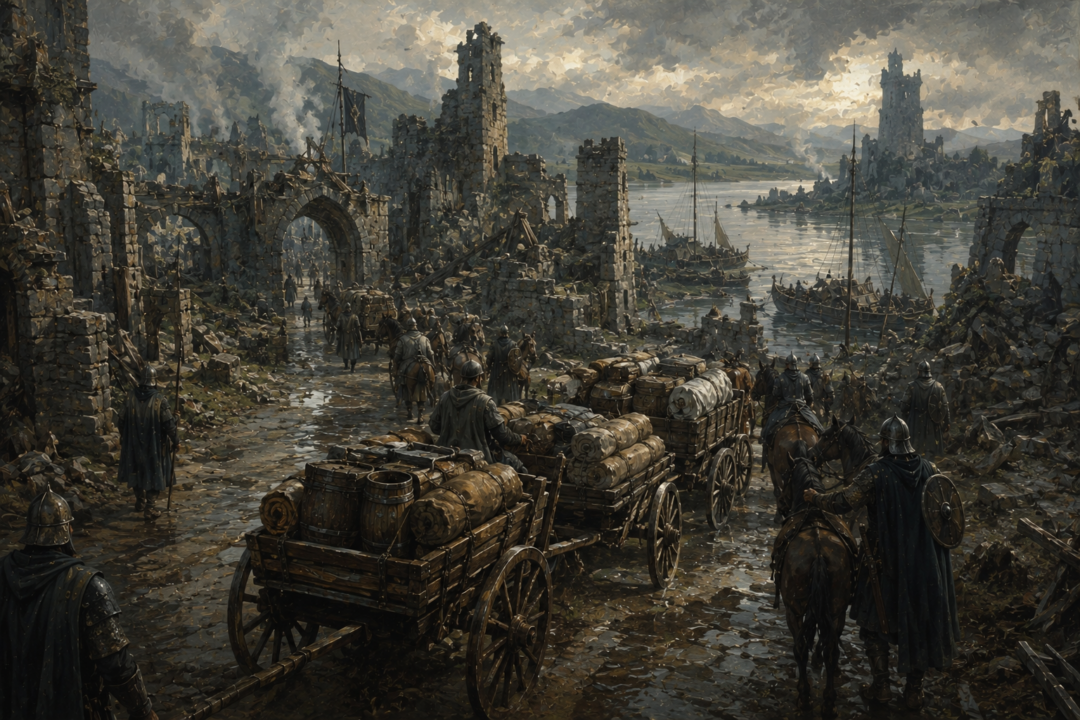
Merry leaves Minas Tirith with wains carrying stores.
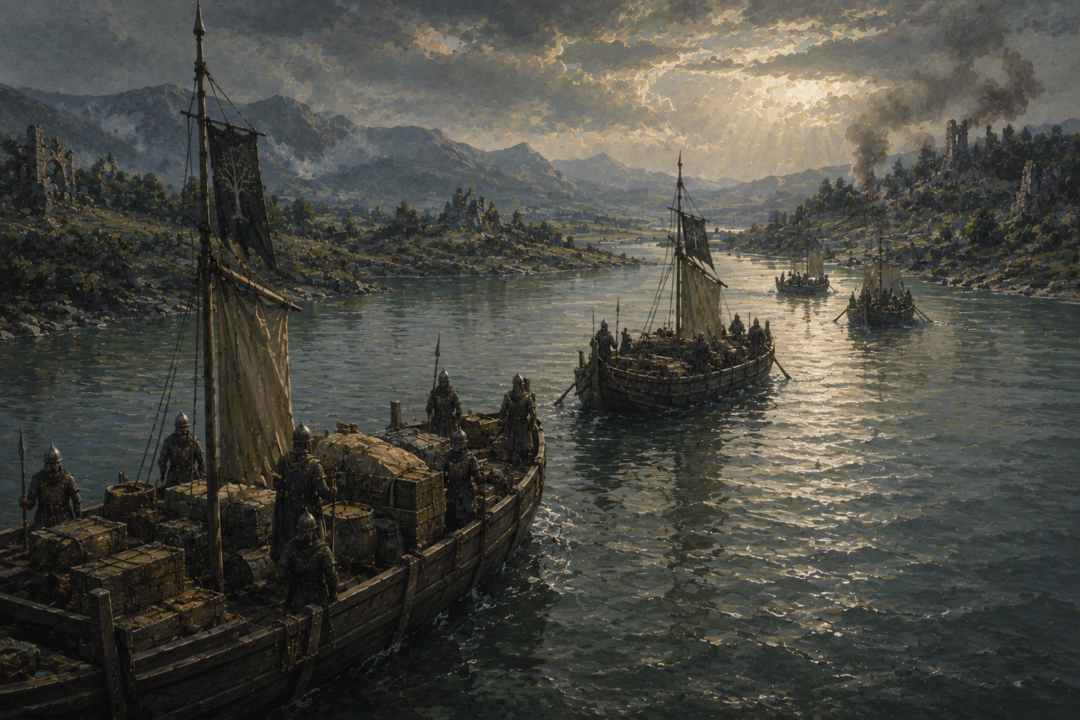
Their route is specifically described: the goods go to Osgiliath and from there by ship to Cair Andros.
Merry is travelling toward the Field of Cormallen.
That short logistical notice transforms the geography.
Minas Tirith is the great surviving centre of Gondor. Osgiliath provides access to the Anduin. Goods can then be moved northward by water to Cair Andros, close to Cormallen in northern Ithilien.
The victorious host is therefore not simply living off whatever happens to remain in the countryside.
Supplies are being deliberately moved out from Gondor to sustain it.
And the use of ships is especially important. Moving substantial stores by water is far more practical than hauling everything overland. The Anduin is not merely a boundary or scenic feature here; it becomes an artery connecting the recovering kingdom with the army in Ithilien.
Cormallen stands at the far end of that restored flow.
This Does Not Prove the Same Supply System Existed Before the Battle
There is an important limit to the argument.
The explicit reference to wains and stores occurs after Sauron has fallen. We should not turn that passage into evidence for a detailed pre-battle supply network that the text never describes.
The outward march was made under very different conditions. Enemy forces remained active. Cair Andros had to be recovered. Ithilien had suffered years of warfare and occupation. The Captains were advancing toward a battle they did not expect to win by force.
So it would be too strong to claim that Cormallen was already functioning as a fully established supply base while Aragorn marched toward the Black Gate.
What the text does show is a usable strategic corridor.
The Captains secured positions behind their advance. Cair Andros was retaken. After the victory, the same broad geography immediately supported the concentration of the surviving host in northern Ithilien, with stores moving from Minas Tirith through Osgiliath and along the Anduin.
Cormallen reveals what the landscape behind the gamble could become once Sauron’s armies collapsed.
Henneth Annûn Shows Why Northern Ithilien Was Still Useful
Cormallen also belongs to a region the story has already taught us to view differently from Mordor.
Earlier, Frodo and Sam encounter Faramir’s Rangers in Ithilien. Henneth Annûn serves as their hidden refuge. Although Ithilien has been devastated by war and abandoned by much of its population, it is not portrayed as completely dead.
Vegetation remains. Water flows through the land. Gondor’s Rangers still know its paths and hidden places.
That distinction becomes even sharper after the destruction of the Ring.
Mordor is the land from which Frodo and Sam must be rescued. Northern Ithilien is where they can recover.
The movement from Mount Doom to Cormallen is therefore more than a transition from danger to safety. It crosses from Sauron’s devastated heartland into a contested Gondorian landscape capable of becoming habitable and organized again.
Cormallen is a fitting place for the Army of the West because Ithilien is itself beginning to pass from battlefield back into realm.
The Final Gamble Was Desperate, Not Careless
This changes how the march on the Black Gate should be understood.
The Captains knowingly risk almost everything.
They march with a force far too small to conquer Mordor. They expose themselves to Sauron’s overwhelming armies. They do so because Frodo’s hidden mission requires the Enemy to look outward instead of inward.
But desperation is not the same as incompetence.
Aragorn sends troops to recover Cair Andros. The army uses the roads through Ithilien. The leaders preserve what useful strength they can rather than wasting frightened men at the Morannon. Behind the advance remains Gondor, wounded but functioning.
Then, once Sauron falls, that surviving structure becomes visible almost immediately.
Messages move.
Stores move.
Ships move.
The host concentrates at Cormallen rather than wandering leaderless through the wilderness.
Victory does not magically erase the material needs of thousands of survivors.
Cormallen Is Where Sacrifice Turns Back Into Government
There is another reason Cormallen matters.
The march to the Black Gate belongs to a world temporarily reduced to one terrible objective: keep Sauron watching.
Once the Ring is destroyed, that logic ends.
The survivors suddenly need ordinary things again.
Food. Rest. Healing. Communication. Transport. Ceremony. Authority.
Cormallen becomes the place where the Army of the West stops being bait and becomes the host of a surviving kingdom.
That is why the apparently minor detail of supply wains matters so much.
The great victory does not conclude with Mount Doom. The West still has to gather its people, feed its soldiers, care for its wounded, communicate with Minas Tirith, and bring its king home.
The road from Cormallen to Aragorn’s coronation is therefore not merely ceremonial. It is the reappearance of ordered society after a war fought on the edge of annihilation.
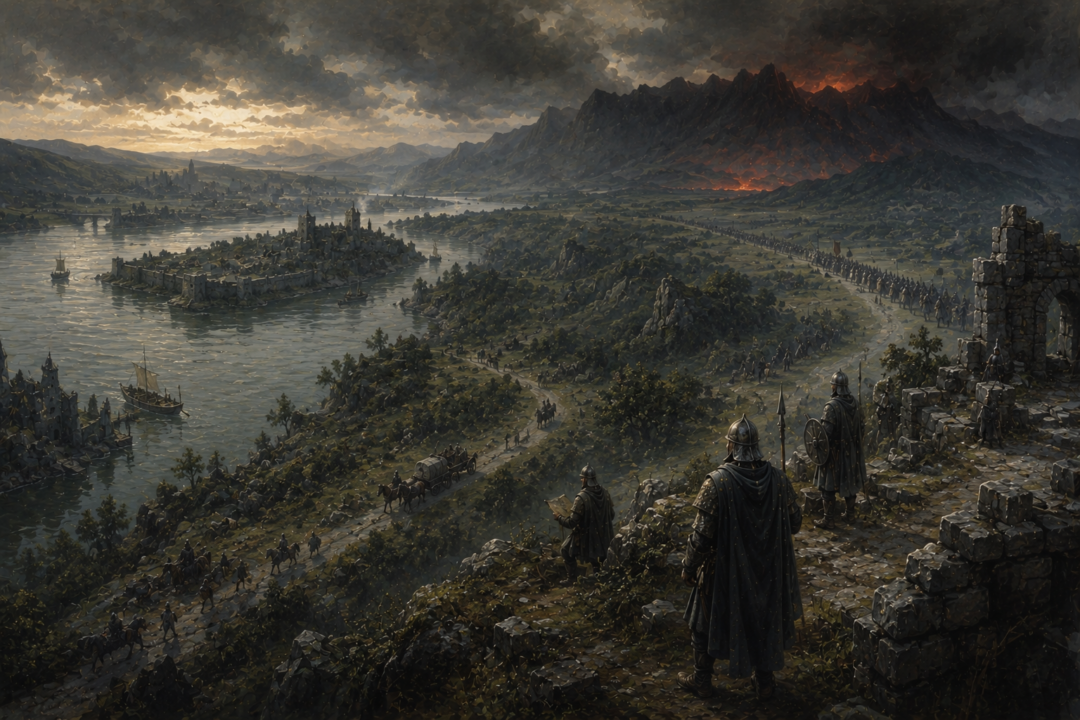
The Quiet Detail Behind the Miracle
The destruction of the Ring is miraculous in the deepest sense of the story: the military plan cannot accomplish it, and the Captains know that.
Yet the men of the West still do everything that remains within their power.
They march.
They hold together.
They recover ground behind them.
And when the impossible victory finally comes, Gondor is still capable of sending wagons to Osgiliath, loading supplies onto ships, moving them toward Cair Andros, and sustaining the host gathered in Ithilien.
Cormallen is never explicitly named as the carefully prepared supply base behind Aragorn’s last gamble.
The text does not allow us to go that far.
What it reveals is subtler and perhaps more interesting: the final gamble took place at the end of a surviving strategic corridor. Cair Andros, Osgiliath, the Anduin, and northern Ithilien remained pieces of a military geography that could be restored as soon as the Enemy’s power broke.
The Captains marched toward what looked like certain destruction.
Behind them, however, Gondor had not ceased to function.
And on the Field of Cormallen, almost unnoticed beneath the songs, reunions, and honour given to Frodo and Sam, the machinery of survival begins moving again.
Sources & Notes
- https://tolkiengateway.net/wiki/Field_of_Cormallen — Tolkien Gateway: location, encampment, field hospital, celebrations, and the hosts gathered after Sauron’s fall.
- https://tolkiengateway.net/wiki/The_Black_Gate_Opens — Tolkien Gateway: the Army of the West’s deliberately risky march and battle at the Morannon.
- https://tolkiengateway.net/wiki/Army_of_the_West — Tolkien Gateway: composition, route, reduced numbers, and logistical movement of the final host.
- https://tolkiengateway.net/wiki/Ithilien — Tolkien Gateway: the region containing Cormallen and the roads and terrain behind Gondor’s eastern operations.
Sources locate Cormallen in Ithilien and connect it to the army’s march, encampment, recovery, and provisioning.