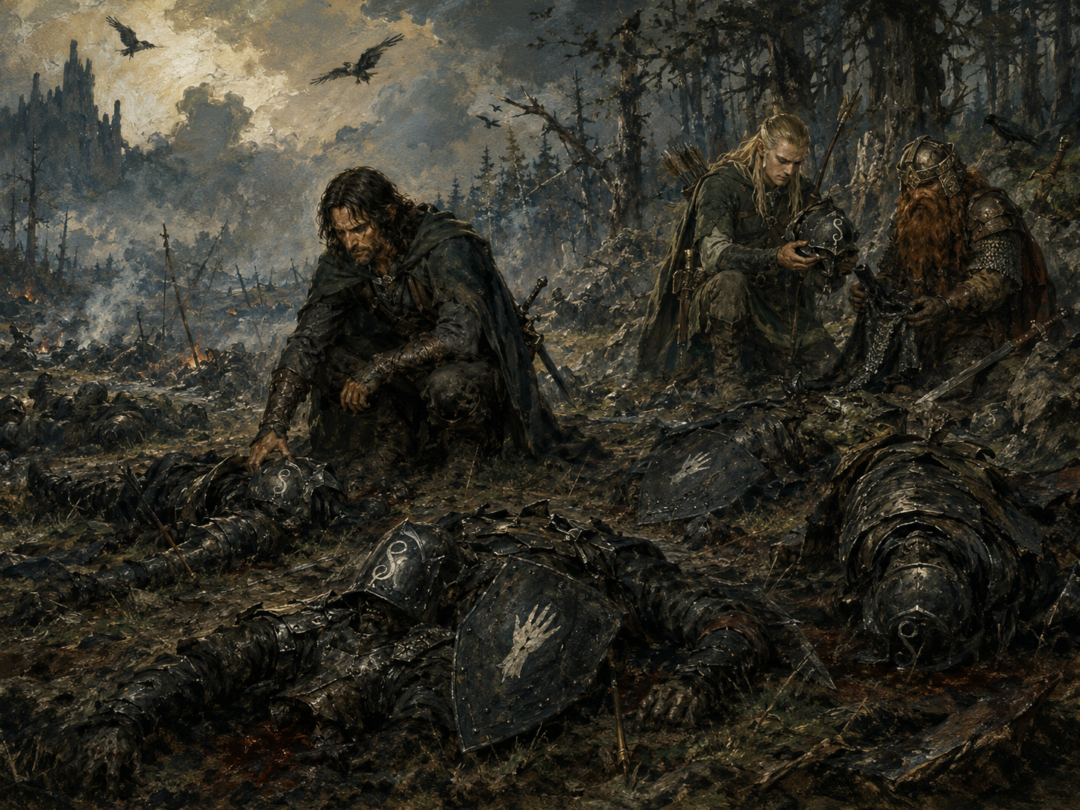
When Aragorn examines the Orcs slain around Boromir, one detail changes the meaning of the entire attack.
The dead are not all alike.
Some appear to have come from the northern mountains. But four larger Orc-soldiers carry equipment Aragorn does not recognize: broad-bladed swords, bows shaped more like those of Men, iron helmets bearing a white S-rune, and shields marked with a small White Hand upon black.
Gimli initially guesses that the letter must stand for Sauron.
Aragorn and Legolas immediately see the problem.
Sauron does not advertise himself that way. His servants use another sign: the Red Eye.
That small piece of battlefield identification reveals something much larger. The Orcs pursuing the Fellowship are not simply one anonymous army of darkness. Different masters command different forces, and those forces carry visible symbols of allegiance.
More importantly, their badges expose a division inside the Enemy’s own ranks.
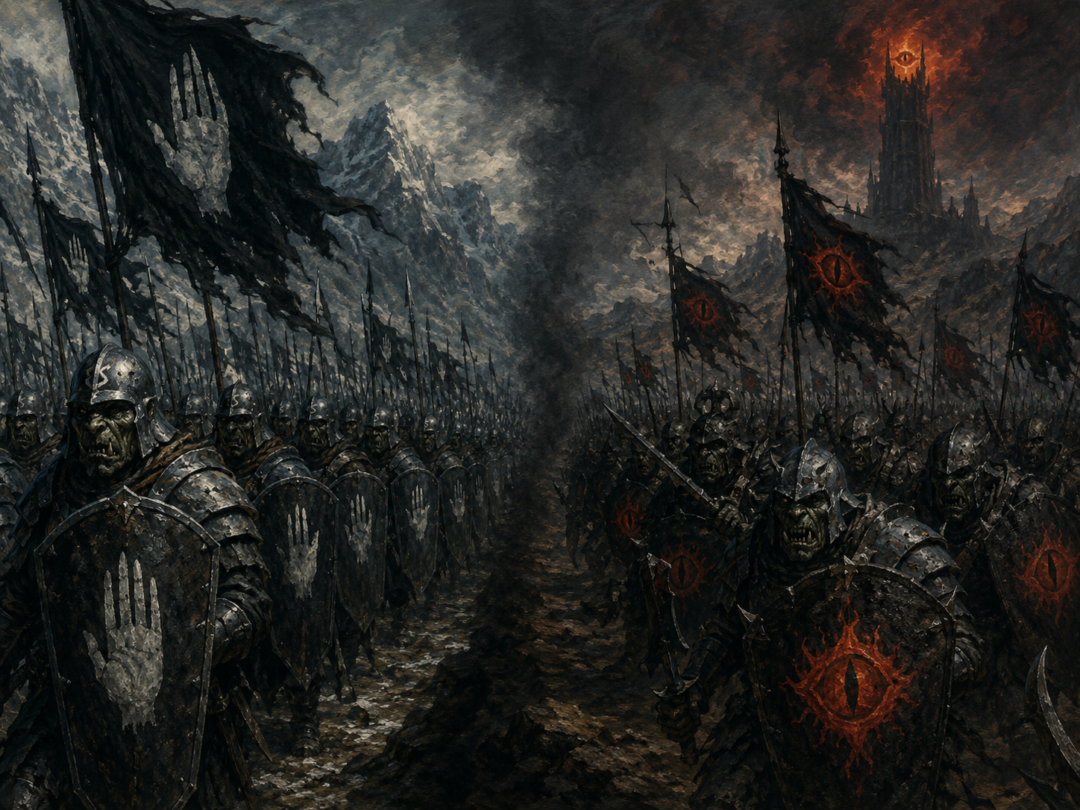
The White Hand Identifies the Orcs of Isengard
The clearest identification comes in The Two Towers, when Aragorn, Legolas, and Gimli study the bodies left after Boromir’s last stand.
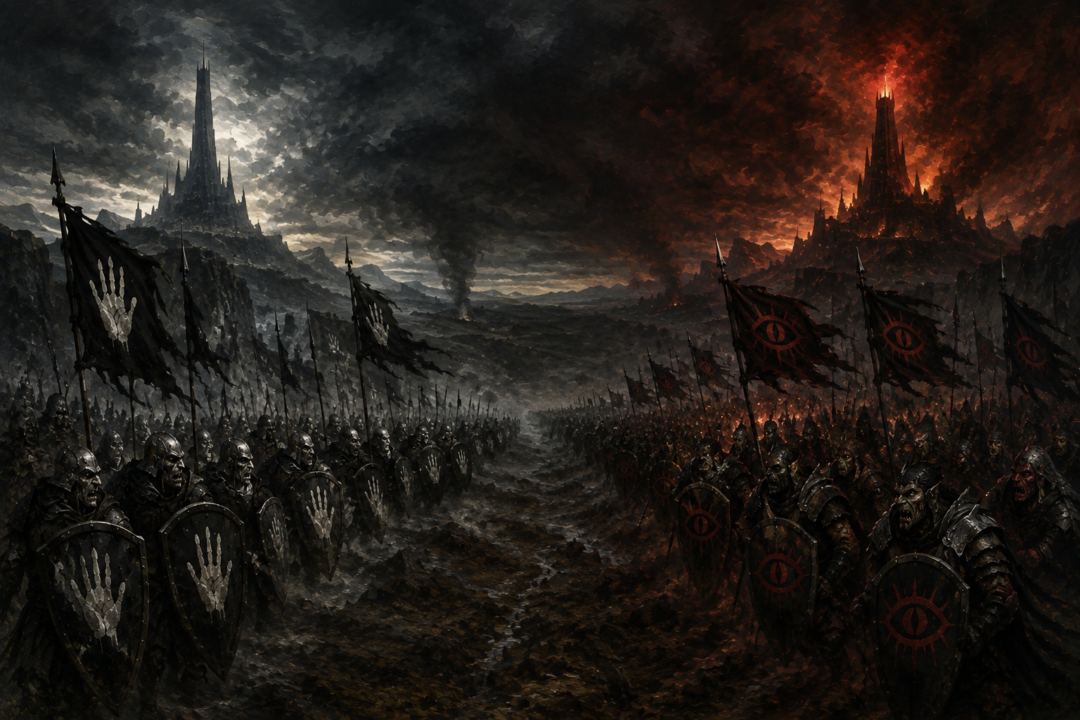
The unusual Orcs have shields marked with a White Hand centered on a black field. Their helmets also bear an S-rune made from white metal.
Aragorn concludes that the S probably stands for Saruman.
The conclusion is significant because neither sign belongs to the established forces of Mordor. Saruman has effectively created his own military identity.
The White Hand appears elsewhere as Saruman’s emblem. Near Isengard, a great hand of stone stands upon a black pillar on the road toward the fortress. The image is therefore not merely a convenient marking slapped onto Orc equipment. It belongs to Saruman’s emerging political and military power.
The symbolism also fits the title by which he had long been known: Saruman the White. Yet by the War of the Ring, that whiteness has become deeply ironic. Saruman has rejected his original purpose and begun building a dominion of his own.
His soldiers nevertheless march beneath a white symbol.
The result is almost a parody of his former identity: the White Hand no longer represents wisdom or resistance to evil, but possession, command, and war.
That symbolic interpretation goes beyond what the text explicitly explains, but the military function of the badge is unmistakable. The White Hand tells observers—and other Orcs—whose soldiers these are.
They belong to Isengard.
Mordor Uses the Red Eye
Saruman’s markings stand in deliberate contrast to the emblem used by Sauron’s servants.
Aragorn states directly that the Orcs serving Barad-dûr use the sign of the Red Eye.
The Eye appears repeatedly in connection with Mordor during the War of the Ring. Sauron’s forces carry it as a military emblem, and a black banner bearing the Red Eye is associated with his power.
This distinction is important because it prevents a common misunderstanding about Orc armies.
The difference is not simply that Saruman possesses “Uruk-hai” while Sauron possesses ordinary Orcs.
Uruks also serve Mordor.
The word Uruk-hai does not identify a uniquely Isengard-created species belonging only to Saruman. Large warrior-Orcs existed in Sauron’s armies as well. What makes Uglúk’s soldiers specifically identifiable is their allegiance: they are the Uruk-hai of Isengard, and they wear Saruman’s tokens.
The badge therefore tells us more reliably who commands an Orc than the general word Uruk does.
White Hand: Isengard.
Red Eye: Barad-dûr.
And in the company carrying Merry and Pippin across Rohan, those differences matter immediately.
Uglúk and Grishnákh Are Not Really on the Same Side
The chapter “The Uruk-hai” provides perhaps the best demonstration of what these emblems mean in practice.
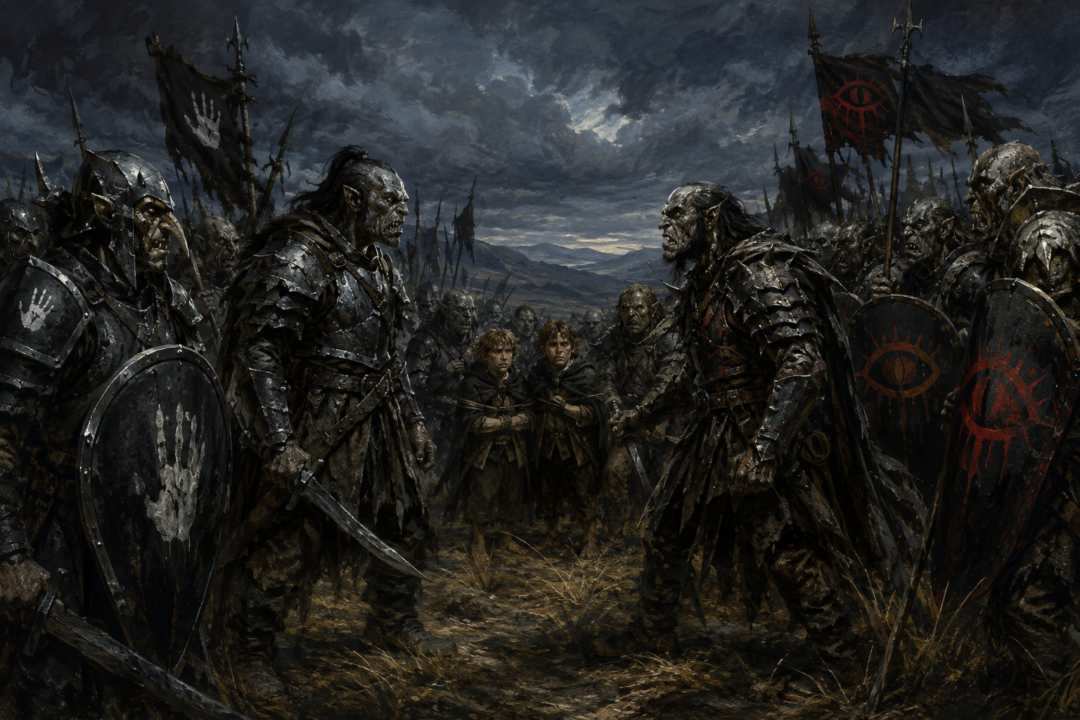
Merry and Pippin have been captured by a combined body of Orcs, but the company is anything but unified.
Uglúk commands the Isengarders. He repeatedly identifies his followers as the fighting Uruk-hai and ultimately insists on taking the prisoners toward Isengard.
Grishnákh belongs to Mordor.
His interests are different.
The two groups may temporarily travel together, but their masters do not have identical objectives. Uglúk obeys orders connected with Saruman. Grishnákh is answerable to the power of the Eye.
Their arguments reveal that Orc military organization follows competing chains of command.
This is precisely why the badges matter.
Imagine the same company from a distance. Without its markings, it might appear to be a single Orc army moving westward. Yet within it are troops owing loyalty to different rulers, alongside Orcs from the northern mountains who form another element again.
The shields make those divisions visible.
The White Hand and Red Eye are therefore more than decorative heraldry. They function as signs of authority in a world where several evil powers are cooperating without truly trusting one another.
The S-Rune Reveals Something Strange About Saruman
The White Hand is not the only clue.
Saruman’s Orcs also wear a white S-rune on their helmets.
Gimli naturally assumes that S means Sauron. But Legolas rejects the idea because Sauron does not use Elf-runes, and Aragorn adds that the Dark Lord does not use his own proper name in that fashion.
That makes Saruman’s emblem unusually revealing.
Sauron prefers the Eye: a symbol rather than his written name.
Saruman places an initial on his troops.
The contrast suggests two different presentations of power. Sauron’s emblem is impersonal and overwhelming. His soldiers belong to the Eye, an image that embodies surveillance, domination, and their master’s terrifying presence.
Saruman’s forces visibly carry something much closer to his personal signature.
The text never gives a formal explanation for why Saruman chose the rune, so conclusions about his psychology should remain cautious. Yet the effect is clear enough: his soldiers are unmistakably branded as his.
He is no longer behaving merely as Sauron’s subordinate.
He is establishing Saruman as a power recognizable in his own right.
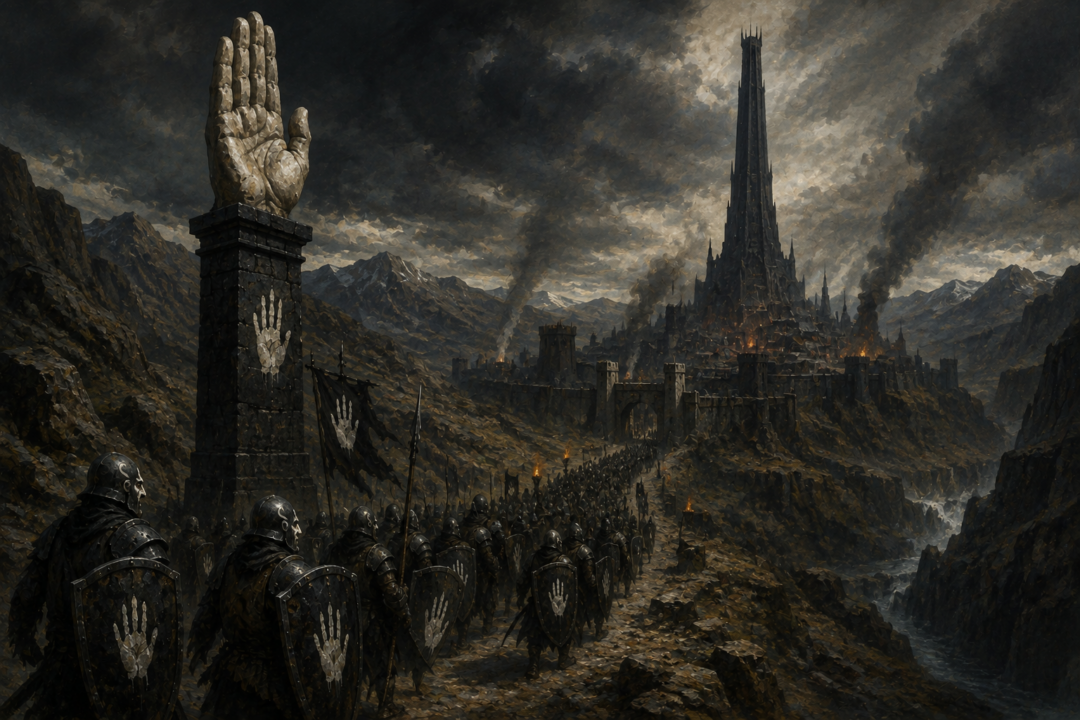
Saruman Is Cooperating with Sauron—and Competing with Him
This is the deeper political meaning behind the badges.
Saruman has fallen under Sauron’s influence, but he has not simply dissolved his ambitions into those of Mordor.
He wants the Ring.
His actions demonstrate that he hopes to obtain it for himself rather than obediently deliver it to Barad-dûr.
That rivalry explains much of the tension among the Orcs carrying Merry and Pippin.
The captives might possess information about the Ring. Saruman wants them brought to Isengard. Mordor has its own interest in them. The disagreement between Uglúk and Grishnákh therefore reflects the conflict between their masters.
The insignia make that invisible struggle visible.
One body of Orcs marches beneath the Hand.
Another serves the Eye.
They may share enemies, but they do not share ultimate loyalty.
Saruman’s entire position during the War of the Ring is caught inside that contradiction. He imitates Sauron by industrializing war, gathering Orc armies, dominating weaker peoples, and seeking greater power. Yet imitation is not enough for him.
He wants his own fortress.
His own servants.
His own emblem.
And eventually, if his plans succeeded, his own Ring.
Not Every Orc Belongs Neatly to Either Badge
The distinction should not be pushed too far.
Middle-earth does not contain only two standardized Orc armies, one marked with hands and the other with eyes.
The Orc band that captures Merry and Pippin includes Orcs associated with the northern mountains as well as the forces of Isengard and Mordor. Aragorn can distinguish different kinds partly through appearance, weapons, equipment, behavior, and eventually the evidence of their markings.
Elsewhere, Orc groups have their own captains, rivalries, strongholds, and local identities.
So the White Hand and Red Eye should be understood primarily as signs of political and military allegiance, not universal classifications for every Orc in Middle-earth.
Even within Mordor, Orcs quarrel viciously among themselves. At Cirith Ungol, the factions of Shagrat and Gorbag effectively destroy one another in a dispute over Frodo’s possessions and the orders governing them.
The servants of evil can be organized, disciplined, and terrifyingly effective.
But they are not united by friendship or genuine loyalty.
They obey power.
The Badges Reveal a Weakness Inside the Shadow
That may be the most important thing the Orc insignia tell us.
Saruman and Sauron can cooperate because their immediate interests overlap. Both oppose the Free Peoples. Both seek domination. Both employ Orc armies.
But domination does not create trust.
Each master wants control.
Each military emblem marks a separate center of authority.
The White Hand declares that these soldiers belong to Saruman.
The Red Eye declares that those soldiers belong to Sauron.
And when the two groups are forced together, the hostility between their commanders quickly surfaces.
That is why Aragorn’s discovery beside Boromir is more than a piece of battlefield detective work.
A few shields and helmets reveal the political shape of the Shadow.
There is not one perfectly unified enemy moving against the West. There is Sauron, seeking absolute dominion, and there is Saruman, already corrupted enough to imitate him yet still ambitious enough to compete with him.
Their Orcs wear the evidence.
One marches beneath the Eye.
The other beneath the Hand.
And those two symbols quietly expose the fundamental weakness of powers built entirely upon domination: everyone wants someone beneath them, but no one willingly accepts another master above.
Sources & Notes
- https://tolkiengateway.net/wiki/Heraldry — Tolkien Gateway: textual catalog of the White Hand, S-rune, and Red Eye devices borne by opposing Orc forces.
- https://tolkiengateway.net/wiki/Orcs_of_Isengard — Tolkien Gateway: Saruman’s Orcs, their equipment, allegiance, and identifying emblems.
- https://tolkiengateway.net/wiki/Orcs_of_Mordor — Tolkien Gateway: Sauron’s Orc forces and the Red Eye badge associated with Barad-dûr.
- https://tolkiengateway.net/wiki/Uruk-hai — Tolkien Gateway: the Uruk-hai’s service under different powers and Saruman’s Isengard contingent.
Sources distinguish the White Hand and S-rune of Isengard from the Red Eye used by Mordor’s Orcs.