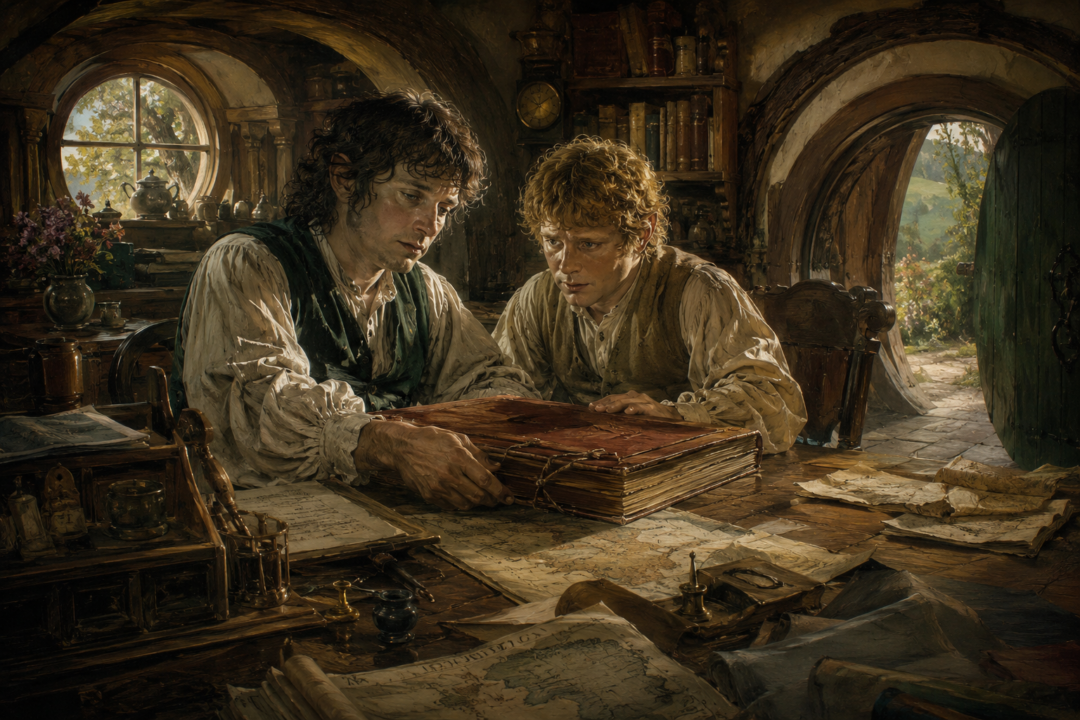
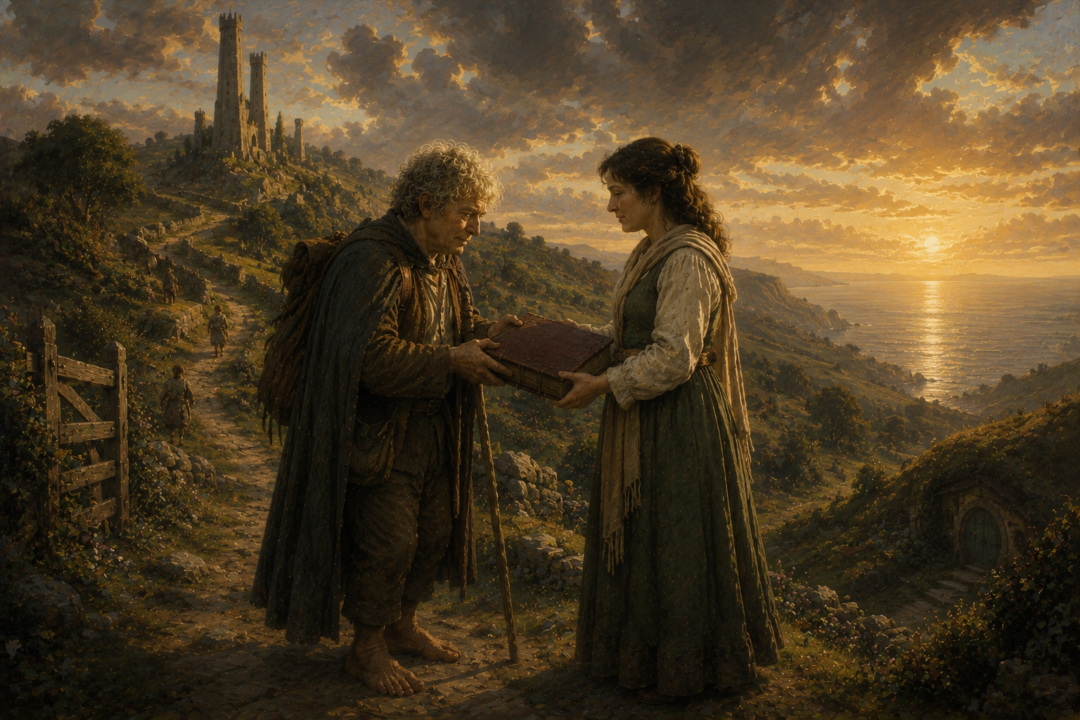
At the Grey Havens, Frodo leaves Samwise Gamgee something almost as important as Bag End.
He leaves him the book.
The manuscript begun by Bilbo and continued by Frodo contains the record of adventures that have already become history: Bilbo’s journey, the War of the Ring, and the experiences of those who carried the burden at its center. Sam himself has helped make that history, yet when Frodo departs over the Sea, Sam does not first return to the Shire as one of its great officials. His first inheritance is more private.
He becomes the keeper of memory.
Only later does Sam become Mayor of the Shire, repeatedly chosen for an office that makes him one of the most prominent hobbits of his generation. The chronology matters. Sam is entrusted with the story before he accumulates decades of public authority.
That sequence reveals something important about the Fourth Age. The great deeds are over, but their survival is not automatic. Before Sam helps govern the world that comes afterward, he must preserve the truth about the world that disappeared.
Frodo Leaves Sam an Unfinished Ending
The final pages of The Lord of the Rings deliberately narrow from the fate of kingdoms to a single household.
Aragorn reigns. Sauron is gone. The Ring has been destroyed. Yet Frodo cannot simply resume the life he possessed before the Quest. His wounds, physical and otherwise, have not entirely healed. Eventually he rides west with Bilbo, Gandalf, Elrond, and Galadriel.
Sam returns.
That difference defines his future.
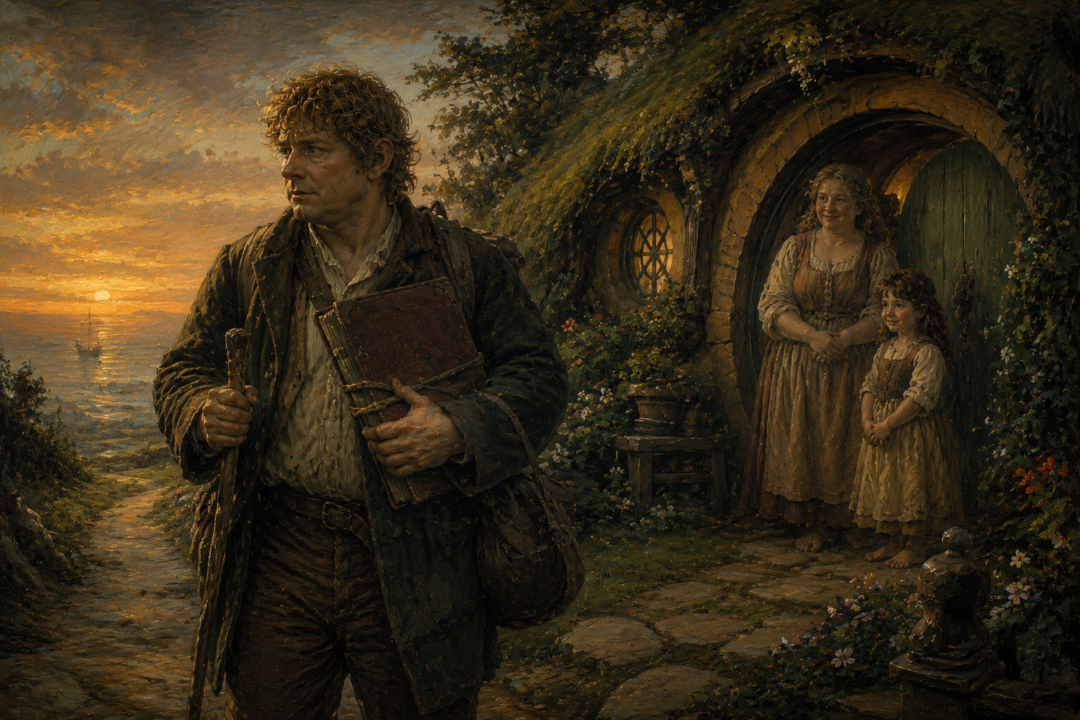
Before leaving, Frodo has been working on the manuscript inherited from Bilbo. The title page described near the end of the story shows how the work has grown from Bilbo’s memoir into an account of the War of the Ring and the return of the King. Frodo has brought the history almost to its conclusion.
Almost.
He tells Sam that the final pages are for him.
This is more than a literary gesture. Sam is the surviving participant who can carry the story beyond Frodo’s departure. He witnessed much of the Quest firsthand, including events for which Frodo himself could not have been a conscious observer. Sam saw Frodo poisoned by Shelob, recovered the Ring when he believed Frodo dead, entered Mordor carrying it, returned it voluntarily, and finally carried Frodo himself toward the Fire.
The person receiving the manuscript is therefore not merely Frodo’s friend. He is one of its essential witnesses.
The Red Book Comes Before the Mayoralty
The order of events is easy to overlook.
Frodo departs at the end of the Third Age, leaving Bag End and the manuscript to Sam. Sam then returns home to Rosie and Elanor.
His long political career comes later.
According to the chronology in Appendix B, Sam is first elected Mayor of the Shire in Shire-reckoning 1427, six years after the departure from the Grey Havens. He will eventually serve seven consecutive seven-year terms.
So Sam does not receive the Red Book because he is Mayor.
He receives it before he is Mayor.
Nor is the book entrusted to him because he belongs to one of the Shire’s traditional ruling families. Sam began life as the son of the Gaffer, Hamfast Gamgee, and worked as a gardener at Bag End. The manuscript passes to him through friendship, experience, loyalty, and trust rather than inherited office.
That distinction is significant.
The Shire already possesses established structures of authority. The Took family provides the Thain. The Master governs Buckland. The Mayor of Michel Delving is the most important elected office.
But none of those institutions receives Frodo’s book.
Sam does.
He Knows What the Official Story Could Miss
The War of the Ring contains events that kings and chroniclers could record easily.
They could record battles, coronations, deaths, treaties, and the restoration of kingdoms.
But the decisive journey into Mordor is different.
For much of it there are almost no external witnesses.
No herald watches Frodo crawl across the plains of Gorgoroth. No royal historian stands beside Sam when he chooses to return the Ring. No army sees the two hobbits struggle toward Mount Doom. Even the military campaign before the Black Gate is intentionally fought elsewhere, drawing Sauron’s attention away from the people actually carrying the fate of Middle-earth.
The central achievement is therefore strangely vulnerable to disappearance.
Sam knows the part of history that public spectacle cannot preserve.
He knows how frightened they were. He knows how little food remained. He knows Frodo’s increasing exhaustion. He knows that pity toward Gollum continued to matter even after betrayal. Most importantly, he knows that the Quest cannot truthfully be reduced to a simple tale of a hero overpowering evil through superior strength.
Frodo does not conquer the Ring through sheer will at the Crack of Doom. He finally claims it.
The destruction of the Ring comes through the consequences of earlier choices, including mercy shown to Gollum.
A truthful keeper of the story therefore has to preserve uncomfortable facts as well as glorious ones.
Sam is unusually well placed to do that.
Sam Has Already Learned the Difference Between Power and Stewardship
Sam’s brief possession of the One Ring gives the later inheritance of the Red Book additional weight.
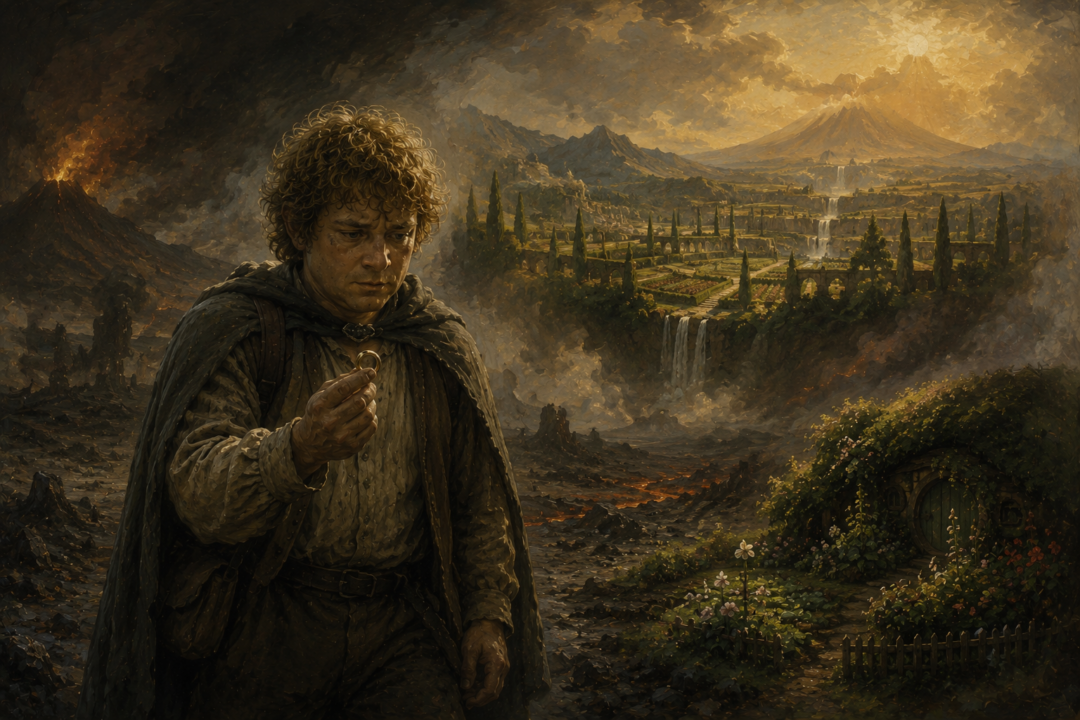
In Mordor, the Ring tempts him with an enlarged vision of himself. The gardener imagines power great enough to overthrow the Dark Lord and transform the barren land into a vast garden.
But Sam rejects that fantasy.
The text emphasizes the importance of his plain hobbit sense and his awareness of his own proper scale. He does not need an empire. One small garden is enough.
That episode provides a useful contrast with the Red Book.
The Ring is something Sam could possess in order to magnify himself.
The book is something Sam possesses in order to preserve something beyond himself.
One offers domination. The other demands stewardship.
This does not mean the text explicitly presents the Red Book as an intentional opposite to the Ring; that would go beyond what is stated. But the contrast is striking. Sam proves capable of surrendering an object of immense power, and afterward he becomes responsible for an object whose value depends on faithful transmission rather than control.
He does not need to become the greatest figure in the story.
He needs to make sure the story survives.
His Public Authority Grows Out of Restoration
Sam’s later prominence in the Shire is not disconnected from this role.
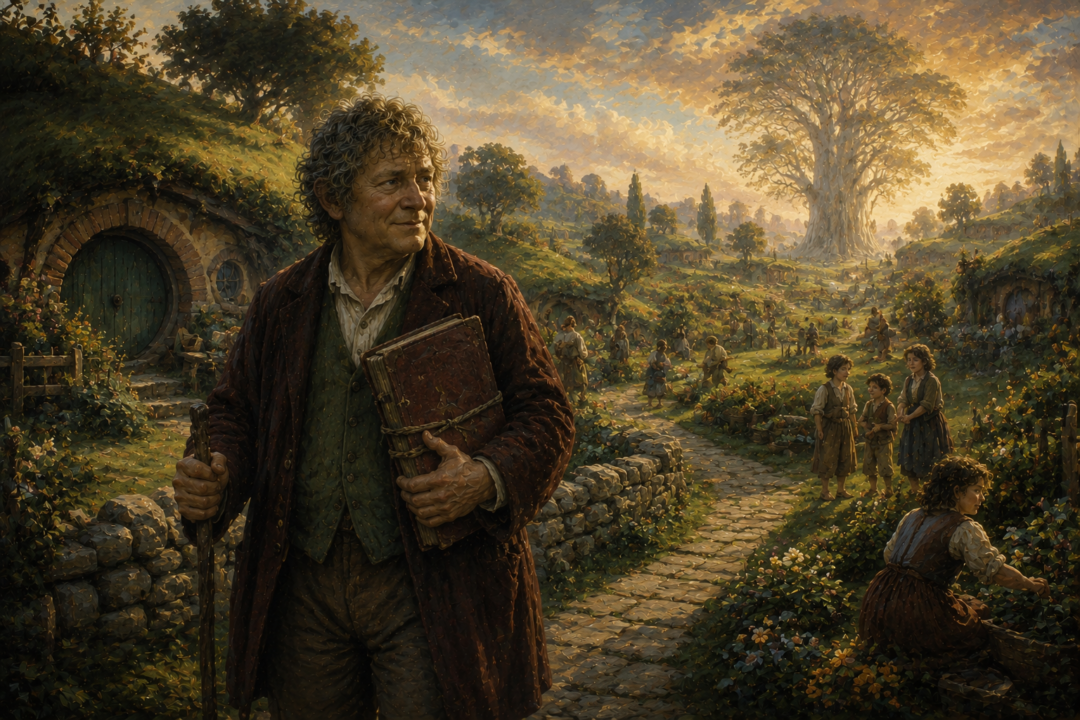
After the hobbits return, Sam uses Galadriel’s gift to help restore the land damaged during the occupation of the Shire. He plants saplings and scatters the precious soil she gave him. The exceptional mallorn grows in the Party Field.
His work is restorative before it is political.
That pattern continues in his life.
Sam marries Rosie Cotton, raises a large family, lives at Bag End, and eventually becomes Mayor. Appendix B records his repeated reelection, his meeting with King Elessar, and his later journey south with Rosie and Elanor. He becomes a figure connecting the ordinary Shire with the restored northern kingdom.
Yet the Sam who enters public life is already carrying the memory of what made that restored world possible.
This matters because political peace can make past danger seem unreal.
Children born after Sauron’s fall will never see Mordor as Frodo and Sam saw it. Later generations of hobbits can enjoy a protected Shire without personally understanding why the Rangers once guarded its borders or what occurred beyond them.
The Red Book bridges that gap.
Sam’s authority therefore develops alongside his custodianship of memory, not instead of it.
The Book Eventually Leaves Sam Too
The final stage makes the pattern even clearer.
After Rosie dies, Sam leaves Bag End in 1482 by Shire-reckoning. Appendix B says that on September 22 he rides out, comes to the Tower Hills, and is last seen by Elanor.
He gives the Red Book to her.
Tradition then holds that Sam, as a Ring-bearer, passed over the Sea.
The manuscript remains.
Through Elanor and her descendants, the Fairbairns of the Towers, the Red Book becomes associated with Westmarch. The Prologue explains that the original was later lost, but copies were made. One especially important textual tradition was the Thain’s Book, a copy taken to Gondor and supplemented there with material available in the southern kingdom.
Memory becomes collaborative.
Bilbo begins the record. Frodo continues it. Sam inherits and contributes to it. Elanor preserves it. Later scribes copy and annotate the tradition.
No single hero owns the whole history.
Each generation receives it temporarily.
Sam’s First Great Fourth-Age Office Is Not an Office at All
Calling Sam a “public elder” is a modern description rather than a canonical Shire title, but it captures what he eventually becomes: a repeatedly elected Mayor, honored by the King and deeply embedded in the civic life of the restored Shire.
Yet before all of that, Frodo gives him another kind of responsibility.
Remember.
That is one of the quiet foundations of the Fourth Age.
The heroes cannot all remain. Elves depart. Frodo leaves. Aragorn’s restored kingdom belongs to a new historical order. Even Sam eventually passes beyond the Shire.
What can remain is testimony.
Sam begins the story as a gardener listening to tales about Elves. He spends much of the Quest wondering whether he and Frodo might someday become part of a story themselves.
By the end, that question has changed.
He is no longer merely wondering whether someone will tell the tale.
He is holding the book.
And before the Shire repeatedly trusts Samwise Gamgee with public office, Frodo has already trusted him with something no election can guarantee: the memory of what truly happened when almost no one was there to see it.
Sources & Notes
- https://tolkiengateway.net/wiki/Red_Book_of_Westmarch — Tolkien Gateway: the manuscript passes from Frodo to Sam before later custody by Elanor and the Fairbairns.
- https://tolkiengateway.net/wiki/Samwise_Gamgee — Tolkien Gateway: Sam inherits Bag End and the Red Book, then is elected Mayor in the Fourth Age.
- https://tolkiengateway.net/wiki/Mayor_of_Michel_Delving — Tolkien Gateway: the Shire office, its duties, and Sam’s seven consecutive terms.
- https://tolkiengateway.net/wiki/The_Shire — Tolkien Gateway: the Shire’s limited public institutions and the mayor’s administrative responsibilities.
Sources establish the sequence from Sam’s inheritance of the Red Book to his later mayoralty and public role.