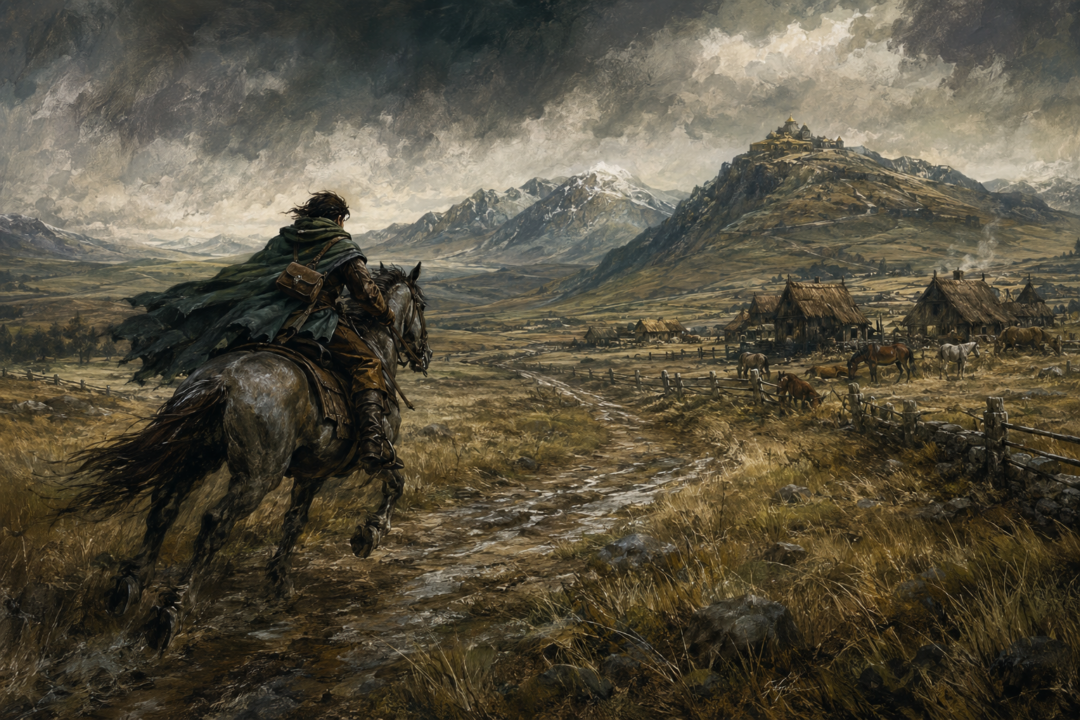
Rohan looks simple from a distance: a king in a golden hall, horsemen on an open plain, horns calling warriors to battle. But that image hides a practical problem. Most of the kingdom was not Edoras.
The Rohirrim occupied a broad country stretching from the Isen eastward toward the Anduin, with inhabited valleys beneath the White Mountains, settlements in the Westfold and Eastfold, and farms and homesteads scattered across the grasslands. Théoden himself remembers the Westfold as a rich country containing many homesteads before Saruman’s forces devastated it. Rohan was therefore not a compact city-state whose ruler could simply shout an order from the palace gates. PagePlace
Something had to connect the Golden Hall to people living many miles away.
The texts never describe a formal Rohirric civil service called “errand-riders.” Indeed, the character who explicitly introduces himself as an errand-rider is Hirgon of Gondor, carrying the Red Arrow to Théoden. But Rohan repeatedly uses mounted messengers, commanders, roads, muster-points, and regional authorities in ways that reveal the same underlying solution.
A horse-kingdom governed distance by riding across it.
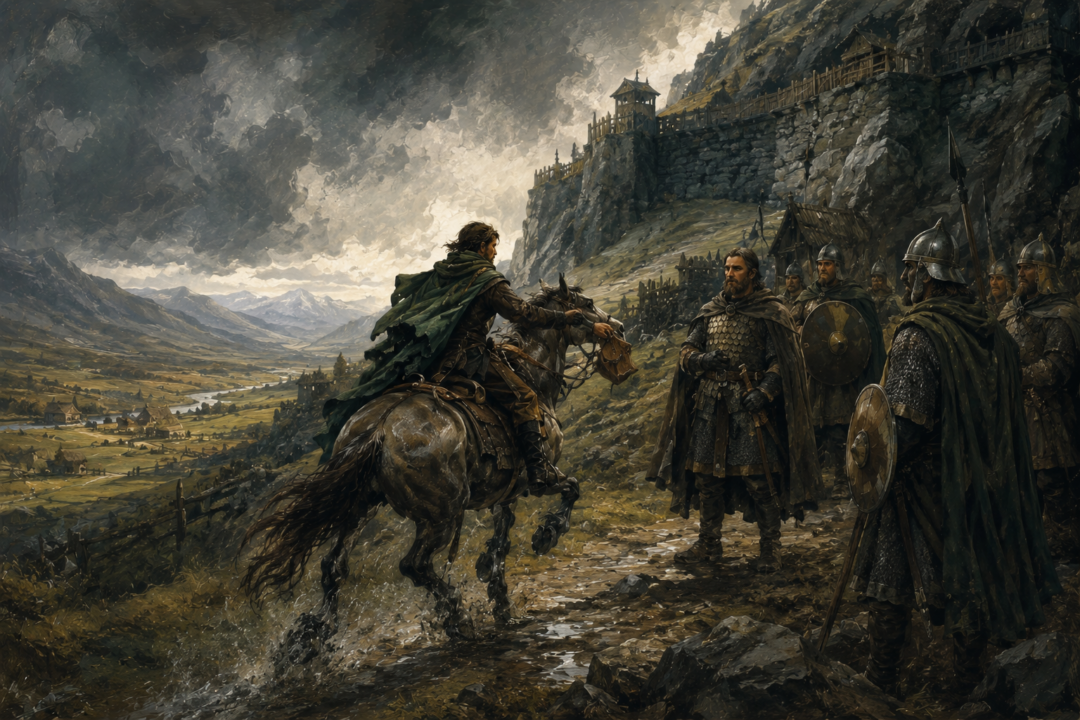
Rohan Was a Realm of Places, Not One Great City
Edoras was the royal seat, but Rohan’s political geography extended far beyond it. The military organisation described in Unfinished Tales divided the kingdom into territorial commands associated with Edoras and the lands to its east and west. Aldburg remained an important centre in the east, while the Hornburg anchored the western defence. The Muster of Edoras drew upon the King’s Lands and Harrowdale; western and eastern forces could likewise be assembled under their own commanders.
Encyclopedia of Arda
This matters because Rohan does not appear to have been governed through a dense chain of towns.
Its people could live far from Meduseld and still owe service to the king. During crisis, fighting men had to be summoned from separate districts, refugees directed toward strong places, warnings carried between commanders, and information returned to whoever held authority.
The horse therefore mattered politically as well as militarily.
The Rohirrim’s famous mobility was not merely useful once armies assembled. The same culture of mounted movement made it possible for royal decisions and urgent news to cross a dispersed country quickly enough to matter.
The Messenger Was the Missing Link Between Hall and Homestead
One revealing moment comes after the victory at Helm’s Deep.
Théoden does not simply ride away and assume that everyone somehow knows his intentions. Before his movements continue, “messengers have gone ahead” to Helm’s Deep with warning of his return and of the next stage of the journey. The king intends to move with men toward Dunharrow while avoiding unnecessary exposure on the open land. Isach
That small detail exposes an entire mechanism of government.
Orders could move separately from the king.
A ruler did not have to visit every settlement himself. A mounted messenger could reach a fortress, regional captain, or gathering-point before the main body arrived. That recipient could then pass instructions onward, prepare supplies, gather Riders, warn neighbouring communities, or alter local arrangements.
The texts do not provide a postal map of Rohan, and it would be too strong to claim that every isolated farm belonged to a formally organised courier circuit. What they do show is a society in which trusted riders routinely carried information between geographically separated centres.
In a kingdom built around horses, that was enough to shrink political distance dramatically.
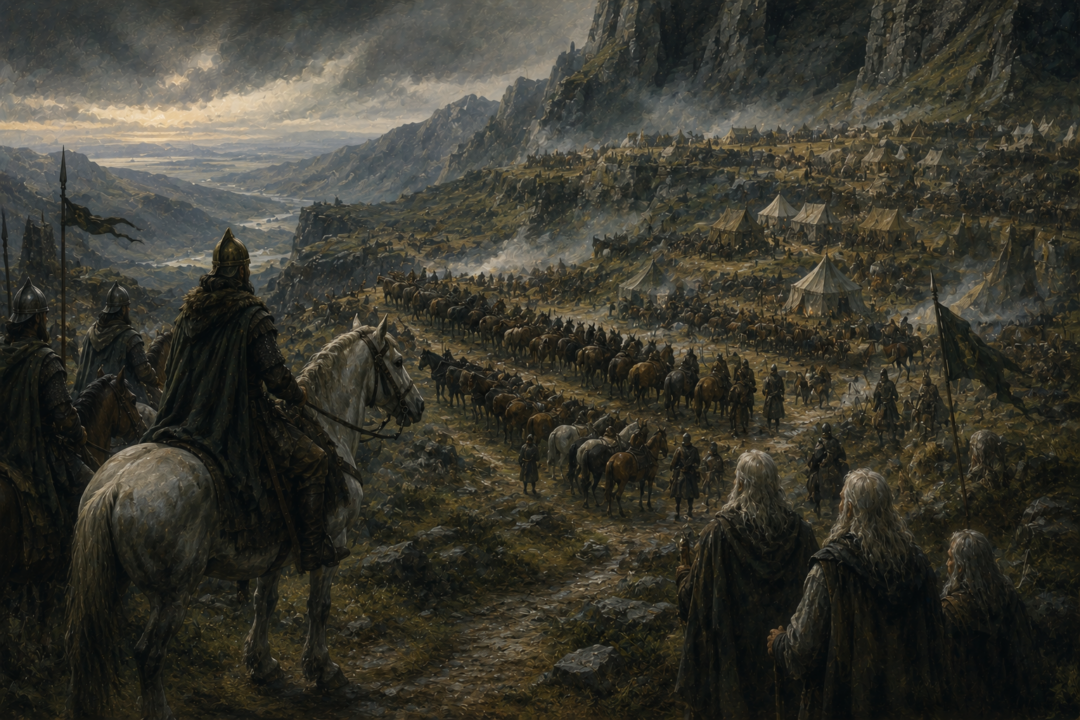
Muster Was Really a Communications Problem
The spectacular result of this system appears in the musters of Rohan.
A muster was not created merely by sounding one horn at Edoras. Men had to receive the summons wherever they were, prepare horses and weapons, leave local duties behind, and travel toward designated assembly points.
The Rohirrim’s military organisation made this manageable. A full éored after the reforms associated with King Folcwine was reckoned at not fewer than 120 Riders, while the theoretical Full Muster consisted of one hundred such units, excluding the King’s Household. The actual numbers available in any crisis were lower, but the organisation reveals that the kingdom thought of mounted manpower in structured units rather than as an undifferentiated mass. middle-earth.xenite.org
Just as importantly, forces were territorially distributed.
The western Riders could be gathered toward the Hornburg; Edoras commanded its own surrounding lands; eastern forces had their own sphere. During the War of the Ring, the surviving structure was strained and reorganised because Théodred had been killed and normal command arrangements had broken down.
Communication was therefore the invisible prerequisite of the famous cavalry charge.
Before thousands of Riders could appear together at Dunharrow, information had to reach thousands of individual lives.
Gandalf Shows How Quickly the Network Could Be Used
The gathering before the ride to Gondor gives an especially clear example.
Gandalf reaches Edoras before Théoden’s arrival at Dunharrow and brings the king’s instruction that the Riders should gather more quickly. When Théoden finally reaches Dunharrow, he finds not an empty mountain refuge awaiting orders, but an enormous assembly already forming: men, tents, horses, weapons, and supplies. Google Groups
The important point is not that Gandalf personally created Rohan’s communications system. He did not.
He exploited a system that already knew how to turn a message into mobilisation.
Someone receiving an instruction in Edoras could act on it while the king remained elsewhere. Local leaders could gather their people. Riders could converge from different regions. By the time Théoden arrived, political command had already produced physical movement across the kingdom.
That is what governability looks like in a low-technology horse society: not paperwork travelling between offices, but trusted words travelling between people who possess recognised authority.
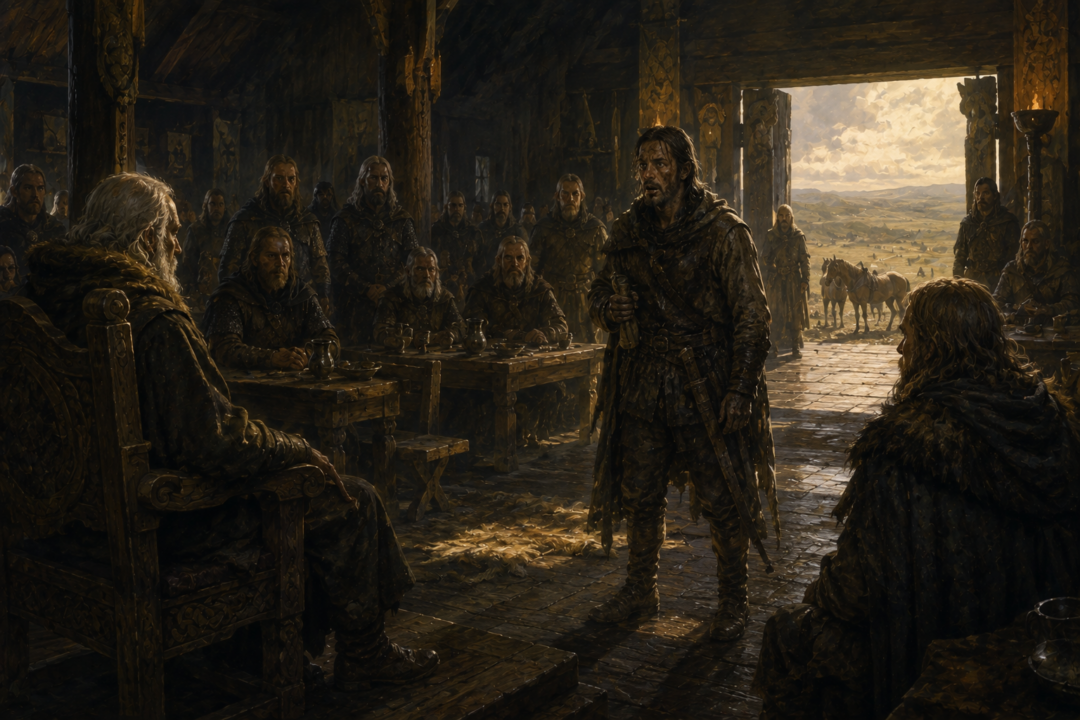
Regional Lords Prevented Everything From Depending on Edoras
Mounted communication alone would have been insufficient if every minor question still required Théoden’s personal answer.
Rohan also possessed delegated command.
The Marshals of the Mark held responsibilities connected with different portions of the realm, while men such as Erkenbrand exercised substantial regional authority in the west. The precise arrangements changed with circumstance, and Unfinished Tales makes clear that Théoden’s later reign suffered an unhealthy disruption of the usual command structure. After the War of the Ring, Éomer revised the organisation and established permanent Marshals of the East-mark and West-mark.
This territorial hierarchy made messages useful.
A rider arriving at the Hornburg did not need to find every farmer individually. He could bring news to a lord or captain capable of acting for the district.
That distinction is crucial. Communication becomes government only when the recipient has authority.
Rohan joined mobility to hierarchy.
Gríma’s Power Reveals What Happened When Communication Failed
The same system had a dangerous weakness.
Fast messages were useless if the ruler receiving them refused to act.
During the crisis on the Isen, the Rohirrim’s normal leadership had been badly disrupted. Théodred commanded in the west and Éomer in the east, while Théoden’s decline under Gríma’s influence weakened coordination at the centre. The later account in Unfinished Tales specifically treats the absence of a functioning First Marshal and the disturbed command arrangements as significant to Rohan’s vulnerability.
This gives the story a deeper political edge.
Rohan was not endangered because its people lacked courage or horses. It was endangered because a realm built on dispersed responsibility depended upon accurate information reaching a centre willing to make decisions.
Gríma did not need to destroy every road.
He only needed to poison the point where information became policy.
That is why Théoden’s recovery produces such an immediate transformation. Once the king again gives commands, riders begin moving, forces gather, regional leaders act, and the kingdom that seemed paralysed becomes mobile almost overnight.
The Red Arrow Shows the Same Principle on a Larger Scale
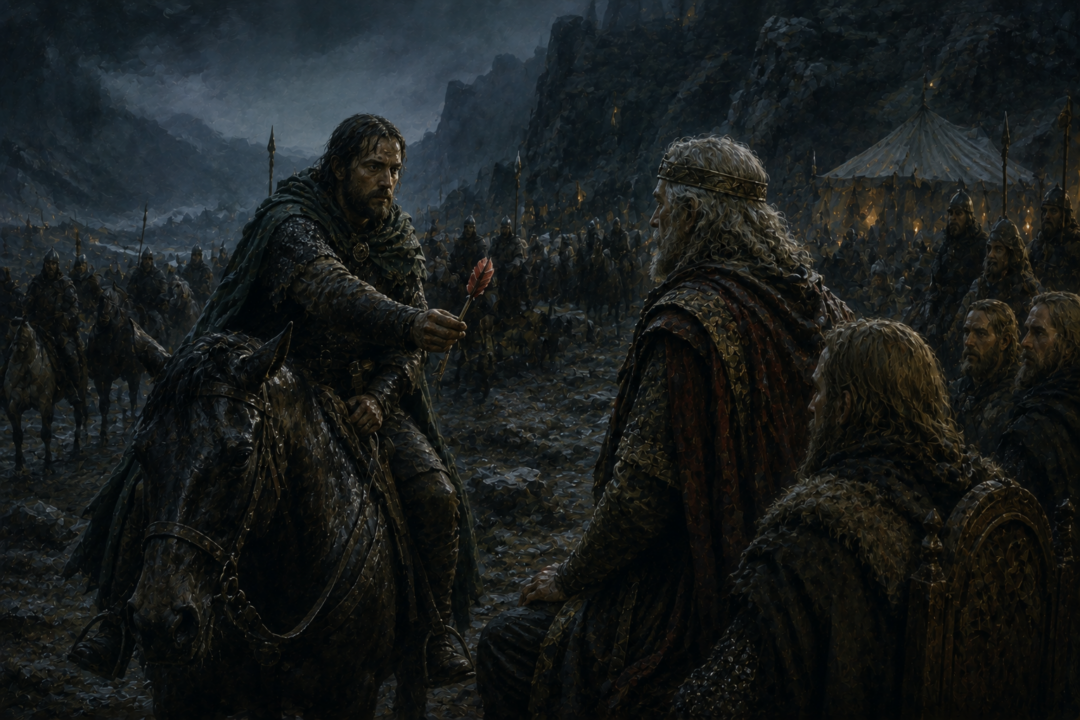
Hirgon’s arrival at Dunharrow expands this system beyond Rohan itself.
He is explicitly an errand-rider of Denethor. He carries the Red Arrow, Gondor’s urgent summons for aid, and personally delivers the Steward’s request to Théoden. Théoden can answer him directly, explaining that six thousand Riders will depart and discussing the practical problem of provisioning their march.
Here the messenger does more than transport an object.
He carries authority, information, questions, and an answer back toward the sender.
That is essentially the political technology on which both kingdoms rely: a trustworthy human being who can cross dangerous distance rapidly enough for one ruler’s intention to become another ruler’s knowledge.
Hirgon dies attempting the return journey. His fate is a grim reminder that communications in Middle-earth were physical things. Messages did not float invisibly between capitals. Someone had to carry them through the world, and the road itself could kill him.
Rohan’s Horses Were Part of the State
It is tempting to think of the Rohirrim’s horses chiefly as weapons of war.
They were more fundamental than that.
The texts never give us enough evidence to reconstruct a permanent nationwide Rohirric courier bureaucracy, and calling every mounted messenger an official “errand-rider” would go beyond what is stated. But the repeated pattern is unmistakable: messages ride ahead of kings; commands reach assembly points before armies arrive; regional officers control territorial musters; distant Riders converge when summoned; news travels between fortresses, settlements, and the royal hall.
The horse connected what geography had separated.
That helps explain how a kingdom of broad grasslands, mountain valleys, scattered homesteads, and only a handful of major centres could still act as one realm.
Rohan’s political unity was not produced by Edoras alone.
It was renewed every time someone mounted a horse with news that could not wait.
Sources & Notes
- https://tolkiengateway.net/wiki/Rohan — Tolkien Gateway: Rohan’s geography, settlements, population, military organization, and regional divisions.
- https://tolkiengateway.net/wiki/The_Muster_of_Rohan — Tolkien Gateway: the gathering at Dunharrow and the arrival of Gondor’s errand-rider Hirgon.
- https://tolkiengateway.net/wiki/Red_Arrow — Tolkien Gateway: Gondor’s physical summons carried by Hirgon to Théoden.
- https://tolkiengateway.net/wiki/Rohirrim — Tolkien Gateway: the mounted people, their organization, settlements, and ability to assemble forces across the Mark.
Sources cover Rohan’s dispersed geography, its muster structure, the Red Arrow mission, and mounted organization.