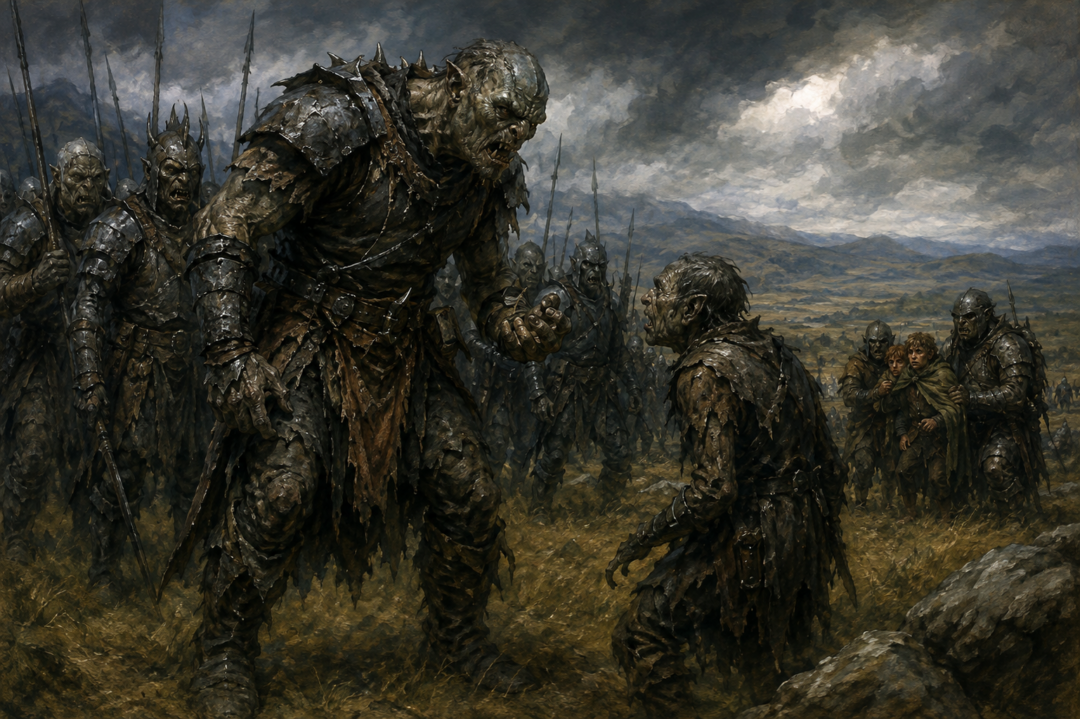
When Uglúk’s company races across Rohan with Merry and Pippin as prisoners, one small word exposes something easy to miss about Orc society.
“Snaga.”
It sounds like a name. In fact, The Lord of the Rings even presents individual Orcs who are addressed that way. But Appendix F gives the word a darker meaning. The lesser kinds of Orcs, it explains, were called snaga — “slave” — especially by the Uruk-hai.
That changes how several Orc scenes can be read.
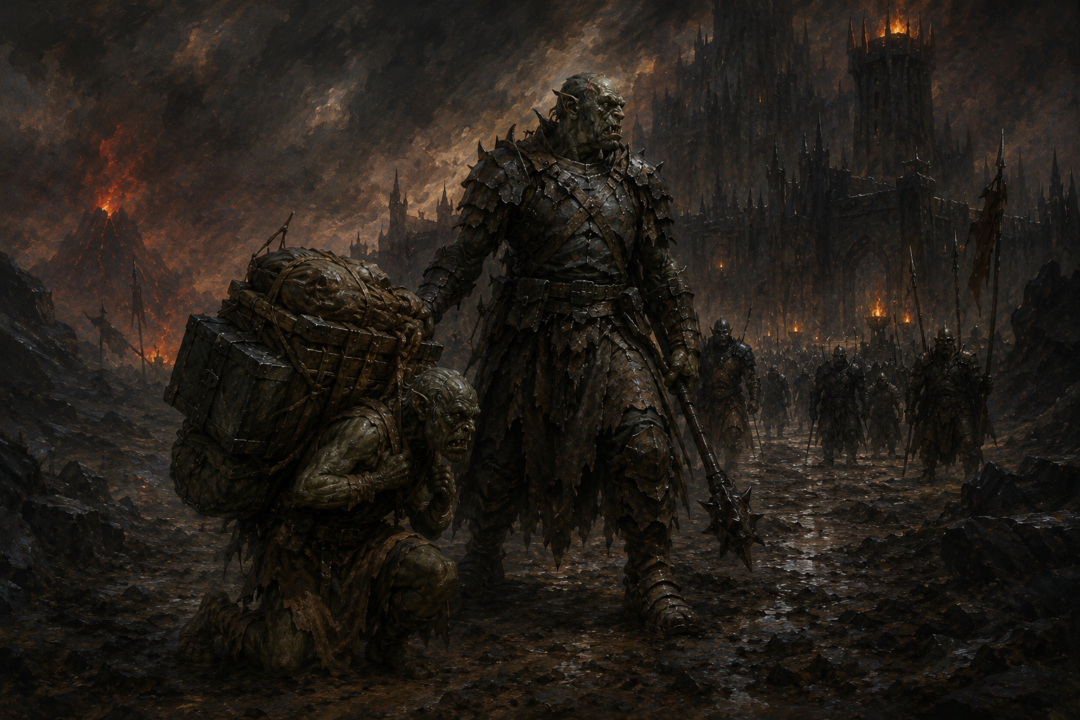
The Orcs are not simply a mass of interchangeable servants beneath Sauron and Saruman. Their conversations reveal ranks, rival groups, commanders, ordinary soldiers, scouts, and differences in physical stature and military status. And within that world, a stronger Orc can use a word meaning “slave” for a lesser one.
The result is a grim miniature of the societies created by the Enemy: domination does not stop at the top. It reproduces itself downward.
“Snaga” Is More Than an Orc’s Name
Two Orcs in The Lord of the Rings are associated with the word Snaga.
One appears among the Orcs carrying Merry and Pippin across Rohan. Uglúk, the leader of Saruman’s Uruk-hai, angrily addresses a scout as Snaga after the Rohirrim discover their trail.
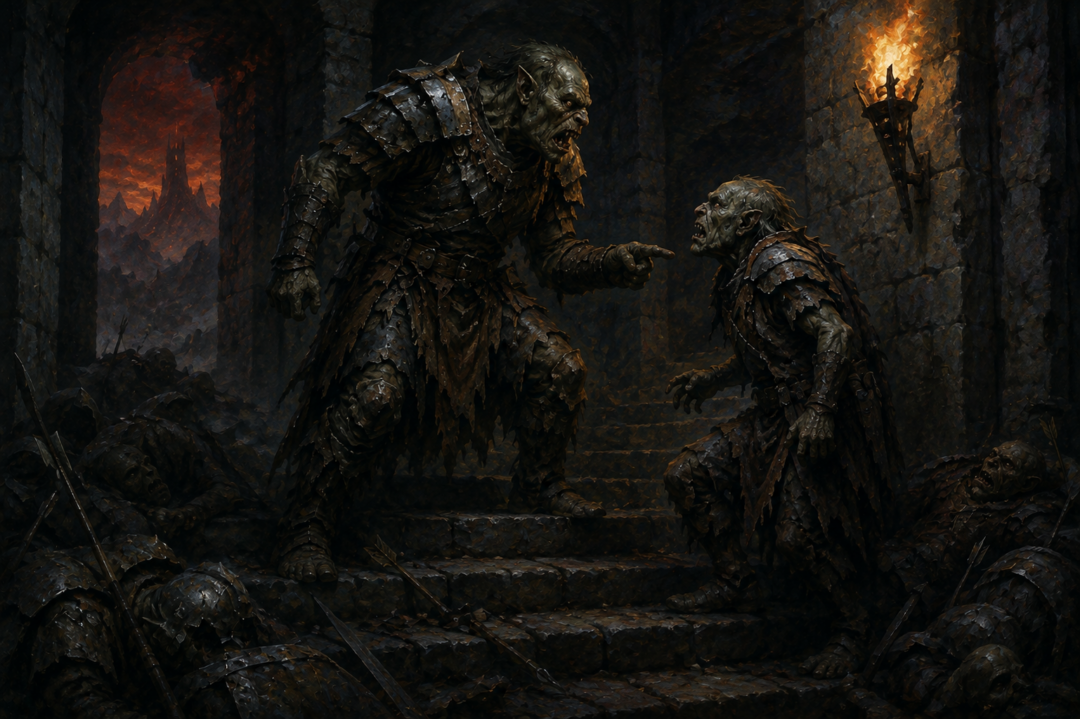
Another appears much later in the Tower of Cirith Ungol. After the disastrous fight between Shagrat’s and Gorbag’s Orcs, a smaller surviving Orc is repeatedly called Snaga.
If these passages were read alone, Snaga might simply look like an Orcish personal name.
Appendix F provides the crucial explanation. The Black Speech word uruk was normally applied to the great soldier-Orcs coming from Mordor and Isengard, while the lesser kinds were called snaga, meaning “slave,” especially by the Uruk-hai.
That makes the word socially revealing.
It can function in the narrative almost like a name, but its underlying meaning marks inferiority. When a powerful Uruk calls a lesser Orc Snaga, he is not merely identifying him. The language itself places that Orc below him.
Uglúk Draws the Line: “We Are the Fighters”
The scene in Rohan gives the distinction unusual clarity.
Uglúk’s mixed company is already divided. There are Saruman’s Uruk-hai, Orcs connected with Mordor under Grishnákh, and Orcs from the northern mountains. They quarrel over authority, destination, orders, and what should be done with the prisoners.
Uglúk considers his own troops superior.
After blaming Snaga and the other scouts for allowing the Rohirrim to discover them, he contrasts them with his own warriors: “we are the fighters.”
The implication is not that the lesser Orcs are incapable of fighting; the scout is part of an armed company. Rather, Uglúk is asserting status. His Uruk-hai are the hard marching, disciplined soldiers around whom he believes the expedition should be organized.
Appendix F makes his insult sharper. Calling the scout Snaga places him among the “lesser kinds.”
This is one of the clearest glimpses of hierarchy among Orcs because physical and military distinctions are reinforced through vocabulary. Uglúk does not speak as though every servant of Saruman possesses equal standing.
Some command.
Some are the fighters.
And some are called slaves.
The Same Insult Appears in Mordor
The pattern is not confined to Isengard.
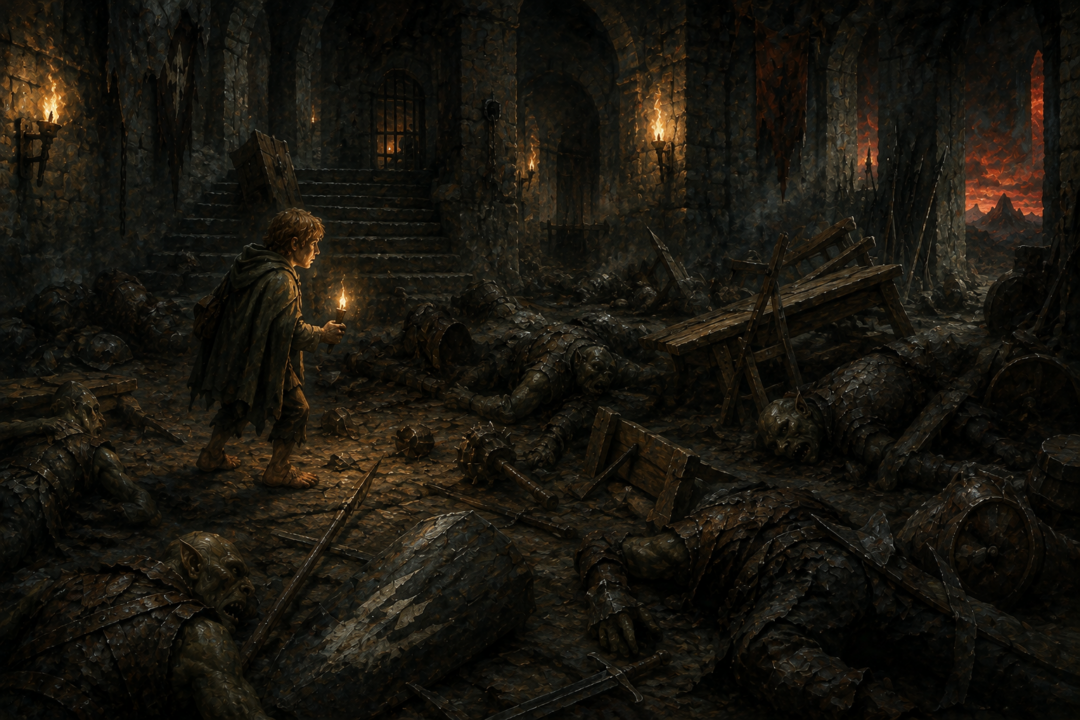
At Cirith Ungol, Sam enters the tower after the Orc garrison has effectively destroyed itself in a violent dispute. Shagrat, captain of the tower, survives, as does a smaller Orc whom the narrative calls Snaga.
When Shagrat orders him to go down again, the Orc refuses.
Shagrat responds with contempt, calling him Snaga and a “little maggot.”
Again, the combination matters.
The word associated with “slave” is directed downward by a larger, commanding Orc toward a smaller subordinate. Shagrat expects obedience and threatens violence when obedience fails.
Yet the lesser Orc is not mindless.
He argues. He refuses. He fears what is below. He insults Shagrat back and tries to evade him.
That detail prevents Orc hierarchy from looking like a perfectly functioning military machine. Authority exists, but it constantly requires intimidation.
The hierarchy is real precisely because the obedience is unstable.
Orc Society Runs on Coercion
This is where snaga reveals something larger than vocabulary.
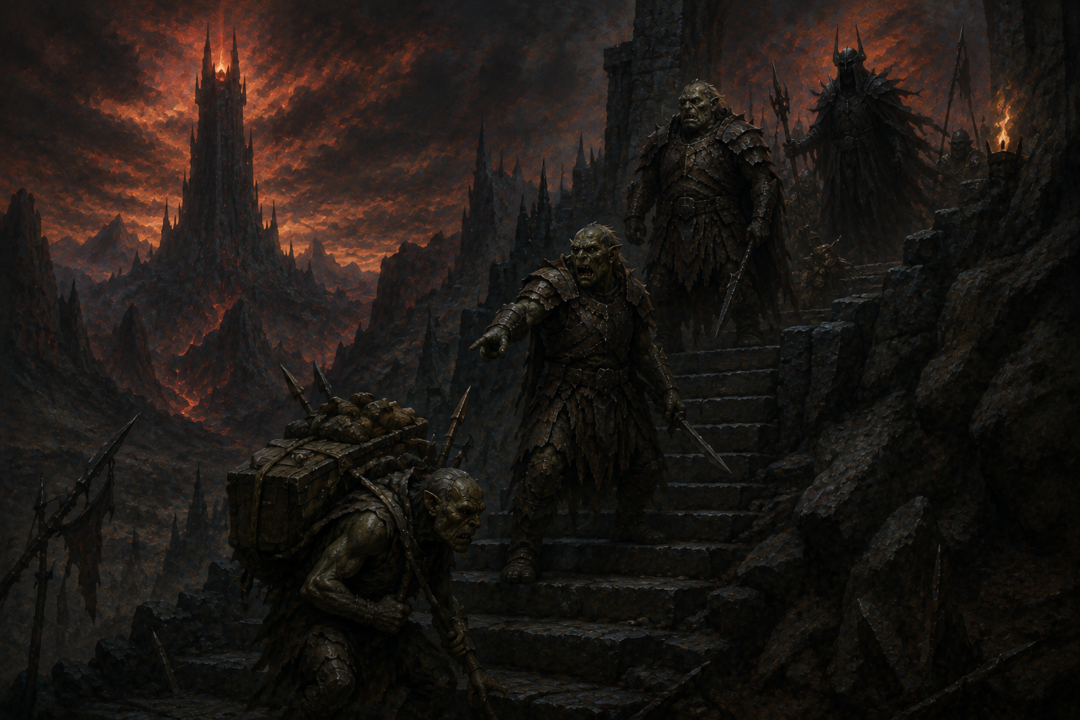
The Orcs repeatedly speak as creatures accustomed to being ordered, punished, watched, and threatened. Their commanders use violence against subordinates, while the distant authorities above them inspire even greater fear.
At Cirith Ungol, Gorbag and Shagrat speak with striking resentment about their situation. They imagine the possibility of escaping the great powers above them and setting up independently with a few trustworthy companions.
The fantasy is revealing.
These are servants of Sauron discussing, however vaguely, life beyond Sauron’s command.
Yet their imagined alternative is hardly a peaceful society. They talk like raiders dreaming of forming their own band and living by plunder. The texts do not suggest that freedom from Sauron would transform them morally.
Instead, the conversation shows that service to the Dark Lord is not built primarily on affection or loyalty. Fear, necessity, opportunity, discipline, and coercion all play visible roles.
The word snaga fits perfectly into that world.
Those who are dominated from above dominate whoever stands beneath them.
Not Every Orc Has the Same Status
It is tempting to speak of “the Orcs” as though Middle-earth contains one uniform Orcish type.
The text is more complicated.
Appendix F distinguishes the great soldier-Orcs known as uruks from lesser Orc kinds. The narrative also repeatedly notices differences in size, strength, origin, equipment, and organization.
Uglúk’s Uruk-hai take pride in their endurance. They boast that they can travel in daylight. They despise other Orc groups and assert Saruman’s authority.
Elsewhere, large fighting Orcs appear in Sauron’s service as well; uruk is not simply another word for “Orc of Isengard.”
That distinction is important. The hierarchy exposed by snaga should not be reduced to a simple movie-like division between “Saruman’s Uruk-hai” and “Sauron’s Orcs.” The terminology in the book is broader.
Uruks are associated with both Mordor and Isengard.
Snaga likewise describes lesser Orcs rather than a single political faction.
What we see is therefore something closer to an internal status distinction running through Orc military society.
Rank, Breed, and Command Are Not Exactly the Same Thing
There is also a limit to what can safely be concluded.
The texts do not provide a complete Orc social system. There is no canonical chart explaining Orc castes, inheritance, civilian institutions, or precisely how military rank related to the distinction between uruks and lesser Orcs.
So snaga should not be treated as proof of a formally codified slave caste with known laws and institutions.
What the text does establish is narrower and more interesting.
There were recognized lesser kinds of Orcs.
The Uruk-hai especially called them snaga, “slave.”
And actual conversations show larger or commanding Orcs applying the word contemptuously to subordinate Orcs.
That is enough to demonstrate hierarchy without inventing a bureaucracy Tolkien never describes.
Even the Powerful Orcs Are Servants
There is a brutal irony here.
Uglúk can call another Orc “slave.”
Shagrat can terrorize a smaller subordinate.
But neither is free.
Uglúk serves Saruman. Shagrat serves Sauron. Orders descend from authorities far beyond them, and disobedience can carry terrifying consequences.
The hierarchy therefore resembles a chain of domination.
At the bottom are lesser creatures bullied by stronger Orcs. Above them stand captains and Uruk soldiers with greater status. Above those commanders are powers such as Saruman or the Nazgûl. Ultimately, in Mordor, everything bends toward Sauron.
The Orc who calls another creature “slave” remains a servant himself.
That contradiction is central to the moral atmosphere of the Shadow.
Power under Sauron does not create genuine independence. It gives one servant permission to stand upon another.
The Tower of Cirith Ungol Shows Where This System Leads
The catastrophe at Cirith Ungol is the perfect ending to this pattern.
Frodo has been captured. His possessions should be valuable intelligence for Mordor. The Orcs have every practical reason to secure the prisoner, preserve the evidence, and report immediately to their superiors.
Instead, Shagrat’s and Gorbag’s companies quarrel over Frodo’s mithril coat.
Suspicion becomes violence.
The garrison tears itself apart.
By the time Sam enters the tower, the servants of Sauron have done much of his work for him.
This is not caused specifically by the word snaga, of course. But the disaster exposes the weakness of a culture held together by fear, rivalry, greed, and domination. Orcs cooperate effectively when sufficiently commanded, yet their conversations repeatedly reveal hostility beneath that cooperation.
The stronger bully the weaker.
Different companies distrust one another.
Captains compete.
Subordinates resent orders.
And when authority momentarily breaks down, the violence normally directed outward can turn inward.
One Black Speech Word Explains a Great Deal
Snaga is a tiny piece of vocabulary, but it opens a window into the machinery of the Enemy.
It tells us that Orcs recognized differences among themselves. The great soldier-Orcs could look down upon lesser Orcs strongly enough to call them “slaves.” Scenes involving Uglúk and Shagrat then show that contempt operating in practice through insults, threats, commands, and physical intimidation.
But the word contains an even darker irony.
No Orc in those scenes truly stands outside servitude.
The captain who humiliates his subordinate still answers to a master. The Uruk who boasts of being one of “the fighters” is still carrying out another power’s orders. Even comparatively powerful Orc commanders live beneath authorities they fear.
That may be the most revealing thing about snaga.
Inside the Shadow, being above someone else does not mean being free.
It merely means there is another servant beneath you.
Sources & Notes
- https://tolkiengateway.net/wiki/Snaga
- https://tolkiengateway.net/wiki/Black_Speech
- https://tolkiengateway.net/wiki/Orcs
- https://tolkiengateway.net/wiki/Uruk-hai
References for snaga, Black Speech vocabulary, Orc hierarchy, and the Uruk-hai.