The secret door into the Lonely Mountain seems, at first, like the sort of obstacle a burglar ought to solve.
Thorin possesses the key. Thrór’s Map identifies a hidden entrance. Bilbo has specifically been brought on the Quest of Erebor because the company needs someone capable of getting into places where thirteen Dwarves cannot simply march through the front gate.
Yet when they finally reach the door, none of those advantages is enough.
The entrance has no visible hinges, threshold, handle, or keyhole. The Dwarves cannot unlock it because, in the ordinary sense, there is nothing to unlock.
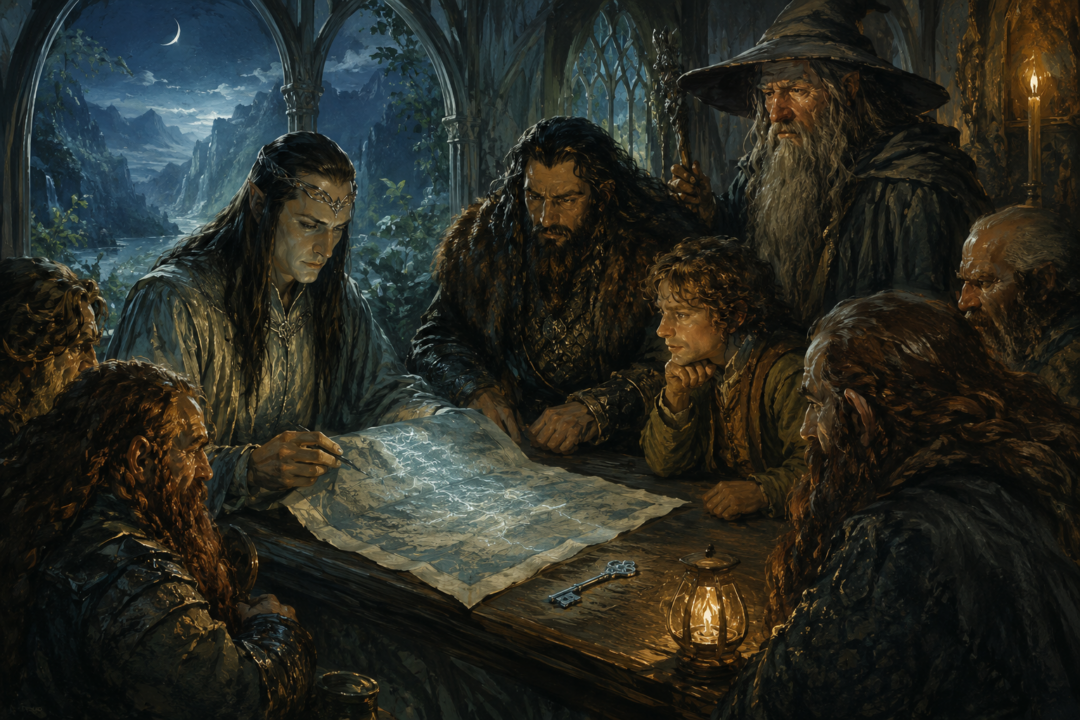
The real mechanism was revealed much earlier in Rivendell, when Elrond discovered the moon-letters on Thrór’s Map. Their instructions link the entrance to a grey stone, a knocking thrush, the setting sun, and the last light of Durin’s Day.
That changes the entire nature of the puzzle.
The key opens the door. But the calendar makes the lock available.
The Secret Is Hidden Twice
Thrór’s Map contains two different layers of secrecy.
The first is geographical. It shows a hidden entrance into Erebor, giving Thorin’s company an alternative to approaching Smaug through the Front Gate.
The second is informational.
The instructions for actually using that entrance are written in moon-letters: Dwarvish runes that remain invisible except under particular lunar conditions. Elrond explains in The Hobbit that ordinary moon-letters can be seen when moonlight shines through them, while more cunning examples can require the same moon phase and season under which they were written.
Thrór’s Map belongs to this more secretive kind. Elrond is able to read its hidden message at Rivendell because the necessary lunar conditions have returned.
So before the company even reaches Erebor, the quest has already become dependent upon celestial timing.
A physical map tells them where to go.
A lunar phenomenon tells them what to do when they arrive.
That distinction matters because the concealed entrance is not merely disguised architecture. Its usability depends on observing the correct moment.
What Durin’s Day Actually Means
When Elrond reads the moon-letters, Thorin explains the Dwarvish New Year.
The first day of their year is the first day of the last moon of autumn, on the threshold of winter. Thorin further says that the Dwarves still call it Durin’s Day when the last moon of autumn and the Sun can be seen in the sky together.
This is much less convenient than a fixed annual date.
A traveler cannot simply write “October 20” in a diary and assume that the door will reveal itself then. The reckoning depends upon the Moon and the season, and Thorin admits that even the Dwarves had difficulty determining beforehand exactly when the required day would fall.
That uncertainty is crucial.
The Quest of Erebor is therefore racing toward a deadline that its participants cannot precisely schedule.
They know the condition.
They do not possess a perfectly convenient method for predicting its arrival.
And if the moon-letters are taken literally, missing the correct sunset could mean losing the opportunity the map describes.
The texts do not explicitly tell us what would have happened had the company missed Durin’s Day, so it would go too far to claim that the door could never have been opened by another method. But the only method given to Thorin’s company requires this specific convergence.
Their problem is astronomical before it is mechanical.
Finding the Door Still Does Not Solve the Puzzle
Eventually Bilbo and the Dwarves locate the hidden entrance on the western side of the Mountain.
Even then, the situation looks hopeless.
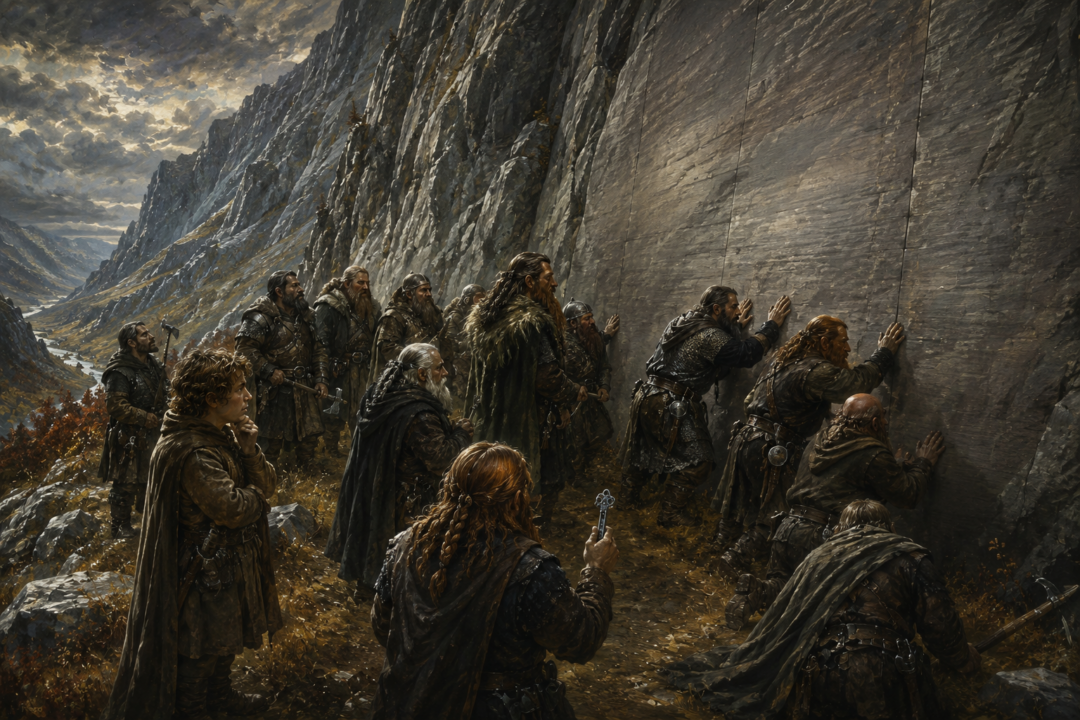
The company finds a smooth stone wall at the back of a steep-walled bay. There is no visible opening. They search for signs of a doorway and try to discover some concealed mechanism, but nothing answers them.
This is one of the cleverest reversals in the episode.
They have successfully found the door and are still effectively locked out.
That is because they continue, for a time, to treat the problem as craftsmanship that can be defeated through craftsmanship: inspect the stone, search for cracks, push, strike, examine.
But the missing component is not strength or locksmithing.
It is light.
The door is waiting for something the Dwarves cannot manufacture merely by working harder.
Bilbo Notices What Everyone Else Is Missing
The breakthrough comes from Bilbo.
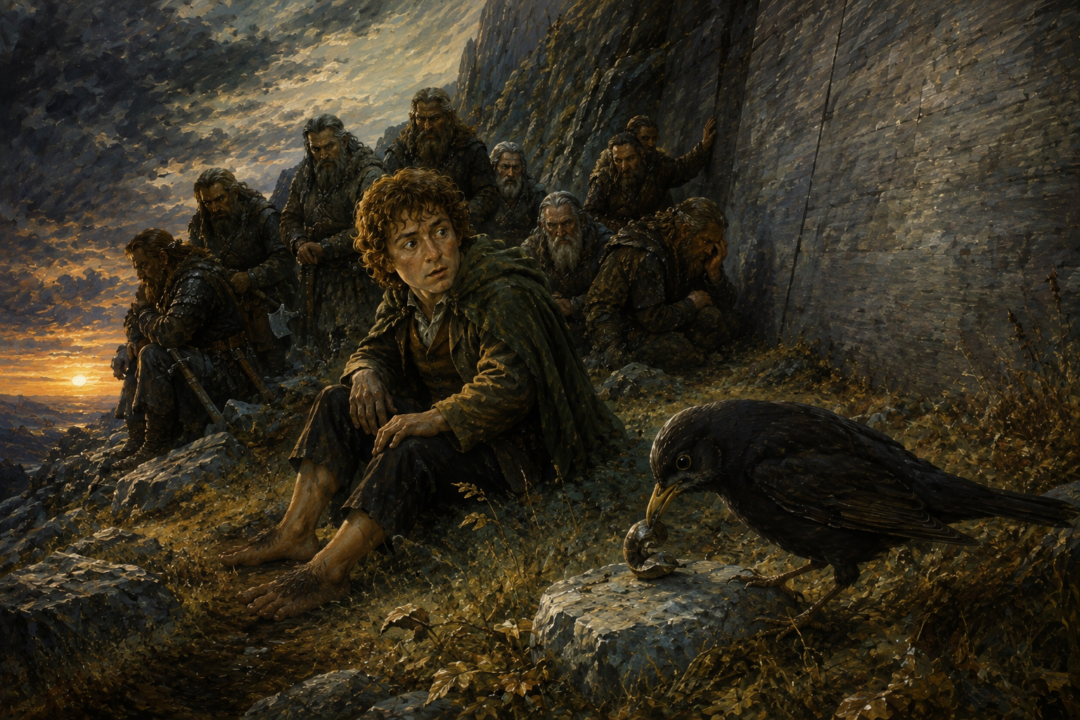
As autumn advances, the company grows discouraged. Bilbo sits outside and watches.
Then he sees a thrush.
The bird catches a snail and begins knocking it against the grey stone.
That mundane little sound transforms the scene because Bilbo remembers the hidden instructions from the map.
The thrush is not opening the door. Nor does the text require us to imagine that the bird deliberately arrives to operate some elaborate Dwarvish mechanism. What matters immediately is that its behavior tells Bilbo that the conditions described by the moon-letters are coming together.
He calls the Dwarves.
Then they wait for sunset.
The sequence makes Bilbo’s contribution especially appropriate. The Dwarves know their history, possess the map, possess the key, and understand Dwarvish traditions. Yet Bilbo is the one who recognizes that the clue has become present reality.
His essential skill here is attention.
The burglar succeeds before he ever enters the Mountain because he notices the moment.
The Sunset Is the Real Lockpick
For a while, even Bilbo appears to have been wrong.
The sun descends. Clouds interfere. The expected revelation does not come.
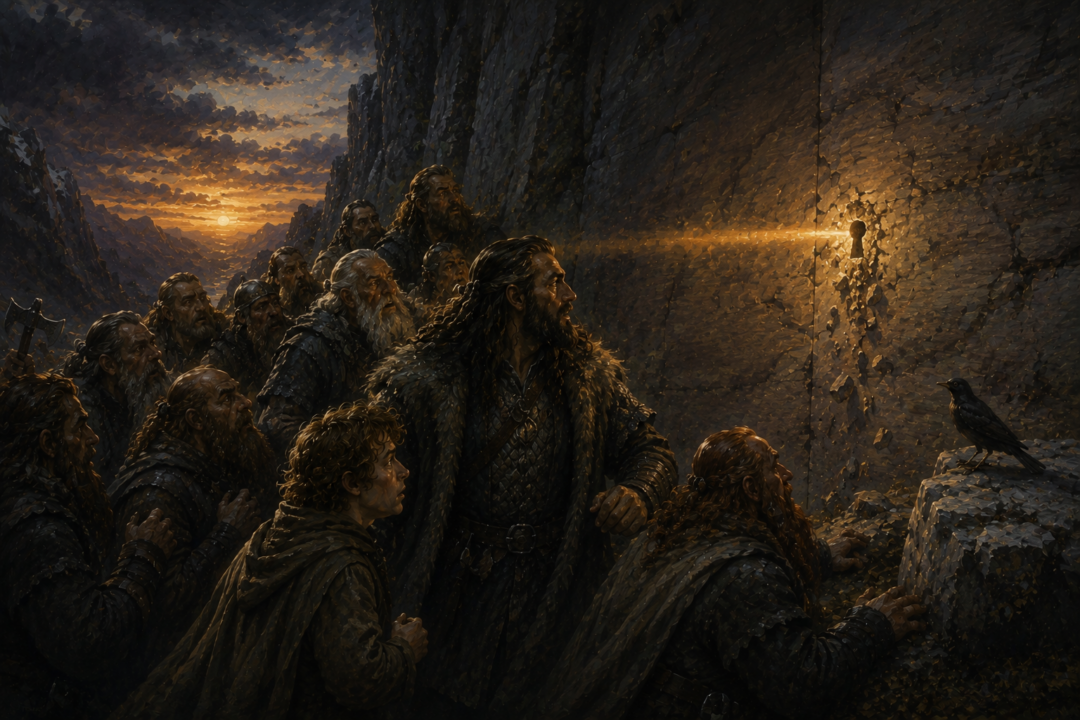
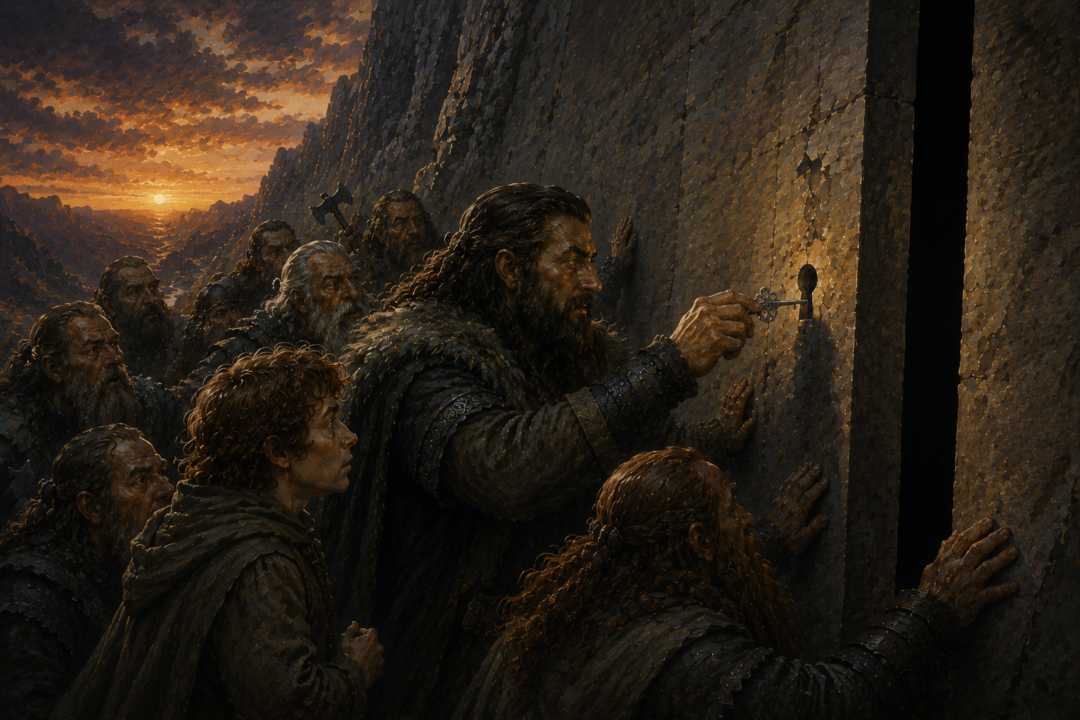
Then, at the final moment, a narrow gleam of sunlight reaches the stone face.
The rock cracks.
A flake falls away.
And a keyhole appears.
Only now can Thorin use the key.
That order is important.
The company does not insert the key and thereby reveal the entrance. The entrance first becomes accessible because the prescribed natural conditions expose the keyhole. Thorin then inserts the key, turns it, and the company pushes the concealed door inward.
The key is therefore necessary, but it is not sufficient.
Possessing it months earlier does Thorin no good.
Finding the correct wall does him no good.
Standing before the entrance with thirteen companions does him no good.
Only when place, season, lunar reckoning, sunset, and the sign of the thrush converge does the ordinary mechanical solution become possible.
The lock is the final step of the puzzle, not the first.
Dwarvish Secrecy Is Built Into Time
There is something fitting about such an entrance belonging to Erebor.
Dwarvish craftsmanship repeatedly blurs the line between engineering, art, and things outsiders would readily call magical. The hidden door is so perfectly integrated into the Mountain that the company cannot identify its boundaries from outside.
But its strongest protection may not be the seamless stonework.
It is the requirement that the user possess several different kinds of knowledge simultaneously.
Someone seeking the entrance needs to know where it is. They need the map. They need access to its hidden moon-letters or knowledge of their message. They need to understand Durin’s Day. They need to recognize the grey stone and the thrush’s knocking. They must be present at the correct sunset.
Finally, they need the key.
The result resembles a layered authentication system more than a conventional lock.
Stealing one component is not enough.
Even Smaug, after occupying Erebor for generations, apparently does not prevent Thorin’s company from using the Back Door. The text does not tell us what Smaug knew about the entrance, so we should not assume ignorance as a fact. What matters is that the door remains usable by Thorin and his companions without first confronting the dragon at the Front Gate.
The old Dwarvish secret has survived the kingdom that created it.
The Door Also Reveals the Weakness of Thorin’s Quest
There is an irony here.
Thorin’s expedition is driven by ancestral memory. He is returning to the kingdom of his forefathers with Thrór’s Map and the key that belonged to his house.
Yet inheritance alone cannot bring him inside.
The heir has the correct object.
He has the correct claim.
He has the correct destination.
He still needs Bilbo to recognize the moment when all those inherited things can finally be used.
That pattern anticipates one of the deeper tensions of the later story. Thorin possesses a powerful sense of what is rightfully his, but possession and rightful descent do not automatically produce wisdom. The quest repeatedly depends upon people and circumstances outside his own authority.
At the secret door, that dependence is beneficial.
Thorin does not conquer the Mountain by force. For one brief moment, his return depends upon patience, memory, observation, and a final ray of sunlight.
Why the Door Works So Well as a Tolkien Puzzle
The episode feels magical without being arbitrary because every piece has been established beforehand.
The map appears at Bag End.
The moon-letters are discovered in Rivendell.
Durin’s Day is explained long before the Mountain is reached.
The grey stone and thrush initially sound like cryptic details.
Then, at Erebor, geography and time finally overlap.
That is why the secret door is more interesting than a simple riddle carved beside a lock. The answer cannot be spoken whenever the travelers please. It cannot be solved in a library and carried ready-made to the Mountain.
The solution must happen.
A particular bird must knock upon a particular stone while the company stands in a particular place on a particular day, watching the dying sunlight.
Only then does the Mountain give them a keyhole.
And that is the overlooked brilliance of Erebor’s Back Door.
Thorin spends much of the journey carrying the key to his lost kingdom.
What he does not carry is the moment when the key will work.
Sources & Notes
- https://tolkiengateway.net/wiki/Erebor
- https://tolkiengateway.net/wiki/Thr%C3%B3r%27s_Map
- https://tolkiengateway.net/wiki/Moon-letters
- https://tolkiengateway.net/wiki/Durin%27s_Day
References for Erebor’s secret door, Thrór’s Map, moon-letters, and Durin’s Day.