When Frodo puts on the One Ring at Amon Hen, he expects escape.
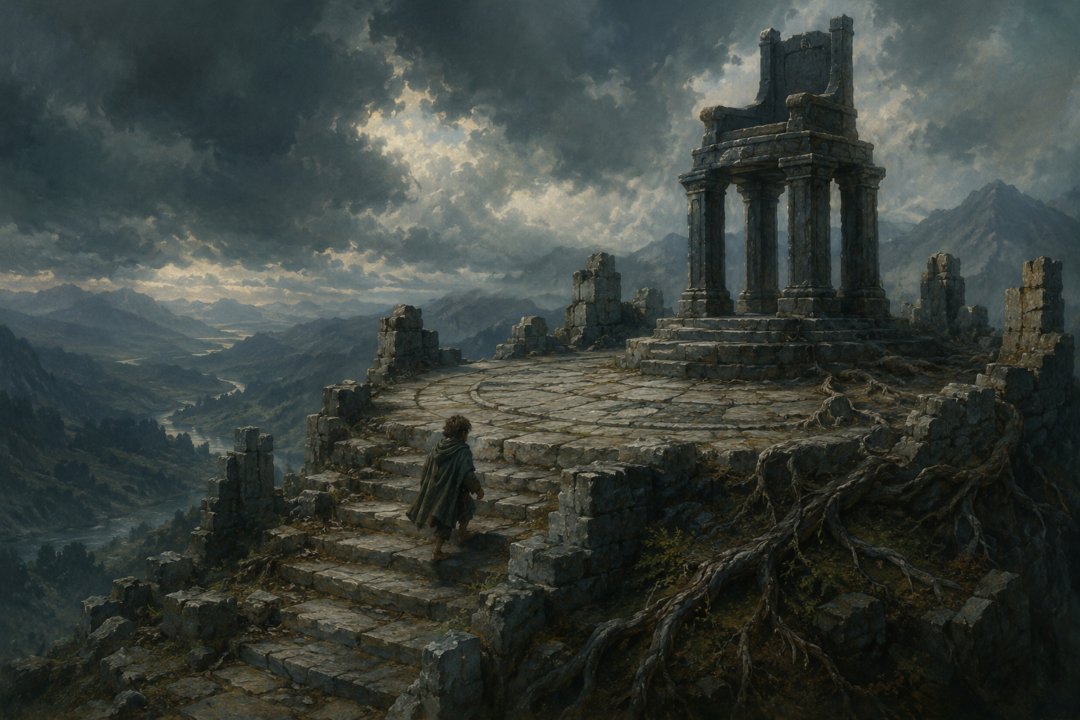
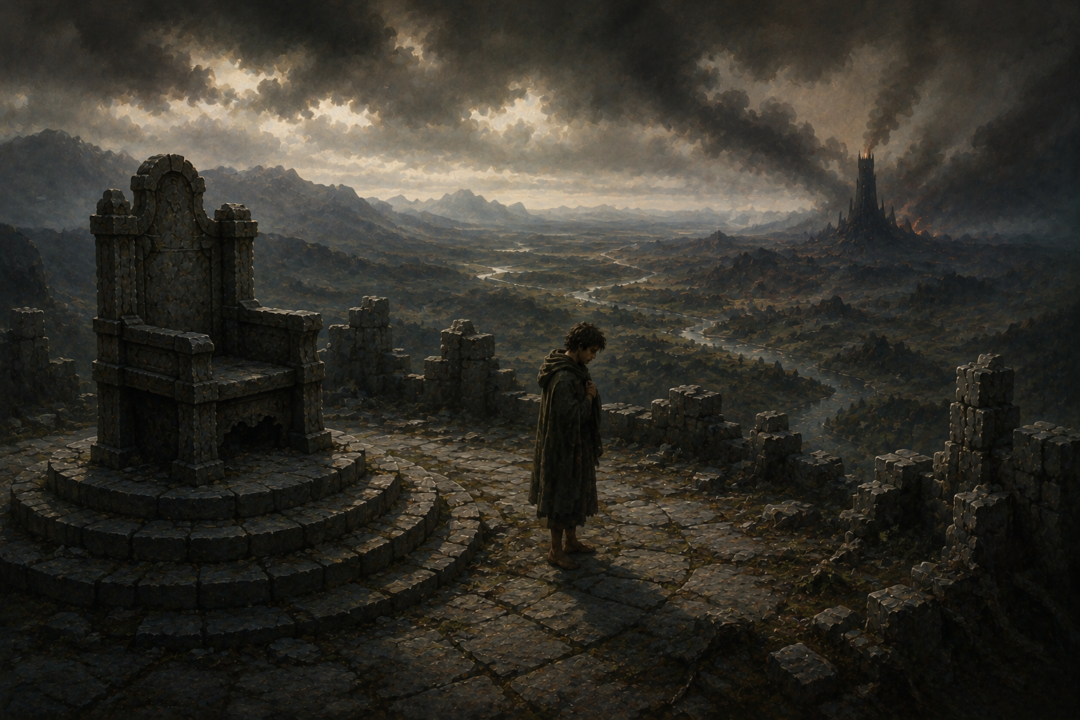
Boromir has tried to take the Ring from him. Frodo has fled, invisible, up the wooded slopes above Parth Galen. Eventually he reaches the summit and finds an ancient work of the Men of Númenor: a paved circle, ruined battlements, and a high chair raised upon carved pillars.
He sits.
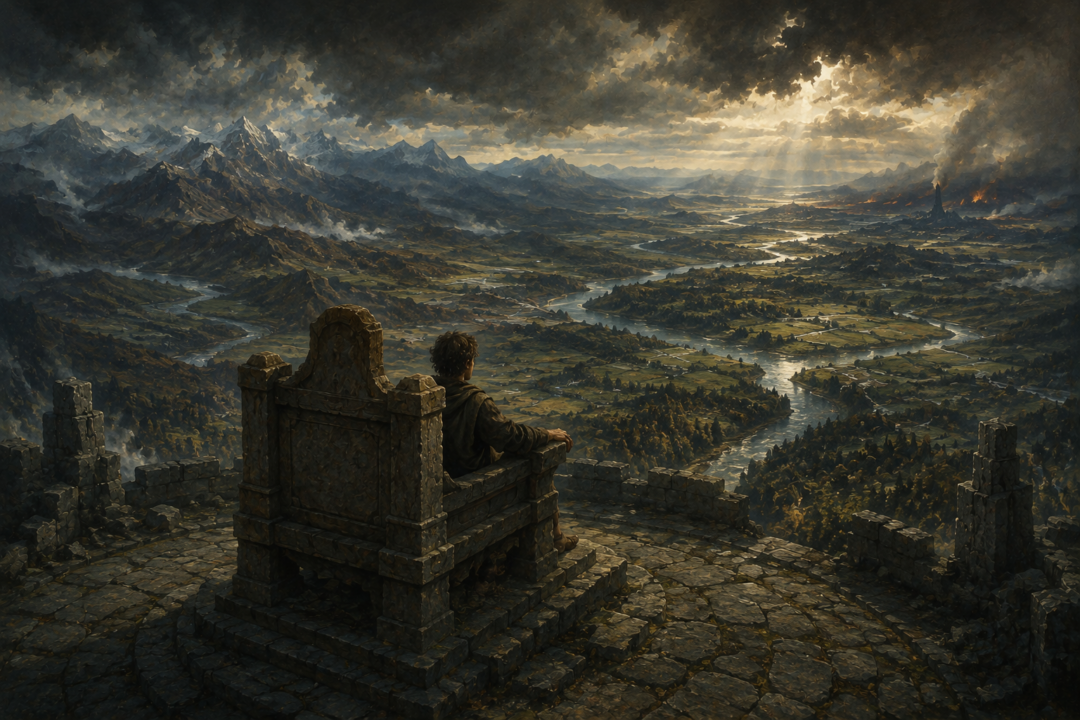
And suddenly Frodo can see Middle-earth.
Not merely the immediate world made strange by the Ring. He sees lands hundreds of miles away. Mountains seem small. The Anduin becomes a ribbon. His sight ranges toward Rohan, Isengard, Mirkwood, the distant mouths of Anduin, and eventually Mordor itself.
It is tempting to say that the Ring simply gives Frodo supernatural vision.
But the scene is more complicated than that.
The Ring is certainly involved. Yet the text deliberately identifies Frodo's location as the Seat of Seeing upon Amon Hen, the Hill of the Eye of the Men of Númenor. Earlier drafts make the relationship even clearer: the power of Amon Hen works upon Frodo even while the Ring initially leaves him amid mist and shadow.
What happens on the hill is therefore best understood not as a demonstration of the Ring alone, but as an extraordinary intersection of powers.
The Ring makes Frodo vulnerable to a terrible kind of perception.
Amon Hen gives that perception a vantage point.
And what Frodo sees from that vantage point changes his understanding of the Quest.
The Ring Does Not Normally Let Frodo See Across Middle-earth
Frodo has worn the Ring before.
At Weathertop, wearing it exposes him more fully to the Ringwraiths and the unseen world associated with them. At other moments, the Ring alters his relationship with ordinary perception and concealment. Its effects are profound, but they do not normally resemble what happens on Amon Hen.
Frodo does not routinely put on the Ring and inspect distant kingdoms.
That matters.
When he reaches the summit of Amon Hen, he is still wearing the Ring, yet his first experience is not expanded vision. Instead, the visible world is obscure. He finds himself amid mist and shadows.
Then the mist begins to clear.
The narrative immediately emphasizes where he is: the Seat of Seeing, upon the Hill of the Eye of the Men of Númenor.
This strongly suggests that Amon Hen is not incidental scenery.
The ancient place is participating in what Frodo experiences.
The surviving published text does not provide a technical explanation of exactly how the Seat works. Middle-earth rarely reduces such things to a mechanical system. But the association between Frodo's extraordinary sight and the Seat of Seeing is explicit enough that attributing everything to the Ring would miss an important part of the scene.
The Ring and the Seat are doing different things.
Amon Hen Is a Ruin of an Older Gondor
Amon Hen belongs to a landscape filled with memories of Númenórean power.
The Fellowship has just passed the Argonath, the enormous stone figures marking the old northern boundary of Gondor. Aragorn explains that the high seats upon Amon Hen and Amon Lhaw were made in the days of the great kings.
By Frodo's time, that world has faded.
The road climbing Amon Hen is broken. Roots have split the ancient stairs. The battlements at the summit are crumbling. Frodo approaches the high chair not as a king or guardian but as a frightened hobbit fleeing one of his own companions.
The contrast is deliberate and powerful.
A place once associated with the watchfulness of a great realm is occupied by someone who feels desperately small.
Frodo is described as resembling a lost child who has climbed onto the throne of mountain-kings.
Yet the ancient place still has significance.
Whatever its precise nature, the Seat of Seeing belongs to the Númenórean tradition of watching over immense distances and organizing the world from a position of height. Its counterpart across the Anduin, Amon Lhaw, is the Hill of Hearing.
These are not ordinary lookout points in the way a wooden watchtower might be.
Amon Hen gives Frodo something that physical height alone cannot explain: perception extending across enormous distances and even beyond intervening geography.
For a brief moment, the small Ring-bearer inherits the perspective of an ancient watch.
Frodo Sees the Scale of the War
The most important thing Frodo receives is not simply better eyesight.
It is scale.
Until Amon Hen, his Quest has largely been experienced through immediate dangers: Black Riders, the journey through the Old Forest, the attack at Weathertop, Moria, the loss of Gandalf, and the pursuit down the Anduin.
The wider war is known, but mostly through reports and warnings.
From the Seat of Seeing, that changes.
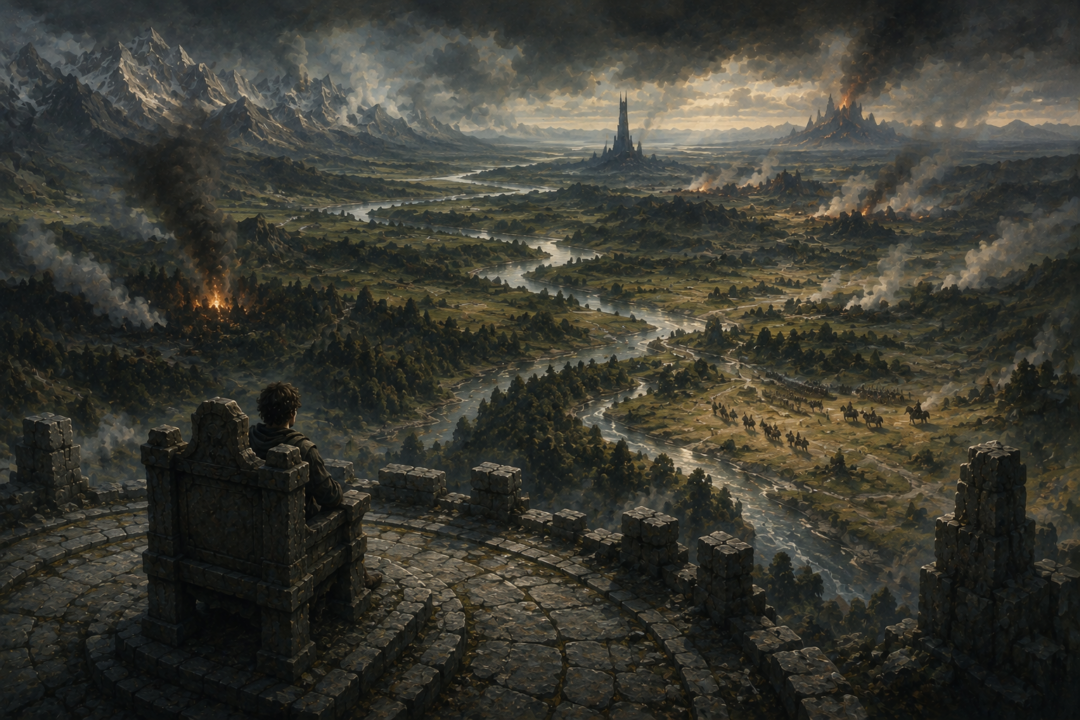
Frodo looks north, west, south, and east. He sees signs of conflict spreading across the world. Orcs move from the Misty Mountains. Trouble reaches the lands around Mirkwood and the Beornings. Smoke hangs near Lórien. Horsemen cross Rohan. Isengard is active. Forces move from the East and South.
The scattered dangers suddenly become one pattern.
Sauron's war is not waiting for Frodo to reach Mordor.
It has already begun.
This is one of the crucial gifts of Amon Hen: it turns abstract warnings into visible reality.
Frodo sees that the War of the Ring is not fundamentally about his own survival, or even about the survival of the Fellowship.
Whole peoples are already being drawn into it.
That realization helps explain the decision that follows.
Then Frodo Looks Toward Mordor
His vision eventually turns eastward toward the heart of the threat.
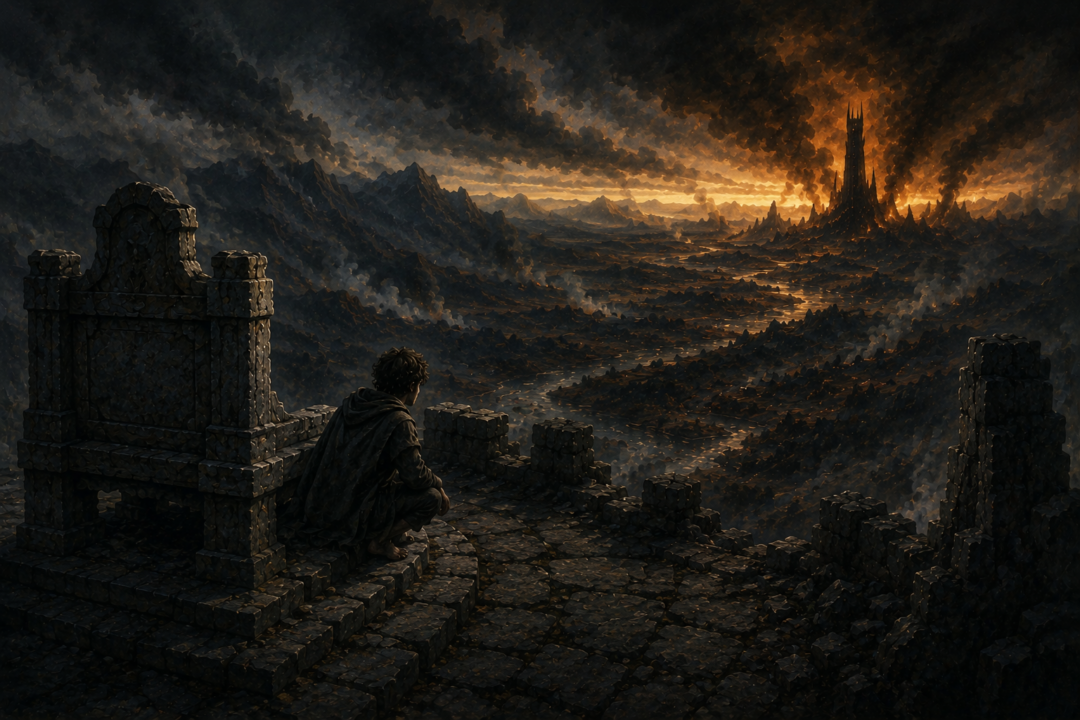
There stands Barad-dûr.
And here the experience changes.
Until this point Frodo has been the observer. Now he begins to feel observed.
He becomes aware of the Eye searching for him.
This is where the Ring's role becomes especially dangerous. Amon Hen has expanded Frodo's field of perception, but the Ring connects him to the power whose attention he most needs to avoid.
The watcher becomes visible to another watcher.
That reversal is central to the scene.
Amon Hen is the Hill of the Eye, an ancient place of Númenórean sight. But beyond it lies another kind of seeing: Sauron's relentless search for the Ring.
The two forms of vision are morally different.
The Seat allows Frodo to witness.
Sauron's Eye seeks to locate, seize, and dominate.
Yet Frodo, while wearing the Ring, is caught between them.
For an instant the ancient Seat has raised him high enough to survey the struggle of Middle-earth. The Ring simultaneously threatens to make him detectable to the very power he is surveying.
Knowledge has become exposure.
A Third Power Intervenes
At the critical moment, Frodo becomes aware of another command urging him to remove the Ring.
The speaker is not identified during the scene itself. Later, in Fangorn, Gandalf reveals that he had struggled with the Dark Tower while sitting in a high place, and that the Shadow passed.
The connection makes clear that Gandalf was involved in the contest surrounding Frodo on Amon Hen.
That means Frodo's experience cannot be reduced to a simple equation of “Ring equals supernatural sight.”
Several forces meet there.
There is Frodo himself, still capable of choosing.
There is the Ring.
There is the ancient Seat of Seeing.
There is Sauron's searching will.
And there is Gandalf resisting that search from afar.
For perhaps the most dangerous instant of the Fellowship's journey, Frodo stands at the intersection of powers vastly greater than himself.
But none of them completely removes his agency.
He takes off the Ring.
That is essential.
The Seat can show him.
The Ring can expose and tempt him.
Sauron can search for him.
Gandalf can warn and resist.
But Frodo must still act.
Aragorn Shows Why the Ring Matters Too
There is another clue that Amon Hen cannot simply be treated as an automatic magical telescope.
Aragorn later reaches the summit and sits in the high seat.
He does not receive Frodo's extraordinary panorama of Middle-earth.
He looks out and sees little that answers his immediate questions, though he does glimpse a great eagle far away.
This prevents an overly simple interpretation.
If Amon Hen alone always granted every visitor the same enormous range of supernatural vision, Aragorn's experience would be difficult to explain.
The safest conclusion is therefore that Frodo's vision arises from a combination of circumstances rather than one isolated cause.
Amon Hen is genuinely the Seat of Seeing.
The Ring has altered Frodo's relationship with the seen and unseen.
Sauron is actively searching.
And Frodo himself has become increasingly perceptive through experiences that have already wounded and changed him.
The texts never provide a precise formula assigning percentages of the vision to each factor.
They do not need to.
What matters is that Amon Hen supplies something the Ring by itself has never supplied Frodo before: a place from which the vast geography of the conflict becomes perceptible at once.
The Vision Answers Frodo's Real Question
Before climbing the hill, Frodo is facing a decision.
The Fellowship has reached the point where its road must divide. Boromir wants to go to Minas Tirith. Frodo knows that his own road ultimately leads toward Mordor.
Then Boromir tries to seize the Ring.
That failure could have taught Frodo only that Boromir is dangerous.
Instead, Amon Hen shows him something larger.
He sees the whole world moving toward war.
He understands that the Ring is already placing those around him in danger—not merely because enemies may attack them, but because possession of the Ring can corrupt desire from within the Fellowship itself.
Frodo therefore resolves to continue toward Mordor alone.
Whether every element of his reasoning is strategically correct is another question; Sam immediately proves that Frodo cannot entirely choose isolation. But morally, the decision is revealing.
Frodo has been shown immense power, armies, kingdoms, towers, and war.
His response is not to seek greater power.
It is to accept a heavier burden.
Amon Hen Gives Frodo Perspective
That may be the deepest answer to what Amon Hen gives Frodo that the Ring alone does not.
Perspective.
The Ring continually narrows moral vision toward possession: what could be done with it, who should hold it, who might take it, whether it might provide safety or victory.
Amon Hen does the opposite.
It widens Frodo's vision until his private fear becomes part of the suffering of an entire world.
He sees kingdoms and battlefields. He sees enemies gathering. He sees how small he is.
And then, almost immediately, he has to choose.
The irony is that one of Frodo's greatest moments of sight occurs while he possesses an object associated with deception, domination, and the desire for power.
The Ring does not give him wisdom.
Seeing more does not automatically make anyone wise.
But on the ruined watchtower of an older kingdom, Frodo is briefly allowed to understand the scale of what is at stake.
Amon Hen does not make him powerful enough to defeat Sauron.
It shows him why trying to become that kind of powerful would be the wrong answer.
He leaves the Seat of Seeing still frightened, still vulnerable, and still carrying the Ring.
But he leaves knowing where he must go.
And in the end, that clarity matters more than the vision itself.
Sources & Notes
- https://tolkiengateway.net/wiki/Amon_Hen
- https://tolkiengateway.net/wiki/Seat_of_Seeing
- https://tolkiengateway.net/wiki/Frodo_Baggins
- https://tolkiengateway.net/wiki/Breaking_of_the_Fellowship
References for Amon Hen, the Seat of Seeing, Frodo, and the Fellowship’s breaking.