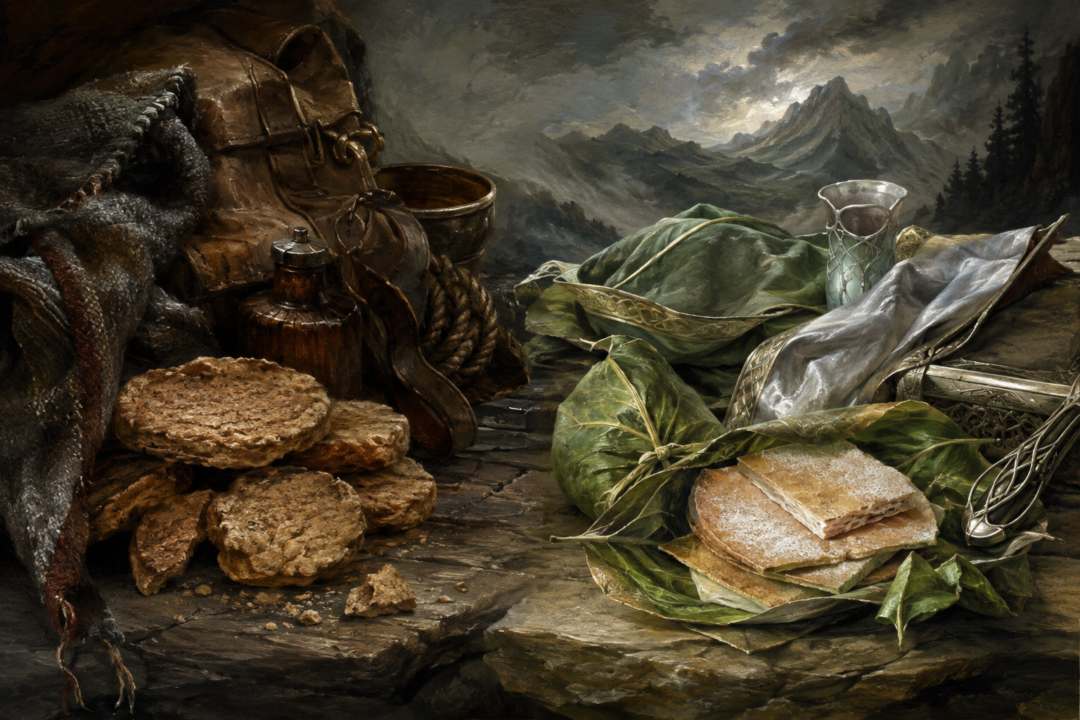
Cram and Lembas Reveal Two Very Different Cultures of Travel
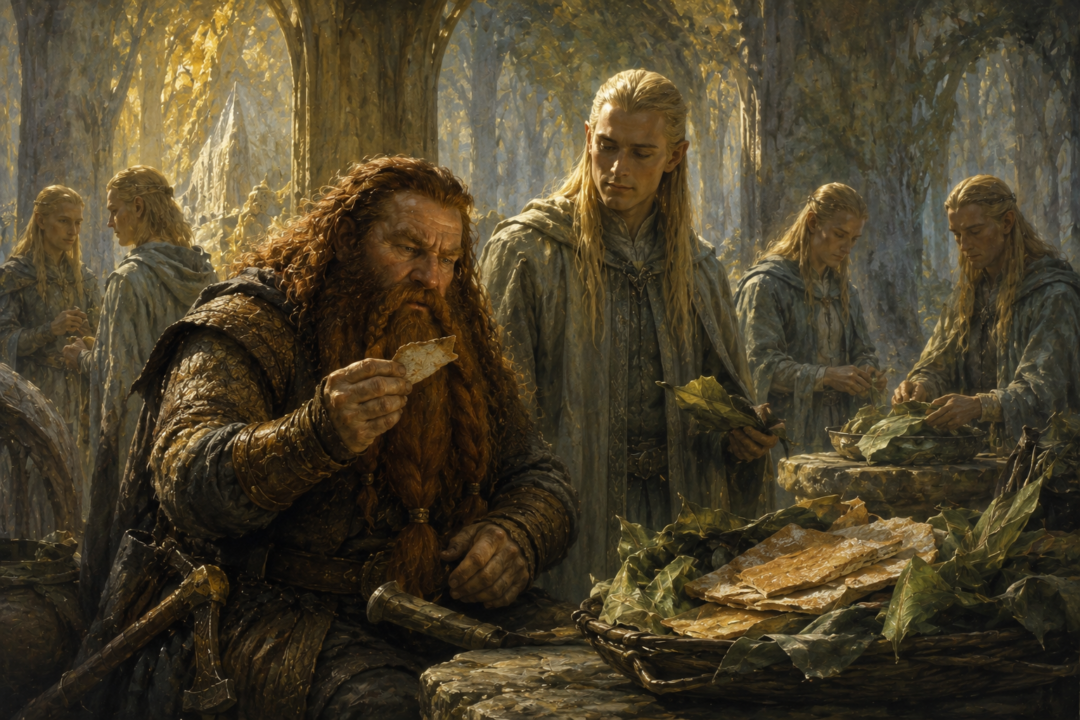
When Gimli is handed a thin cake of Elvish waybread in Lothlórien, his first reaction is not awe. It is recognition.
He thinks it is something like cram: the durable travelling food made by the Men of Dale.
That small comparison in The Fellowship of the Ring creates one of Middle-earth’s most revealing contrasts. Cram and lembas solve essentially the same problem. Both are compact provisions meant to sustain travellers far from ordinary kitchens and settlements. Yet the similarities quickly end.
Cram belongs to a practical culture of endurance. Lembas belongs to an Elvish tradition in which nourishment, craftsmanship, hospitality, and the preservation of life are difficult to separate.
The difference is not simply that Elves make better food.
It is that two cultures have looked at the same question — what should a traveller carry into the wilderness? — and produced answers reflecting very different relationships with necessity, beauty, and the road itself.
Cram Is Food Designed to Survive the Journey
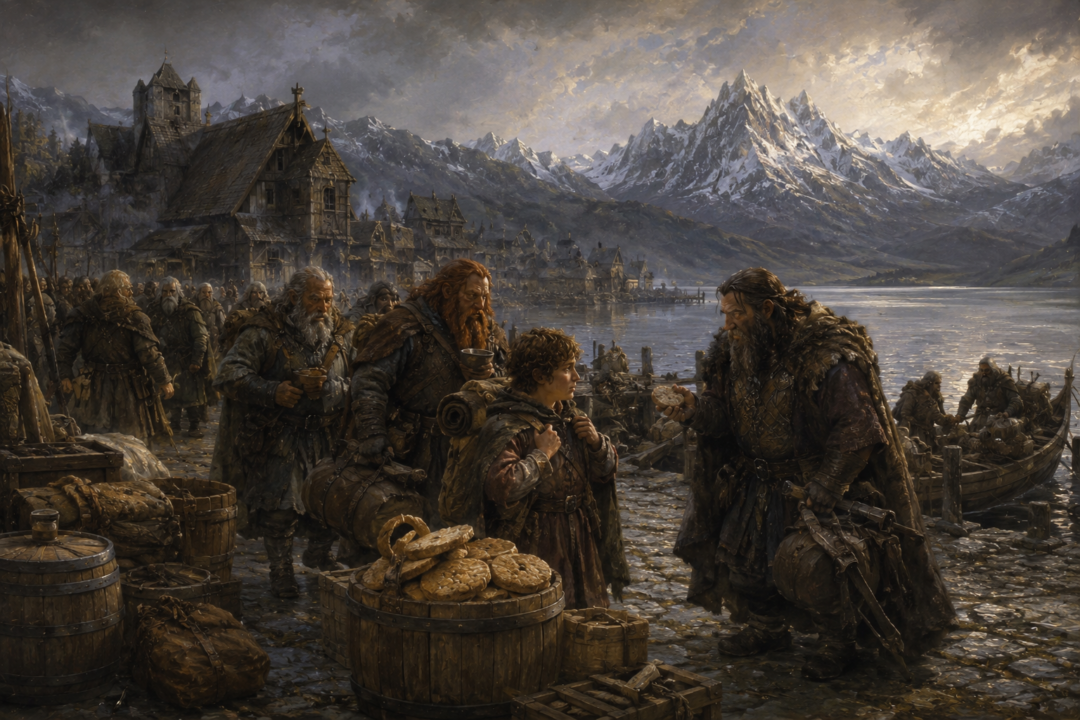
Cram appears in The Hobbit when Bilbo and Thorin's company leave Lake-town for the Lonely Mountain.
The Lake-men provide them with supplies, including the hard travelling food called cram. The text describes it as a biscuit-like preparation that is nutritious and keeps well, although it is not especially enjoyable to eat. It is associated again with Dale in The Fellowship of the Ring, when Gimli identifies it as something the Men of Dale make for journeys in wild country.
Its purpose is wonderfully straightforward.
Cram exists because travellers need calories that can be carried for a long time.
That makes perfect sense for the peoples around the Lonely Mountain. Their world is connected by roads, rivers, trade, hunting, and difficult journeys through large stretches of dangerous country. A provision that is compact, durable, and nourishing has obvious value.
Nothing in the texts suggests that cram possesses supernatural properties. It is simply very effective food.
And that simplicity matters.
Cram represents an extremely human answer to wilderness: prepare something tough enough to last, carry enough of it, and endure.
It does not need to transform the traveller's experience. It only needs to keep the traveller moving.
Gimli Immediately Understands What Lembas Is For
When the Fellowship prepares to leave Lothlórien, the Elves bring provisions for the road. Among them are thin cakes, brownish on the outside and cream-coloured within.
Gimli initially suspects that they are a form of cram.
His mistake is completely reasonable.
He is an experienced traveller, and he recognizes the category before he understands the particular food. Here is something compact, baked, portable, and apparently intended to sustain people on a long journey.
Then he tastes it.
The Elves explain that they call it lembas, or waybread, and that it is more strengthening than food made by Men. Gimli enthusiastically admits that it is far better than the cram he knows.
The scene is humorous, but it establishes an important distinction.
Cram and lembas occupy the same practical niche.
They are not the same thing.
The comparison therefore gives readers a scale. We do not have to imagine lembas merely as vaguely magical bread. Gimli gives us an ordinary Middle-earth equivalent against which it can be measured.
Cram is what skilled mortal peoples can produce for travellers.
Lembas is what the Elves produce when answering the same need.
Lembas Is More Than Efficient Nutrition
Reducing lembas to an extremely concentrated ration misses much of what the texts actually emphasize.
It is sustaining, certainly. A small amount can support extraordinary exertion. The Fellowship is warned not to consume it casually, because its strength becomes especially apparent when travellers rely upon it without other food.
But lembas is also pleasant to eat. It retains its freshness when properly wrapped. The Fellowship receives the cakes wrapped in mallorn leaves, preserving them for the road.
Most importantly, its significance increases as ordinary food disappears.
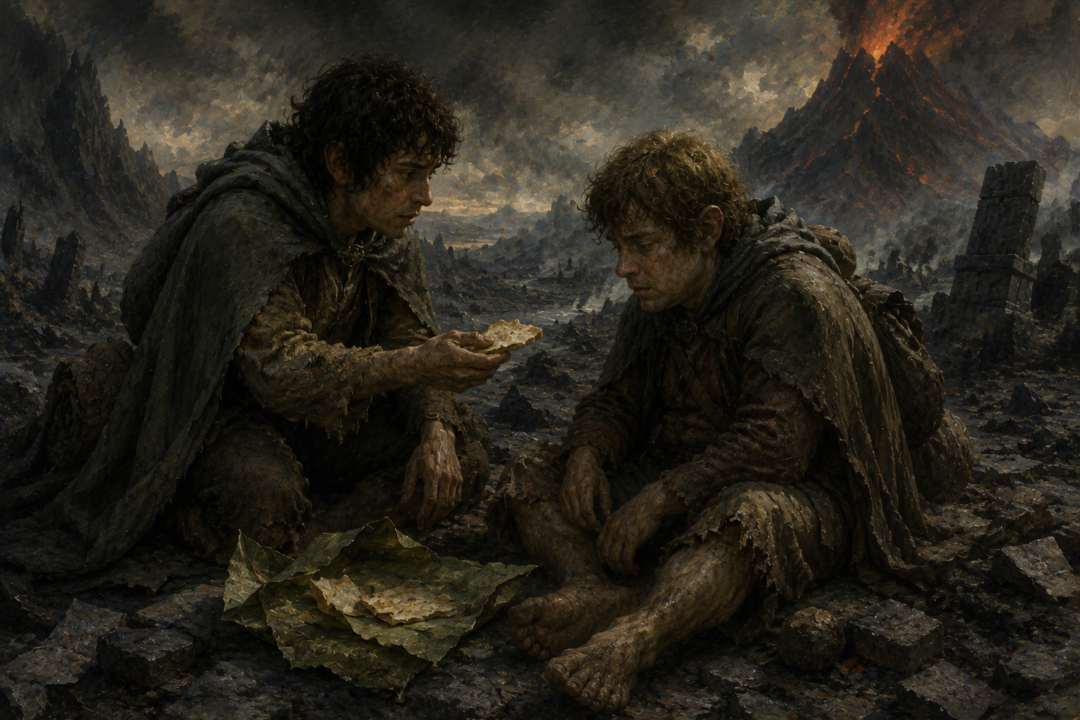
This becomes particularly clear during Frodo and Sam's final journey through Mordor.
By then, almost everything associated with comfort has been stripped away. They have little water. Their strength is failing. The landscape offers almost nothing wholesome. Yet they still possess lembas.
The bread does not remove exhaustion or make them invulnerable. It does not solve the problem of thirst. It cannot erase Frodo's burden.
It sustains them.
That distinction is essential.
Lembas does not make the road easy. It enables someone to continue along a road that remains terrible.
The History of Lembas Makes the Contrast Deeper
Later writings concerning lembas give the food a much older and more ceremonial background than cram.
In traditions associated with the First Age, lembas is connected with Melian in Doriath. In The Silmarillion, Melian gives Beleg a store of lembas when he goes in search of Túrin. The gift is described as an exceptional favour, since such waybread had not previously been given by the Elves to Men.
That tells us something important about its cultural status.
Lembas is not presented merely as merchandise or standard equipment.
Its giving matters.
The deeper traditions surrounding its making, discussed in Tolkien's later writings, associate lembas with guarded knowledge and particular customs among the Elves. Those details should not be treated as though every Elven society followed an identical practice in every age, but they reinforce what the narrative already suggests: waybread could possess ceremonial as well as practical importance.
Galadriel's gift to the Fellowship therefore belongs to a much older pattern.
Food for the road becomes an expression of favour.
To give lembas is not merely to calculate how many days someone will be travelling.
It is to send strength with them.
Cram Reflects a Mortal World of Practical Limits
Cram has no comparable aura of sacred tradition in the published narratives.
That does not make it inferior as a cultural achievement.
In some ways, it makes cram more revealing.
The Men of Lake-town are not living in an enchanted refuge protected by an Elven Ring. Their society depends upon commerce and practical adaptation. When Thorin's company departs toward a dangerous wilderness, they receive provisions suitable for exactly that situation.
Cram is hard. It is not particularly exciting. It lasts.
There is something recognizably mortal about that solution.
The traveller cannot expect the wilderness to provide. Supplies spoil. Loads become heavy. Roads stretch farther than expected. Therefore food is engineered around scarcity and durability.
Cram accepts the unpleasantness of travel and answers it efficiently.
Lembas seems to do something subtly different.
It preserves something of home within the journey.
Lembas Carries the Memory of a Better Place
The Fellowship receives lembas only when it must leave Lothlórien.
That timing is significant.
Lórien has been a place of rest, beauty, safety, and recovery. The Company cannot remain there. Their road leads back toward danger, separation, and eventually Mordor.
Yet they do not depart empty-handed.
They carry cloaks, boats, gifts — and food.
The lembas becomes one of the most durable physical connections between their refuge and the ordeal ahead.
This becomes especially powerful with Frodo and Sam. By the time they cross Mordor, Lothlórien is geographically and emotionally remote. Almost every landscape around them belongs to the Enemy.
Yet something made in the Golden Wood remains with them.
The texts never require us to turn this into a rigid allegory. The narrative function is already powerful enough.
The travellers have left the good place, but the good place has provisioned them for what comes afterward.
That is a very different philosophy of travel from simply packing enough food to survive.
Even Gollum Reveals the Difference
There is another strange feature of lembas that cram does not share.
Gollum cannot bear it.
When Frodo and Sam offer him some, he rejects the Elvish food. Later, Orcs also react with hatred toward the lembas associated with Frodo's captured belongings.
The precise metaphysical mechanism is not explained, and it would be too strong to claim that lembas operates according to some fully defined magical rule.
But the pattern is unmistakable.
Lembas is not morally neutral in quite the way ordinary provisions are.
It belongs to the wholesome things of the Elves, and creatures deeply shaped by corruption find it repellent.
That makes its role in Mordor especially striking.
Frodo and Sam are carrying Elvish waybread directly into the land dominated by Sauron. In a place where almost nothing living or beautiful seems welcome, their remaining food comes from one of the most preserved and beautiful realms in Middle-earth.
They survive partly by carrying something Mordor itself would never have made.
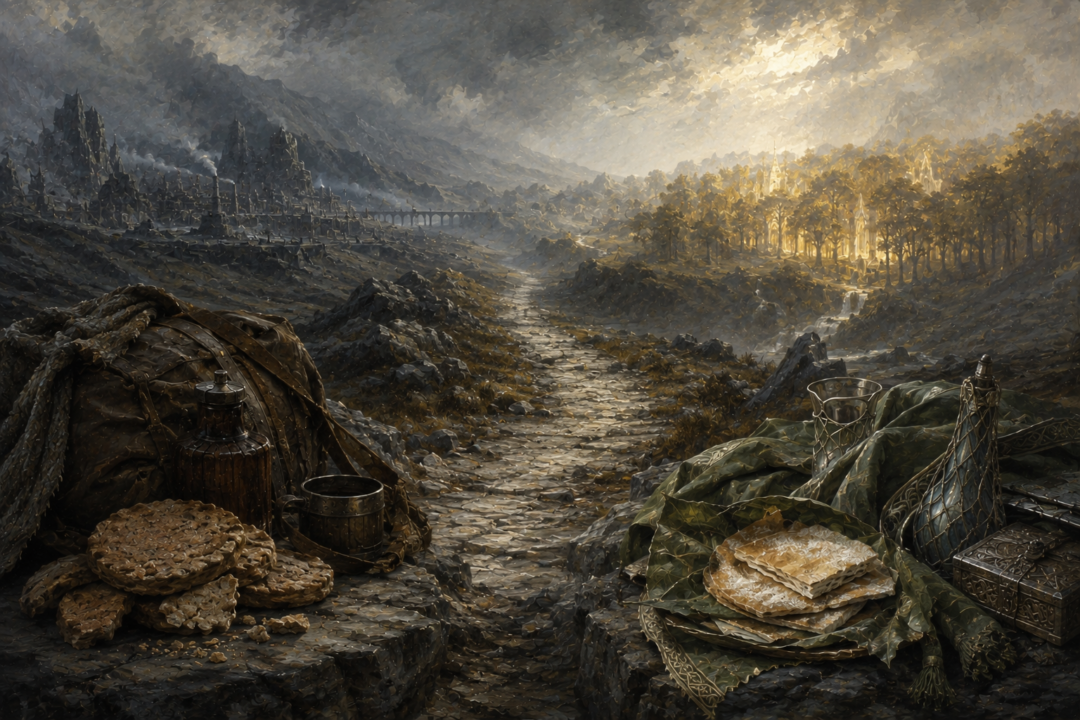
Two Foods, Two Answers to the Wilderness
It would be easy to turn cram and lembas into a simple hierarchy: Men make mediocre travel biscuits; Elves make wonderful magical bread.
But that misses what makes the comparison interesting.
Both foods are successful.
Cram does exactly what its makers need it to do. It is durable, portable nourishment for people crossing dangerous country.
Lembas answers the same physical need while belonging to a culture that repeatedly refuses to separate usefulness from beauty and meaning.
That distinction appears throughout Middle-earth.
Elven objects are often intensely practical. Cloaks conceal. Rope holds. Boats carry. Swords cut.
But their usefulness rarely exhausts what they are.
Lembas follows the same pattern.
It is food, but it is also craftsmanship, hospitality, memory, and preservation compressed into something a traveller can carry.
Cram says: the road will be hard, so take something that lasts.
Lembas says something slightly different: the road will be hard, so carry with you something of the strength of the place you are leaving.
And that may be why Gimli's small mistake in Lothlórien matters.
For a moment, the two foods look almost interchangeable.
Only after the journey begins does the deeper difference become clear.
Sources & Notes
- The Encyclopedia of Arda, “Cram” — https://www.glyphweb.com/arda/c/cram.html
- The Encyclopedia of Arda, “Lembas” — https://www.glyphweb.com/arda/l/lembas.html
- The Encyclopedia of Arda, “Samwise Gamgee” — https://www.glyphweb.com/arda/s/samwisegamgee.html
Reference entries document the people, places, events, and objects directly discussed in this article.