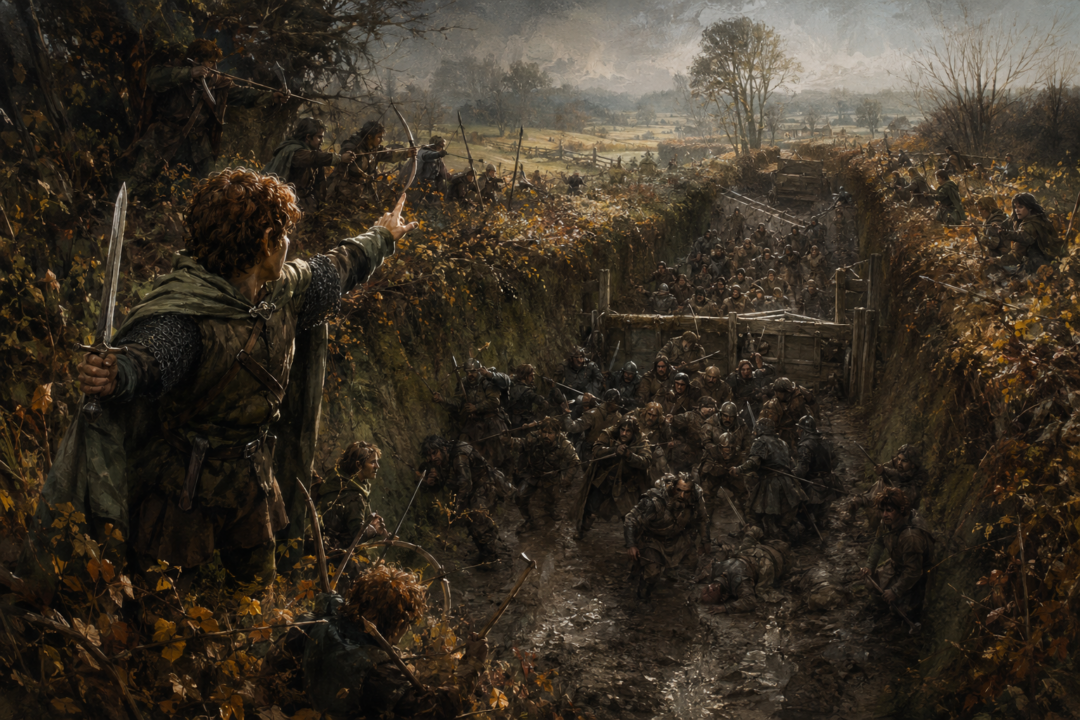
The last battle of the War of the Ring does not take place beneath the walls of a fortress.
There are no siege towers at Bywater, no cavalry charge across an open field, no vast host beneath black banners. Instead, the decisive fighting happens on an ordinary Shire road bordered by banks and hedges.
That modest landscape is not incidental.
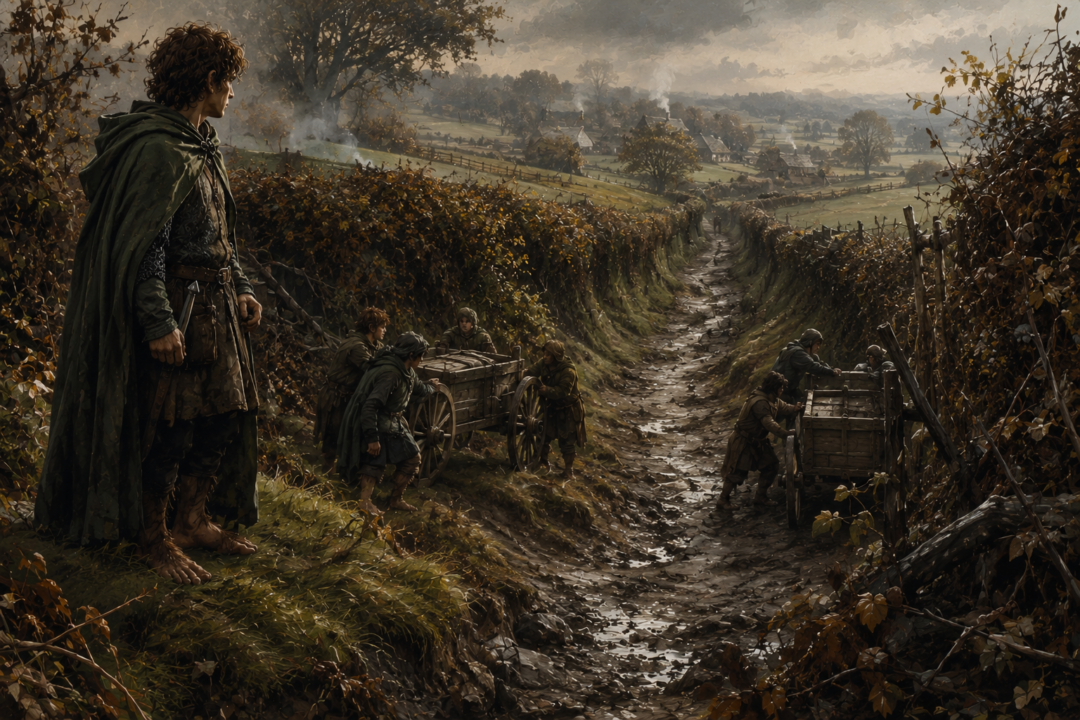
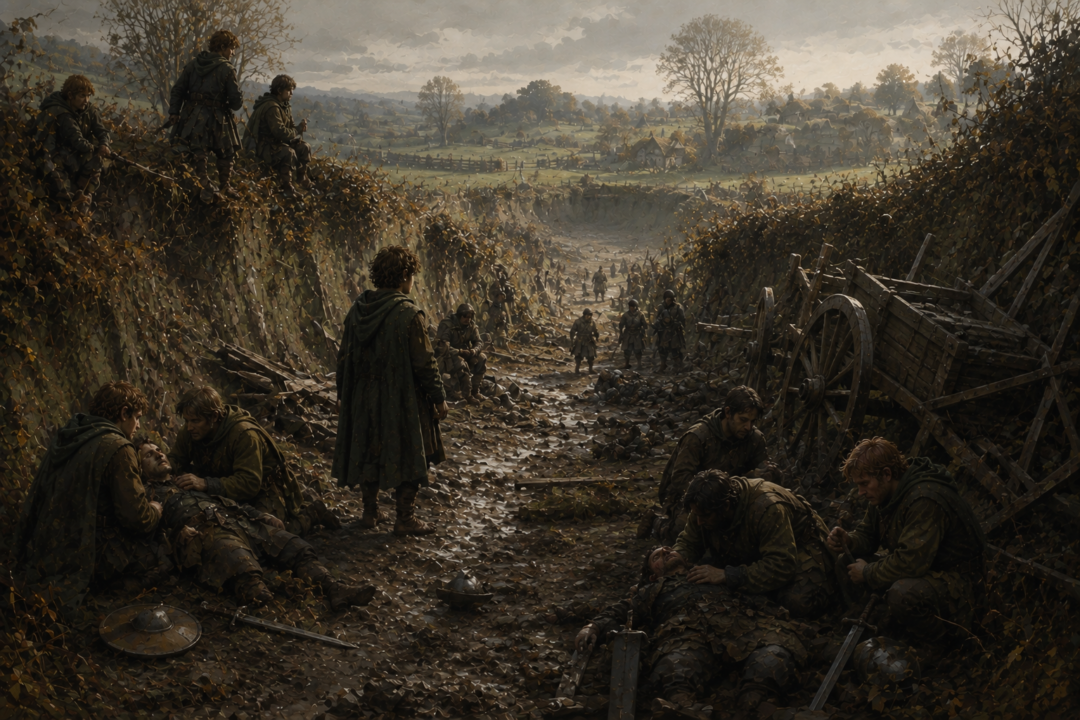
When Merry Brandybuck prepares the hobbits to face Sharkey’s Men, he does not try to imitate the great battles he has witnessed outside the Shire. He studies the ground in front of him. The narrow, deeply banked Bywater Road becomes a trap. Waggons become barricades. Hedges and lanes help determine where larger Men can move and where hobbits can resist them.
The Battle of Bywater is therefore one of the clearest examples in The Lord of the Rings of landscape becoming strategy.
But there is something deeper happening as well. The very features that make the Shire peaceful — enclosed roads, cultivated fields, hedges, farms and small settlements — become the means by which its people defend it.
The Shire Is Not Built for War
The Shire has almost no conventional military culture by the end of the Third Age.
Its hobbits remember old conflicts, particularly the Battle of Greenfields, but such events belong to history. Weapons are more likely to survive as curiosities than as everyday necessities. The Shire’s institutions are deliberately small, and its inhabitants have lived for generations largely untouched by the wars surrounding them.
That isolation has consequences when Saruman’s ruffians take control.
The hobbits do not possess castles or fortified towns. There are no permanent garrisons waiting to retake Hobbiton. There is no professional army capable of meeting a force of Men in conventional battle.
Yet the Shire does possess something else: a landscape shaped by centuries of habitation.
Roads pass between fields. Lanes run beside hedges and banks. Villages, farms, bridges and crossroads organize movement through the countryside.
For peaceful inhabitants these are simply features of home.
For Merry Brandybuck, they become tactical assets.
Merry Has Learned to See Ground Differently
The Merry who returns to the Shire is not the same hobbit who left it.
He has travelled through war. He has seen the military power of Rohan and Gondor. He has ridden with the Rohirrim and taken part in the Battle of the Pelennor Fields. Pippin has likewise experienced the defence of Minas Tirith and the great war in the South.
Neither hobbit suddenly becomes a professional general in the formal sense. But their experiences have changed what they notice.
When Sharkey’s Men threaten the rebellion, Merry immediately begins organizing resistance rather than simply gathering an angry crowd.
His most important decision is geographical.
The approaching ruffians are expected along the Bywater Road. Merry chooses a stretch where the road runs between high banks topped with hedges. He has the hobbits prepare obstacles so that the Men can be caught within the confined roadway.
The plan is simple because it needs to be.
The hobbits do not need to defeat the Men in an open contest of strength. They need to prevent the Men from using their greater size and physical power effectively.
The road does that for them.
The Road Becomes a Trap
The battle on 3 November 3019 begins with roughly a hundred ruffians advancing from the direction of Waymeet.
They expect to suppress resistance.
Instead, they enter prepared ground.
The hobbits have created a barricade across the road. More importantly, waggons are concealed nearby so that another barrier can be moved into position after the Men have entered the chosen stretch.
The result is essentially a pocket.
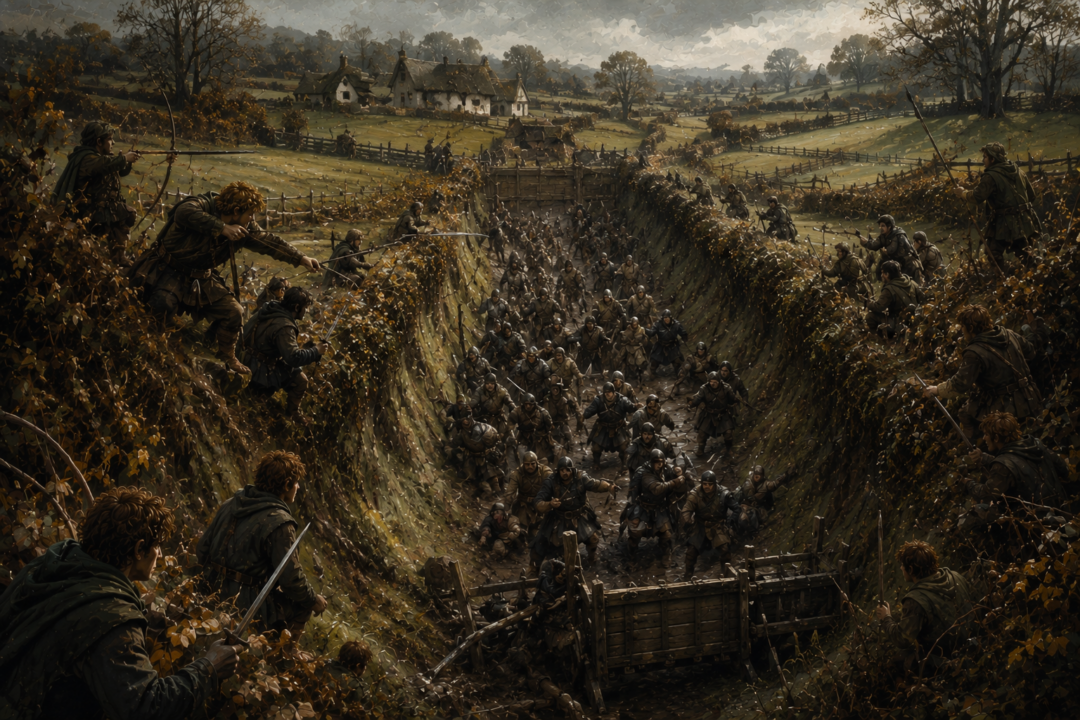
The ruffians find themselves confined between the road’s steep banks while their easiest routes forward and backward are obstructed.
This is why the banks and hedges matter so much.
A barricade across an open field can simply be walked around. A barricade across a narrow road enclosed by difficult banks is a different problem entirely.
The landscape extends the barricade.
The earth itself becomes part of the hobbits’ defensive line.
Why the Ruffians Cannot Simply Scatter
The text makes clear that escape from the trap is possible, but difficult and costly.
Some of the Men attempt to break through. A group manages to force its way out and flee toward the Woody End, where the Tooks pursue them.
But the main body remains caught.
As the fighting becomes desperate, the steep banks restrict the Men’s ability to spread out or escape sideways. Their numerical force is compressed into a confined space.
This changes the balance of the encounter.
A Man is larger and generally more physically formidable than a hobbit. In open terrain, a body of armed Men would have considerable advantages.
Inside a narrow sunken or banked road, those advantages are reduced.
The ruffians cannot easily surround the hobbits. They cannot freely choose their frontage. They cannot simply deploy across broad ground.
Instead, they are forced to fight within terrain selected by their opponents.
Merry has transformed a weakness — the hobbits’ smaller stature and lack of conventional military power — into a problem of movement.
The battle is not won because hobbits suddenly become stronger than Men.
It is won because the Men are denied the opportunity to use their strength efficiently.
Hedges Are Part of the Shire’s Hidden Geography
Hedges can seem like decorative details when reading descriptions of the Shire.
They are not.
A hedged countryside is divided countryside. Boundaries separate fields, gardens, roads and properties. Paths channel movement rather than allowing travellers to move freely in every direction.
In ordinary life, this produces the intimate geography associated with the Shire: winding roads, enclosed fields, farms tucked behind boundaries and settlements connected by familiar lanes.
During the Battle of Bywater, those same characteristics acquire military significance.
The hobbits know this landscape.
The invading Men do not know it in the same way.
That distinction matters.
The ruffians have occupied the Shire, but occupation is not the same thing as belonging to a place. Merry, Pippin, the Cottons, the Tooks and the local hobbits understand where roads lead, where people can gather and where movement can be constrained.
Their knowledge of home becomes a form of power.
Merry Does Not Recreate the Pelennor Fields
One of the most revealing aspects of the battle is what Merry does not do.
He does not attempt to reproduce the warfare of Rohan.
There is no heroic imitation of Théoden’s cavalry charge. There could not be. The Shire does not possess the horses, weapons, organization or numbers required for such warfare.
Instead, Merry applies what he has learned to the resources actually available.
That distinction is important.
His experience outside the Shire has not taught him that every battle must look like the battles of great kingdoms. It has taught him that preparation, leadership and terrain matter.
So Bywater remains unmistakably a Shire battle.
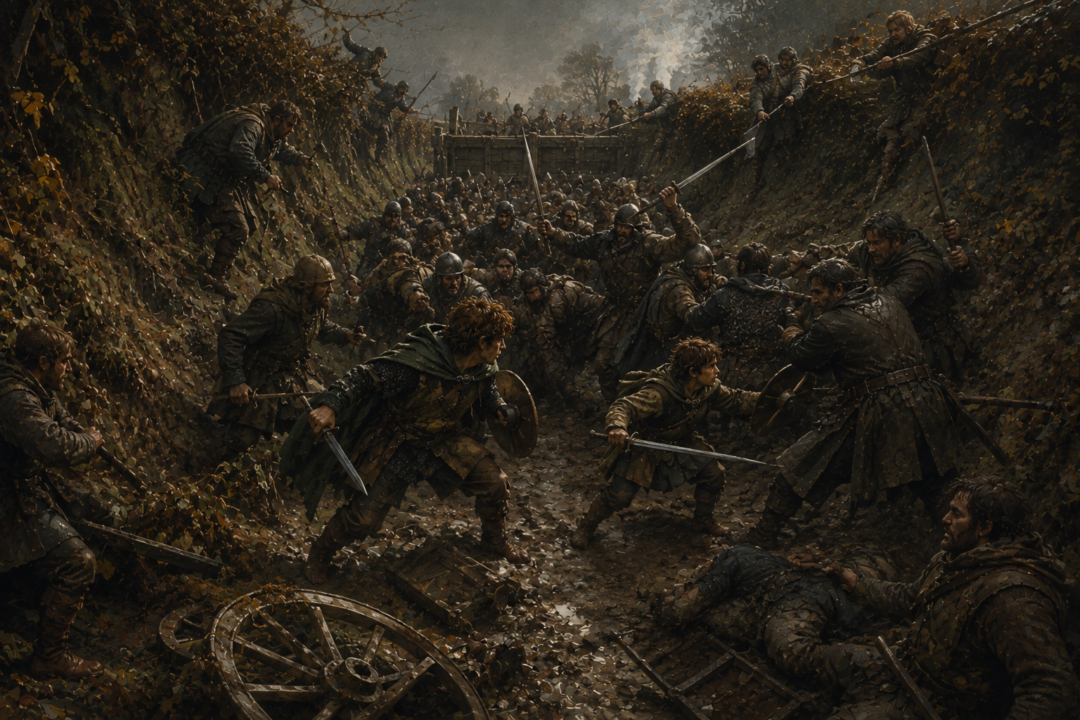
Farm waggons become military obstacles.
Neighbours become a muster.
Country lanes become defensive corridors.
Hedges and banks substitute for walls.
The hobbits defend the Shire using the physical vocabulary of the Shire itself.
Even Victory Is Deliberately Limited
There is another important feature of the battle: Frodo repeatedly tries to prevent unnecessary killing.
He does not oppose resistance. By this point the ruffians have imposed violence on the Shire, destroyed property and threatened its inhabitants. Fighting becomes unavoidable.
But Frodo does not want revenge to become the purpose of the uprising.
That moral restraint exists alongside Merry’s practical military preparations.
The hobbits offer opportunities to surrender. Some of the Men do surrender. Others attempt to escape. The worst fighting comes when the trapped ruffians become desperate and choose violence rather than yielding.
The final cost is severe by Shire standards: nineteen hobbits are killed and about thirty wounded. Nearly seventy of the ruffians are killed, while twelve are captured.
This is victory, but it is not presented as uncomplicated triumph.
The battlefield itself becomes part of the Shire’s memory. The dead hobbits receive an honoured grave, while the fallen ruffians are buried in an old sand-pit that becomes known as the Battle Pit.
The peaceful landscape now carries the marks of war.
The Battle Reverses Saruman’s Logic
There is a striking irony in where Saruman’s rule finally collapses.
His domination of the Shire has involved regulation, confiscation, destruction and crude industrialization. Trees have been cut down. Buildings have been damaged or replaced. The old rhythms of local life have been subjected to centralized “Rules” enforced by intimidation.
Yet his Men are ultimately defeated by the older landscape they have failed to master.
Banks.
Hedges.
Country roads.
Farm waggons.
Local knowledge.
None of these things are individually powerful. Together, however, they allow an organized community to control the battlefield.
Saruman’s system depends heavily on fear. Once the hobbits stop obeying that fear, his ruffians discover that occupation has not given them true control of the country.
They can command a road.
The hobbits know how to use it.
The Shire Defends Itself by Remaining the Shire
That is what makes the Battle of Bywater so fitting as the final battle of the War of the Ring.
The great struggle against Sauron has already been decided far away. Barad-dûr has fallen. Aragorn has been crowned. Armies have marched home.
Yet the returning hobbits discover that saving Middle-earth did not automatically save their own fields and villages.
They must do that themselves.
And when the moment comes, they do not transform the Shire into a miniature Gondor or Rohan.
They defend it through its own geography and community.
The lane beside the hedge becomes as strategically important, for one morning, as a fortress wall.
The farm waggon becomes a gate.
Neighbours who had lived quiet lives become defenders.
That does not mean the Battle of Bywater is merely a charming miniature version of a larger war. People die there. The violence is real, and the Shire cannot simply return to exactly what it was before.
But the battlefield reveals why the Shire survives.
Its strength was never hidden in castles.
It was hidden in relationships, memory, familiarity and the intimate shape of the land itself.
At Bywater, the hobbits finally learn how powerful those things can be.
Sources & Notes
- The Encyclopedia of Arda, “Battle of Bywater” — https://www.glyphweb.com/arda/b/battleofbywater.html
- The Encyclopedia of Arda, “Shire” — https://www.glyphweb.com/arda/s/shire.html
- The Encyclopedia of Arda, “Meriadoc Brandybuck” — https://www.glyphweb.com/arda/m/meriadocbrandybuck.html
Reference entries document the people, places, events, and objects directly discussed in this article.