The Pelennor Fields are remembered as a battlefield: Théoden’s last charge, the fall of the Witch-king, the mûmakil of Harad, and the desperate meeting of Aragorn and Éomer amid slaughter. But before any of that, the Pelennor was something far less legendary and far more necessary.
It was farmland.
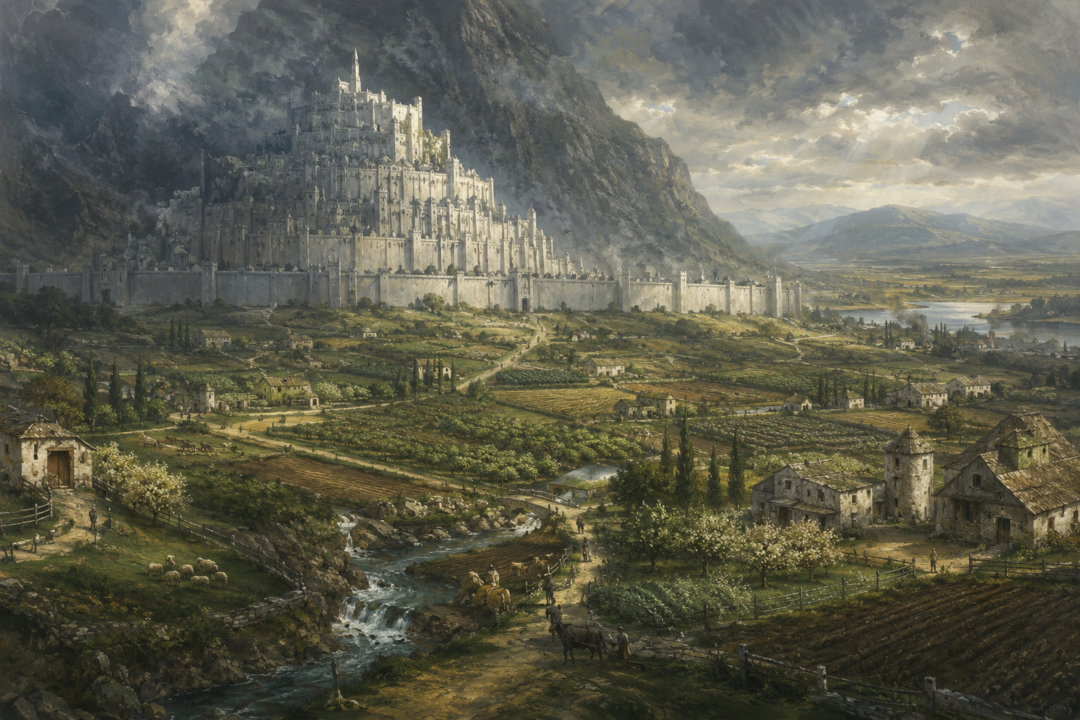
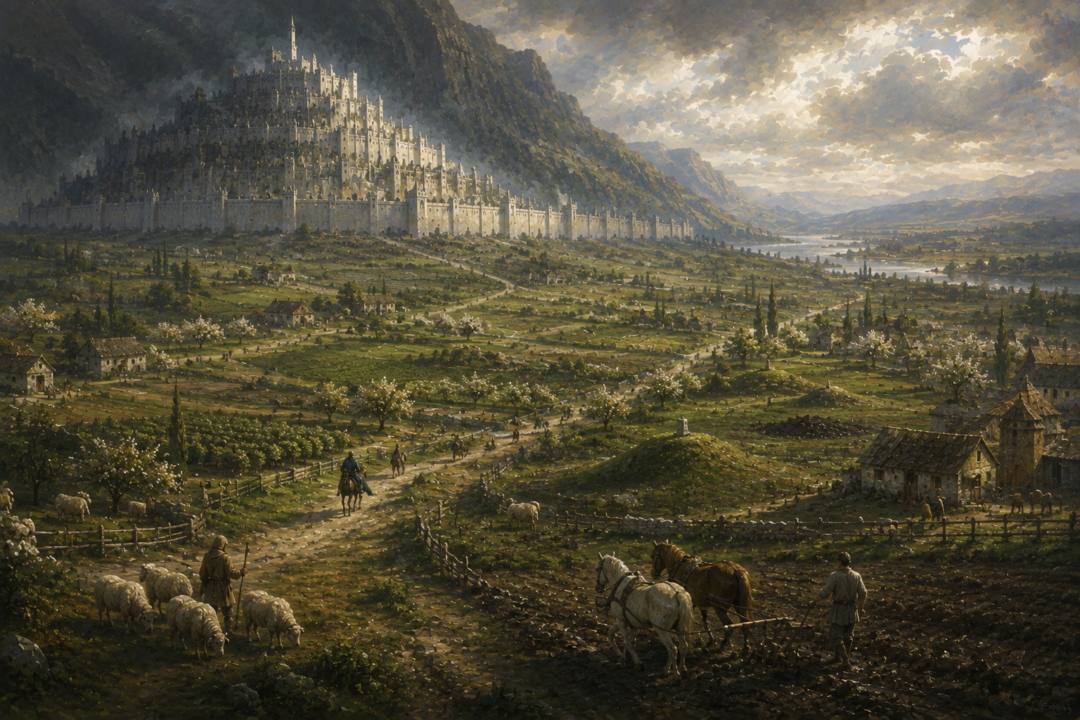
The broad country beneath Minas Tirith contained tilled fields, orchards, homesteads, barns, livestock enclosures, granaries, and small streams running down toward Anduin. These were the townlands of the City, enclosed by the Rammas Echor. When Sauron’s army entered them, it did not simply occupy an empty plain. It turned inhabited and cultivated land into a siege camp and then into one of the greatest killing grounds of the Third Age.
That raises an easily overlooked question: once the songs were sung and the armies departed, what happened to the farms?
The texts never give us a detailed agricultural reconstruction of the Pelennor. Yet they tell us enough to see both the scale of the destruction and something important about what followed. The battlefield did not remain a permanent wasteland. It became living country again—but not without scars.
The Pelennor Was the Land That Fed a City
When Pippin first approaches Minas Tirith, the Pelennor is not described as an empty sweep of grass. It is a settled agricultural landscape.
Its slopes and terraces are fertile. There are fields under cultivation and orchards. Houses and agricultural buildings stand among them. Roads and tracks cross the country, while watercourses descend toward the Anduin.
This matters because Minas Tirith was not economically isolated from its surroundings. The Pelennor was part of the functioning life of Gondor’s capital.
The Rammas Echor itself emphasizes that importance. The great enclosing wall protected not merely the City but the townlands surrounding it. During the final crisis, however, that defensive landscape became exposed to exactly the destruction it had been intended to prevent.
Before Sauron’s main assault, the inhabitants and livestock had already been removed from the threatened countryside. That evacuation probably prevented an even greater civilian disaster.
It could not save the farms themselves.
Sauron’s Army Did More Than March Across the Fields
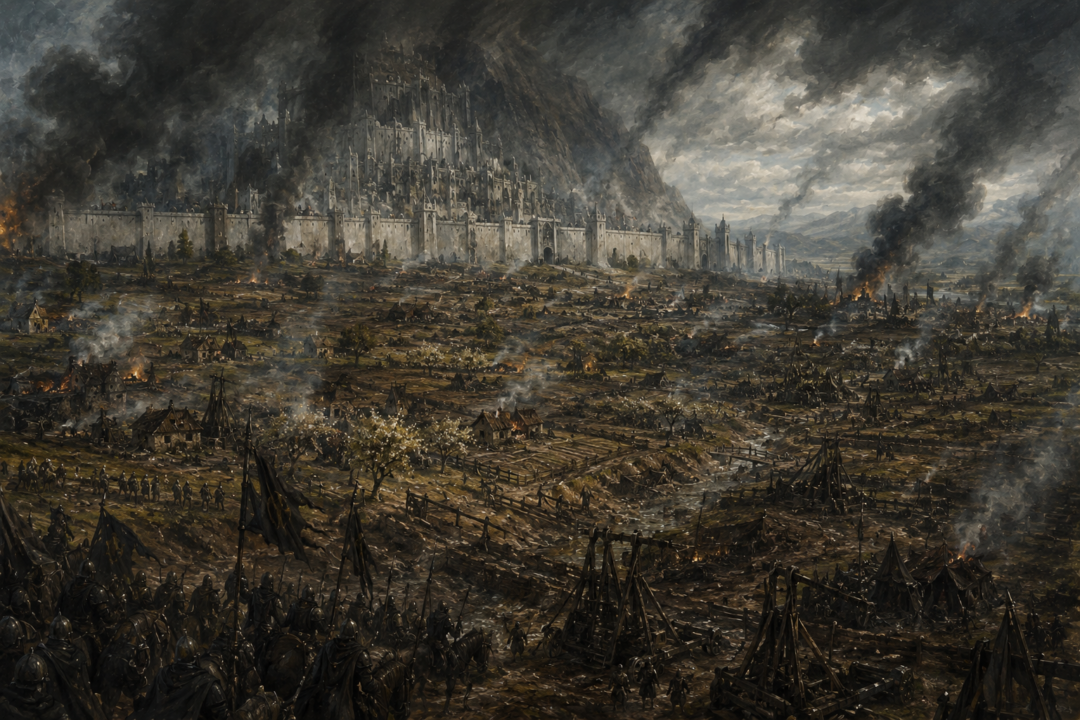
Once the defenders of the Rammas were overcome, the Pelennor became the staging ground for the siege of Minas Tirith.
The transformation was brutal.
The enemy burned houses and trees. Siege works were established across cultivated ground. Trenches and pits were dug, and fires burned across the field. Camps, engines, troops, horses, and enormous mûmakil occupied land that shortly before had supported ordinary rural life.
Then came the battle itself.
Thousands of horses charged across the Pelennor. Infantry formations fought and broke over it. Great beasts moved through the fighting. Men and Orcs fell in enormous numbers. By sunset, the grass itself is described through the imagery of blood and red light.
This means the postwar problem was not simply that a crop had been trampled.
Buildings had been destroyed. Trees had burned. Defensive walls were breached. Roads and fields had been cut by military works. The dead lay across the landscape, along with abandoned weapons, broken equipment, dead animals, and the remains of the enemy’s camps.
The Pelennor had effectively ceased to function as farmland.
The First Harvest After the Battle Was the Dead
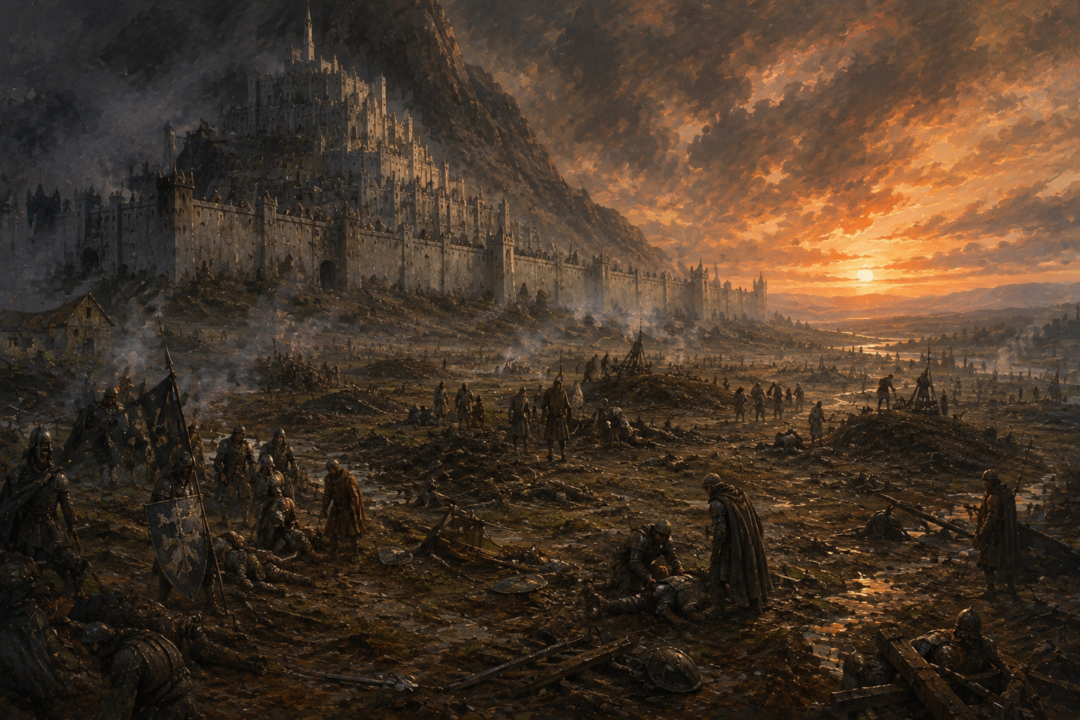
The immediate work after such a battle could not have begun with ploughing.
The fallen had to be dealt with.
The text gives one especially important clue in the Song of the Mounds of Mundburg. Gondorians and Rohirrim who died in the battle were laid beneath burial mounds. The song remembers great captains and ordinary warriors together, sleeping beneath the earth in Gondor near the Great River.
The exact arrangement of every burial is not described, and we should not invent a complete system for disposing of the enormous number of enemy dead. What is explicit is that burial mounds became part of the post-battle landscape.
The Pelennor therefore could never simply return to exactly what it had been.
Parts of agricultural country had become memorial ground.
One grave was particularly distinctive.
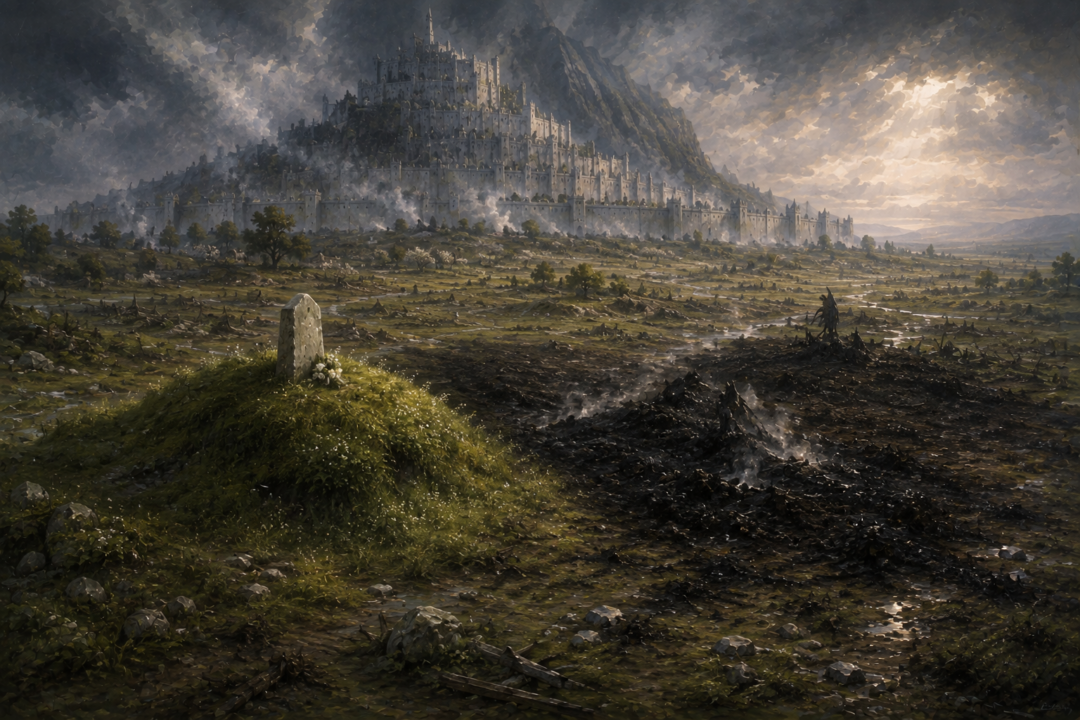
Snowmane, Théoden’s horse, was buried where he fell, and a stone was raised over him. The grass afterward grew especially green and long upon Snowmane’s Howe.
Nearby was a very different scar.
The carcass of the winged creature ridden by the Lord of the Nazgûl was burned. The ground where it was burned remained black and bare.
That contrast is one of the clearest answers to what became of the Pelennor.
Most of the land could live again. Some places remembered.
Was the Pelennor Permanently Poisoned?
There is no textual basis for treating the entire battlefield as permanently corrupted soil.
That distinction matters.
The presence of Mordor’s armies did enormous physical damage, but the books do not say that Orc blood, mûmakil, Nazgûl, or the violence of the battle somehow sterilized the whole Pelennor.
Indeed, the specific description of the place where the Witch-king’s beast was burned strongly suggests that its lasting barrenness was exceptional. That particular patch remained black and bare, while Snowmane’s burial mound became conspicuously green.
If the whole battlefield had become infertile, that contrast would lose much of its force.
The safer conclusion is therefore that the Pelennor suffered catastrophic wartime destruction rather than becoming another supernatural wasteland like the lands immediately surrounding Mordor.
Its ordinary soil remained capable of recovery.
And the text soon shows people using the Pelennor again.
Recovery Began Almost Immediately
There was very little time between battle and renewed activity.
The Battle of the Pelennor Fields ended on 15 March 3019. Two days later, the Army of the West was assembled on the Pelennor before marching toward the Black Gate.
Aragorn himself had pitched his tents on the field near the place where Théoden fell, and the captains held council there.
That does not mean the farms were restored within days. Clearly they were not. But it shows that the Pelennor rapidly ceased to be enemy-held ground and returned to Gondor’s control.
The greater restoration would have taken longer.
The books never provide a timetable for rebuilding individual barns, replanting orchards, filling siege trenches, restoring field boundaries, or bringing evacuated livestock home. Any precise account of those tasks would be reconstruction rather than canon.
Yet they are reasonable implications of the land returning to ordinary use.
There was also a much larger reconstruction underway. Minas Tirith itself had suffered heavily, the Great Gate had been destroyed, and the Rammas Echor had been breached in numerous places. Gondor was not repairing a few damaged farms; it was emerging from a war that had struck directly at its capital.
The Fields Become a Landscape of Restoration
The most important evidence comes from what the Pelennor does not become.
It does not become a forbidden battlefield.
People continue to travel through it. The roads remain essential approaches to Minas Tirith. When the Riders of Rohan depart in May, people line their route from the City all the way toward the walls of the Pelennor. By Midsummer, the company of Elrond approaches Minas Tirith through the same country.
Life is moving across the battlefield again.
This fits the larger transformation of Gondor after Sauron’s fall. The new age is repeatedly associated with rebuilding, planting, renewed population, restored beauty, and lands made safe again.
The Pelennor belongs naturally within that recovery, even though no passage gives us a year-by-year account of its farms.
Some damage would have disappeared quickly. Grass would cover churned earth. Temporary camps would vanish. Fields could be worked again.
Other losses were harder to reverse. A mature orchard destroyed by fire could not simply be replaced in a season. Burned homes required rebuilding. The Rammas required major repair if Gondor wished to restore the old defensive boundary.
And some features were never supposed to disappear.
The graves remained.
Gondor Would Farm Around Its Memory
That may be the most Tolkien-native answer to the question.
The Pelennor after the War of the Ring was neither restored as though nothing had happened nor abandoned because too much had happened.
It became both farmland and memory.
Imagine the implication, without claiming details the text never supplies: generations working fields within sight of burial mounds raised for the defenders of the City. Riders passing Snowmane’s Howe. Children hearing why one patch of earth remained strangely black while the grass nearby grew long over the grave of Théoden’s faithful horse.
The landscape itself carried the story.
This pattern appears repeatedly across Middle-earth. History is not confined to books or monuments. It remains embedded in hills, ruins, roads, graves, forests, and places whose names outlive the people who first gave them meaning.
The Pelennor is an unusually powerful example because its identity begins with ordinary usefulness. It was cultivated because people needed food, animals, homes, and productive land beside their City.
War temporarily transformed that living landscape into a place of death.
Victory did not erase what happened there. It made ordinary life possible there again.
And that may be the deepest significance of the Pelennor after the battle. The final defeat of Sauron was not valuable merely because great warriors survived or a king received a crown. It mattered because places meant for growing things could once again be used for growing things.
The grass returned.
The roads filled.
The fields endured.
But beneath some of that grass lay the dead who had made their recovery possible.
Sources & Notes
- The Encyclopedia of Arda, “Battle of the Pelennor Fields” — https://www.glyphweb.com/arda/b/battleofthepelennor.html
- The Encyclopedia of Arda, “Minas Tirith” — https://www.glyphweb.com/arda/m/minastirith.html
- The Encyclopedia of Arda, “Gondor” — https://www.glyphweb.com/arda/g/gondor.html
Reference entries document the people, places, events, and objects directly discussed in this article.