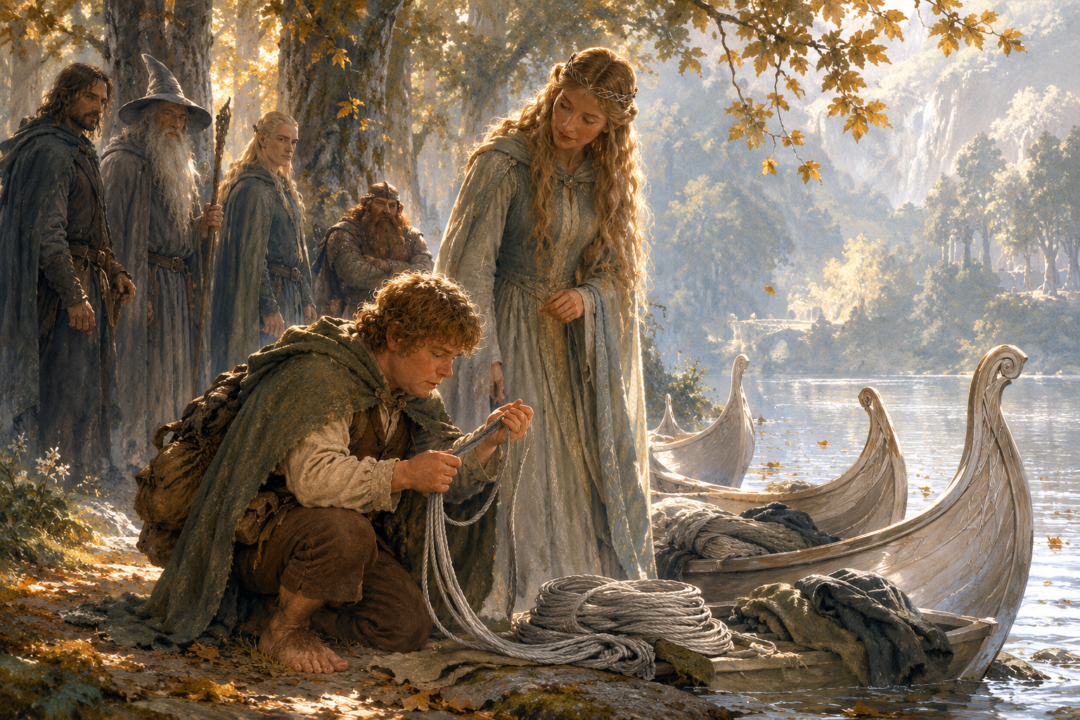
When Sam Gamgee leaves Lothlórien, one of the gifts that delights him most is not a weapon, a jewel, or anything obviously enchanted. It is rope.
That is perfectly in character. Sam knows something about rope-making, and the lack of rope has bothered him since the Fellowship left Rivendell. The Galadhrim give the travellers coils made of hithlain: slender, grey, silky to the touch, extraordinarily light, and strong enough to trust with their lives.
Later, in the Emyn Muil, that ordinary-looking rope does something much stranger.
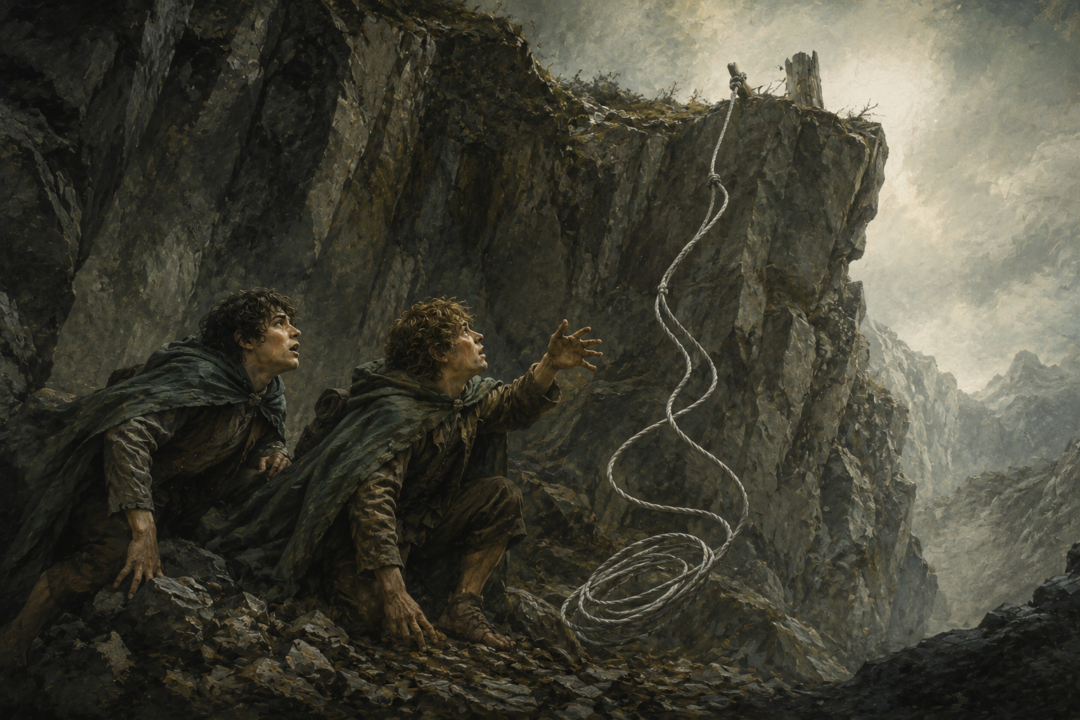
After Frodo and Sam descend a cliff, Sam realizes that the rope remains tied above them. Recovering it seems impossible. Yet when he gives it a final tug, the rope suddenly falls down.
Sam wonders whether it came because he called it.
Frodo offers the less romantic explanation: perhaps Sam’s knot was not as secure as he thought.
The text deliberately leaves the incident hovering between those possibilities. But that ambiguity reveals something important about Elvish craftsmanship. The rope can possess qualities that seem magical without needing to be a thinking, obedient artifact.
What the Galadhrim Actually Say About the Rope
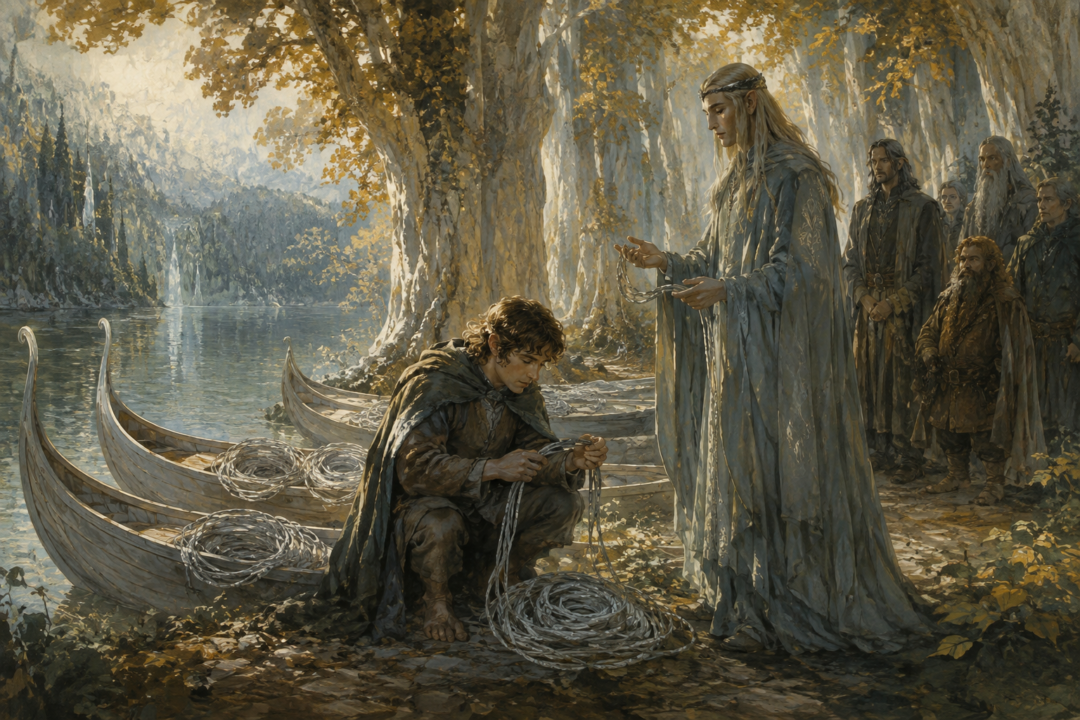
The Fellowship receives the ropes in “Farewell to Lórien.” Three coils are placed in each of the three Elven boats. They are described as slender yet strong, grey like the cloaks of Lórien, and silky to the touch.
Sam immediately wants to know what they are made from.
The answer is hithlain.
The Elf speaking with him does not describe the material as enchanted. Instead, he speaks of the “art” of making the ropes and regrets that there is no time to teach Sam more about the craft. Had the Galadhrim known how interested he was in rope-making, Sam might have learned something of their methods.
That distinction matters.
The ropes belong first to the category of craftsmanship. They are things made with extraordinary knowledge and skill. Their makers understand materials and techniques that Hobbits do not.
The name hithlain is glossed as “mist-thread,” an appropriately delicate name for something that appears slender and light while possessing remarkable strength.
Exactly what hithlain ultimately consists of is less secure in the published narrative than is sometimes assumed. Earlier compositional material associates the ropes with silver-grey fibre from mallorn bark, but the final Lord of the Rings does not pause to provide a technical account of its manufacture. The important canonical point is that hithlain is a distinctive Elvish material and that its working is an art practiced by the Galadhrim.
The Strange Knot in the Emyn Muil
The rope becomes more mysterious after the breaking of the Fellowship.
Frodo and Sam must descend the difficult terrain of the Emyn Muil. Sam has retained one of the Lórien ropes, and his practical enthusiasm suddenly becomes essential.
After reaching the bottom, however, he faces a problem familiar to any climber: the rope is still secured above.
Sam had tied it firmly around a stump. He is confident in his knots, which means retrieving it from below should be impossible.
He gives the rope a frustrated pull.
It comes down.
Nothing in the scene establishes that the rope heard Sam, understood him, or deliberately obeyed him. In fact, the conversation immediately preserves uncertainty. Sam suspects something extraordinary has happened; Frodo suggests that perhaps the knot simply failed.
The reader is never given an authoritative explanation.
That restraint is significant because it prevents the rope from becoming a miniature character. There is no evidence that it possesses a will, consciousness, personality, or independent purpose.
Something remarkable may have happened.
That does not mean the rope thought about doing it.
“Magic” Is Not Always a Useful Category
The Fellowship encounters the same problem of language elsewhere in Lórien.
When the travellers receive their grey cloaks, the Elves do not readily accept the simple distinction outsiders might make between ordinary craftsmanship and “magic.” The cloaks have extraordinary properties: their colours seem to shift with their surroundings, helping their wearers pass unnoticed.
Yet the Elves describe them as the products of their own craft.
This offers a useful framework for understanding the rope.
From a Hobbit or modern reader’s perspective, a rope that is impossibly light and strong, that seems remarkably suited to its user’s needs, and that perhaps releases a knot at the right moment looks magical.
To the Galadhrim, these properties need not imply that someone has cast a spell upon an otherwise ordinary rope.
They may instead be inseparable from the material, the maker, and the craft.
Middle-earth repeatedly blurs the boundary that later fantasy often draws between technology, art, nature, and enchantment. Exceptional Elvish objects can appear supernatural precisely because Elvish craft works at a level beyond ordinary mortal skill.
That still does not make the object alive.
Gollum Reveals Another Property
The most unsettling evidence concerning the rope comes soon afterward.
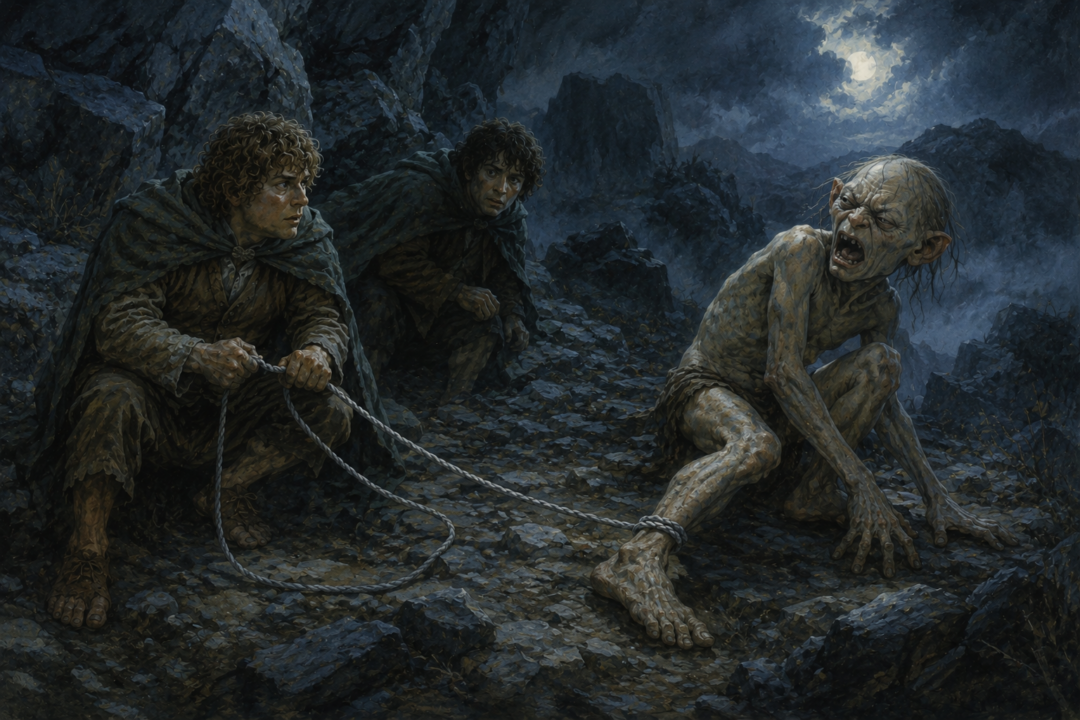
When Frodo and Sam capture Gollum, they use the Lórien rope to restrain him. Gollum reacts with intense pain and begs them to remove it. He identifies its Elvish origin as the reason for his suffering.
Again, the text gives us the effect without explaining its mechanism.
It does not establish that the rope consciously recognizes Gollum as corrupted. Nor does it say that the rope decides to punish him.
The safer conclusion is narrower: contact with the Elven rope is agonizing to Gollum, and Gollum himself connects that agony with the Elves who made it.
That resembles a broader pattern in the story. Things associated with the Elves and their enemies can carry qualities that affect different beings differently without behaving like conscious creatures.
The important distinction is between inherent quality and independent agency.
Fire burns without hatred.
Light exposes darkness without making a decision.
The Lórien rope can therefore be profoundly hostile to something in Gollum without needing to possess a mind.
The Rope Does Not Behave Like the One Ring
The contrast with the One Ring makes this clearer.
The Ring is repeatedly described in language suggesting something far closer to agency. It betrays Isildur. It abandons Gollum. It works toward returning to its master. Its influence interacts with the desires and weaknesses of those who possess it.
Even here, careful distinctions remain necessary: the Ring contains much of Sauron’s power, but it is not simply Sauron himself in miniature.
Nevertheless, the narrative treats it as having something resembling purpose.
The Lórien rope receives no comparable treatment.
It never tempts Sam. It does not manipulate events. It does not seek an owner, resist an owner, communicate, or pursue an objective.
Its remarkable behaviour remains connected to what a rope is supposed to do.
It is light.
It is strong.
It holds when needed.
And, perhaps, it can be recovered when its user needs it again.
If that last property is genuinely part of its making, it represents an extraordinary perfection of function rather than evidence of consciousness.
Elvish Craft Often Perfects Rather Than Replaces Nature
This is one of the most characteristic features of Lórien.
Its wonders rarely feel like machines imposing themselves upon the world.
The Galadhrim live among trees rather than clearing them to build a conventional city. Their dwellings are raised among branches. Their cloaks resemble the colours of the landscape. Their boats, food, weapons, fabrics, and ropes are practical objects whose extraordinary qualities remain closely connected to their purposes.
The rope is perhaps the purest example because Sam understands ordinary rope.
He comes from a family connected with rope-making. He therefore recognizes craftsmanship where another traveller might merely see enchantment.
His fascination gives the episode an additional layer: the supposedly simple Hobbit is exactly the person capable of appreciating the gift properly.
He does not initially ask what spell has been placed upon it.
He asks what it is made of.
That is a craftsman’s question.
Why the Ambiguity Matters
It would have been easy for the story to confirm that Lórien ropes obey spoken commands.
It does not.
Instead, Sam thinks the rope may have responded to him, while Frodo supplies a mundane alternative. Neither explanation is decisively confirmed.
That ambiguity protects something important about the Elves.
Their works remain wondrous without becoming mechanically defined magic systems. We see results but rarely receive exhaustive rules.
The same uncertainty also keeps Sam central to the moment. Perhaps an Elven rope possesses some quality he does not understand. Perhaps his own knot slipped. Perhaps the truth belongs somewhere within an Elvish art that cannot be translated neatly into either explanation.
What the text does not support is the stronger claim that the rope is sentient.
There is no indication of thought, speech, desire, memory, personality, or independent intention.
The rope remains a rope.
It is simply a rope made in Lórien.
And in Middle-earth, that difference can be enormous.
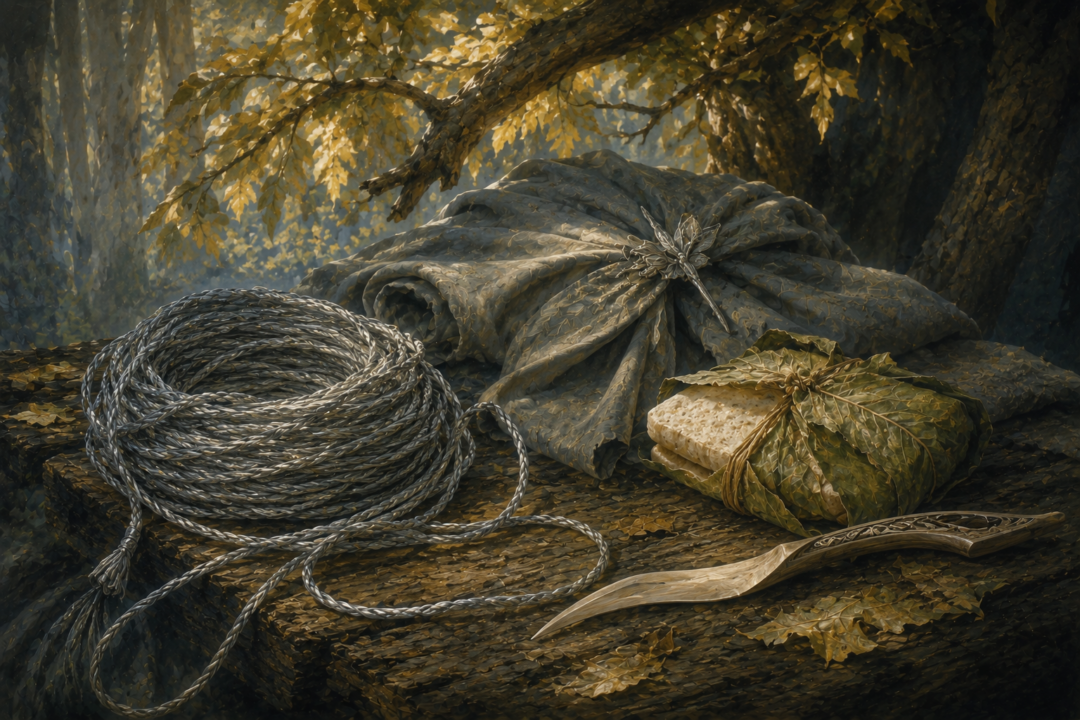
A Small Object That Explains Lórien
The hithlain rope reveals something larger about Elvish power.
Greatness in Middle-earth does not always announce itself through swords, Rings, armies, or spectacular acts of sorcery. Sometimes it appears in the perfection of something useful.
A cloak conceals because its makers understand their art beyond mortal expectations.
Lembas sustains travellers far beyond ordinary bread.
A slender grey rope can bear the weight of desperate Hobbits on a cliff and cause agony to Gollum.
None of these qualities requires the object to become a person.
That is why the scene in the Emyn Muil works so well. Sam pulls the rope. It falls.
For a moment, the boundary between craft and enchantment disappears.
Sam accepts the wonder more readily than Frodo does, but even he does not receive an explanation. The rope has done exactly what he desperately wished a perfect rope could do.
Whether that was an extraordinary property of Lórien craftsmanship or merely a fortunate knot is never explicitly settled.
And that uncertainty is more faithful to Lórien than a catalogue of magical rules could ever be.
Sources & Notes
- The Encyclopedia of Arda, “Hithlain” — https://www.glyphweb.com/arda/h/hithlain.html
- The Encyclopedia of Arda, “Lothlórien” — https://www.glyphweb.com/arda/l/lothlorien.html
- The Encyclopedia of Arda, “Samwise Gamgee” — https://www.glyphweb.com/arda/s/samwisegamgee.html
Reference entries document the people, places, events, and objects directly discussed in this article.