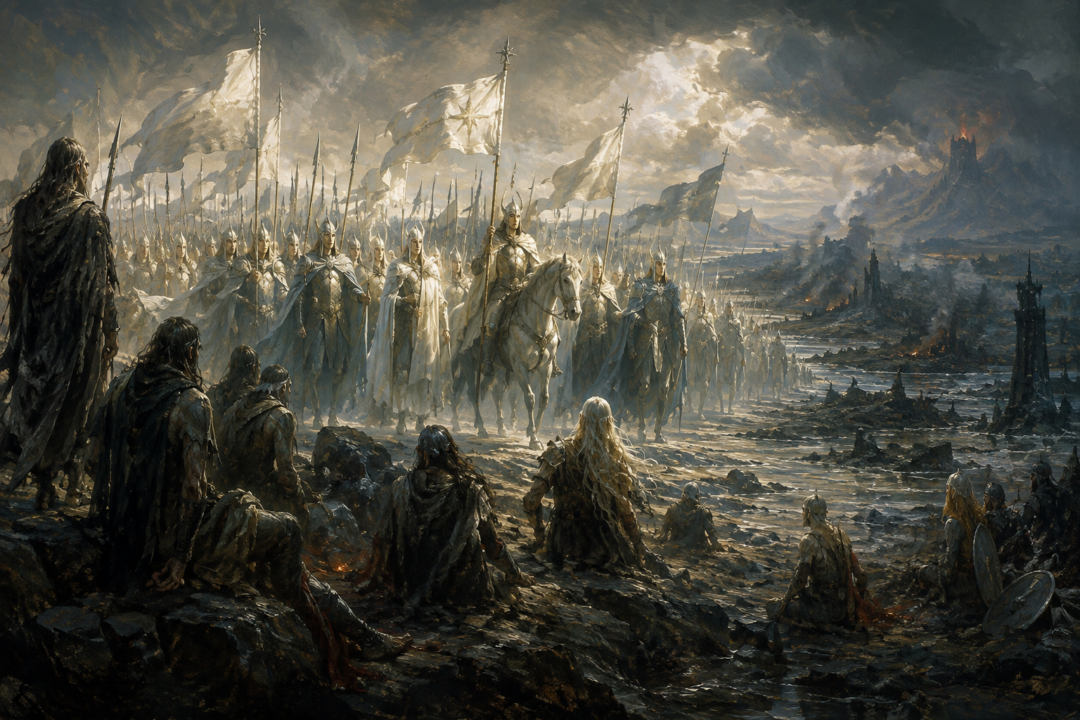
Why the Final War Required a Host from Aman Rather Than the Beleriand Noldor Alone
By the end of the First Age, Morgoth still possessed Angband, armies beyond counting, Balrogs, Orcs, and dragons. Yet the Elves who had once challenged him most fiercely were no longer capable of mounting another great offensive.
That is one of the central tragedies behind the War of Wrath.
The Noldor had returned to Middle-earth believing they could pursue Morgoth, recover the Silmarils, and build realms strong enough to resist him. For centuries they did resist him. Fingolfin’s people helped maintain the Siege of Angband. Fingon and Maedhros assembled armies for the Nirnaeth Arnoediad. Finrod built Nargothrond. Turgon raised hidden Gondolin.
But resistance was not the same thing as victory.
By the time Eärendil finally reached Aman, the question was no longer whether the remaining Noldor could devise a better campaign. Their military and political world had already been shattered.
The final overthrow of Morgoth required something Beleriand could no longer produce: a fresh host from the West.
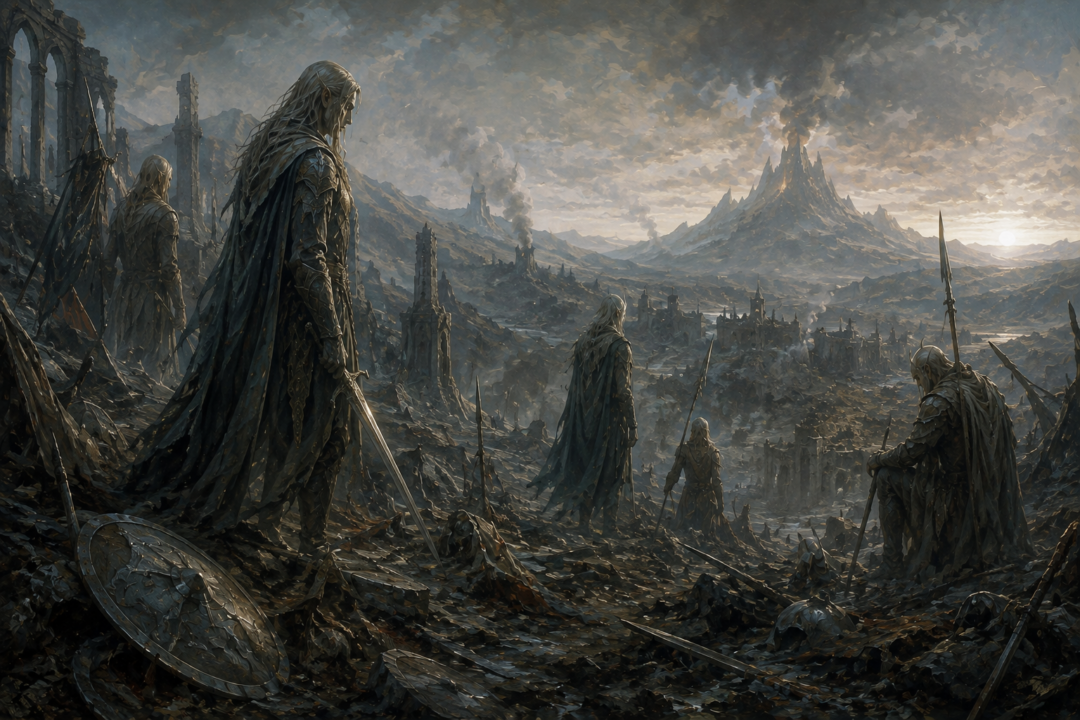
The Noldor Had Already Tested Their Strength Against Morgoth
The First Age contains repeated attempts to contain or defeat Morgoth.
After the Noldor returned to Middle-earth, their early victories were impressive. Morgoth's forces were defeated in the Dagor Aglareb, and Angband was placed under a long siege.
For centuries, the northern realms of the Eldar effectively contained him.
But this created a dangerous illusion. Morgoth had not been defeated. He remained inside Angband, increasing his strength and developing weapons his enemies had not yet faced in their full power.
The illusion ended with the Dagor Bragollach, the Battle of Sudden Flame.
Morgoth broke the Siege of Angband. Ard-galen was burned. The northern defenses of the Noldor were shattered, and several of their realms or territories were overrun.
Even Fingolfin's extraordinary personal challenge to Morgoth could not reverse the strategic disaster. The High King wounded Morgoth repeatedly before being killed, but individual heroism could not substitute for the military power necessary to destroy Angband.
From that point onward, the struggle increasingly became one of survival.
The Nirnaeth Arnoediad Was the Last Great Coalition—and It Failed
If the Noldor of Beleriand were ever going to overthrow Morgoth by their own military strength, the Union of Maedhros was their greatest later opportunity.
Maedhros attempted something larger than the defense of individual kingdoms. Elves, Men, and Dwarves were drawn into a broad alliance against the North.
Yet the Nirnaeth Arnoediad became the Battle of Unnumbered Tears.
The alliance suffered from division, treachery, poor coordination, and Morgoth's ability to manipulate his enemies. The result was catastrophic.
Fingon's host was destroyed. Fingon himself was slain. Húrin's desperate resistance allowed Turgon's forces to escape, preserving Gondolin for a time, but the wider military situation had collapsed.
The importance of the Nirnaeth is not simply that the Noldor lost a battle.
They lost the possibility of easily recreating such a coalition.
Morgoth now had the strategic initiative. The surviving Elven kingdoms were increasingly isolated from one another, while the Edain who had supported them suffered terribly.
The Noldor could still resist.
They could no longer plausibly assemble enough strength to storm Angband.
Morgoth Won by Destroying His Enemies Separately
After the Nirnaeth, Morgoth did not need to defeat one united Elven empire. No such empire existed.
The remaining great refuges fell separately.
Nargothrond was destroyed after Túrin's counsel helped turn its policy toward open warfare, and Glaurung played a decisive role in its ruin. Doriath survived Morgoth's direct military expansion for longer, protected by Melian's power, but its destruction ultimately came through a chain of tragedies surrounding the Silmaril, including conflict with the Dwarves and later the attack of the sons of Fëanor.
Gondolin remained hidden, but secrecy could preserve it only while its location remained unknown. When Gondolin was betrayed, Morgoth's forces destroyed it as well.
That sequence matters.
Morgoth did not merely kill warriors. He erased the political and military structures capable of producing armies.
Strongholds disappeared. Ruling houses were broken. Populations became refugees. Communication and coordination became increasingly difficult.
The surviving Eldar were inheriting ruins rather than kingdoms.
The Oath of Fëanor Made the Collapse Worse
The greatest irony is that the Noldor did not merely lose strength fighting Morgoth.
Some of their remaining strength was consumed fighting one another.
The Oath of Fëanor repeatedly turned the Silmaril into a source of internal violence. The assault upon Doriath by the sons of Fëanor was followed later by their attack on the refugees at the Havens of Sirion.
This last Kinslaying is especially important to understanding why a Beleriand-only victory had become unrealistic.
The people gathered near Sirion were survivors. Among them were refugees connected with Doriath and Gondolin—the remnants of communities Morgoth had already devastated.
Yet even there the Oath produced another catastrophe.
Instead of consolidating the remaining free peoples for a final resistance against Morgoth, the sons of Fëanor attacked them over the Silmaril held by Elwing.
The enemy in Angband had succeeded so thoroughly that some of his surviving opponents were still destroying one another.
The Noldor's problem was therefore not simply numerical weakness. Their unity had been poisoned by oath, grievance, exile, and accumulated tragedy.
Eärendil's Mission Reveals How Desperate Beleriand Had Become
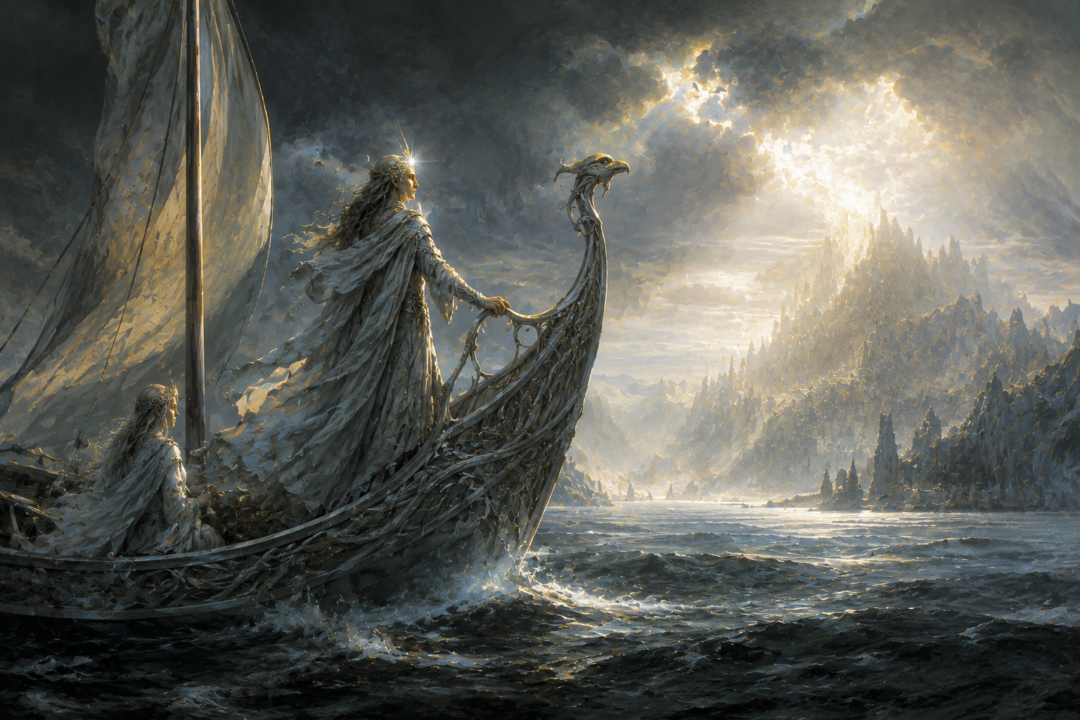
Eärendil's voyage to Aman was not simply another request for reinforcements.
It represented the admission that Middle-earth could not free itself from Morgoth with the forces still available there.
Eärendil came as an advocate for both Elves and Men. His mission crossed boundaries that had repeatedly divided the resistance to Morgoth: Noldor and Sindar, Elves and Edain, the exiles and the Powers of the West.
His success changed the scale of the conflict.
The response was not the creation of another Beleriandic alliance.
A host came out of Aman.
The published Silmarillion specifically names the Vanyar and the Noldor who had remained in Valinor, led by Finarfin, among the forces marching beneath the banners of the West. The Teleri did not themselves march to war because they remembered the Kinslaying at Alqualondë, though they provided ships to carry the host.
Eönwë, herald of Manwë and mighty in arms, commanded the Host of the West.
A useful distinction is necessary here: the text does not clearly establish that the Valar themselves personally fought on the battlefield. The safer description is that the Host of Valinor came under Eönwë's leadership and acted with the authority and aid of the Powers.
What matters is that the decisive army was assembled in Aman, not from the shattered kingdoms of Beleriand.
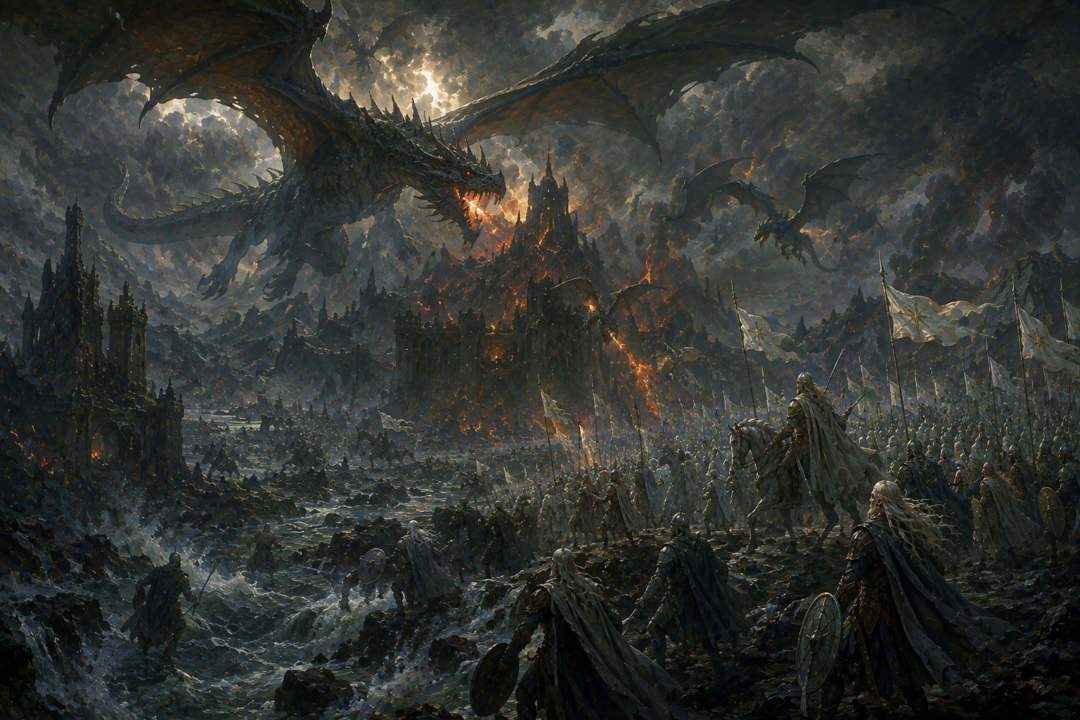
The Host of Aman Had Something Beleriand No Longer Possessed
The Vanyar had not endured the centuries of attrition suffered by the exiled Noldor.
Likewise, Finarfin's Noldor were not the battered remnants of Hithlum, Nargothrond, Gondolin, or the sons of Fëanor. They belonged to the part of the Noldorin people that had remained or returned in the West.
The contrast is striking.
The Noldor who followed Fëanor into exile had produced some of the greatest warriors and realms of the First Age. But they had spent themselves in the struggle.
Now Noldor from Aman returned under Finarfin.
This does not mean the Beleriand Elves were cowardly or irrelevant. They had borne the war for centuries. Their resistance prevented Morgoth's victory from being effortless, and their histories fed directly into the circumstances that eventually brought Eärendil to Aman.
But endurance had cost them the strength needed for conquest.
A fresh army could do what exhausted survivors could not.
Morgoth's Remaining Power Was Still Enormous
There is another reason the western intervention mattered: even after centuries of warfare, Morgoth was still terrifyingly strong.
When the Host of the West finally confronted him, the account describes the power of his throne as immense. The war was not a ceremonial finishing blow against an already helpless enemy.
His Orcs were present in enormous numbers. Balrogs fought in his defense. Men also fought on Morgoth's side.
And when his conventional forces were being overwhelmed, Morgoth revealed a weapon his enemies had never previously encountered: winged dragons.
Their assault was so violent that even the Host of the Valar was driven back.
That detail alone shows the scale of the problem.
The surviving Noldor of Beleriand had already failed to withstand earlier forms of Morgoth's military power. The final war exposed an even more terrible reserve.
Victory ultimately required Eärendil himself to enter the battle in the sky aboard Vingilot, accompanied by the great birds led by Thorondor. Eärendil slew Ancalagon the Black, whose fall broke the towers of Thangorodrim.
The final defeat of Morgoth was therefore not simply the last campaign of the Noldorin wars.
It was an intervention on an entirely greater scale.
Even Victory Destroyed the World the Noldor Had Fought For
The cost of the War of Wrath also helps explain why an ordinary Beleriandic campaign was no longer sufficient.
The struggle devastated the land.
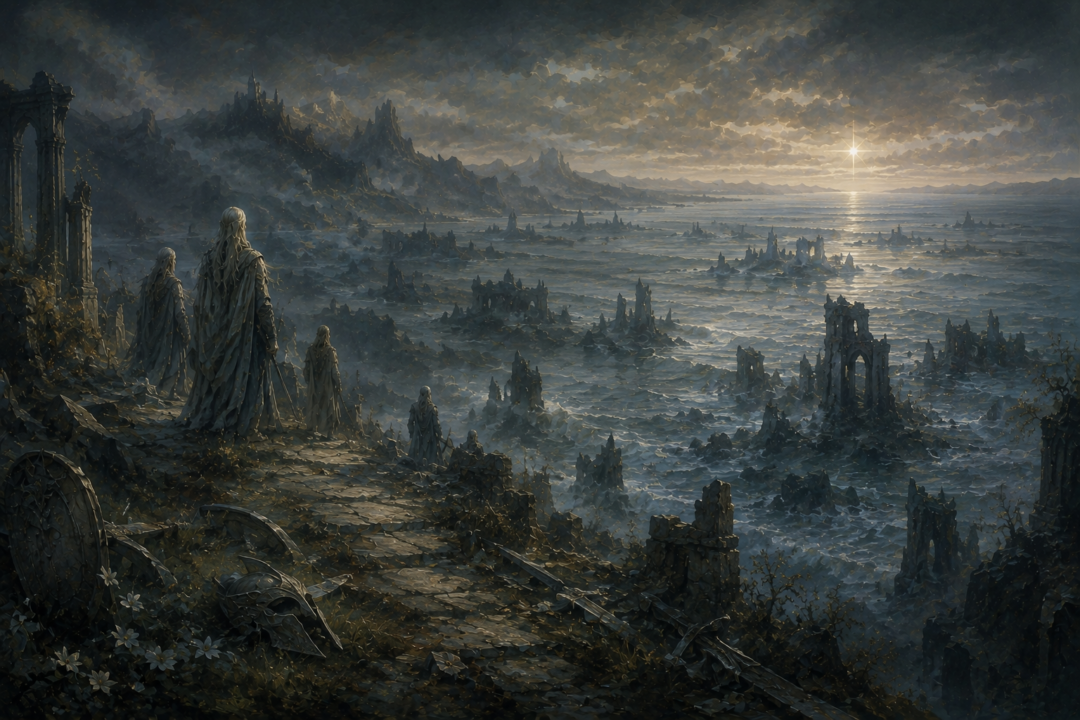
By the beginning of the Second Age, most of Beleriand had disappeared beneath the Sea. Lindon survived east of the former Blue Mountains, but the great geography of the First Age—the lands containing Doriath, Nargothrond, Gondolin, and the old northern battlefields—was largely gone.
The texts do not give a detailed mechanical explanation assigning every geological change to particular combatants or weapons. It is therefore safer not to imagine the War of Wrath as a sequence of precisely described supernatural attacks.
But the association is unmistakable: the overthrow of Morgoth coincided with catastrophic destruction in Beleriand.
The victory that finally removed him from the world also ended the world in which the Noldorin struggle against him had been fought.
The Noldor's Failure Was Not Simply Military
This is what makes the ending more complicated than “the Valar had a bigger army.”
The exiled Noldor had enormous courage, skill, and power. What they could not overcome were the consequences accumulating around their rebellion and Morgoth's long strategy.
Their kingdoms became isolated.
Their alliances failed.
Their populations diminished.
The Oath of Fëanor repeatedly turned potential allies into enemies.
Their greatest hidden refuges were discovered or destroyed.
And Morgoth remained in Angband with reserves sufficient to unleash winged dragons during the final war.
By the time Eärendil sailed west, Beleriand did not need one more heroic king.
It needed outside intervention.
That may be the deepest significance of the Host of the West. The final victory came only when the struggle ceased to be the private war begun by Fëanor and his followers.
Vanyar marched who had never joined the rebellion. Finarfin led Noldor who had not shared the long exile. The surviving Edain fought beside the western host. Eönwë commanded in the name of the Powers. Eärendil, descended from both Elves and Men, had made the appeal that opened the way.
The defeat of Morgoth required a coalition broader than the exiles who had originally sworn to pursue him.
The Beleriand Noldor had fought magnificently.
But by the end, they were survivors of the war, not an army capable of finishing it.
The final victory had to come from beyond Beleriand.
Sources & Notes
- The Encyclopedia of Arda, “War of Wrath” — https://www.glyphweb.com/arda/w/warofwrath.html
- The Encyclopedia of Arda, “Valar” — https://www.glyphweb.com/arda/v/valar.html
- The Encyclopedia of Arda, “Beleriand” — https://www.glyphweb.com/arda/b/beleriand.html
Reference entries document the people, places, events, and objects directly discussed in this article.