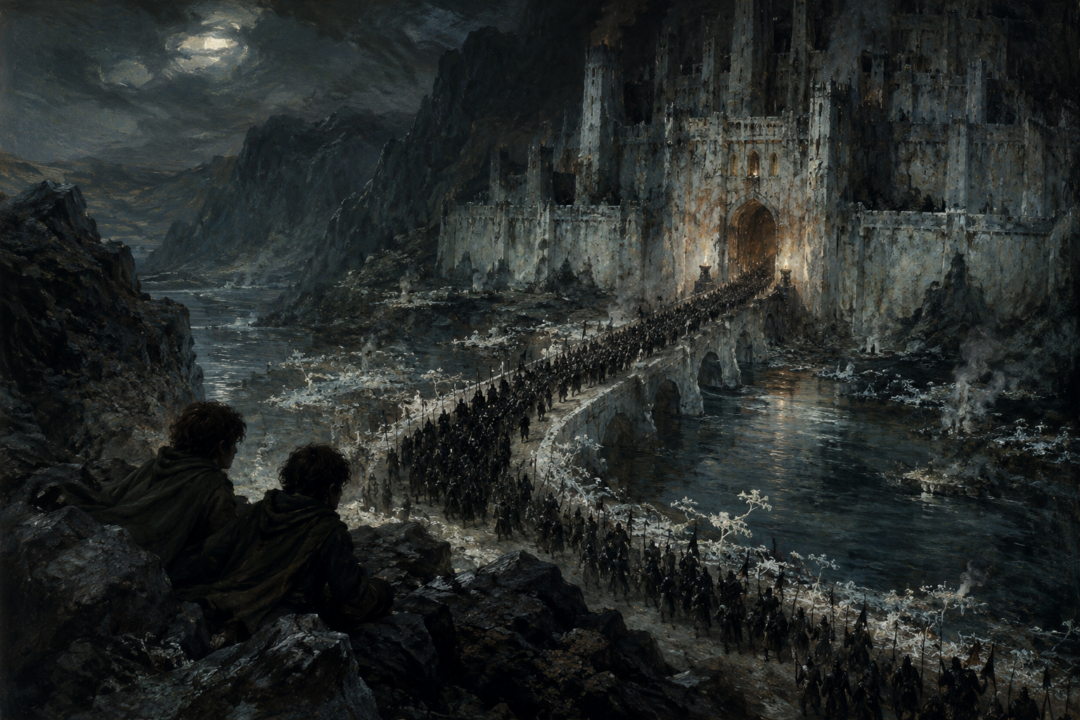
Frodo and Sam do not need a map covered in military symbols to understand what is happening below Minas Morgul.
They have the road.
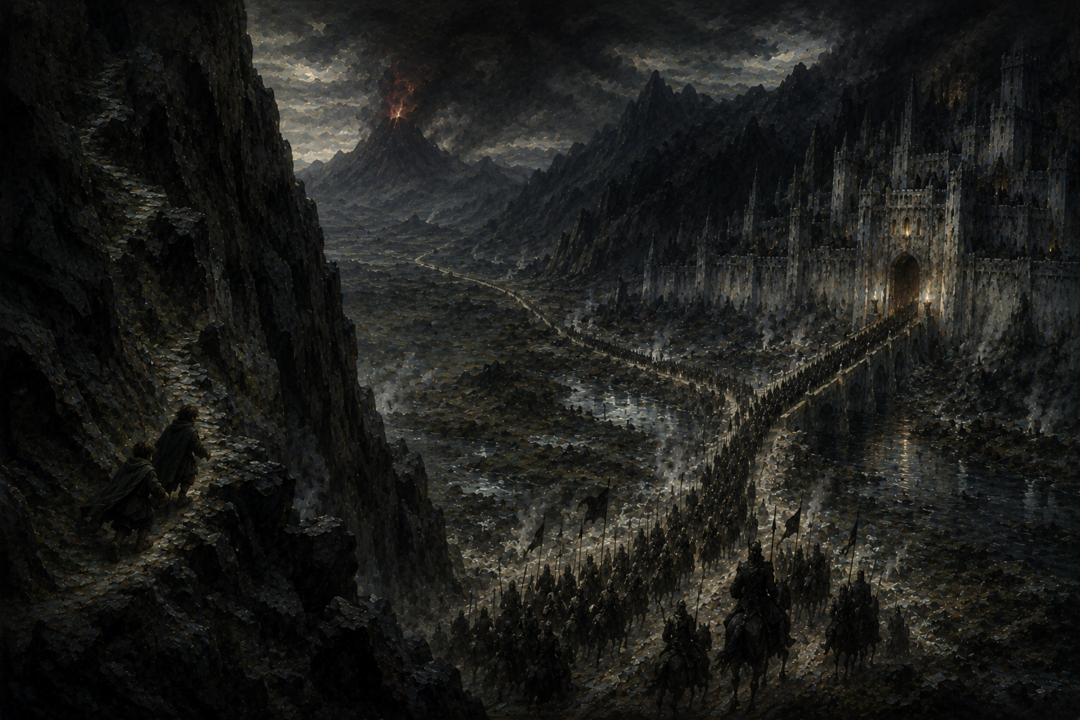
From their hiding place above the Morgul Vale, they watch the gates of the corrupted city open. The Witch-king rides out. Cavalry follows. Behind them come ordered ranks of soldiers, pouring across the bridge and down the road toward the west.
The most frightening detail is not simply that Sauron has an army.
It is that the army seems to keep coming.
And the narrative then makes the scale even worse: this enormous force is only one of the hosts Mordor is sending into war.
For Frodo, that realization is devastating. He immediately thinks of Faramir and Osgiliath. The road beneath him has become something more than a route through Ithilien. It is visible proof that the war has entered its decisive stage—and that Sauron's preparations are far larger than anything two hobbits can fully see.
The Road Was Built for Gondor, Not Mordor
The Morgul-road carries an important historical irony.
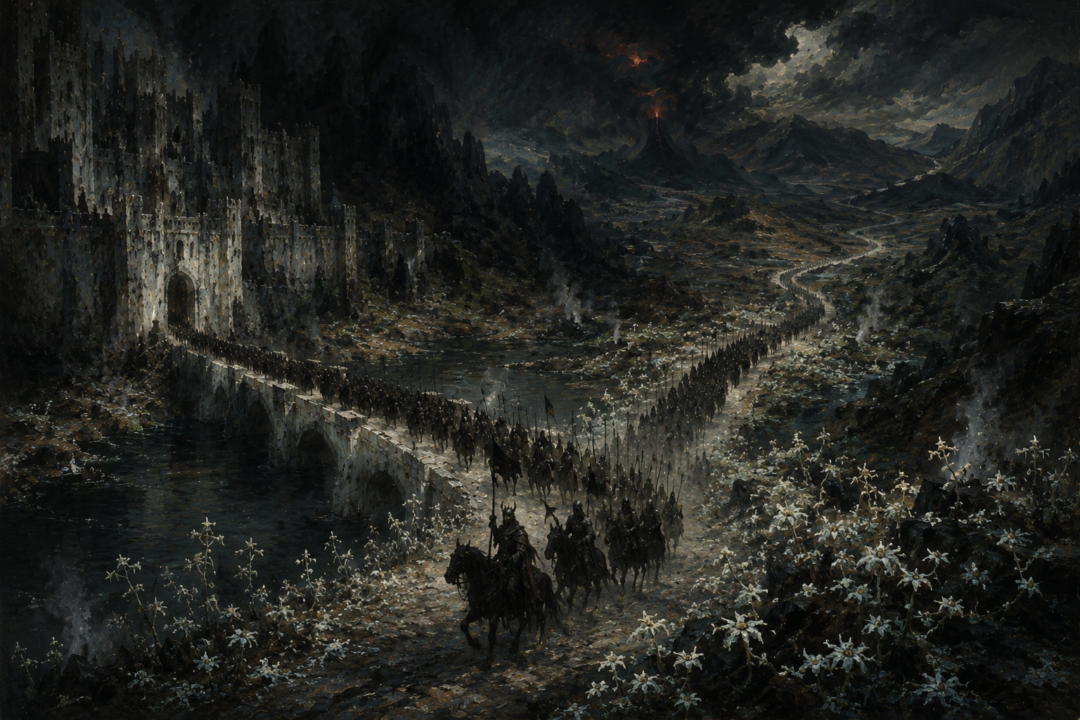
It belongs to the older geography of Gondor. Minas Morgul had once been Minas Ithil, the Tower of the Moon, founded by Isildur in the early years of the kingdoms in exile. The road running west through Ithilien connected this eastern stronghold with Osgiliath and the heartlands of Gondor.
By the end of the Third Age, that infrastructure has been turned against the kingdom that created it.
Frodo, Sam, and Gollum reach the Cross-roads in Ithilien and follow the eastward road toward the Morgul Vale. Near Minas Morgul, they leave the main road for the path leading toward the Stairs of Cirith Ungol. From there they witness the beginning of the Witch-king's march.
The geography matters because Sauron's forces are not merely emerging chaotically from wilderness.
They are moving along an established military route directly toward Gondor.
The old road of Minas Ithil has become an invasion corridor.
That reversal mirrors Minas Morgul itself: something built by Gondor has been captured, corrupted, and made useful to Gondor's enemy.
Then the Signal Comes
The timing of the scene makes the march unmistakably deliberate.
A red flash rises from the direction of Barad-dûr. Minas Morgul answers with its own dreadful display of light and sound. The gates open, and the host begins to move.
This is coordinated mobilization.
The Witch-king is not conducting a local raid or independently deciding to attack. The text explicitly presents him as acting at his master's command and according to an appointed hour.
That tells the hobbits something they could not have known while crossing Ithilien: Sauron's offensive has reached a predetermined moment.
The pieces have already been assembled.
The routes have already been prepared.
The commander is already in place.
Now the order has been given.
For Frodo and Sam, watching from almost directly above the road, the strategic machinery of Mordor suddenly becomes visible.
Rank After Rank Crosses the Bridge
The army leaving Minas Morgul is described primarily through movement.
Frodo sees dark figures advancing in ordered ranks. A great body of cavalry goes before the main force, and the Witch-king leads them. Behind him the soldiers continue crossing the bridge.
The text gives no numerical strength for this Morgul-host.
That absence is important.
Attempts to assign an exact number to the army necessarily move beyond what the narrative actually states. We can compare other forces in the War of the Ring and make estimates, but no canonical figure tells us that a particular number of soldiers marched from Minas Morgul that night.
What the text gives us instead is scale through duration and perspective.
Frodo watches the Witch-king depart.
The commander disappears down the road.
Yet the ranks are still crossing.
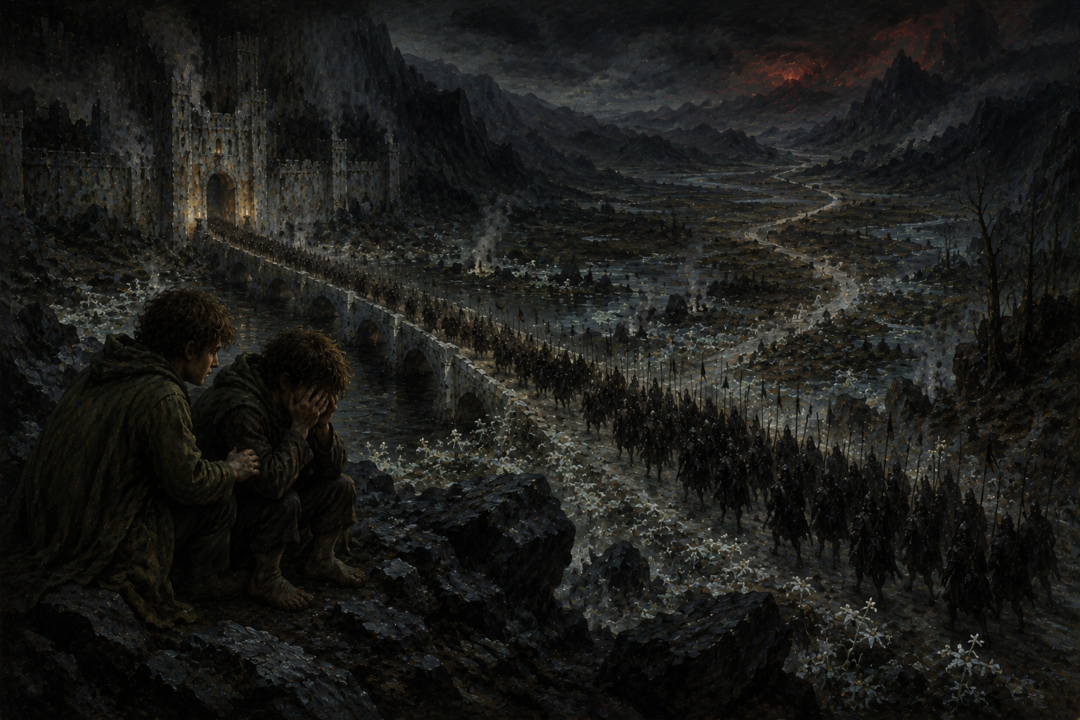
Frodo has time to think of Faramir, despair over Osgiliath, imagine the failure of his entire quest, and break down in tears.
Still the host continues moving.
The road itself becomes a measuring device. Tolkien does not need to tell us how many soldiers there are. He shows a fixed bridge and road carrying a continuous flow of troops while the observer waits.
The Most Terrifying Detail Comes After the Army Appears
The narrative then places the Morgul-host in a much larger context.
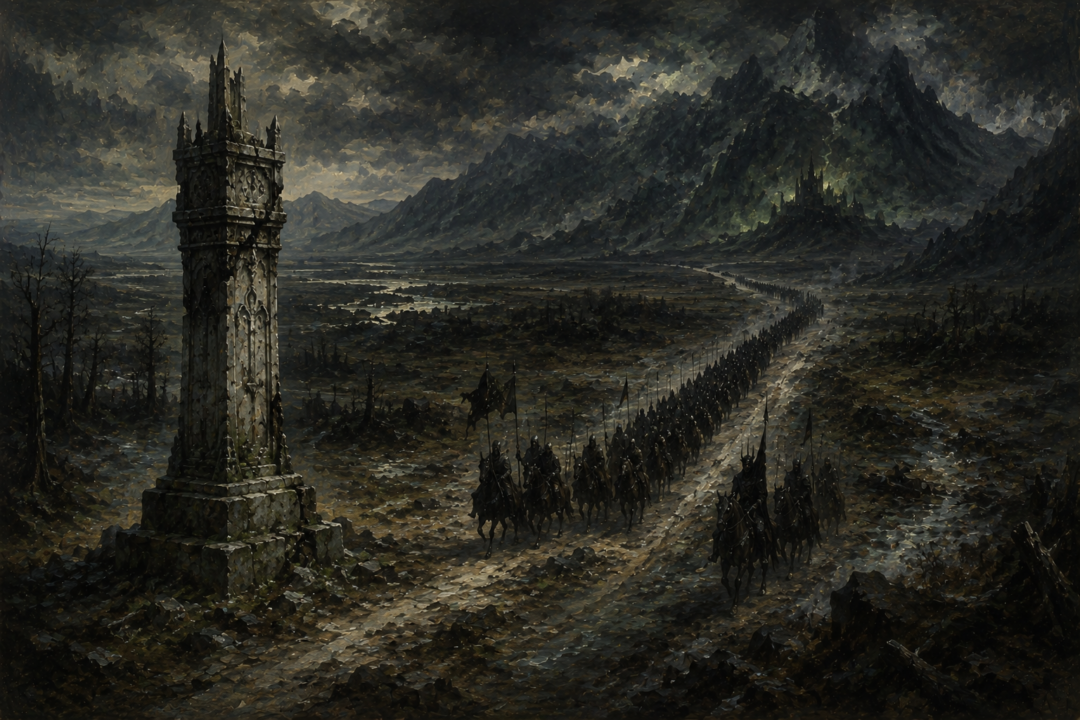
This is the greatest army to emerge from that vale since the ancient days of Gondor's power, and no force so terrible had yet attacked the crossings of Anduin.
Then comes the qualification that changes the entire scene.
The host is only one of Mordor's armies—and not the greatest being sent out.
That statement prevents us from treating what Frodo sees as Sauron's entire available strength.
Minas Morgul is only one point in a wider mobilization.
This is crucial to understanding Sauron's war. His attack is not concentrated exclusively on the road from Minas Morgul to Osgiliath. Appendix B records simultaneous or closely connected assaults across a much broader theatre: forces attack Gondor, while war also reaches Dale and Erebor and the Elven realms of northern and southern Mirkwood and Lórien.
Sauron's strategy is therefore larger than the siege of Minas Tirith.
The Morgul-road reveals one enormous column within a multi-front war.
Frodo Immediately Understands Where They Are Going
Frodo does not need military training to understand the destination.
He thinks of Osgiliath.
That conclusion follows naturally from the geography. The road runs west through Ithilien toward the crossings of Anduin. Faramir has recently spoken with Frodo and warned him about the danger surrounding Minas Morgul. Frodo now realizes that the assault Faramir anticipated has begun.
His fear is intensely personal.
Faramir is no longer merely the captain who detained and released him. He is someone Frodo has come to respect and care about.
Now an army is moving directly toward him.
Frodo wonders whether Faramir can reach safety and who could hold the river crossings against the Lord of the Nazgûl.
That reaction is one of the scene's most effective choices. The scale of Sauron's mobilization is communicated through one hobbit thinking about one man he knows somewhere down that road.
Strategy becomes personal.
What Frodo Cannot See Is Even Worse
Frodo's position gives him an extraordinary view, but it is still a limited one.
He can see Minas Morgul.
He can see its bridge.
He can see the road.
He can see one host marching west.
He cannot see the entire military system behind it.
Other forces are already operating elsewhere. The subsequent narrative shows troops coming from multiple directions and regions, including Orcs and Men under Sauron's command or influence. Haradrim march north to the war. Forces move from the Morannon. Cair Andros is attacked. Gondor faces pressure beyond the single axis Frodo can observe.
This is why the statement that the Morgul-host is not the greatest matters so much.
The road gives Frodo a terrifying sample.
The narrator gives the reader the larger truth.
What appears from the hillside to be an overwhelming army is not Sauron's complete throw of the dice.
It is part of a system of armies.
Sauron Has Been Preparing More Than Soldiers
The scene also suggests why roads matter so much in understanding Mordor's strength.
Large armies require movement.
Sauron's power is not expressed only through Orcs, Nazgûl, trolls, and allied Men. It also depends upon fortresses, roads, crossings, supply, organization, signals, and command.
Later, when Frodo and Sam enter Mordor itself, they encounter evidence of this organized military landscape. Roads connect strategic positions across the land, and troops are being directed toward the war.
Mordor is not simply a volcanic wasteland filled with monsters.
It is a realm organized for conquest.
That distinction helps explain why the West cannot defeat Sauron by conventional military strength alone.
The problem is not merely that Sauron possesses powerful servants.
He possesses depth.
Destroy one company and there are others.
Defeat one army and more forces remain.
The Captains of the West eventually march to the Morannon with a force they know cannot conquer Mordor. Their purpose is diversion: to draw Sauron's attention away from the true threat approaching Mount Doom.
The logic visible on the Morgul-road anticipates that desperate strategy.
The Army Is Huge, but Numbers Are the Wrong Question
It is tempting to ask exactly how many troops Frodo watches leave Minas Morgul.
The text does not answer.
Later numerical information allows readers to understand some parts of the war more clearly—for example, Théoden rides with six thousand Rohirrim to Gondor, and the forces assembled by the Captains of the West can also be partially counted.
But the Morgul-host itself is never assigned a canonical total.
The safer conclusion is also the more important one.
It is extraordinarily large by the standards of the late Third Age, unprecedented from the Morgul Vale since the ancient era invoked by the narrator, and still not Sauron's greatest host.
That is the scale Tolkien wants the reader to understand.
Not ten thousand.
Not twenty thousand.
Not any speculative total.
Multiplicity.
There are more armies.
Why the Sight Nearly Breaks Frodo
Frodo's despair after watching the host is understandable.
For much of his journey, the war has existed at a distance. He knows armies are moving. He has heard Faramir's account of Gondor's struggle. He knows Sauron's power is growing.
At Minas Morgul, he sees that power physically moving past him.
The war becomes a road full of weapons.
And Frodo's immediate conclusion is that he is too late.
This is the deeper importance of the scene. Sauron's mobilization does not merely threaten Gondor militarily. It attacks Frodo psychologically.
The Ring-bearer is already exhausted, frightened, and entering the most dangerous stage of his journey. Now he is shown evidence suggesting that the West may collapse before he can complete his task.
Even success begins to seem meaningless to him.
Yet he continues.
That is the contradiction at the heart of the Morgul-road.
Below the hobbits is an army large enough to make resistance seem hopeless.
Above it, almost unnoticed, two small travelers continue toward Mordor carrying the one thing that can make all those armies irrelevant.
Sauron has roads, fortresses, cavalry, commanders, signals, and hosts beyond counting from Frodo's perspective.
But his mobilization cannot solve the problem he does not recognize.
The Morgul-road shows the hobbits the overwhelming scale of Sauron's visible power.
Their hidden path shows the limit of it.
Sources & Notes
- The Encyclopedia of Arda, “Minas Morgul” — https://www.glyphweb.com/arda/m/minasmorgul.html
- The Encyclopedia of Arda, “Mordor” — https://www.glyphweb.com/arda/m/mordor.html
- The Encyclopedia of Arda, “Frodo Baggins” — https://www.glyphweb.com/arda/f/frodobaggins.html
Reference entries document the people, places, events, and objects directly discussed in this article.